The Return of the King (Ace Books Title A-6), by J.R.R. Tolkien – 1965 (1955) [Jack Gaughan]

You never quite know what you’ll find…

Case in point: During a recent walk through a (for now) anonymous suburb, I chanced upon a copy of Ace Science Fiction Classics 1965 edition (Ace book number “A-6”) of J.R.R. Tolkien’s The Return of the King.  “Hmmm…,” I pondered, “Eh.  Neat, but, it’s not science fiction.  I just don’t know….  Meh.”  Then, I took a closer look at the cover art, and immediately realized that – though his name is absent from the illustration itself – the cover art was by Jack Gaughan, which was confirmed by a look at the title page.  “Okay, that’s interesting.  A find most worthy for the blog!”

So, you can see the book below.  Bedraggled; showing the full weight of its 55 years and probably having passed before the eyes of more than a few readers; bearing several age lines on its cover, it still’s passable:  In the center, Sauron (one eye barely visible) stands behind Barad-dûr (well, it sure ain’t Za’ha’dum, though I don’t know which would be worse), while five knights in green – members of the Fellowship, I suppose – approach from the foreground.

Yet, only upon putting together this post did I realize the unusual nature of this particular edition of The Return of the King.  As fully discussed in Clarence Petersen’s 1965 Chicago Tribune article (below), the publication of Ace’s edition of The Return of the King, along with the company’s The Fellowship of the Ring (Ace book number A-4), and The Two Towers (Ace A-5), was done with neither authorization from J.R.R. Tolkien nor payment of royalties to him, based on a (then?) loophole in copyright laws.  The cover illustrations of all three books were created by Jack Gaughan, and are distinguished by background color as well as title:  While the The Return of the King is in blue, The Fellowship of the Ring, with Gandalf surrounded by members of the Fellowship, is in red, and The Two Towers, showing a Nazgûl (ringwraith) is in yellow.  Each book cover has a different line of Celtic runes in the background.

The unusual nature of these Ace editions is indicated by the selling price – at both EBay and ABE books – of complete good-quality sets, with the trio going for between $200 and $500.  (No plug.  Just an observation!)

________________________________________

Another Battle of Editions Is Joined

Clarence Petersen
Chicago Tribune
August 15, 1965

COPYRIGHT laws, especially those involving reprint rights to books first published abroad, seem to be one of the biggest flies in the book industry ointment this season.

About half a dozen lawsuits have been filed in recent months in which one publisher has charged another – or two or three others – with getting out “unauthorized editions” of books to which the first publisher claimed exclusive rights.

At times the situation has become unbelievably confusing, even to the publishers themselves.  One Monday afternoon I received by mail a news release from New York in which Putnam announced its suit against Lancer over rights to Terry Southern and Mason Hoffenberg’s “Candy.”  Earlier the same day I had discovered another version of the book, published by Greenleaf, which had arrived in Chicago bookstores over the weekend.  There was no mention of the Greenleaf edition in the news release. Putnam had not yet heard about it.

THE latest battle, however, is not expected to reach the courts at all.  The public will decide the outcome.  It centers on the fantasies of British author J.R.R. Tolkien and involves Houghton Mifflin, Ballantine Books, and the author on one hand, and Ace Books on the other.  The drama will begin to unfold tomorrow morning.

At that time, if distribution schedules are met, Ballantine’s 95 cent edition of “The Hobbit” will go on sale in Chicago.  “The Hobbit” is the prelude to Tolkien’s imaginative trilogy, “The Lord of the Rings,” which has been one of those underground best sellers.  Since 1937, when Houghton Mifflin published the first American edition in hard cover, a persistent if never spectacular demand has put “The Hobbit” thru 19 hard cover printings.  Houghton Mifflin never sold the reprint rights until a few weeks ago.

What broke the ice was publication of “The Lord of the Rings” by Ace Books in three 75-cent paperback volumes [“The Fellowship of the Rings,” “The Two Towers,” and “The Return of the King”].  Although Ace paid nothing for reprint rights, either to Houghton Mifflin or to Tolkien, there is nothing illegal about the Ace editions, due to technicalities in the copyright laws during the early years of World War II.

Having no legal recourse, Houghton Mifflin did the next best thing by selling rights to an “authorized edition” to Ballantine Books, which will publish the trilogy in 95-cent editions in October.  The difference of 20 cents a copy, of course, pays Houghton Mifflin and Tolkien.

THE new Ballantine editions will offer some additional enticements for potential buyers.  The covers are a sort of squared-off jigsaw puzzle, so that when you stand them in line face out, they form a miniature mural of the landscape on which “The Fellowship of the Rings” takes place.  Inside, there is some additional material by Prof. Tolkien which should be of interest especially to those for whom “The Hobbitt” and the trilogy have formed the basis of a cult.

But the clincher is Prof. Tolkien’s pungent paragraph that will appear on the back covers of all four volumes: “This paperback edition, and no other, has been published with my consent and co-operation.  Those who approve of courtesy – at least to living authors – will purchase it, and no other.”

In a letter to booksellers, Houghton Mifflin, Ballantine, and Tolkien join in the statement that “tho there is no legal weapon to prevent exploitation of an author’s property, we believe that booksellers will prefer to sell authorized, royalty-paying editions if they exist.”

However, the Ace trilogy has been in the bookstores since May, and there is little indication that anyone plans to send copies back.  “In this case, where the issues aren’t clear, where there is no legal issue at all, I suppose we will wind up selling both versions,” said Paul Horowitz, paperback manager of Charles Levy Circulating company, which supplies paperbacks to most Chicagoland outlets.  “The public will have to decide which version they like best.”

________________________________________

One ring to rule them all,
one ring to find them,
One ring to bring them all
and in the darkness bind them.

Ash nazg durbatulûk,
ash nazg gimbatul,
Ash nazg thrakatulûk
agh burzum-ishi krimpatul.
________________________________________

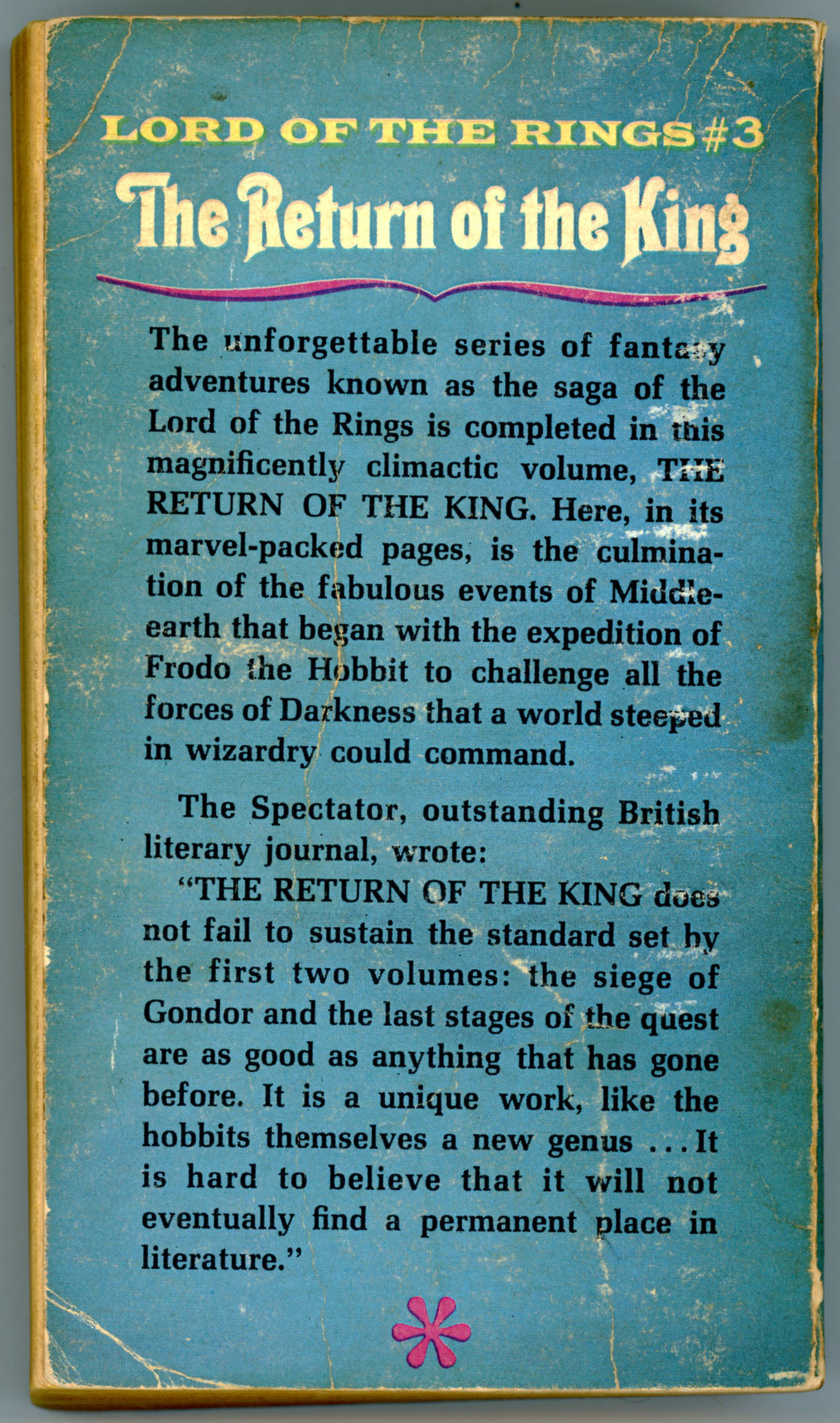
LORD OF THE RINGS # 3

The Return of the King

The unforgettable series of fantasy adventures known as the saga of the Lord of the Rings is completed in this magnificently climactic volume, THE RETURN OF THE KING.  Here, in its marvel-packed pages, is the culmination of the fabulous events of Middle-earth that began with the expedition of Frodo the Hobbit to challenge all the forces of Darkness that a world steeped in wizardry could command.

The Spectator, outstanding British literary journal, wrote:

“THE RETURN OF THE KING does not fail to sustain the standard set by the first two volumes: the siege of Gondor and the last stages of the quest are as good as anything that has gone before.  It is a unique work, like the hobbits themselves a new genus. … It is hard to believe that it will not eventually find a permanent place in literature.”

References

One Ring, at Wikipedia

Barad-dûr, at Wikipedia

Za’ha’dum, at Babylon 5 Fandom

World’s Best Science Fiction 1971 – Donald A. Wollheim and Terry Carr – 1971 [Davis Meltzer] [Updated post…!]

Like John Schoenherr’s work, this Douglas Meltzer cover includes both front and rear panels of World’s Best Science Fiction 1971.  It is rather inventive: A human face forms the center of a radio telescope which is aimed at a galaxy.  The dark blue of the sky contrasts nicely with the deep yellow below.

Update – January, 2020

Originally posted in June of 2017, this image of the cover of World’s Best Science Fiction 1971 has been updated to include the volume’s spine, thus given a complete representation of Metlzer’s cover art. 

Contents

Slow Sculpture, by Theodore Sturgeon, from Galaxy Science Fiction, February, 1970

Bird in The Hand, by Larry Niven, from The Magazine of Fantasy and Science Fiction, October, 1970

Ishmael In Love, by Robert Silverberg, from The Magazine of Fantasy and Science Fiction, July, 1970

Invasion of Privacy, by Bob Shaw, from Amazing Stories, July, 1970

Waterclap, by Isaac Asimov, from If, April, 1970

Continued on Next Rock, by R.A. Lafferty, from Orbit 7

The Thing in The Stone, by Clifford D. Simak, from If, March, 1970

Nobody Lives on Burton Street, by Gregory Benford, from Amazing Stories, May, 1970

Whatever Became of The McGowans, by Michael G. Coney, from Galaxy Science Fiction, May, 1970

The Last Time Around, by Arthur Sellings, from If, November-December, 1970

Greyspun’s Gift, by Neal Barret, Jr., from Worlds of Tomorrow, Winter, 1970

The Shaker Revival, by Gerald Jonas, from Galaxy Science Fiction, February, 1970

Dear Aunt Annie, by Gordon Eklund, from Fantastic Stories, April, 1970

Confessions, by Ron Goulart, from The Magazine of Fantasy and Science Fiction, August, 1970

Gone are The Lupo, by H.B. Hickey, from Quark / 1

________________________________________

Image originally posted…

Reference

World’s Best Science Fiction 1971, at Internet Speculative Fiction Database

The Macabre Reader, edited by Donald A. Wollheim – 1959 [Edmund Emshwiller]

Though his art is typically associated with science fiction, such as covers for The Magazine of Fantasy and Science Fiction, Galaxy Science Fiction, and (but of course…!) Ace Books, and other publications, Edmund Emshwiller’s creativity found a different outlet in Ace Books’ 1959 The Macabre Reader: horror.

Note that all the spaces in the composition that might otherwise be “blank” and “empty” are instead cleverly occupied by elements denoting horror, terror, and fear, such as a spider, a ghost, the figure of a woman-in-peril, and three menacing ghoul-like figures, all within or surrounding a sickly-green skull.  And, as per his works of science fiction, Emshwiller signed the composition with his trademark “EMSH” (visible in the lower right).

It’s notable that five of the volume’s thirteen (hmm…was it intentionally thirteen?!) works are either solely by, or by authors in collaboration with, H.P. Lovecraft. 

Contents

The Phantom-Wooer, poem from Death’s Jest Book, 1850, poem Thomas Lovell Beddoes

The Crawling Horror, from Weird Tales, November, 1936, by Thorp McClusky

The Opener of the Way, from Weird Tales, October, 1936, by Robert Bloch

Night Gaunts (variant of “Night-Gaunts”, alternative title “Fungi from Yuggoth”), poem from The Phantagraph, Spring, 1936, by H.P. Lovecraft

In Amundsen’s Tent, from Weird Tales, January, 1928, by John Martin Leahy

The Thing on the Doorstep, from Weird Tales, January, 1937, by H.P. Lovecraft

The Hollow Man, from The Evening Standard Book of Strange Stories, 1934, by Thomas Burke

It Will Grow On You, from Esquire, April, 1942, by Donald Wandrei

The Hunters from Beyond, from Strange Tales of Mystery and Terror, October, 1932, by Clark Ashton Smith

The Curse of Yig, poem by Zealia Bishop and H.P. Lovecraft (as by Zealia Brown Bishop)

The Cairn on the Headland, from Strange Tales of Mystery and Terror, January, 1933, by Robert E. Howard

The Trap, from Strange Tales of Mystery and Terror, March, 1932, by H.P. Lovecraft and Henry S. Whitehead (as Henry S. Whitehead)

The Dweller, poem from Weird Tales, March, 1940, by H.P. Lovecraft

Reference

The Macabre Reader, at The Internet Speculative Fiction Database

World’s Best Science Fiction – Fourth Series – Edited by Donald A. Wollheim and Terry Carr – 1970 [Jack Gaughan]

A 1970 reprint of Ace Books 1968 edition (Ace Catalog Number A-15).

______________________________

Contents

See Me Not, by Roger Wilson, from Impulse

Driftglass, by Samuel R. Delaney, from If

Ambassador to Verdammt, by Colin Kapp, from Analog Science Fiction – Science Fact

The Man Who Never Was, by R.A. Lafferty, from Magazine of Horror

The Billiard Ball, by Isaac Asimov, from Galaxy Science Fiction

Hawksbill Station, by Robert Silverberg, from Galaxy Science Fiction

The Number You Have Reached, by Thomas M. Disch, from Impulse

The Man Who Loved the Fajioli, by Roger Zelazny, from Galaxy Science Fiction

Population Implosion, by Andrew J. Offutt, from Galaxy Science Fiction

I Have No Mouth, and I Must Scream, by Harlan Ellison, from If

The Sword Swallower, by Ron Goulart, from The Magazine of Fantasy and Science Fiction

Coranda, by Keith Roberts, from New Worlds Science Fiction

Thus We Frustrate Charlemagne, by R.A. Lafferty, from Galaxy Science Fiction

Handicap, by Larry Niven, from Galaxy Science Fiction

Full Sun, by Brian W. Aldiss, from Orbit 2

It’s Smart to Have an English Address, by D.G. Compton, from Impulse

World’s Best Science Fiction: 1966 – Donald A. Wollheim and Terry Carr – 1966 [Jack Gaughan]

This anthology would be reprinted in 1970 under Ace Books Catalog Number 91354, with cover art by Jack Gaughan.

______________________________

Contents

Sunjammer, by Arthur C. Clarke, from Boy’s Life

Calling Dr. Clockwork, by Ron Goulart, from Amazing Stories

Becalmed in Hell, by Larry Niven, from The Magazine of Fantasy and Science Fiction

Apartness, by Vernor Vinge, from New Worlds SF

Over The River and Through The Woods, by Clifford D. Simak, from Amazing Stories

Planet of Forgetting, by James H. Schmitz, from Galaxy

“Repent, Harlequin!” Said the Ticktockman, by Harlan Ellison, from Galaxy

The Decision Makers, by Joseph Green, from Galaxy

Traveller’s Rest, by David L. Masson, from New Worlds SF

Uncollected Works, by Lin Carter, from The Magazine of Fantasy and Science Fiction

Vanishing Point, by Jonathan Brand, from Galaxy

In Our Block, by R.A. Lafferty, from Galaxy

Masque of the Red Shift, by Fred Saberhagen, from Galaxy

The Captive Island, by Christopher Anvil, from Analog Science Fiction – Science Fact

The Good New Days, by Fritz Leiber, from Galaxy

World’s Best Science Fiction – Second Series – Edited by Donald A. Wollheim and Terry Carr – 1970 [Jack Gaughan]

A 1970 reprint of Ace Books 1966 edition (Ace Catalog Number H-15).

______________________________

Contents

Sunjammer, by Arthur C. Clarke, from Boy’s Life

Calling Dr. Clockwork, by Ron Goulart, from Amazing Stories

Becalmed in Hell, by Larry Niven, from The Magazine of Fantasy and Science Fiction

Apartness, by Vernor Vinge, from New Worlds SF

Over The River and Through The Woods, by Clifford D. Simak, from Amazing Stories

Planet of Forgetting, by James H. Schmitz, from Galaxy

“Repent, Harlequin!” Said the Ticktockman, by Harlan Ellison, from Galaxy

The Decision Makers, by Joseph Green, from Galaxy

Traveller’s Rest, by David L. Masson, from New Worlds SF

Uncollected Works, by Lin Carter, from The Magazine of Fantasy and Science Fiction

Vanishing Point, by Jonathan Brand, from Galaxy

In Our Block, by R.A. Lafferty, from Galaxy

Masque of the Red Shift, by Fred Saberhagen, from Galaxy

The Captive Island, by Christopher Anvil, from Analog Science Fiction – Science Fact

The Good New Days, by Fritz Leiber, from Galaxy

World’s Best Science Fiction – First Series – Edited by Donald A. Wollheim and Terry Carr – 1970 [Jack Gaughan]

A 1970 reprint of Ace Books 1965 edition (Ace Catalog Number G-551).

______________________________

Contents

Greenplace, by Tom Purdom, from The Magazine of Fantasy and Science Fiction

Men of Good Will, by Ben Bova and Myron E. Lewis, from Galaxy Science Fiction

Bill for Delivery, by Christopher Anvil, from Analog Science Fact – Science Fiction

Four Brands of Impossible, by Norman Kagan, from The Magazine of Fantasy and Science Fiction

A Niche In Time, by William F. Temple, from Analog Science Fact – Science Fiction

Sea Wrack, by Edward Jesby, from The Magazine of Fantasy and Science Fiction

For Every Action, by C.C. MacApp, from Amazing Stories

Vampires Ltd., by Josef Nesvadba

The Last Lonely Man, by John Brunner, from New Worlds Science Fiction

The Star Party, by Robert Lory, from The Magazine of Fantasy and Science Fiction

The Weather in the Underworld, by Colin Free

Oh, To Be a Blobel!, by Philip K. Dick, from The Magazine of Fantasy and Science Fiction

The Unremembered, by Edward Mackin, from New Worlds Science Fiction

What Happened to Sergeant Masuro?, by Harry Mulisch, from The Busy See Review: New Writing from the Netherlands

Now Is Forever, by Thomas M. Disch, from Amazing Stories

The Competitors, by Jack B. Lawson, from Galaxy Science Fiction

When The Change-Winds Blow, by Fritz Leiber, from The Magazine of Fantasy and Science Fiction

Hell in the Heavens, by Capt. John M. Foster, USMCR – 1961

Hell in the Heavens - John M Foster - 1961 - 1(Ace Giant Edition, 1961)

     While reading an old newspaper that afternoon, I heard a dull distant noise that sounded like a muffled explosion, but I didn’t pay any attention to it.

     “A plane went in – a plane went in,” someone yelled.

     I ran outside and jumped on the running board of a command car.  We drove down the taxi-strip toward the east.

     A tall column of black smoke funneled into the sky from fifty feet offshore.  We stopped and I stood on a coral boulder that provided a good view.

     “My hell” I exclaimed at the full scene.  Only fifty feet away a piece of metal showed above the water, burning with the flame of a gasoline and oil fire and sending the cloud of smoke skyward.  A propeller poked one of its blades above the surface of the burning water.  Farther out in the water and a few feet away, another part of an airplane was partly above the water.  There were five men pulling something out of the metal.

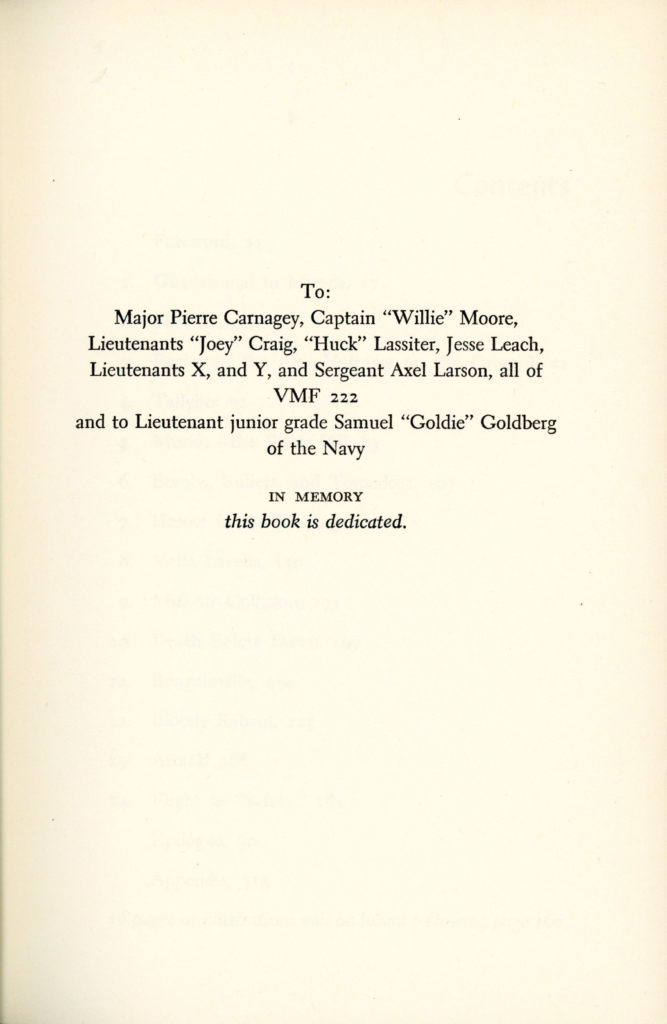
Hell in the Heavens - John M Foster - 1961 - Dedication_edited-2

(G.P. Putnam’s Sons Edition, 1961)

     They waded through chest-deep water with a body and carried it toward me.  It was the limp, still form of the pilot.  They carried him to within five feet of me.  I could see the face burned black, with its scorched remnants of a beard.  The white bones of the knuckles protruded from a blackened hand from which a glove had been partly burned off.  A steamy smell of charred hair and flesh came to me as they passed.

     The pilot was not dead when he was carried past me, amazing though it was that he could still be alive.  The doctors did all they could to maintain that spark of life and fan it into flame.  They injected adrenalin, administered oxygen and plasma.  Fifteen minutes later he died.

     The casualty list would rise by one tiny digit in the KILLED IN ACTION column.  In a few days his next of kin would receive a telegram informing them of that fact.  They would cry and feel very bad.  The neighbors would try to console them.  A funeral would be held with praying and singing and sentiments expressed – perhaps by someone who had never known him.

Hell in the Heavens - John M Foster - 1961 - 4(G.P. Putnam’s Sons Edition, Back Cover, 1961)

     A few lives would feel empty, as they had while he was away at college and out in the Pacific, fighting.  The father and mother and the sisters and the brothers would always remember him and regret that he had to die so young.  The sweetheart would be brokenhearted and hysterical.

     Time would pass and the family again would laugh at jokes and enjoy the dancing, the theatres and their fellow men; the sweetheart would find that someone else could matter.  She would marry, have children, and soon but faint remembrances of the pilot who died so young, so long ago, would remain.

     Very quickly in the lives of mankind all is forgotten.  All that remains is the record – DIED IN ACTION.

World’s Best Science Fiction: 1965 – Donald A. Wollheim and Terry Carr

This anthology would be reprinted in 1970 under Ace Books Catalog Number 91353, with cover art by Jack Gaughan.

______________________________

Contents

Greenplace, by Tom Purdom, from The Magazine of Fantasy and Science Fiction

Men of Good Will, by Ben Bova and Myron E. Lewis, from Galaxy Science Fiction

Bill for Delivery, by Christopher Anvil, from Analog Science Fact – Science Fiction

Four Brands of Impossible, by Norman Kagan, from The Magazine of Fantasy and Science Fiction

A Niche In Time, by William F. Temple, from Analog Science Fact – Science Fiction

Sea Wrack, by Edward Jesby, from The Magazine of Fantasy and Science Fiction

For Every Action, by C.C. MacApp, from Amazing Stories

Vampires Ltd., by Josef Nesvadba

The Last Lonely Man, by John Brunner, from New Worlds Science Fiction

The Star Party, by Robert Lory, from The Magazine of Fantasy and Science Fiction

The Weather in the Underworld, by Colin Free

Oh, To Be a Blobel!, by Philip K. Dick, from The Magazine of Fantasy and Science Fiction

The Unremembered, by Edward Mackin, from New Worlds Science Fiction

What Happened to Sergeant Masuro?, by Harry Mulisch, from The Busy See Review: New Writing from the Netherlands

Now Is Forever, by Thomas M. Disch, from Amazing Stories

The Competitors, by Jack B. Lawson, from Galaxy Science Fiction

When The Change-Winds Blow, by Fritz Leiber, from The Magazine of Fantasy and Science Fiction