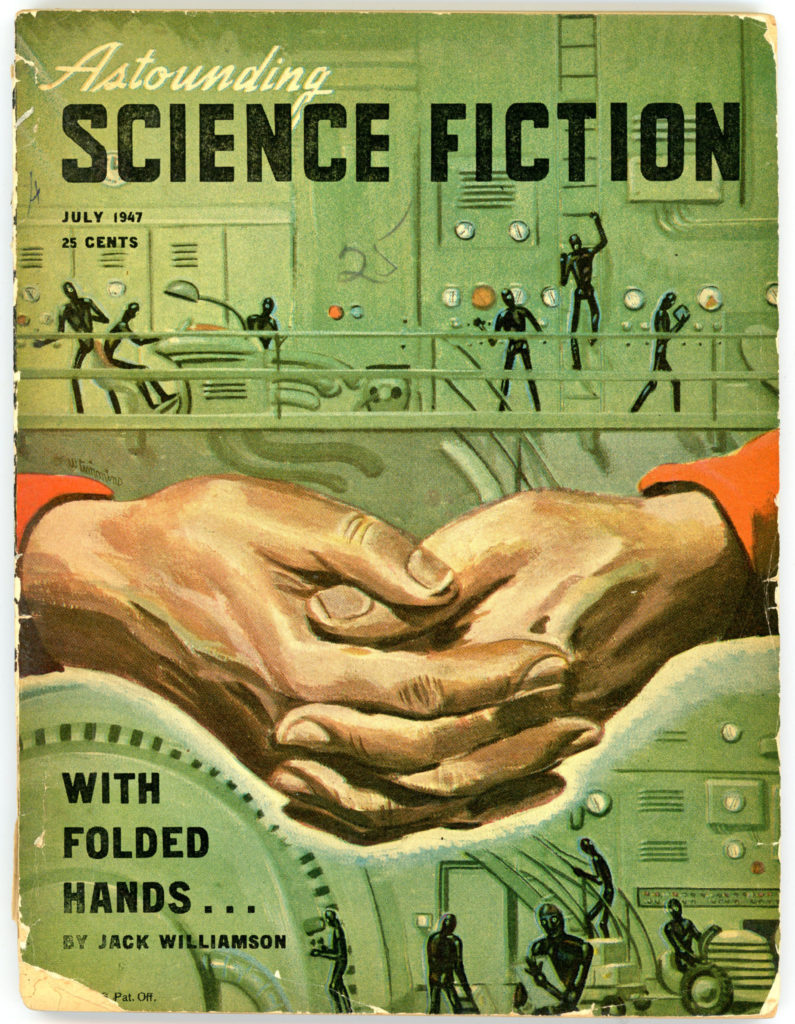
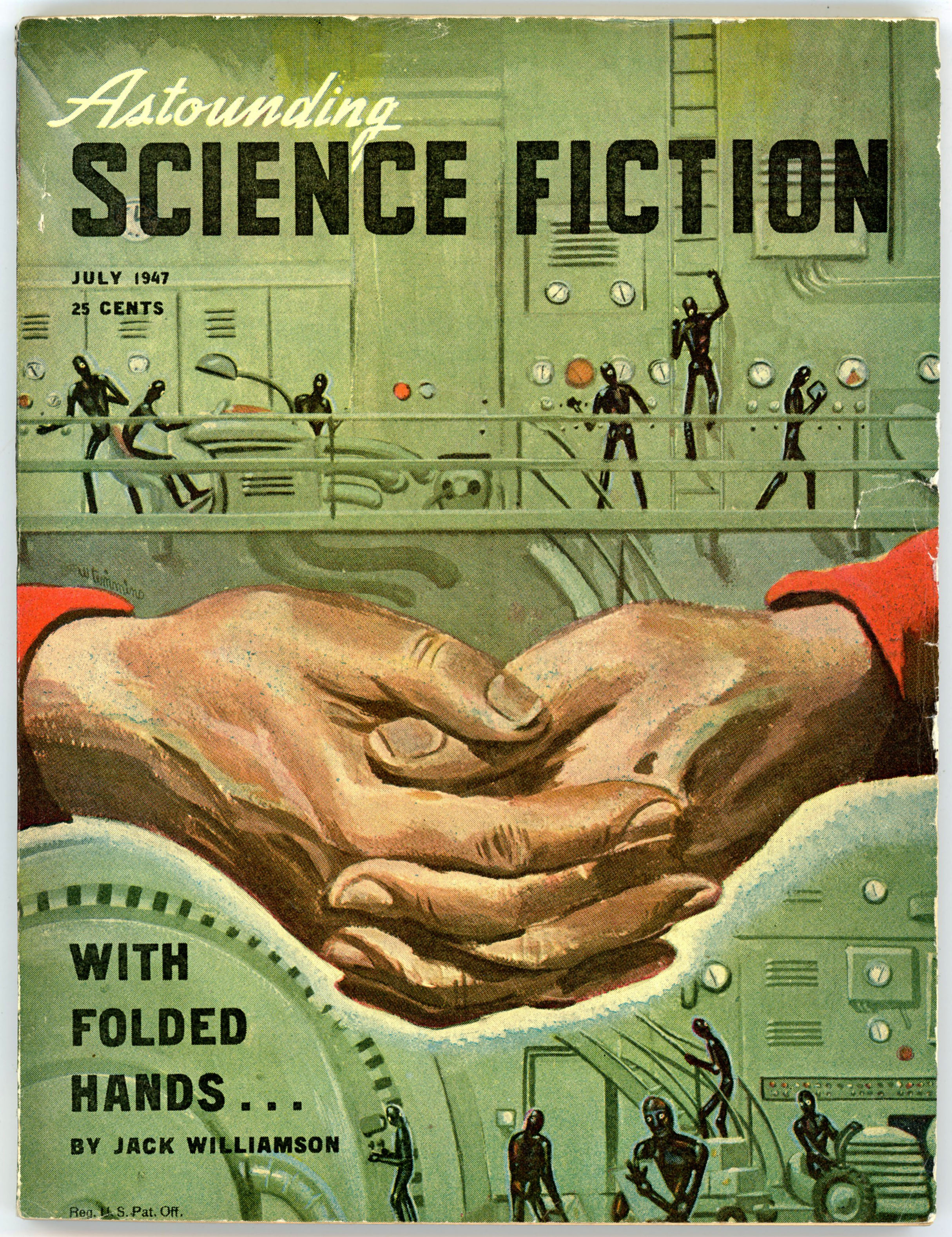
William Timmins’ straightforward and somewhat uninspiring covert art, though visually consistent with and appropriate for “With Folded Hands…”, belies the depth, power, and literary quality of Jack Williamson’s 1947 story. In 1954, it was expanded as Galaxy Science Fiction Novel number 21, under the title The Humanoids, with cover art by Edward Emshwiller.
I discovered Williamson’s tale years ago, within “Volume IIA” of The Science Fiction Hall of Fame.
The story was one of fifty science fiction stories adapted by Ernest Kinoy and George Lefferts for the NBC 1950-1951 radio program Dimension X, and broadcast on April 15, 1950. You can listen to the program here, at the American Radio Classics YouTube channel, where, oddly, it’s listed under the category of “comedy”.
“Comedy?!” Nooo… No. It’s not a comedy.
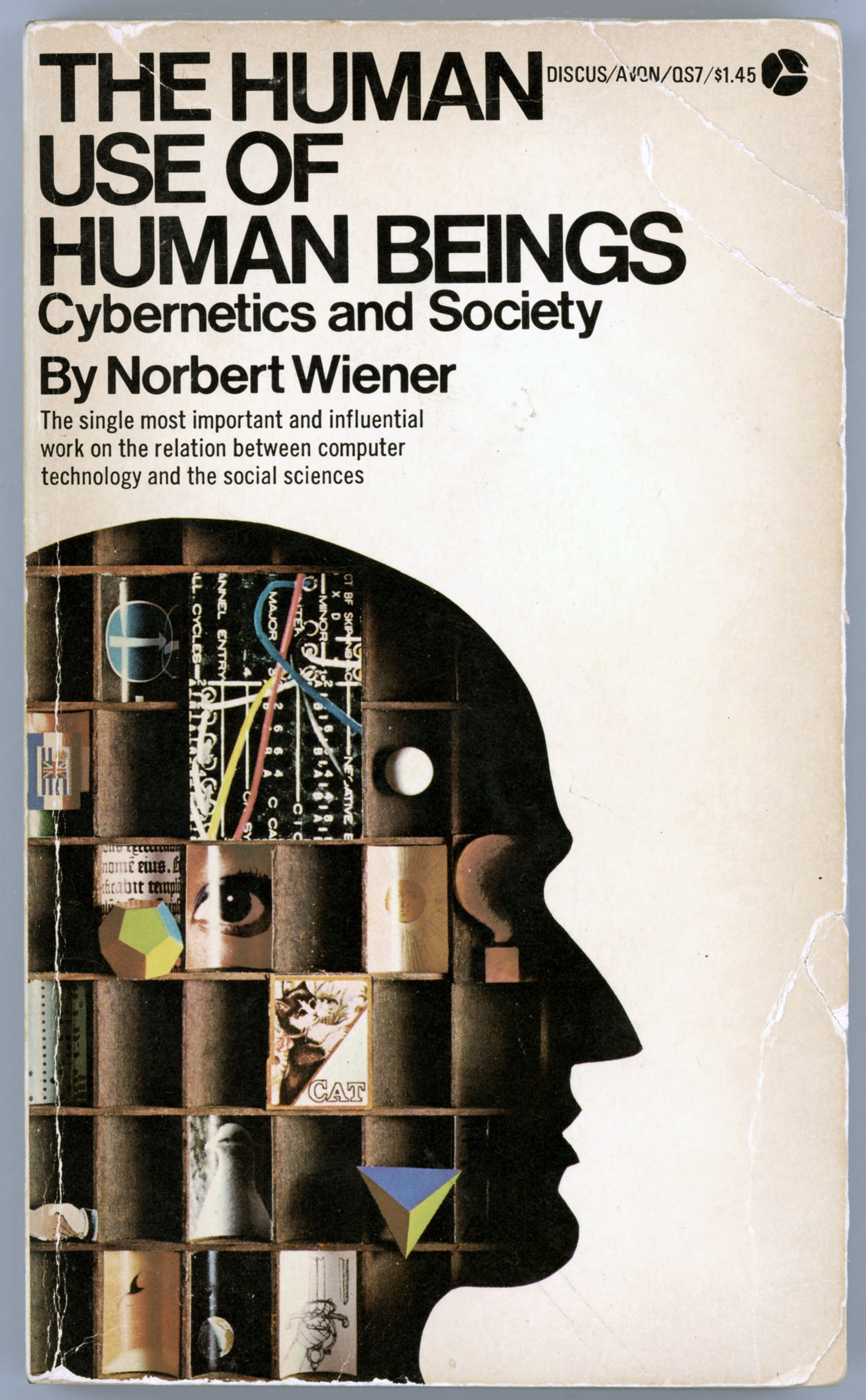
I was reminded of Williamson’s story in the mid-1990s after reading Norbert Wiener’s The Human Use of Human Beings, which I found to be eerily – nay, chillingly! – prescient (albeit now, 69 years too early…), imbued with a sense of compassion, and, composed with an almost poetic sense of language (though obviously not poetry, per se!). Above all, the “tone” of the book is one of deep humility, and, a profound, refreshing absence of the ideologically motivated hubris that passes for intellectuality, so characteristic of the current age. In this, the book’s resemblance to Sir Roger Penrose’s works on the origin and nature of consciousness is striking.
Anyway… I read With Folded Hands once again, and found that Williamson’s story had lost neither its depth nor its impact despite the passage of time. (Other science fiction stories? Not always so much.)
It’s interesting that Williamson’s story and Wiener’s book appeared within three years of one another. This may attest to a commonality of thought about the implications and effect – viewed from the perspective of the mid-twentieth century, the Second World War having ended only a few years earlier – of the intersection of and anticipation of several technological and social trends: Automation, the eventuality of artificial intelligence and machine learning (though I doubt those phrases were conceived of as such, at the time), and computer networks (the humanoids are in constant real-time communication with one another, after all), upon the economic and social “place” of men, both individually and collectively.
Excerpts from Norbert Wiener’s book (1973 Discus edition) follow, a little further down this post..
“At your service,” Mr. Underhill.” Its blind steel eyes stared straight ahead, but it was still aware of him. “What’s the matter, sir? Aren’t you happy?”
(Since creating this post in May of 2019, I’ve acquired a copy of the July, 1947, Astounding, in much better condition than the original – which is displayed at the “bottom” of this post. The “new” copy, minus chipped edges and missing corners, is shown below…)
 Underhill felt cold and faint with terror.
His skin turned clammy.
A painful prickling came over him.
His wet hand tensed on the door handle of the car,
but he restrained the impulse to jump and run.
That was folly.
There was no escape.
He made himself sit still.
“You will be happy, sir,” the mechanical promised him cheerfully.
“We have learned how to make all men happy under the Prime Directive.
Our service will be perfect now, at last.
Even Mr. Sledge is very happy now.”
Underhill tried to speak, but his dry throat stuck.
He felt ill.
The world turned dim and gray.
The humanoids were prefect – no question of that.
They had even learned to lie, to secure the contentment of men
He knew they had lied.
That was no tumor they had removed from Sledge’s brain,
but the memory,
the scientific knowledge,
and the bitter disillusion of their own creator.
Yet he had seen that Sledge was happy now.
He tried to stop his own convulsive quivering.
“A wonderful operation!”
His voice came forced and faint.
“You know Aurora has had a lot of funny tenants,
but that old man was the absolute limit.
They very idea that he had made the humanoids,
that he knew how to stop them! I always knew he must be lying!”
Stiff with terror, he made a weak and hollow laugh.
“What is the matter, Mr. Underhill?”
The alert mechanical must have perceived his shuddering illness.
“Are you unwell?”
“No, there’s nothing the matter with me,” he gasped desperately.
“Absolutely nothing!
I’ve just found out that I’m perfectly happy under the Prime Directive.
Everything is absolutely wonderful.”
His voice came dry and hoarse and wild.
“You won’t have to operate on me.”
The car turned off the shining avenue,
taking him back to the quiet splendor of his prison.
His futile hands clenched and relaxed again, folded on his knees.
There was nothing left to do.
( – Jack S. Williamson – )
____________________
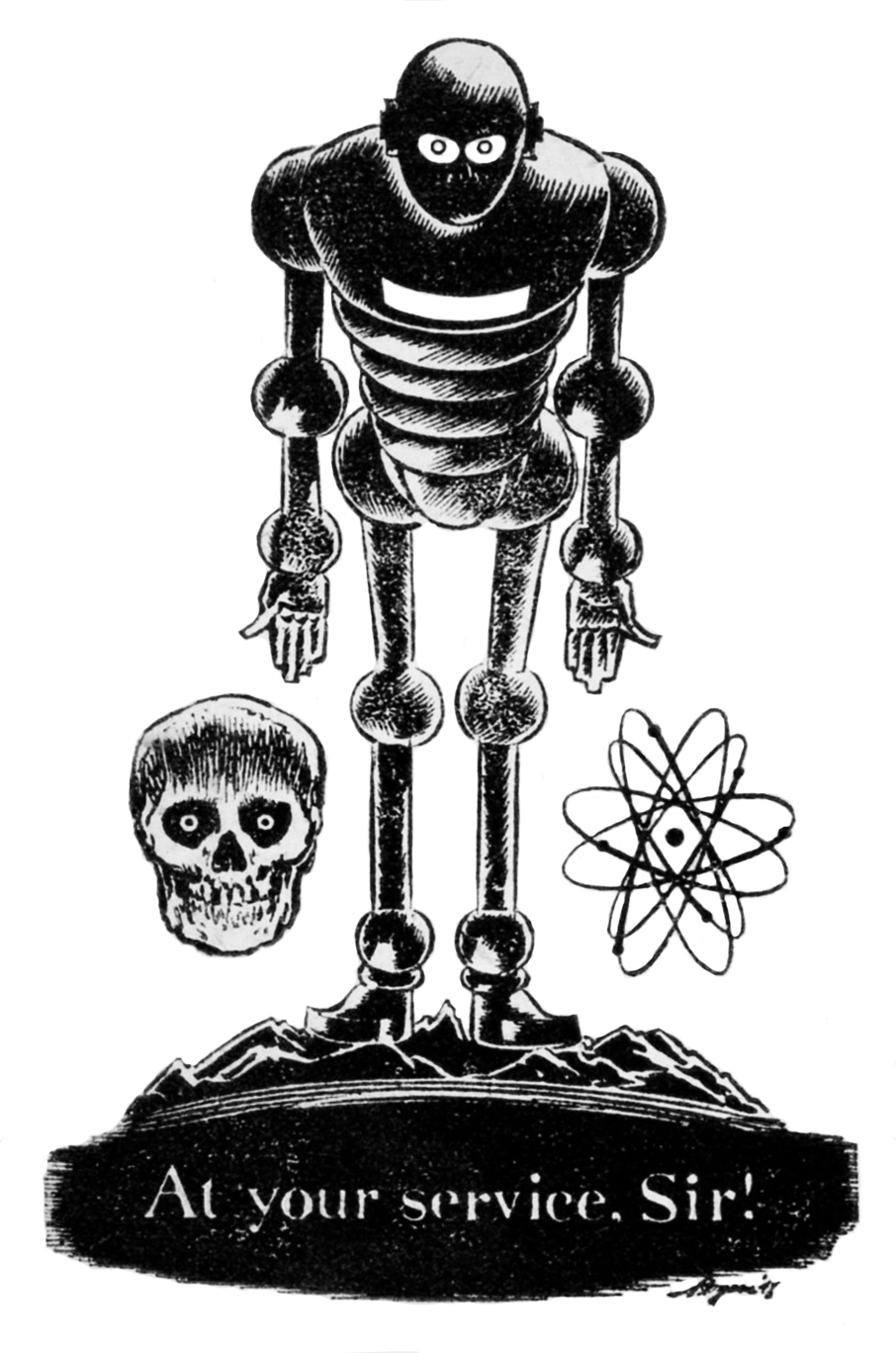 Illustration by Hubert Rogers, for Jack Williamson’s story “And Searching Mind” (Astounding Science Fiction, May, 1948 – Part III of III) (p. 118)
______________________________
The Human Use of Human Beings
by Norbert Wiener
Avon Books – (1950) 1973
 In the myths and fairy tales that we read as children
we learned a few of the simpler and more obvious truths of life,
such as that when a djinnee is found in a bottle,
it had better be left there;
that the fisherman who craves a boon from heaven too many times on behalf of his wife
will end up exactly where he started;
that if you are given three wishes, you must be very careful what you wish for.
These simple and obvious truths represent the childish equivalent of the tragic view of life
which the Greeks and many modern Europeans possess,
and which is somehow missing in this land of plenty.
“Whether we entrust our decisions to machines of metal,
or to those machines of flesh and blood
which are bureaus
and vast laboratories
and armies
and corporations,
we shall never receive the right answers to our questions unless we ask the right questions.”
I have said that the modem man,
and especially the modern American,
however much “know-how” he may have, has very little “know-what.”
He will accept the superior dexterity of the machine-made decisions
without too much inquiry as to the motives and principles behind these.
In doing so, he will put himself sooner or later in the position of the father
in W.W. Jacobs’ The Monkey’s Paw, who has wished for a hundred pounds,
only to find at his door the agent of the company for which his son works,
tendering him one hundred pounds as a consolation for his son’s death at the factory.
Or again, he may do it in the way of the Arab fisherman in the One Thousand and One Nights,
when he broke the Seal of Solomon on the lid of the bottle which contained the angry djinnee.
Let us remember that there are game-playing machines
both of The Monkey’s Paw type and of the type of the Bottled Djinnee.
Any machine constructed for the purpose of making decisions,
if it does not possess the power of learning,
will be completely literal-minded.
Woe to us if we let it decide our conduct,
unless we have previously examined the laws of its action,
and know fully that its conduct will be carried out on principles acceptable to us!
On the other hand,
the machine like the djinnee which can learn and can make decisions on the basis of its learning,
will in no way be obliged to make such decisions as we should have made,
or will be acceptable to us.
For the man who is not aware of this,
to throw the problem of his responsibility on the machine,
whether it can learn or not,
is to cast his responsibility to the winds,
and to find it coming back seated on the whirlwind.
Reference
Bova, Ben (Editor), The Science Fiction Hall of Fame – Volume IIA, Avon Books, New York, N.Y., 1973
____________________
Original cover image, from May of 2019…