A Decade of Fantasy and Science Fiction, edited by Robert P. Mills – 1962 [Richard M. Powers]

Here’s a nice Richard Powers cover from 1962, with elements typical of his art: Multicolored, curved, geometric, mobile-like shapes; a weird, irregularly-shaped, dented, floating, metallic king of thingy; a figure garbed in a space-suit.  (Well, it looks like a space-suit!) 

Like many of the images of “people” in Powers’ art, the space explorer’s outfit looks detailed and ornate, but on closer inspection, this arises from a series of rings or ridges covering the garment, giving it the suggestion rather than the reality of detail. 

But, it still looks cool.

The “lower” of the two images, appearing on the book’s back cover, is simply a reproduction of the art on the front cover, sans text.

As for the stories within the book?  Though I have read them all (some years ago!), none particularly currently stand out in memory.  Yet, in a larger sense, I was always impressed by the works of Zenna Henderson (“The People” series), Ward Moore (author of one of the best time travel stories I’ve ever read; fully worthy of a mini-series on Netflix or Amazon Prime (hint, hint, Mr. Bezos!): “Bring the Jubilee”), and, Manly Wade Wellman. 

Contents

Walk Like A Mountain, by Manly Wade Wellman, June, 1955

Men of Iron, by Guy Endore, Fall, 1949

Rabbits to The Moon, by Raymond E. Banks, July, 1959

The Certificate, by Avram Davidson, March, 1959

The Sealman, by John Mansfield, July, 1955

The Sky People, by Poul Anderson, March, 1959

The Causes, by Idris Seabright, June, 1952

The Hypnoglyph, by John Anthony, July, 1953

A Tale of The Thirteenth Floor, by Ogden Nash, July, 1955

Spud and Cochise, by Oliver La Forge, December, 1957

Unto The Fourth Generation, by Isaac Asimov, April, 1959

Jordan, by Zenna Henderson, March, 1959

Will You Wait?, by Alfred Bester, March, 1959

Proof Positive, by Graham Greene, August, 1952

Shock Treatment, by J. Francis McComas, April, 1956 (From 9 Tales of Space and Time, May, 1954)

Gandolphus, by Anthony Boucher, June, 1952

The Last Shall Be First, by Robert P. Mills, August, 1958

A Trick Or Two, by John Novotny, July, 1957

Lot’s Daughter, by Ward Moore, October, 1954

Saturnian Celia, by Horace Walpole, April, 1957 (May, 1774.  First known to have been published in The Letters of Horace Walpole, 1903)

Fear Is A Business, by Theodore Sturgeon, April, 1956

Meeting of Relations, by John Collier, January, 1959 (From The Yale Review, December, 1941)

First Lesson, by Mildred Clingerman, December, 1956

To Fell A Tree, by Robert F. Young, July, 1959

Reference

A Decade of Fantasy and Science Fiction, at Internet Speculative Fiction Database

I Robot, by Isaac Asimov – 1956 [Robert Emil Schulz]

Contents

I, Robot (Introduction)

Robbie, (variant of “Strange Playfellow” – Super Science Stories, September, 1940)

Runaround, from Astounding Science Fiction, March, 1942

Reason, from Astounding Science Fiction, April, 1941

Catch That Rabbit, from Astounding Science Fiction, February, 1944

Liar!, from Astounding Science Fiction, May, 1941

Little Lost Robot, from Astounding Science Fiction, March, 1947

Escape!, from Astounding Science Fiction, August, 1945

Evidence, from Astounding Science Fiction, September, 1946

The Evitable Conflict, from Astounding Science Fiction, June, 1950

______________________________

Portrait of Isaac Asimov, from back cover

Reference

I, Robot, bibliographic record from Internet Speculative Fiction Database

Before the Golden Age – Book 3 – August, 1975 (1974) [Unknown Artist]

The cover of Book 3 of Before the Golden Age  follows the style of Books 1 and 2 of the series, albeit with a twist: The figure of a man wearing a white protective suit and helmet stands before an urban skyline, with an orange sun setting (or is it rising?) in the background. 

But, the figure is a toy, the skyline is comprised of pieces of rectangular plastic, the orange “sun” is made of an unidentifiable “something”, and red spherical plastic something-“bubbles” float across the scene.  It’s interesting to contemplate how such a scene would have appeared in the form of a panting by Bok, Emsh, Freas, Schoenherr, or Powers (especially Powers!): Probably far more compelling.  But, still, that’s what we have, and it does connote at least some kind of atmosphere and mood – albeit unrelated to any of the stories in the volume. 

As those stories go, in terms of numbers of really good stories, Book 3 is the best of the trio.  Murray Leinster’s “Proxima Centauri” is excellent, while Edmond Hamilton’s “Devolution” is very well written, fast-paced, and would have suited equally well for appearance in such a venue as Weird Tales.  You kind of “know” how the story will conclude well before its ending, but the literary “ride” is fun, nonetheless.

Particularly notable and eminently worthy of inclusion are John W. Campbell, Junior’s, “The Brain Stealers of Mars” and “Other Eyes Watching”.  Both stories – anticipating themes inherent to the works of Philip K. Dick – center around ideas of mimicry, identity, percepetion, and cognition.  Though somewhat light-hearted in nature, they ultimately have a very serious bent, prefiguring Campbell’s well-known 1938 classic “Who Goes There?” (and its cinematic maladaptations) in which concepts used in the two stories are given frightening and fuller expression. 

Contents

Part Six: 1935

The Parasite Planet, by Stanley G. Weinbaum, from Astounding Stories, February, 1935
Proxima Centauri, by Murray Leinster (William Fitzgerald Jenkins), from Astounding Stories, March, 1935
The Accursed Galaxy, by Edmond Hamilton, from Astounding Stories, July, 1935

Part Seven: 1936

He Who Shrank, by Henry Hasse, from Amazing Stories, August, 1936
The Human Pets of Mars, by Leslie Francis Stone, from Amazing Stories, October, 1936
The Brain Stealers of Mars, by John W. Campbell, Jr., from Thrilling Wonder Stories, December, 1936
Devolution, by Edmond Hamilton, from Amazing Stories, December, 1936
Big Game, by Isaac Asimov (not previously published)

Part Eight: 1937

Other Eyes Watching, by John W. Campbell, Jr., from Astounding Stories, February, 1937
Minus Planet, by John D. Clark, from Astounding Stories, April, 1937

Before the Golden Age – Book 2 – June, 1975 (1974) [Unknown Artist]

Here, the cover of Book 2 of Before the Golden Age shows a newly-hatched “bird” departing from its egg.  The anonymous artist used crêpe paper for the bird’s wings and body, and white feathers – appropriate! – for the tail.  I don’t think there’s an actual connection to any story in the volume, but the simple design does indeed work.  Simplicity can go far.

Contents

Part Four: 1933

The Man Who Awoke, by Lawrence Manning, from Wonder Stories, March, 1933
Tumithak in Shawn, by Charles R. Tanner, from Amazing Stories, June, 1933

Part Five: 1934

Colossus, by Donald Wandrei, from Astounding Stories, January, 1934
Born of the Sun, by Jack Williamson, from Astounding Stories, March, 1934
Sidewise in Time, by Murray Leinster (William Fitzgerald Jenkins), from Astounding Stories, June, 1934
Old Faithful, by Raymond Z. Gallum, from Astounding Stories, December, 1934

Before the Golden Age – Book 1 – April, 1975 (1974) [Unknown Artist]

Unlike the illustrations typical appearing on the covers of works of science fiction, the cover art for Fawcett Crest’s 1975 three-volume series Before the Golden Age (originally published in a single hard-bound volume by Doubleday in 1974) is strikingly different: The cover art of all three paperback volumes are collages of simple objects arranged to represent the theme of a specific story within a volume, or, arrayed to form a general scene emblematic of the popular conception of science-fiction “in general”.   

If you look closely at the covers, you’ll see that the objects appearing on the covers appear are unelaborate in nature and origin: Paper, cloth, and plastic items that can be found in art supply stores.  Or, natural materials, like feathers and plants.

While the results have nowhere near the impact of classic science fiction art of any era, it can be granted that they do make Fawcett Crest’s paperback series, well, er, uh … distinctive, at least in comparison with other books of the genre.  (I’ll grant that!)  In any event, the artist’s (artists’ – plural?) names are not given anywhere on, or in, the three volumes. 

For Book 1 of Before the Golden Age, a series of overlapping translucent blue (plastic? – it seems) triangles, within a plastic sphere, represents P. Schuyler Miller’s The Tetrahedra of Space.  Pretty straightforward, eh?

That would not have been my choice for an emblematic story.  The best tale appearing in volume I is – by far; easily; without question; hands-down; et-cetera! – Jack Williamson’s “The Moon Era”.  Williamson’s story is utterly unlike “hard” or heroic science fiction (stereo)typical of the 1930s (and 40s…and later), for technology and space travel only provide a near-incidental backdrop to a notably deeper tale, strikingly reminiscent – in style, plot, and theme – of the works of Catherine L. Moore.  The story has an unexpected, subtle – and thereby all the more effective – quietly erotic tone, and powerfully reminds me of Moore’s “The Bright Illusion” from Astounding Stories of 1934.  In a larger sense, the depth of Williamson’s story presages the substantive nature of his later works, such as the powerful “With Folded Hands”, and, “…And Searching Mind” from Astounding in 1947.    

Contents

Part One: 1920 to 1930

Introductory Essay by Isaac Asimov

Part Two: 1931

The Man Who Evolved, by Edmond Hamilton, from Wonder Stories, April, 1931
The Jameson Satellite, by Neil R. Jones, from Amazing Stories, July, 1931
Submicroscopic, by Captain S.P. Meek (Capt. Sterner St. Paul Meek), from Amazing Stories, August, 1931
Awlo of Ulm, by Captain S.P. Meek (Capt. Sterner St. Paul Meek), from Amazing Stories, September, 1931
Tetrahedra of Space, by P. Schuyler Miller, from Wonder Stories, November, 1931
The World of the Red Sun, by Clifford D. Simak, from Wonder Stories, December, 1931

Part Three: 1932

Tumithak of the Corridors, by Charles R. Tanner, from Amazing Stories, January, 1932
The Moon Era, by Jack Williamson, from Wonder Stories, February, 1932


The Visitors, by Clifford D. Simak – November, 1980 [Dennis Luzak] [Revised Post]

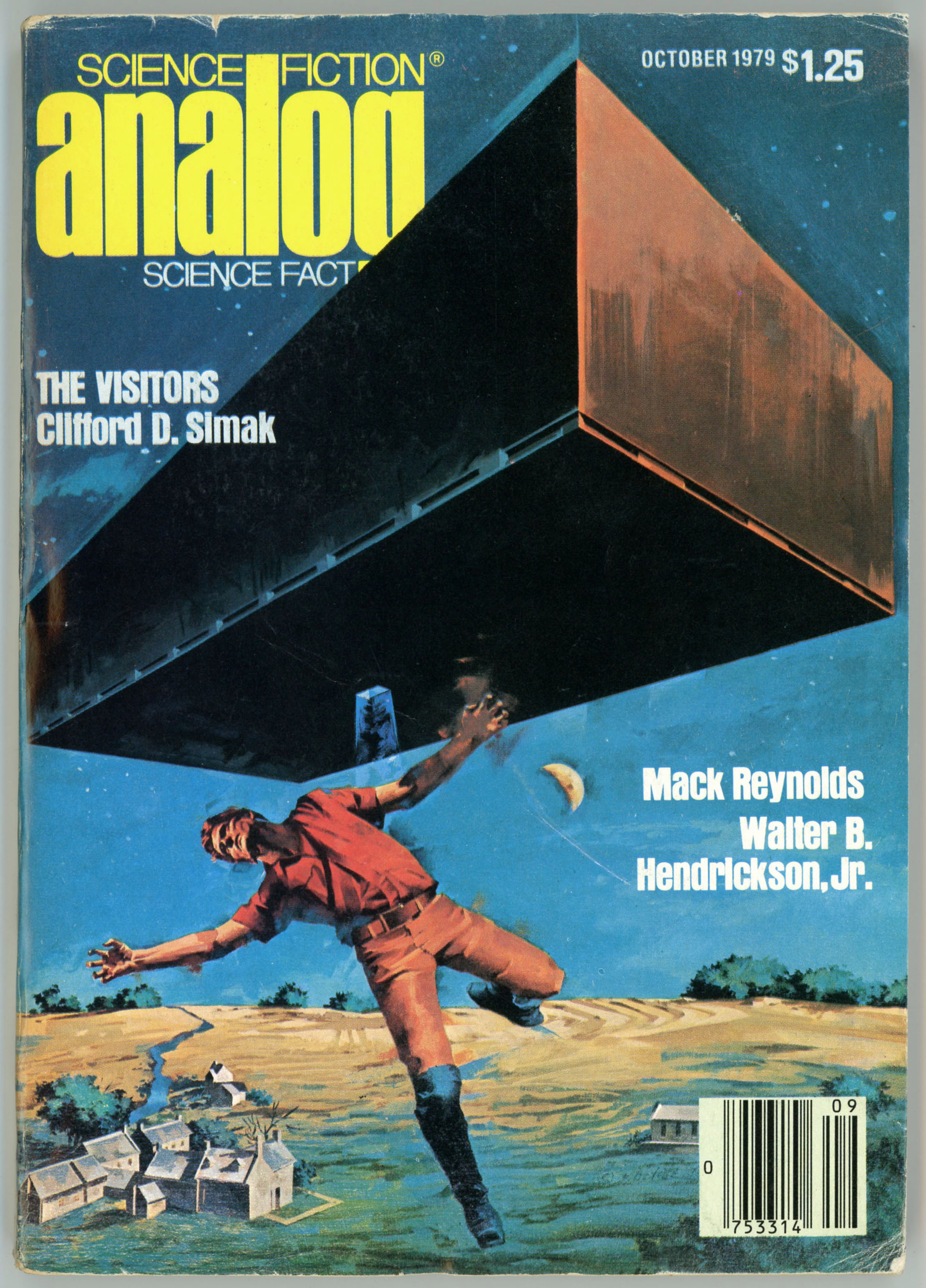
This post features Vincent DiFate’s cover art for the October, 1979 issue of Analog, Science Fiction – Science Fact, in which was published the first installment of “The Visitors”.  The post has also been updated to include Clifford Simak’s obituary from The New York Times, which appeared on April 28, 1988.

______________________________

____________________

______________________________

____________________

______________________________

____________________

______________________________

Star Shine, by Fredric Brown – 1954 [Richard M. Powers]

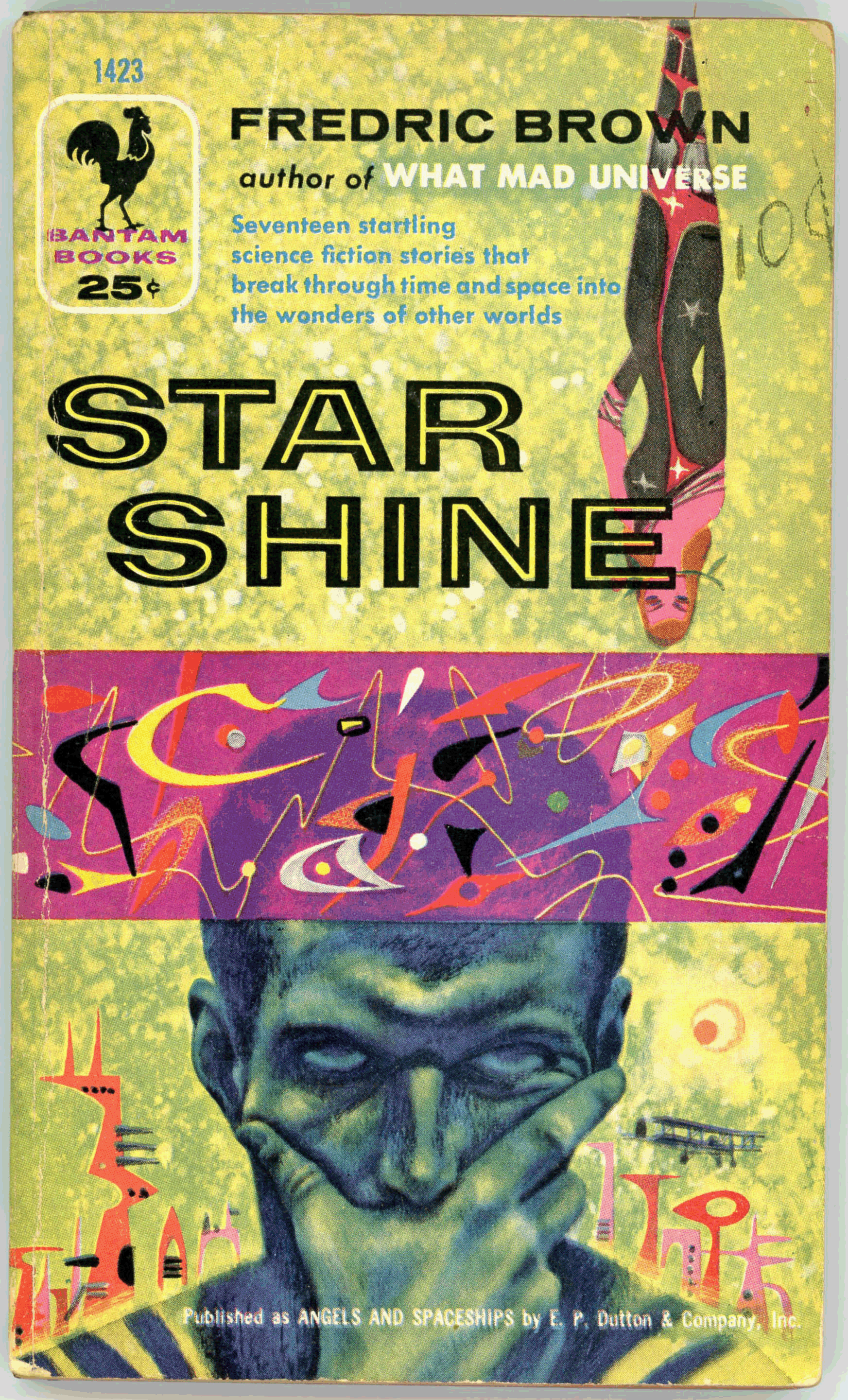
While a number of my prior posts illustrate the work of Richard Powers,* his cover art for the 1954 Bantam Books edition of Fredric Brown’s Star Shine uniquely exemplifies his skill and versatility, to an extent not necessarily evident in his other compositions.

Specifically, Powers’ painting is composed of four elements.

First, the skyline of a futuristic city, composed of asymmetrical buildings, all finished in  orange and pink, appears in the lower background.  A World War One era biplane (well, it looks like a biplane!) incongruously  floats above.

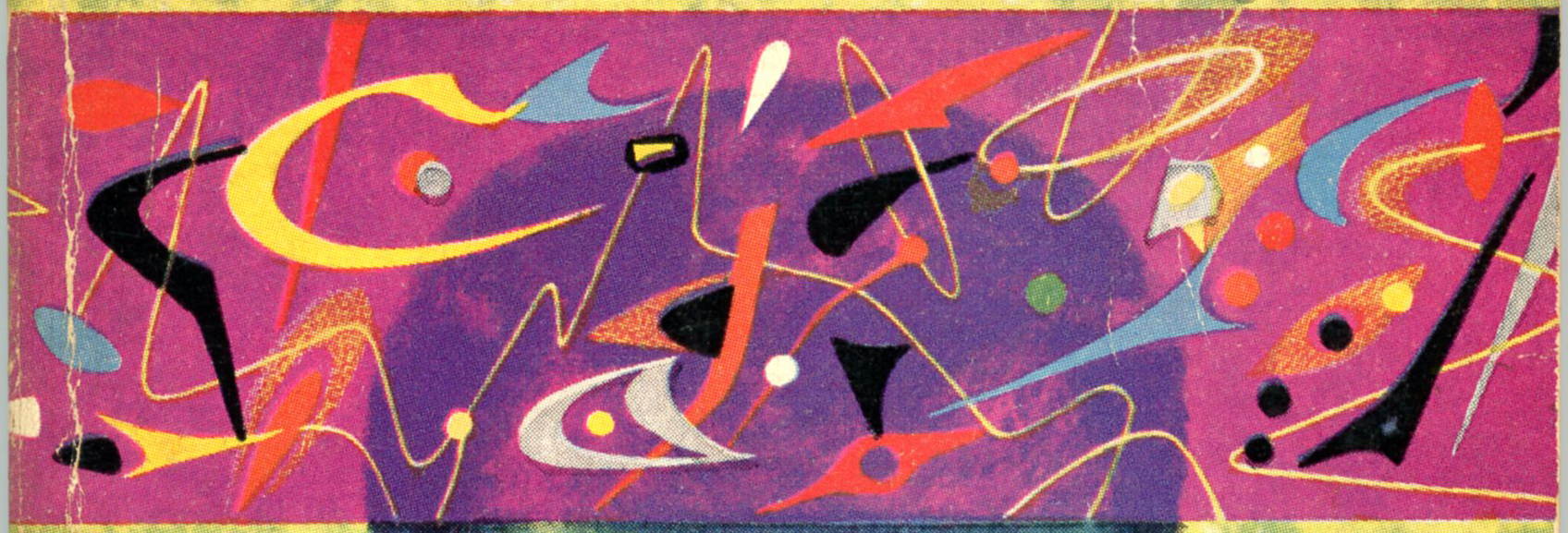
Second, a violet band covered with frivolous, indefinable curves – probably not representing anything at all! – of yellow, black, blue, and orange, occupies the center of the cover.  Patterns like this are present in many of Powers’ compositions.

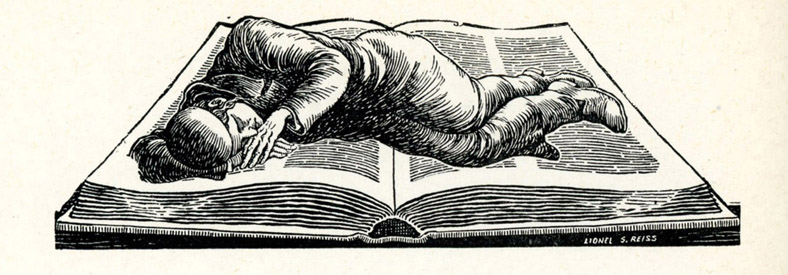
Third, a stylized lady – an upside-down-lady, at that!, holding a rose in her mouth – occupies the upper cover.  (You can see her in greater detail by scrolling down a little.)

Fourth – and in the context of Powers’ work, most interestingly – the central element of the cover is the face of a very contemplative man.  Neither stylized nor abstract (albeit greenish-blue!), this figure shows Powers’ skill in natural representation, which is not apparent in most of his science fiction illustrations.

Contents

Pattern, from Angels and Spaceships (1954 anthology)

Placet Is a Crazy Place, from Astounding Science Fiction, May, 1946

Answer, from Angels and Spaceships

Etaion Shrdlu, from Unknown Worlds, February, 1942

Preposterous, from Angels and Spaceships

Armageddon, from Unknown Fantasy Fiction, August, 1941

Politeness, from Angels and Spaceships

The Waveries, from Astounding Science Fiction, January, 1945

Reconciliation, from Angels and Spaceships

The Hat Trick, from Unknown Worlds, February, 1943

Search, from Angels and Spaceships

Letter To a Phoenix, from Astounding Science Fiction, August, 1949

Daisies, from Angels and Spaceships

The Angelic Angleworm, from Unknown Worlds, February, 1943

Sentence, from Angels and Spaceships

The Yehudi Principle, from Astounding Science Fiction, May, 1944

Solipsist, from Angels and Spaceships

______________________________

The Mural

______________________________

The Upside-Down-Lady

* With more to follow in future posts…

October the First Is Too Late, by Fred Hoyle – July, 1968 (March, 1966) [Paul Lehr]

Though the artist’s name appears neither on the cover, nor within the title or copyright pages, the distinctive style of the cover art of Fred Hoyle’s October the First Is Too Late is an immediate “key” to the identify of the compositions’ creator: Paul Lehr.

Paralleling the cover of the Berkeley Medallion edition (August, 1972) of Stanislaw Lem’s Solaris, a small number of human figures, all diminutive; all indistinctive (though distinctly garbed?!), appear in the foreground, and at distance.

With the human presence minimal, it’s the book’s theme, as in the art for Solaris, that provides the basis and center of the cover art:  In this case, the central concept is nature of time, albeit distorted time; albeit parallel time.

An asymmetrical, Salvador-Dali-like clock occupies the center of the image, beneath which stand architectural symbols of both past (two pyramids, at left – one Egyptian and another Meso-American) and future (a futuristic city, composed of ovoid buildings, at right).  Above, going to and fro, are two spacecraft.  And, imparting a sense of detachment, a flock of unconcerned birds hover above the landscape.  (The same birds as on the cover of Solaris?)

In terms of color, Lehr’s composition akin to the art for Solaris (and, to my knowledge, his other works) in intentionally limiting range of colors to create a distinctive mood and “feel”.  While Solaris was limited to shades of green, blue,  gray, and violet, the palette of October the First Is Too Late is limited to tones of yellow, orange, violet, and ochre.

I like this one.

From rear cover:

October the First Is Too Late unfolds the incredible adventures on a planet twisted by time splits.  The familiar world of the 1960s has vanished everywhere except in England.  In Western Europe World War I is still raging.  Greece is in the Golden Age of Pericles, America is thousands of years into the future, while Russia and Asia are nothing but a glasslike plain incapable of sustaining life – the final phase before the end of the earth as we know it.

Against this macabre backdrop of co-existing time-spheres, two young men risk their lives to find the truth.  But the truth is in the mind of the beholder.  And who is to say who are the dreamers and who are the dreams?  You and I, dear reader, may indeed be shadows, existing solely in the mind of some traveler through time…

The Humanoids, by Jack Williamson – 1954 [Edmund A. Emshwiller]

One of the forty-six Galaxy Science Fiction novels published between 1950 and 1961, The Humanoids includes and was based upon Jack Williamson’s tale “With Folded Hands…”, which appeared in the July, 1947 issue of Astounding Science Fiction, with cover art by William Timmins.