New Tales of Space and Time, Edited by Raymond J. Healy – October, 1958 (1951) [Paul Lehr] [New cover…]

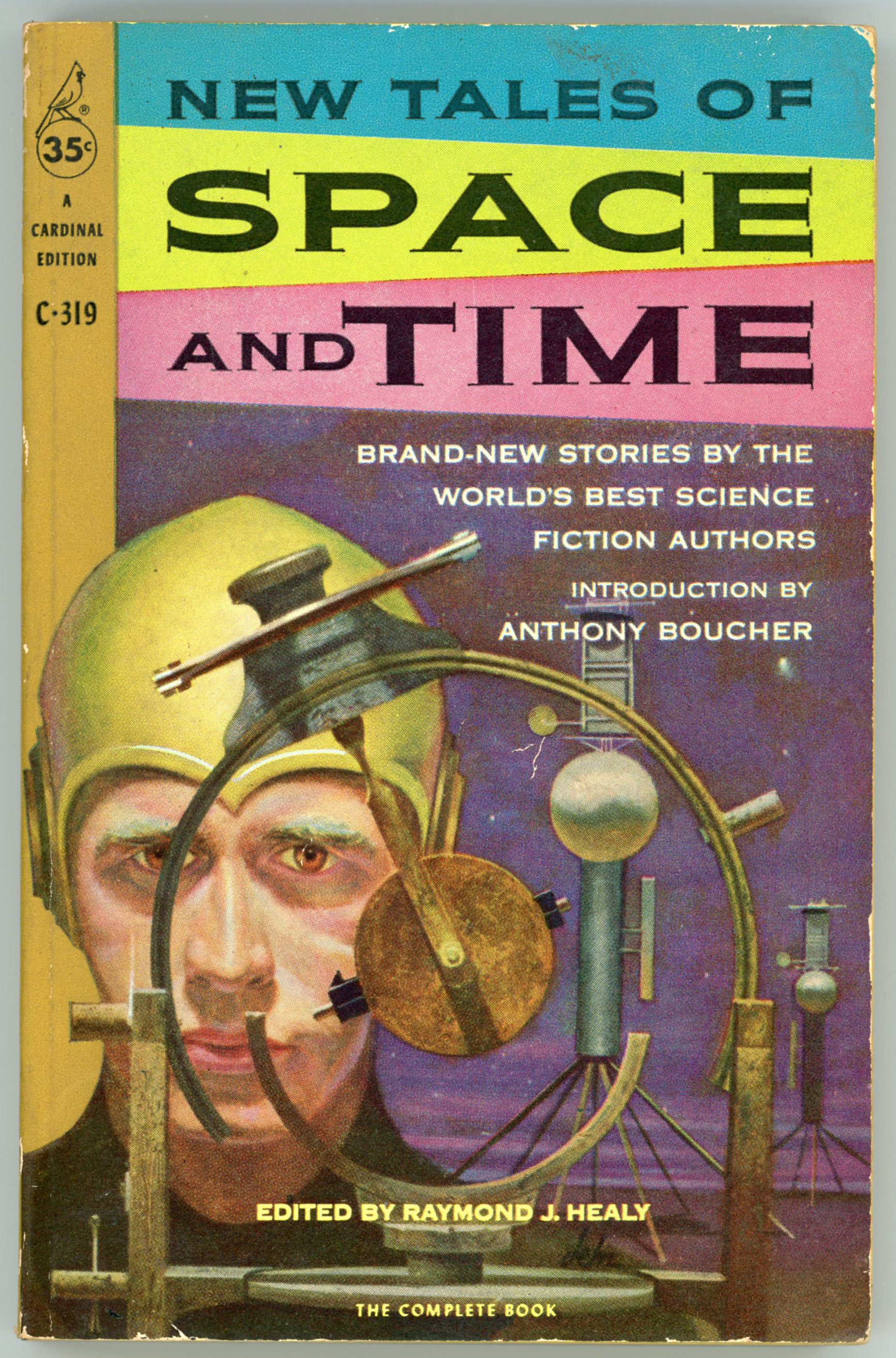
Created way back when – in the world April of 2018 – I’ve since acquired a new copy of Raymond Healy’s New Tales of Space and Time, the cover of which appears below, the original image (a little chipped, slightly dinged and somewhat dented) appearing at the bottom of the post.

According to the Internet Speculative Fiction Database, the book’s cover art was the third cover illustration to have been created by Paul Lehr, whose most recent work appeared on the cover of 2019’s Cosmic Assembly.  It’s extremely evocative of the best of science fiction art of the 40s and 50s, for it combines themes of simple machines having an abstract look, with a man wearing a futuristic helmet the shape of which imparts a sort of “ancient” appearance.  More importantly, the book’s content: All the stories are unique to this volume, not having previously appeared in pulp magazines.  

You can view the 1952 paperback edition here

(I like this one more.)

What’s in the Book?

“Here There Be Tygers”, by Ray Bradbury, from this volume…

“In A Good Cause –“, by Isaac Asimov, also from this volume…

“Tolliver’s Travels”, by Fran Fenton and Joseph Petracca, from this volume, too…

“Bettyann”, by Kris Neville, unsurprisingly, from this volume…

“Little Anton”, by R. Bretnor, from this volume, too? – yes!

“Status Quondam”, by P. Schuyler Miller, yet again, from this volume…

“B + M – Planet 4”, by Gerald Heard, and another, from this volume…

“You Can’t Say That”, by Clive Cartmill, as above…

“Fulfillment”, by A.E. van Vogt, first appearance in this volume…

“The Quest for Saint Aquin”, by Anthony Boucher, but I repeat myself; from this very volume…

____________________

Alas, the dinged original.

Some Things to Refer To…

New Tales of Space and Time, at…

GoodReads

Black Gate

Internet Speculative Fiction Database

Raymond J. Healy, at…

Wikipedia

Internet Speculative Fiction Database

April 7, 2018 279

Men, Martians and Machines, by Eric Frank Russell – May, 1965 (1958) [Paul Lehr?]

“The exciting world of the outer galaxies”

Though the artist’s name is absent from both the cover and copyright pages of Eric Frank Russell’s Men, Martians and Machines, the cover art is almost certainly by Paul Lehr. 

The appearance and presentation of the human figures (only one figure in the foreground, with several vaguely defined figures in the background), the scene’s limited range of colors, and the visual “softness” – versus the crispness and detail inherent to the works of Emsh (Edmund Emshwiller) – is consistent with Lehr’s art. 

Contents

Jay Score, from Astounding Science Fiction, May, 1941

Mechanistria, from Astounding Science Fiction, January, 1942

Symbiotica, from Astounding Science Fiction, October, 1943

Mesmerica (first publication)

VOYAGE OF THE MARATHON

“Even at the time when space ships were making regular voyages across the universe, the MARATHON was a remarkable craft.  Powered by the Flettner system, its speed was so great that for the first time exploration of the outer galaxies was made possible.

MEN, MARTIANS AND MACHINES describes some of the great voyages made by the MARATHON.  There was, for example, the planet which was solely inhabited by machines – survivors, perhaps, from a civilization in which the first machine-makers had perished.  On another planet, the inhabitants had developed the power of hypnotism to a fantastic degree, so that the observer saw only what he was willed to see.”

References

Men, Martians and Machines, at Internet Speculative Fiction Database

Men, Martians and Machines, at Wikipedia

October the First Is Too Late, by Fred Hoyle – July, 1968 (March, 1966) [Paul Lehr]

Though the artist’s name appears neither on the cover, nor within the title or copyright pages, the distinctive style of the cover art of Fred Hoyle’s October the First Is Too Late is an immediate “key” to the identify of the compositions’ creator: Paul Lehr.

Paralleling the cover of the Berkeley Medallion edition (August, 1972) of Stanislaw Lem’s Solaris, a small number of human figures, all diminutive; all indistinctive (though distinctly garbed?!), appear in the foreground, and at distance.

With the human presence minimal, it’s the book’s theme, as in the art for Solaris, that provides the basis and center of the cover art:  In this case, the central concept is nature of time, albeit distorted time; albeit parallel time.

An asymmetrical, Salvador-Dali-like clock occupies the center of the image, beneath which stand architectural symbols of both past (two pyramids, at left – one Egyptian and another Meso-American) and future (a futuristic city, composed of ovoid buildings, at right).  Above, going to and fro, are two spacecraft.  And, imparting a sense of detachment, a flock of unconcerned birds hover above the landscape.  (The same birds as on the cover of Solaris?)

In terms of color, Lehr’s composition akin to the art for Solaris (and, to my knowledge, his other works) in intentionally limiting range of colors to create a distinctive mood and “feel”.  While Solaris was limited to shades of green, blue,  gray, and violet, the palette of October the First Is Too Late is limited to tones of yellow, orange, violet, and ochre.

I like this one.

From rear cover:

October the First Is Too Late unfolds the incredible adventures on a planet twisted by time splits.  The familiar world of the 1960s has vanished everywhere except in England.  In Western Europe World War I is still raging.  Greece is in the Golden Age of Pericles, America is thousands of years into the future, while Russia and Asia are nothing but a glasslike plain incapable of sustaining life – the final phase before the end of the earth as we know it.

Against this macabre backdrop of co-existing time-spheres, two young men risk their lives to find the truth.  But the truth is in the mind of the beholder.  And who is to say who are the dreamers and who are the dreams?  You and I, dear reader, may indeed be shadows, existing solely in the mind of some traveler through time…

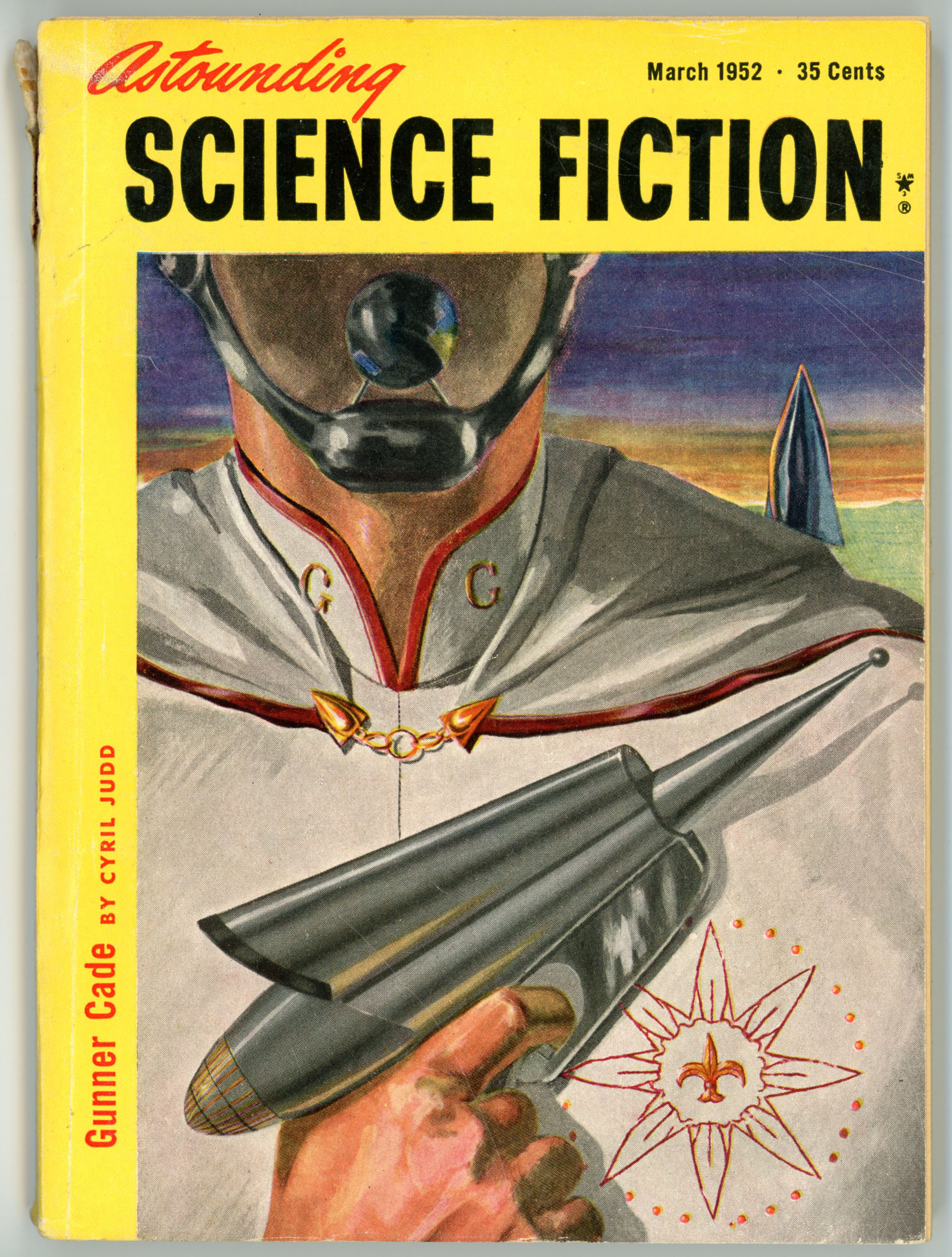
Astounding Science Fiction – March, 1952 (Featuring “Gunner Cade”, by Cyril Judd (Cyril M. Kornbluth and Judith Merril) [G. Pawelka]

Illustration by G. Pawelka, for “Gunner Cade”, by Cyril Judd (Cyril M. Kornbluth and Judith Merril), p. 19.

______________________________

Illustration by G. Pawelka, for “Gunner Cade”, by Cyril Judd (Cyril M. Kornbluth and Judith Merril), p. 37.

______________________________

Illustration by Paul Lehr, for Dell Publishing Company 1969 edition of “Gunner Cade”