A Canticle for Leibowitz, by Walter M. Miller, Jr. – October, 1959 (February, 1961) [Unknown Artist]

“Maybe you’ve always thought of war as a business for the tough and the unimaginative.
It has been said that the best soldier leaves his emotions at home;
that pre-battle training is a period calculated to harden both mind and body.
But what of the boy who cannot harden?
What of the lad who cannot put his sensitivity in a suitcase and store it for the duration?
Walter Miller tells us.”

– Introduction to “Wolf Pack”, by Walter M. Miller, Jr., Fantastic, September-October, 1953

____________________

If the spirit of an age – its dreams and moods; fancies and wonders; fears and hopes – is reflected in its literature, then a prime example of such remains Walter M. Miller., Jr.’s 1959 novel, A Canticle for Leibowitz.  Based on and derived from three short stories published in the mid-1950s – the first of which shares and perhaps inspired the novel’s title – only a decade after the development of atomic weapons and amidst the (first?) Cold War, Miller’s tale was one of many works of science-fiction that presented a vision of the world, and particularly man’s place within that world, subsequent to a global nuclear war. 

In this context, I strongly recommend the recent (October, 2020) essay about Miller’s Canticle by Pedro Blas González, “A Canticle for Leibowitz and Cyclical History“.  Therein, Dr. Gonzalez discusses Miller’s novel through the lens of Catholicism (to which Miller converted after the war), viewing the novel as an expression of Miller’s interpretation and understanding of the nature of history.  As implied (albeit not specifically mentioned) within Dr. González’s essay, and moreso readily understood through a reading of the Canticle, Miller did not view human history as being “progressive” – and thus not having an “arc” in any direction – but instead, as being cyclical, even if those cycles would occupy great intervals of time.  

Though doubtless inspired by technological developments and geopolitics of the mid-twentieth century, the two animating ideas of Miller’s novel extend well beyond science fiction, for they represent chords of thought embedded deep within the psyche of men, nations, and civilizations.  These are the idea of an apocalypse, and, the gradual and tenuous rebirth of civilization after centuries during which the collective knowledge of the past (perhaps our present?…) has become myth at best, and utterly forgotten at worst.  However, rather than concluding upon a note of redemption, the book’s final chapters leave the reader with a sense of deep ambivalence, for the novel suggests that the currents of history are by nature cyclic.

Despite the novel’s origin during the Cold War, Miller’s inspiration for A Canticle for Leibowitz seems to have arisen from something simpler, immediate, and intensely personal: His military service during the Second World War, during which he served as an aerial gunner and radio operator in the United States Army Air Force.  Specifically, the impetus for his creation of the stories and novel was his participation in a combat mission during which his bomb group participated in the destruction of the hilltop abbey of Monte Cassino.  As discussed in academic and popular literature (see Alexandra H. Olsen’s paper in Extrapolation, William Roberson’s Reference Guide to Miller’s life and fiction, and Denny Bowden’s essay at Volusia History) on a fundamental level Miller world-view was profoundly affected, if not irrevocably altered, by the experience.

Though most sources (at least, web sources) about Miller describe his military service in general terms, Roberson’s Reference Guide specifically identifies Miller’s military unit: The 489th Bombardment Squadron.  The 489th was one of the four squadrons of the 340th Bomb Group (its three brother squadrons having been the 486th, 487th, and 488th), a unit of the Mediterranean-based 12th Air Force which flew B-25 Mitchell twin-engine medium bombers.  During the time that Miller was a member of the 489th (probably late 1943 through mid-1944) the squadron was stationed at the Italian locales of San Pancrazio, Foggia, Pompeii, and the Gaudo Airfield.

The 489th’s evocative unit insignia, which doubtless adorned the leather flight jackets of many of its officers and men, is shown below…

The best resource on the web (certainly better than anything in print!) for information about the 489th and 340th is the website of the 57th Bomb Wing Association.  This resource, covering the 57th’s four bomb groups (the 310th, 319th, 321st, and 340th) gives access to an enormous amount of information, as original Army Air Force Group and Squadron histories and Mission Reports, (many of which are transcribed as PDFs), and, a plethora of photographs.  Typical of Army Air Force WW II military records, there’s a degree of variation in the quantity and depth of this information from group to group, and, squadron to squadron:  Records for some (most?) combat units are complete, though there are inevitable gaps, “here and there”.

In documents pertaining to the 489th, I’ve discovered three references to Miller’s military service.

____________________

First, Timing: A record of combat missions flown by the 489th during the February of 1944.  For the fifteenth of that month, the record – like that for all other missions – is unsurprisingly laconic: “Benedictine Monastery, Italy.  6 planes.”

____________________

Second, Identification: Miller’s name appears within a list of airmen who, already having received the Air Medal (for completing five combat missions), had been awarded two Bronze Oak Leaf Clusters, thus signifying the completion – by the end of February – of up to fifteen combat missions.  His name is listed eleventh from the top in the “upper” list…

____________________

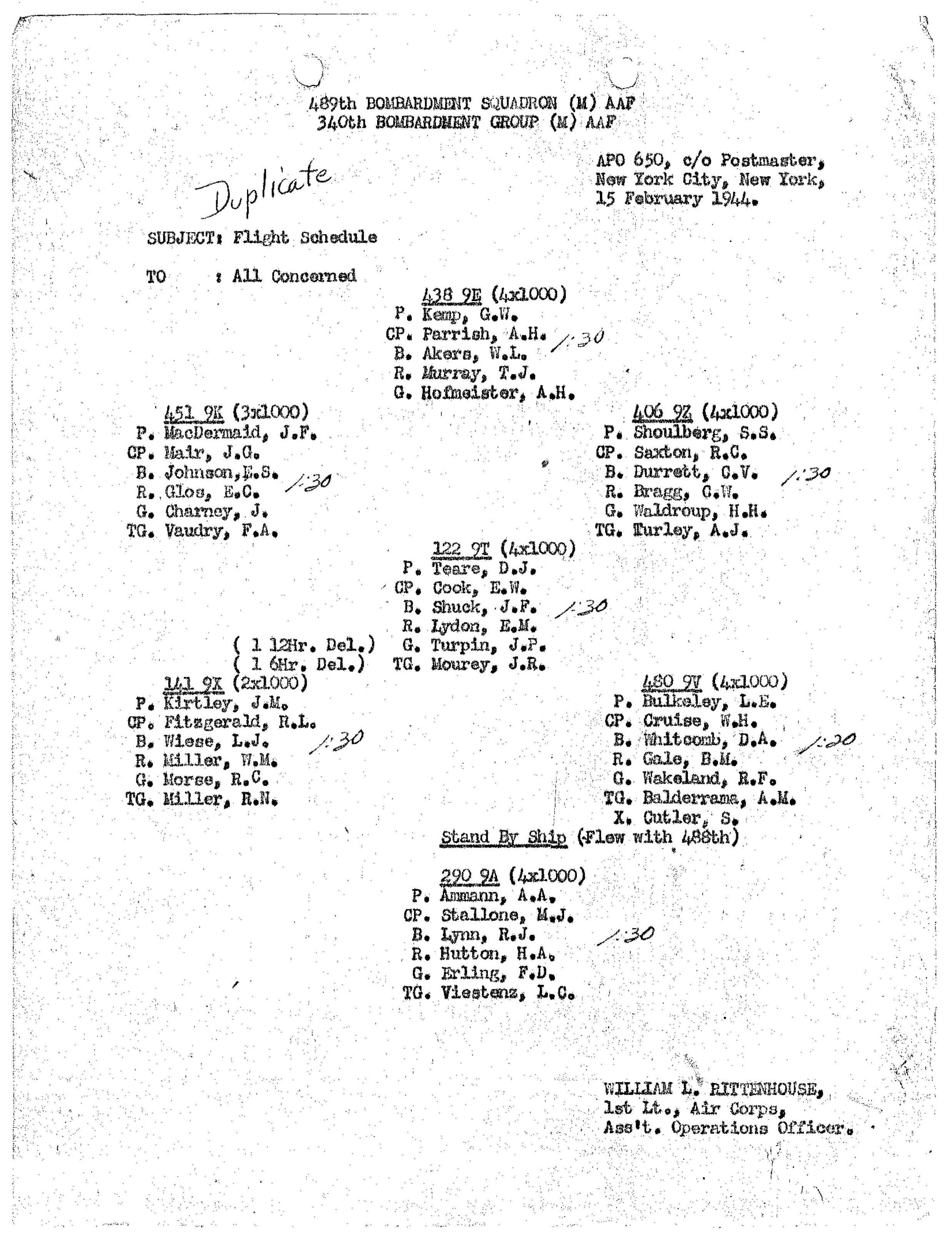
Third, Verification:  This “third” document – also found at 57th Bomb Wing – is what’s known in the parlance of the WW II Army Air Force as a “Loading List”, meaning that it lists the names of crewman assigned to specific planes during a combat mission or sortie, on an aircraft-by-aircraft basis.  This Loading List, covering 489th Bomb Squadron aircraft and crews which participated on the Cassino mission of February 15, 1944, shows that seven of the Squadron’s B-25s took part in the mission. 

Each plane is denoted by a three-digit number, which represents the last three digits of the B-25s Army Air Force serial number.  This is followed by the number “9” and a letter, the “9” representing the 489th Bomb Squadron, and the adjacent letter – a different letter for every plane in the squadron – uniquely identifying each B-25 in the squadron.  Each such number-letter combination was painted on the outer surface of the twin vertical tails of the squadron’s planes, a practice shared by the 340th’s other three squadrons.  This is followed by information about the planes’ bomb loads, which – in all cases but one – were three or four thousand-pound demolition bombs.

Then, we come to the crews themselves, which follow the same general sequence: P (Pilot), CP (Co-Pilot), B (Bombardier), R (Radio Operator), G (Aerial Gunner / Flight Engineer), and TG (Tail Gunner).

Where was Walter M. Miller, Jr.?  He’s there:  He was a radio operator in the aircraft commanded by J.M. Kirtley, B-25 “#141”, or, “9X”. 
As the 57th Bomb Wing includes Loading Lists for other missions flown by the 489th (and the 340th Bomb Group’s three brother squadrons), doubtless Miller’s name appears in these documents, as well.  But, this will suffice for now. 

____________________

The image below may be akin to the view seen by Miller on February 15, 1944:  Captioned,”Formation of North American B-25s of the 340th Bomb Group enroute to their target – Cassino.  March 15, 1944,” the picture is United States Army Air Force photo “68261AC / A22901”, and can be found within the (appropriately) entitled collection “WW II US Air Force Photos“, at Fold3.com.  The planes are aircraft of the 488th Bomb Squadron, the “give-away” being the “8C” (“8”, for 488th) code on the vertical tail of the aircraft in the left center. 
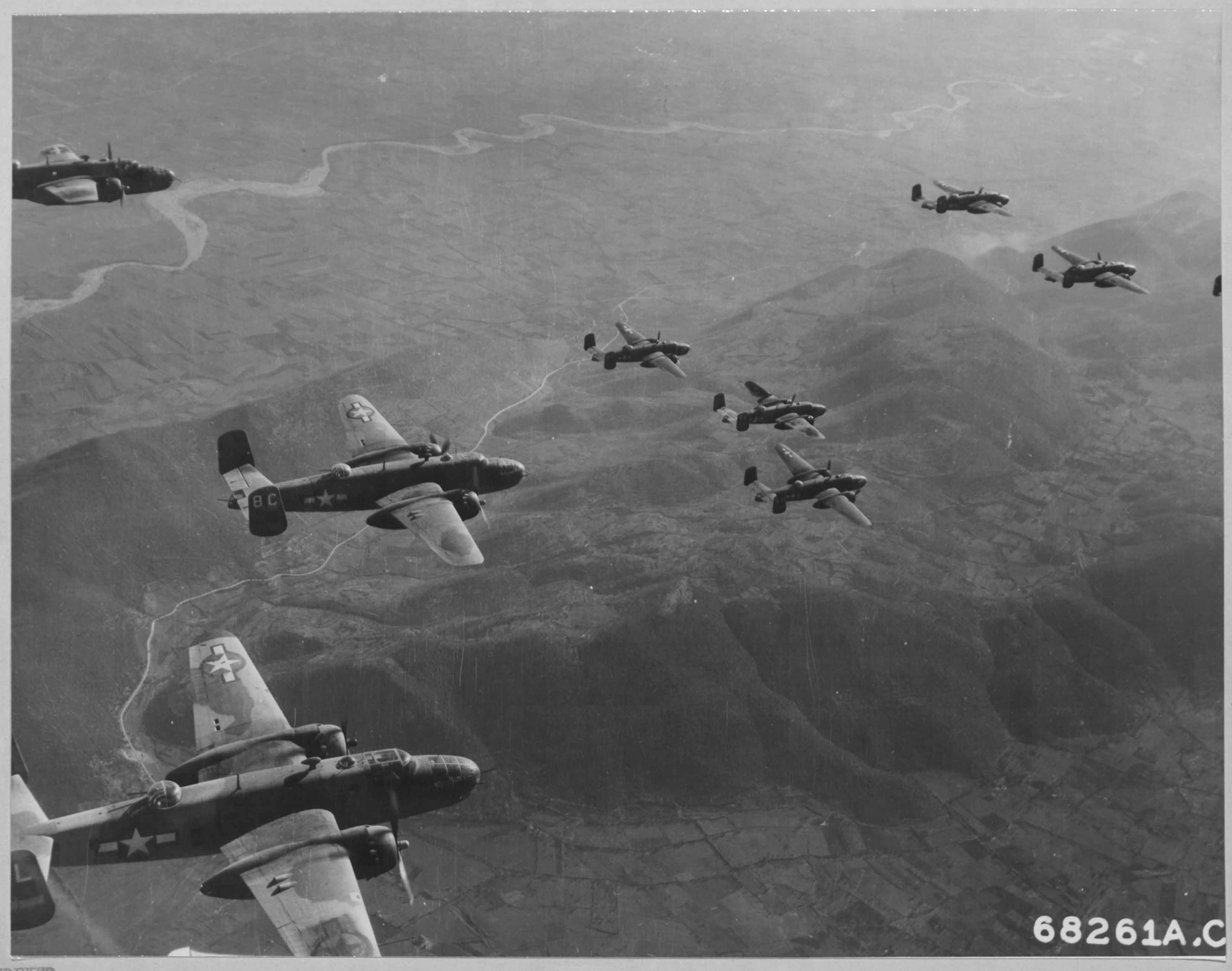
But, Walter Miller did not participate on the day’s mission, for his name is absent from the 489th’s Loading List for March 15….

____________________

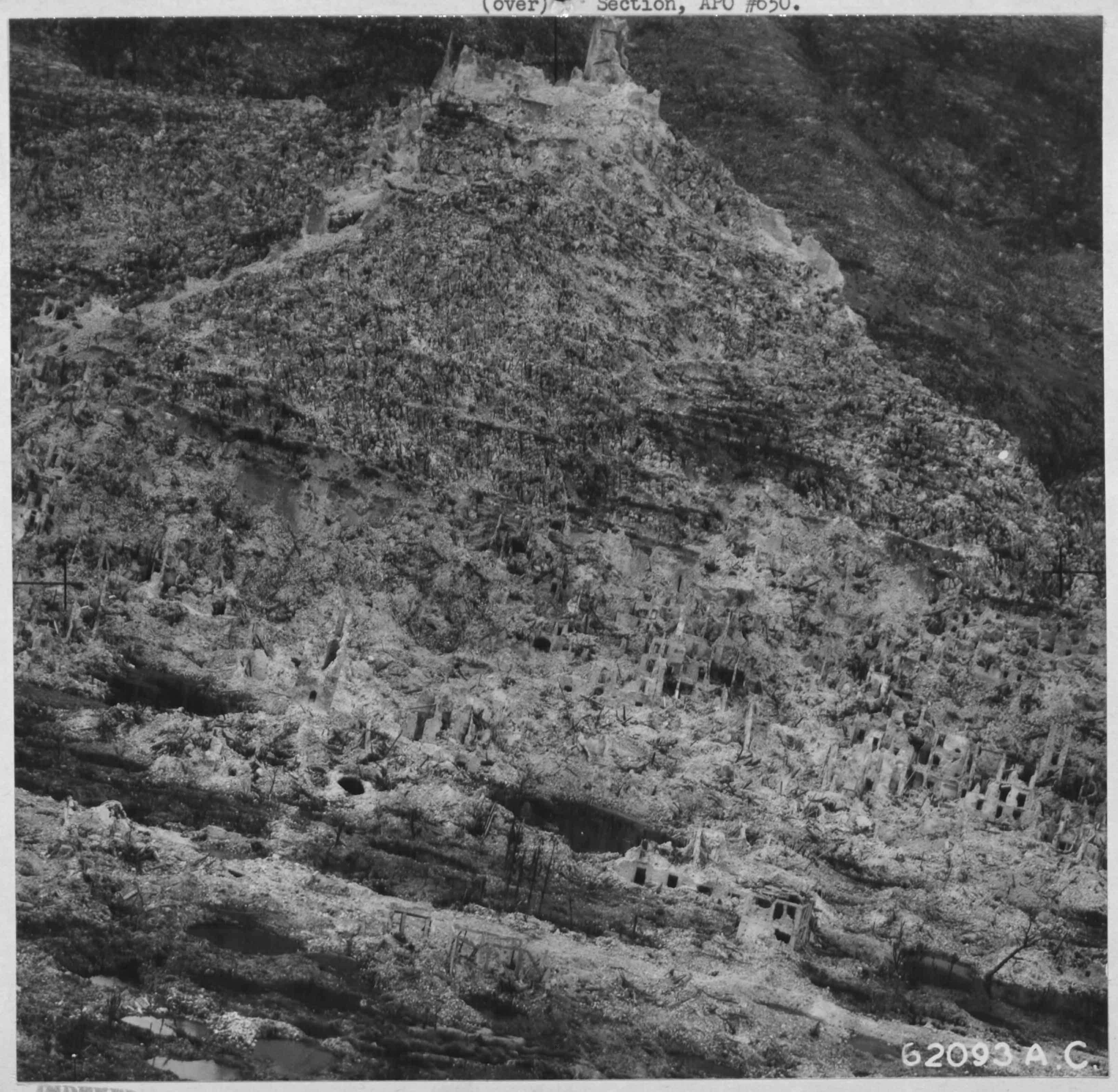
The results of war: A view of the remnants of the town of Cassino (foreground), and the hilltop abbey (upper center), in Army Air Force Photograph 62093AC / A25003.  Curiously, the caption on the rear of the photo states, “Bomb damage to Monte di Cassino  Abbey, Cassino, Italy, after bombing attacks by Allied planes.  The centuries-old monastery had been used by the German defenders as a strong point to block the Allied drive on Rome,” but the words “Monte di Cassino Abbey” are crossed out. 

The image is undated, but it was received by the Army Air Force or War Department in November of 1944.
________________________________________

As mentioned in the Wikipedia entry for the novel, and, discussed by Alexandra H. Olsen, A Canticle for Leibowitz, published in October of 1959, was created by melding and altering elements, characters, concepts, and plot devices from his three previously published post-cataclysmic stories (all having appeared in The Magazine of Fantasy and Science Fiction) into a single work, and, adding passages in Latin. 

The three stories which formed the basis of the novel were:

“A Canticle for Leibowitz”, published in April of 1955 (pp. 93-111)
“And the Light Is Risen”, published in August, 1956 (pp. 3-80)
“The Last Canticle”, published in February, 1957 (pp. 3-50)

A final tale in the series, “God Is Thus”, appeared in Fantasy & Science Fiction in November of 1997 (pp. 13-51), thirty-eight years after the novel’s publication. 

But… 

…though the motivation for the ultimate creation of Canticle of 1955 was Miller’s participation in the bombardment of Monte Cassino, evidence for the emotional impact of that is clearly evident in an earlier story of a vastly different literary nature:  This was “Wolf Pack”, which appeared in the September-October, 1953, issue of Fantastic.  Among the thirty-eight works of short fiction listed in Miller’s biographical profile at the Internet Speculative Fiction Database, “Wolf Pack” was the 26th, while “Secret of the Death Dome”, published in Amazing Stories in 1951, was the first.  “Wolf Pack” appeared two years before “A Canticle for Leibowitz’s” publication, in the 1955 The Magazine of Fantasy and Science Fiction. 

Though I’ve thus far barely (!) skimmed the story, it seems to belong entirely to the realm of fantasy as opposed to science fiction, for it relates a combat flyer’s confrontation with his conscience – himself? – on levels symbolic, psychological, and perhaps supernatural.

Do you want to read the story?  Here’s a PDF version of “Wolf Pack”

As for the artistic aspects of the Fantastic story – visual art, that is! – here’s the two-page opening illustration for the tale…

…and here’s an accompanying illustration, showing representations of a B-25 bomber (viewed from above) and a bombardier peering through a generic “black box” looking bombsight (not quite a Norden bombsight!), both visual elements being surrounded by symbolic vignettes of villages.  Both pieces are by Bernard Krigstein, whose work is much more strongly associated with comic books than pulps. 

________________________________________

Continuing on a theme of art, here’s the cover of Bantam Books’ 1961 paperback edition of the novel, which shows a monk against a backdrop of a destroyed city’s skyline.  Though the artist’s name isn’t listed, perhaps he was Paul Lehr, given the era of the book’s publication, and, the visual style of the composition.

In terms of Miller’s use of Latin, here’s the prayer uttered by Brother Francis Gerard of The Albertian Order of Saint Leibowitz, which appears very early in the novel’s first part (“Fiat Homo”), during the Brother’s exploration of the remains of a fallout shelter somewhere in the American Southwest.  The allusions to the actuality and legacy of nuclear war are explicit and vivid, and – recited in the format of prayer rather than prose, with each of the three central groups of verses being thematically linked – powerfully expressed and visually evocative. 

A spiritu fornicationis,
Domine, libera nos.
From the lighting and the tempest,

O Lord, deliver us.

From the scourge of the earthquake,
O Lord, deliver us.
From plague, famine, and war,

O Lord, deliver us.

From the place of ground zero,
O Lord, deliver us.
From the ruin of the cobalt,

O Lord, deliver us.
From the rain of the strontium,

O Lord, deliver us.
From the fall of the cesium,

O Lord, deliver us.

From the curse of the Fallout,
O Lord, deliver us.
From the begetting of monsters,

O Lord, deliver us.
From the curse of the Misborn,

O Lord deliver us.
A morte perpetua,

Domine, libera nos.

Peccatores,
te rogamus, audi nos.
That thou wouldst spare us,

we beseech thee, hear us.
That thou wouldst pardon us,

we beseech there, hear us.
That thou wouldst bring us truly to penance,

te rogamus, audi nos.
(pp. 14-15)

(In just a moment, Brother Gerard will discover a relic from the life of Saint Leibowitz…)

________________

________________

Of the larger folded papers, one was tightly rolled as well,
and it began to fall apart when he tried to unroll it;
he could make out the words RACING FORM, but nothing more. 
After returning it to the box for later restorative work,
he turned to the second folded document;
its creases were so brittle that he dared inspect only a little of it,
by parting the folds slightly and peering between them.

A diagram, it seemed, but – a diagram of white lines on dark paper!

Again he felt the thrill of discovery. 
It was clearly a blueprint
– and there was not a single original blueprint left at the abbey,
but only inked facsimiles of several such prints. 
The originals had faded long ago from overexposure to light. 
Never before had Francis seen an original,
although he had seen enough hand-painted reproductions to recognize it as a blueprint,
which, while stained and faded,
remained legible after so many centuries because of the total darkness and low humidity in the abbey.  He turned the document over – and felt brief fury:
What idiot had desecrated the priceless paper? 
Someone had sketched absent-minded geometrical figures and childish cartoon faces all over the back.  What thoughtless vandal-

The anger passed after a moment’s reflection.
At the time of the deed, blueprints had probably been as common as weeds,
and the owner of the box the probably culprit.
He shielded the print from the sun with his own shadow while trying to unfold it further.
It the lower right-hand corner was a printed rectangle containing,
in simple block-letters, various titles, dates, “patent numbers”, reference numbers, and names.
His eye traveled down the list until it encountered:
“CIRCUIT DESIGN BY: Leibowitz, I.E.

He closed his eyes tightly and shook his head until it seemed to rattle. 
Then he looked again. 
There is was, quite plainly:

“CIRCUIT DESIGN BY: Leibowitz, I.E.”

He flipped the paper over again. 
Among the geometric figures and childish sketches,
clearly stamped in purple ink,
was the form:

The name was written in a clear feminine hand,
not in the hasty scrawl of the other notes. 
He looked again at the initialed signature of the note in the lid of the box,
I.E.L. – and again at “CIRCUIT DESIGN BY …” 
And the same initials appeared elsewhere throughout the notes.

(Proof of the Saint’s existence!  Here’s the “Circuit Design Form” bearing his signature, from page 23 of the Bantam paperback.  Absent from “Canticle” in the 1955 edition of The Magazine of Fantasy and Science Fiction, in book form, it really catches the reader’s attention.) 

There had been argument, all highly conjectural,
about whether the beautiful founder of the Order, if finally canonized,
should be addressed as Saint Isaac or as Saint Edward.
Some even favored Saint Leibowitz as the proper address,
since the Beatus had, until the present, been referred to by his surname.

“Beate Leibowitz, ora pro me!” whispered Brother Francis. 
His hands were trembling so violently that they threatened to ruin the brittle documents.

He had uncovered relics of the Saint.  (pp. 22-24)

________________________________________

Given the novel’s success, it’s unsurprising that it was adapted for radio broadcast.  It’s available via Archive.org, at The Classic Archives Old Time Radio Channel, and Old Time Radio Downloads

Created in 1981, the play is comprised of fifteen segments, each of roughly a half-hour duration.  The informational blurb at Archive.org states, “The radio drama adaptation by John Reed, and produced at WHA by Carl Schmidt and Marv Nunn.  The play was directed by Karl Schmidt, engineered by Marv Nunn with special effects by Vic Marsh.  Narrator – Carol Collins and includes Fred Coffin, Bart Hayman, Herb Hartig and Russel Horton.  Music was by Greg Fish and Bob Budney and the Edgewood College Chant Group.”

________________________________________

________________________________________

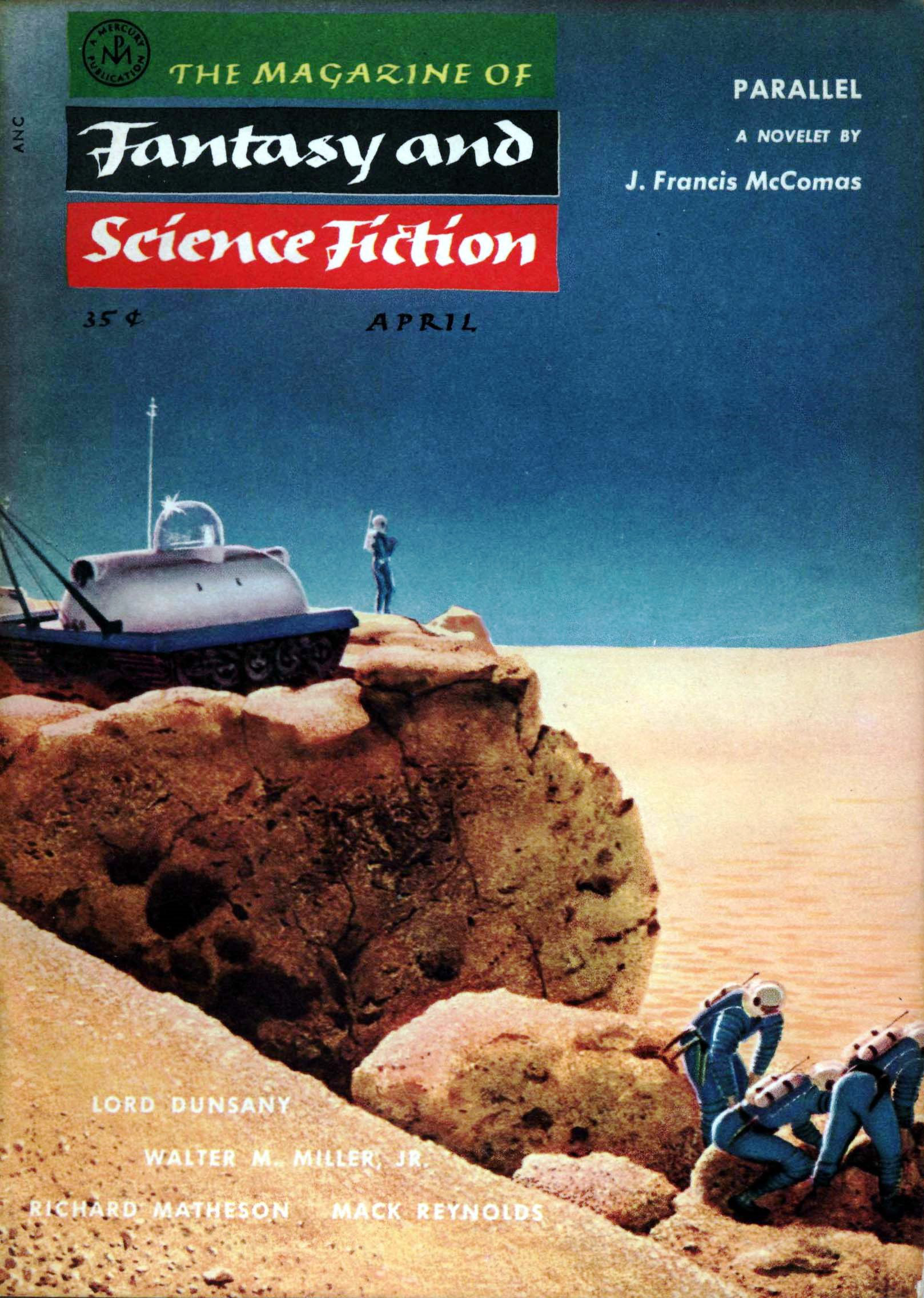
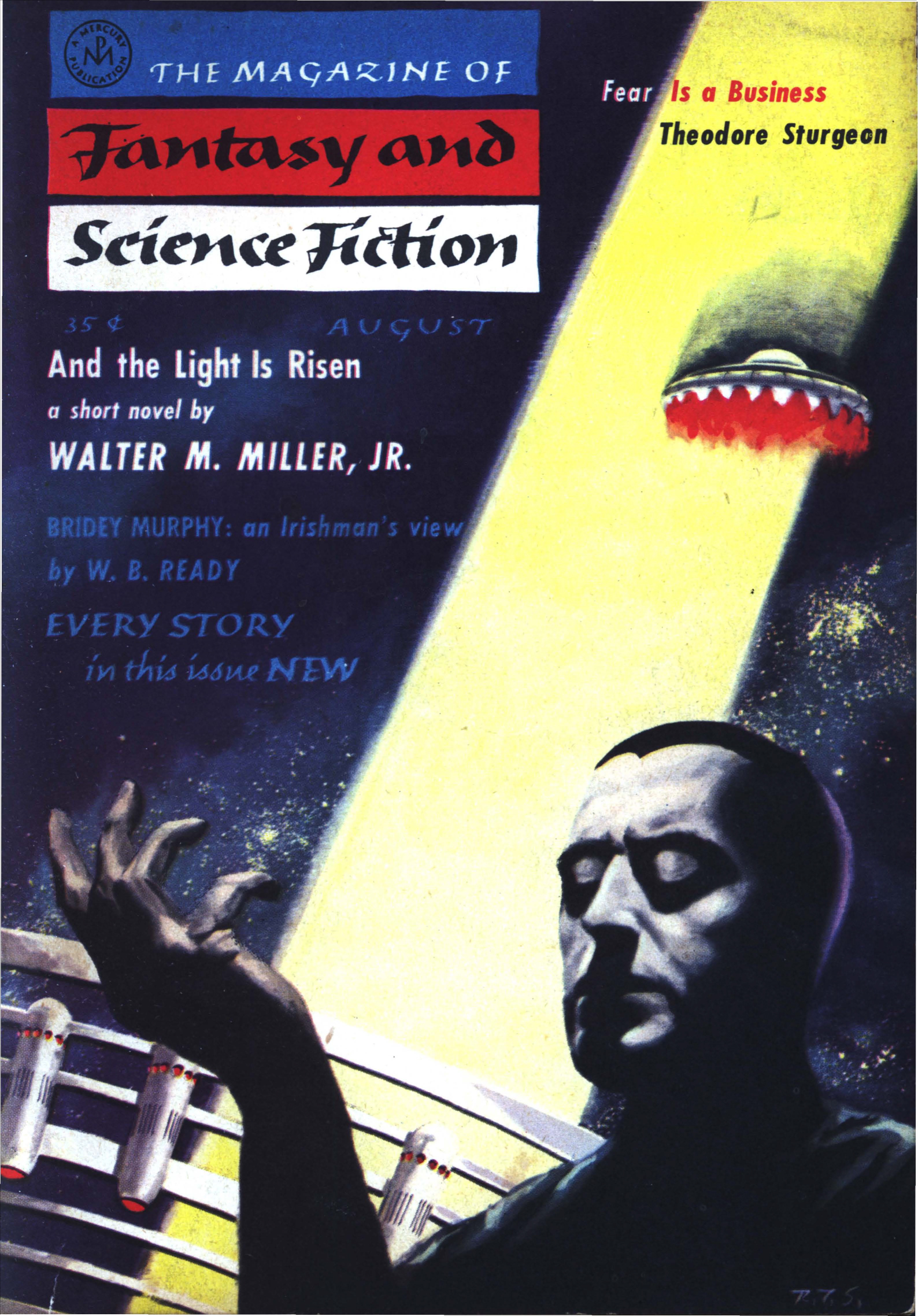
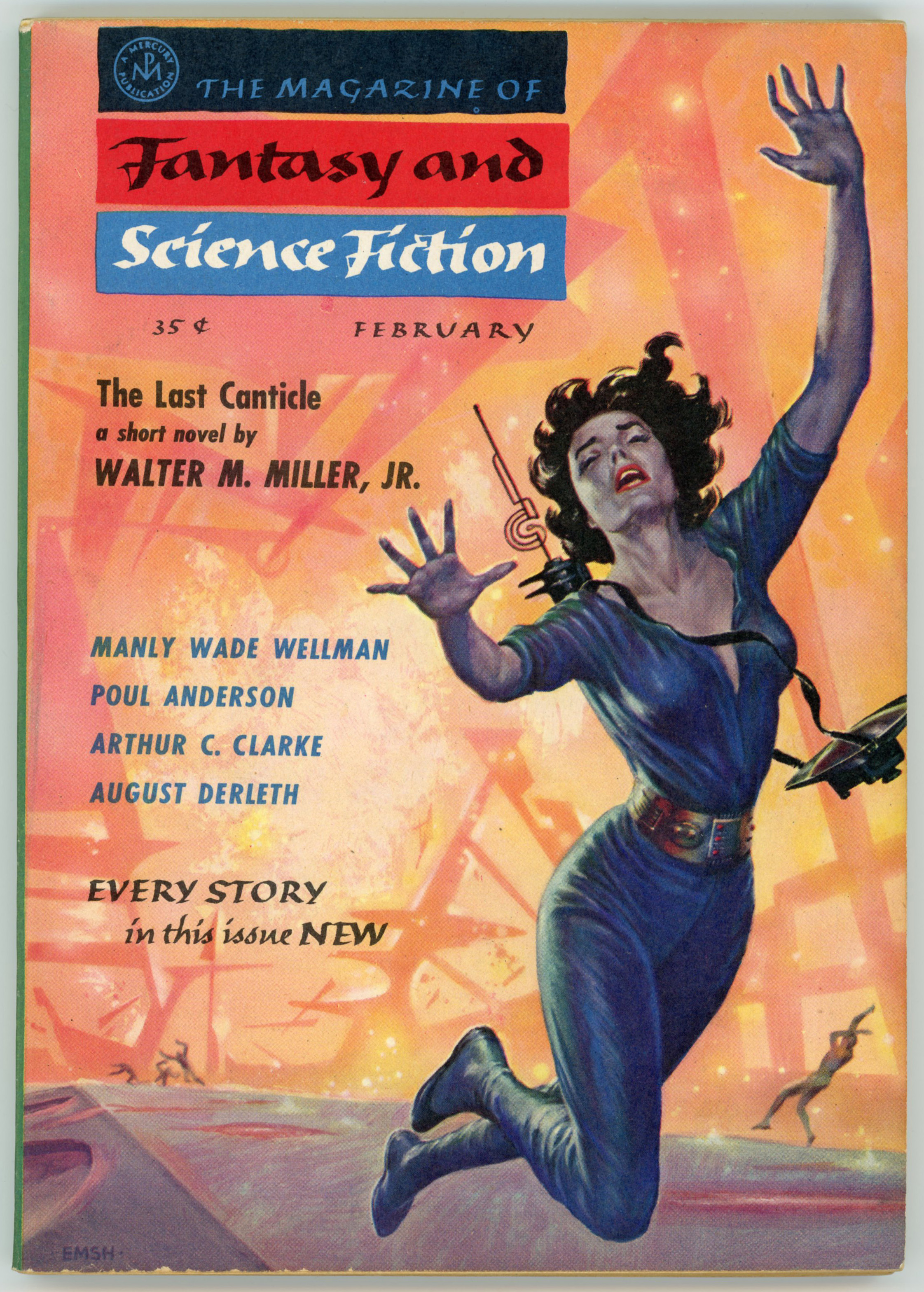
These are covers of the three 1950’s issues of The Magazine of Fantasy and Science Fiction in which appeared the three stories from which were derived Miller’s novel, and, the cover of Fantasy & Science Fiction in October-November of 1997, which was the venue for the last story in the series.  Ironically, none of the four issues feature cover art actually pertaining to Miller’s stories or novel.  Much the same was so for 1951 issue of Galaxy Magazine in which appeared Ray Bradbury’s “The Fireman”, later published in book form as Farhenheit 451:  That issue featured cover art by Chesley Bonestell.

__________

The cover of the April, 1955 issue features a close-up from Chesley Bonestell’s stunning panorama “Mars Exploration”.  Notice that the painting shows a strip of green – vegetation – at the base of weathered background hills.  Well, this was the mid-1950s, over a decade before Mariner probes revealed the true nature of the Martian surface.  Then again, maybe Mars is “green”, but a deeper, below-the-surface kind of green?

“A Canticle for Leibowitz”
April, 1955
____________________

“Mars Exploration”, by Chesley Bonestell

________________________________________

“And the Light Is Risen”
August, 1956
________________________________________

“The Last Canticle”
February, 1957
________________________________________

“God Is Thus”
October-November, 1997

________________________________________

References, Readings, and What-Not…

57th Bomb Wing, at 57thBombWing.com

340th Bomb Group History, at 57thBombWing.com

489th Bomb Squadron History, at 57thBombWing.com

489th Bomb Squadron History for February, 1944 (PDF Transcript), at 57th BombWing.com

489th Bomb Squadron insignia, at RedBubble.com

Bernard Krigstein, at Wikipedia

Walter M. Miller, Jr., at Wikipedia

Walter M. Miller, Jr., at Internet Speculative Fiction Database

“A Canticle for Leibowitz”, at Wikipedia

“Mars Exploration” (painting), by Chesley Bonestell, at RetroFuturism (subreddit)

The Magazine of Fantasy and Science Fiction (covers for April, 1955, August, 1956, and October-November, 1997), at Pulp Magazine Archive (Archive.org)

Bond, Harold L., Return to Cassino, Pocket Books, Inc., New York, N.Y., March, 1965

Bowden, Denny, Secret Life / Death of the Author of the Greatest Science Fiction Novel – Born in New Smyrna, Died in Daytona Beach, at VolusiaHistory.com

Majdalany, Fred, The Battle of Cassino, Ballantine Books, Inc., New York, N.Y., 1957

Olsen, Alexandra H., Re-Vision: A Comparison of Canticle for Leibowitz and the Novellas Originally Published, Extrapolation, Summer, 1997

Piekalkiewicz, Janusz, Cassino – Anatomy of the Battle, Orbis Publishing, London, England, 1980

Roberson, William H., Walter M. Miller, Jr.: A Reference Guide to His Fiction and His Life, McFarland and Company, Inc., Jefferson, N.C., 2011

Webley, Kayla, Top Ten Post-Apocalyptic Books: A Canticle for Leibowitz, Time, June 7, 2010
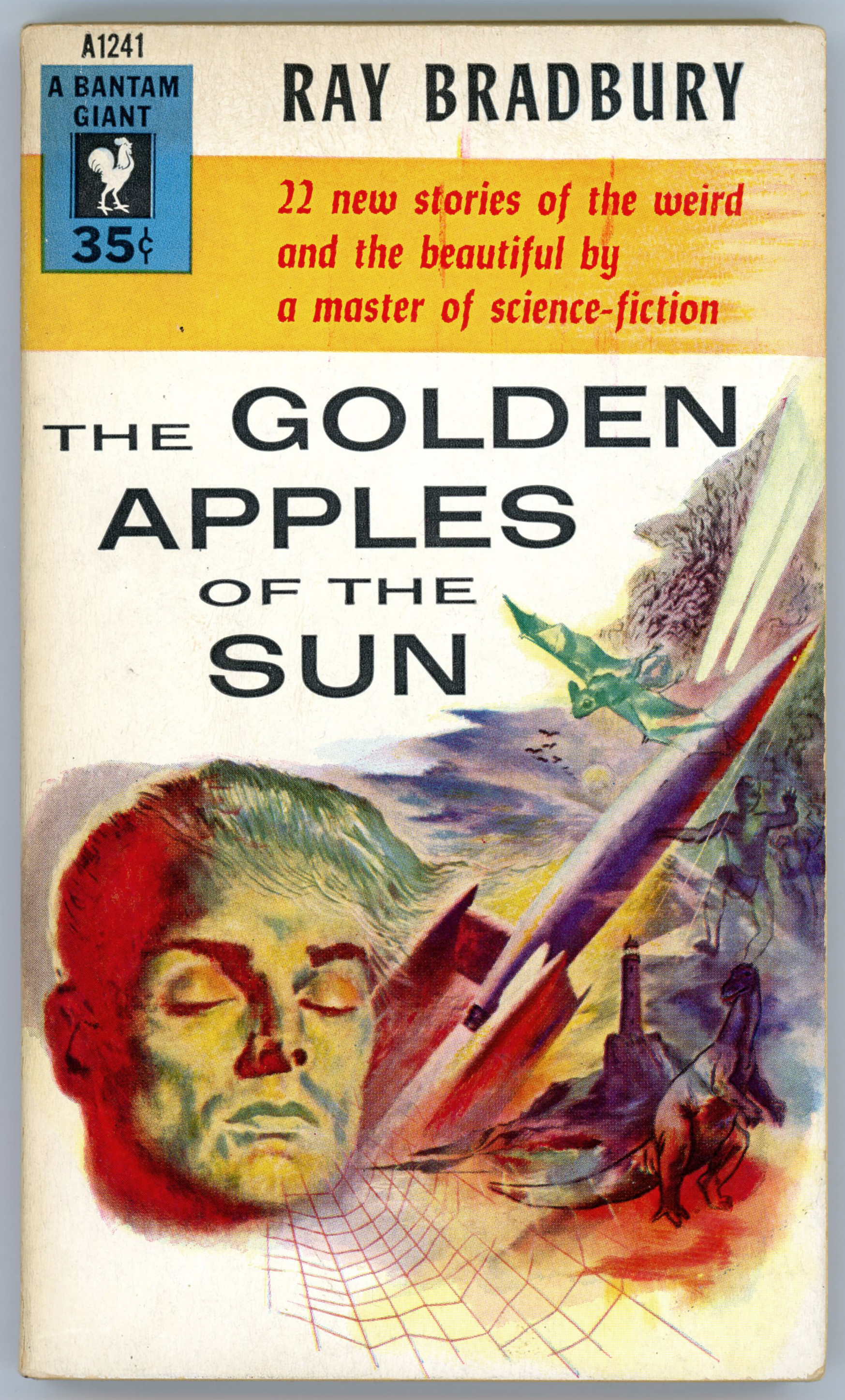
The Golden Apples of the Sun, by Ray Bradbury – 1954 [Barye W. Phillips…maybe]

Though I’ve never been partial to the literary style or underlying themes of Ray Bradbury’s writing, I can still appreciate and respect the cultural and historical significance of his body of work.  And, from what I know “about” him, he was a genuinely kind human being, quite willing to bestow time and advice to budding authors.  In that regard, the foremost qualities that emerge from his interview by Charles Platt (in Dream Makers – The Uncommon People Who Write Science Fiction) are a sense of integrity, and, a deep dedication to his craft.

You can’t ignore somebody like that.

So, here’s Bantam’s 1954 anthology of twenty-two of his stories, entitled (by virtue of the last listed title) The Golden Apples of the Sun.  For the story “Embroidery”, originally published in the November, 1951 issue of Marvel Science Fiction, I’ve included the magazine’s cover (by Hannes Bok), while for “The Golden Apples of The Sun”, which first appeared in the November, 1953 issue of Planet Stories, I’ve added the issue’s cover (by Frank Kelly Freas).  Both images were downloaded from Archive.org, and Photoshopified just a little bit.

Contents

The Fog Horn, from The Saturday Evening Post, June 23, 1951

The Pedestrian, from The Magazine of Fantasy and Science Fiction, February, 1952

The April Witch (from “The Elliott Family” series), from The Saturday Evening Post, April 5, 1952

The Wilderness (from “The Martian Chronicles” series) from The Magazine of Fantasy and Science Fiction, November, 1952

The Fruit at the Bottom of the Bowl, from Detective Book Magazine, Winter, 1948

Invisible Boy, from Mademoiselle, Winter, 1945

The Flying Machine

The Murderer

The Golden Kite, the Silver Wind

I See You Never, from The New Yorker, November 8, 1947

____________________

Embroidery, from Marvel Science Fiction, November, 1951

“This month’s 4-color cover by well-known cover and interior artist, HANNES BOK.  Using a mixed technique of dyes, color pencil, water-color, and ink.”

____________________

The Big Black and White Game, from The American Mercury, August, 1945

A Sound of Thunder, from Colliers, June 28, 1952

The Great Wide World Over There

Powerhouse (1948?)

En la Noche, from Cavalier, November, 1952

Sun and Shadow, The Reporter, 1953

The Meadow, World Security Workshop (ABC Radio Network radio program), 1947

The Garbage Collector

The Great Fire (“Green Town”?) (1949?)

Hail and Farewell

____________________

The Golden Apples of the Sun, Planet Stories, November, 1953

____________________

References

Platt, Charles, Dream Makers – The Uncommon People Who Write Science Fiction, Berkley Books, New York, N.Y., November, 1980

The Golden Apples of the Sun, at Internet Speculative Fiction Database

The Golden Apples of the Sun, at Wikipedia

Ray Bradbury, at RayBradbury.com

The Best of Barry N. Malzberg – January, 1976 [Robert Emil Schulz]

While common themes of science fiction art and illustration are inspired by technology, engineering, space exploration, let alone transcending the known and established physical laws governing the nature of the universe, another motif of the genre’s art pertains to the realm of the biological:

Genetic engineering, the effects of man upon his environment (and likewise, the effects of nature upon man – how jarringly topical now, in March of 2020…); relationships with alien species – whether romantic, sexual, or familial – as exemplified in striking combination through Philip Jose Farmer’s great “The Lovers“; the natural, random evolution of homo sapiens into forms and variants whose physical and intellectual abilities effectively create a new species of “man”.

These and other concepts have all been the basis of science fiction art, both in books and magazines.

A nice example of biological art appears as Robert E. Schulz’s cover illustration for The Best of Barry Malzberg.  No stylized, abstract spacecraft here, the symbolic center of the image is the form of a man, before whom are two helixes, probably representations of strands of DNA.  At his right side, glass laboratory-ware associated with chemistry (see that Erlenmeyer flask?), which seem to be involved in the condensation of some kind of chemical.  Plus, there’s that dark sphere outlined in a diffuse red halo (a planet?; a miniature black hole?), with an electrical circuit below.

But, his other side is different, for the symbolism isn’t scientific, it’s religious.  The central object is a huge chalice, above which is a crucifix, all ornamented by a seeming brass clockwork.  And, there seems to be a brass shield covering the man’s thigh.

Lots going on here!

As for the book itself?  – Oh, yes…  Though titled “The Best of…”, it’s actually a Pocket Books publication, rather than being part of the Del Rey / Ballantine Series “The Best of…” which covered the works of a variety of other authors.

Contents

Introduction to The Best of Barry N. Malzberg, by Barry N. Malzberg

Introduction to “A Reckoning”, by Barry N. Malzberg

“A Reckoning” (variant of Notes Leading Down to the Conquest), from New Dimensions III, October, 1943

Introduction to “Letting It All Hang Out”, by Barry N. Malzberg

“Letting It All Hang Out” (variant of Hanging), from Fantastic, September, 1974

Introduction to “The Man in the Pocket”, by Barry N. Malzberg

“The Man in the Pocket” (variant of The Men Inside), from New Dimensions II, December, 1972

Introduction to “Pater Familias”, by Barry N. Malzberg

“Pater Familias”, from The Magazine of Fantasy and Science Fiction, March, 1972 (by Kris Neville and Barry N. Malzberg)

Introduction to “Going Down”, by Barry N. Malzberg

“Going Down”, from Dystopian Visions, 1975

Introduction to “Those Wonderful Years”, by Barry N. Malzberg

“Those Wonderful Years”, from Frontiers 1: Tomorrow’s Alternatives, 1973

Introduction to “On Ice”, by Barry N. Malzberg

“On Ice”, from Amazing Science Fiction, January, 1973

Introduction to “Revolution”, by Barry N. Malzberg

“Revolution”, from Future City, 1973

Introduction to “Ups and Downs”, by Barry N. Malzberg

“Ups and Downs”, from Eros in Orbit, 1973

Introduction to “Bearing Witness”, by Barry N. Malzberg

“Bearing Witness”, from Flame Tree Planet, 1973

Introduction to “At the Institute”, by Barry N. Malzberg

“At the Institute”, from Fantastic, 1974

Introduction to “Making It Through”, by Barry N. Malzberg

“Making It Through”, from And Walk Now Gently Through the Fire and Other Science Fiction Stories, 1972

Introduction to “Tapping Out”, by Barry N. Malzberg

“Tapping Out”, from Future Quest, 1973

Introduction to “Closed Sicilian”, by Barry N. Malzberg

“Closed Sicilian”, from The Magazine of Fantasy and Science Fiction, November, 1973

Introduction to “Linkage”, by Barry N. Malzberg

“Linkage”, from Demon Kind, 1973

Introduction to “Introduction to the Second Edition”, by Barry N. Malzberg

“Introduction to the Second Edition”, by Barry N. Malzberg

Introduction to “Trial of the Blood”, by Barry N. Malzberg

“Trial of the Blood”, from The Berserkers, 1974

Introduction to “Getting Around”, by Barry N. Malzberg

“Getting Around”, from Frontiers 1: Tomorrow’s Alternatives, 1973

Introduction to “Track Two”, by Barry N. Malzberg

“Track Two”, from Fantastic, July, 1974

Introduction to “The Battered-Earth Syndrome”, by Barry N. Malzberg

“The Battered-Earth Syndrome”, from Saving Worlds, 1973

Introduction to “Network”, by Barry N. Malzberg

“Network”, from Fantastic, January, 1974

Introduction to “A Delightful Comedic Premise”, by Barry N. Malzberg

“A Delightful Comedic Premise”, from The Magazine of Fantasy and Science Fiction, February, 1974

Introduction to “Geraniums”, by Barry N. Malzberg

“Geraniums”, from Omega, 1973 (by Valerie King and Barry N. Malzberg)

Introduction to “City Lights, City Nights”, by Barry N. Malzberg

“City Lights, City Nights”, from Future City, 1973

Introduction to “Culture Lock”, by Barry N. Malzberg

“Culture Lock”, from Future City, 1973

Introduction to “As in a Vision Apprehended”, by Barry N. Malzberg

“As in a Vision Apprehended”, from The Berserkers, 1974

Introduction to “Form in Remission”, by Barry N. Malzberg

“Form in Remission”, from The Berserkers, 1974

Introduction to “Opening Fire”, by Barry N. Malzberg

“Opening Fire”, from Frontiers 2: The New Mind, 1973

Introduction to “Running Around”, by Barry N. Malzberg

“Running Around”, from Omega, 1973

Introduction to “Overlooking”, by Barry N. Malzberg

“Overlooking”, from Amazing Science Fiction, June, 1974

Introduction to “Twenty Sixty-one”, by Barry N. Malzberg

“Twenty Sixty-one”, from The Magazine of Fantasy and Science Fiction, July, 1974

Introduction to “Closing the Dead”, by Barry N. Malzberg

“Closing the Deal”, from Analog Science Fiction / Science Fact, March, 1974

Introduction to “What the Board Said”, by Barry N. Malzberg

“What the Board Said”, 1976

Introduction to “Uncoupling”, by Barry N. Malzberg

“Uncoupling”, from Dystopian Visions, 1975

Introduction to “Over the Line”, by Barry N. Malzberg

“Over the Line”, from Future Kin, 1974

Introduction to “Try Again” and “An Oversight”, by Barry N. Malzberg

“Try Again”, from Strange Gods, 1974

“An Oversight”, 1976, (variant of “Oversight”, from Strange Gods, 1974)

Introduction to “And Still in the Darkness”, by Barry N. Malzberg

“And Still in the Darkness”, 1976

References

The Best of Barry N. Malzberg, at the Internet Speculative Fiction Database

Robert E. Schulz, at the Internet Speculative Fiction Database

Facebook Page for The Art of Robert E. Schulz

World’s Best Science Fiction 1971 – Donald A. Wollheim and Terry Carr – 1971 [Davis Meltzer] [Updated post…!]

Like John Schoenherr’s work, this Douglas Meltzer cover includes both front and rear panels of World’s Best Science Fiction 1971.  It is rather inventive: A human face forms the center of a radio telescope which is aimed at a galaxy.  The dark blue of the sky contrasts nicely with the deep yellow below.

Update – January, 2020

Originally posted in June of 2017, this image of the cover of World’s Best Science Fiction 1971 has been updated to include the volume’s spine, thus given a complete representation of Metlzer’s cover art. 

Contents

Slow Sculpture, by Theodore Sturgeon, from Galaxy Science Fiction, February, 1970

Bird in The Hand, by Larry Niven, from The Magazine of Fantasy and Science Fiction, October, 1970

Ishmael In Love, by Robert Silverberg, from The Magazine of Fantasy and Science Fiction, July, 1970

Invasion of Privacy, by Bob Shaw, from Amazing Stories, July, 1970

Waterclap, by Isaac Asimov, from If, April, 1970

Continued on Next Rock, by R.A. Lafferty, from Orbit 7

The Thing in The Stone, by Clifford D. Simak, from If, March, 1970

Nobody Lives on Burton Street, by Gregory Benford, from Amazing Stories, May, 1970

Whatever Became of The McGowans, by Michael G. Coney, from Galaxy Science Fiction, May, 1970

The Last Time Around, by Arthur Sellings, from If, November-December, 1970

Greyspun’s Gift, by Neal Barret, Jr., from Worlds of Tomorrow, Winter, 1970

The Shaker Revival, by Gerald Jonas, from Galaxy Science Fiction, February, 1970

Dear Aunt Annie, by Gordon Eklund, from Fantastic Stories, April, 1970

Confessions, by Ron Goulart, from The Magazine of Fantasy and Science Fiction, August, 1970

Gone are The Lupo, by H.B. Hickey, from Quark / 1

________________________________________

Image originally posted…

Reference

World’s Best Science Fiction 1971, at Internet Speculative Fiction Database

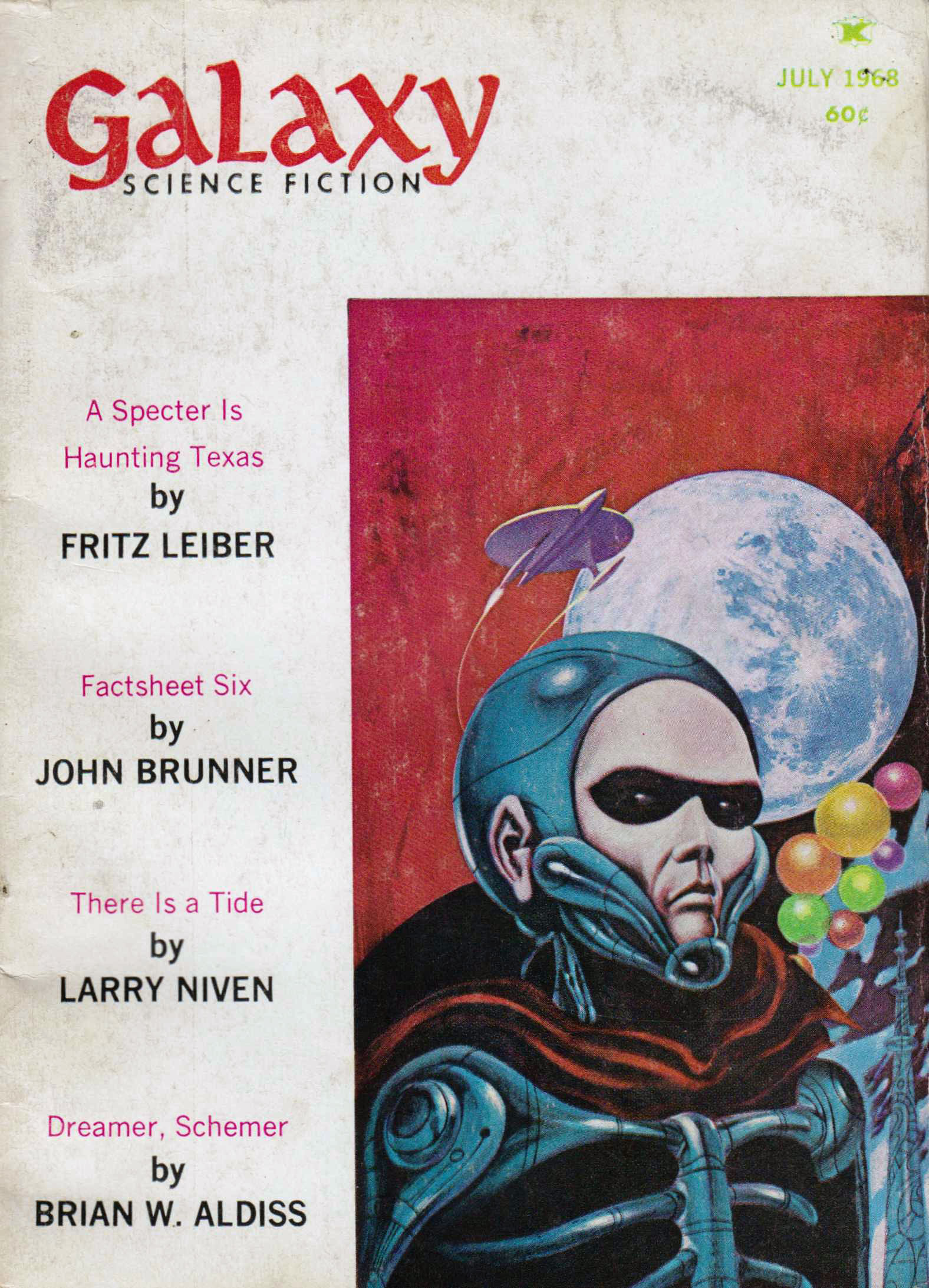
A Specter Is Haunting Texas, by Fritz Leiber – 1978 (1968) [Henry Richard Van Dongen (plus, Jack Gaughan)]

________________________________________

Symbolic illustration of Scully La Cruz (facing title page) by Jack Gaughan.

________________________________________

From rear cover …

“Scully La Cruz was a Thin – a muscleless free-fall phenomenon whose home was the Sack circling the Moon, who could only support life in Earth-gravity conditions by having himself encased in a titanium exo-sekleton.  To the inhabitants of the ravaged post-war Earth, he looked spectrally outlandish.

To Scully, the inhabitants of the Earth looked equally odd.  Because the U.S.A. had disappeared in the aftermath of the atomic conflict and had been replaced by Greater Texas.  And Greater Texas was dominated by the Greater Texans, masterful giants created by hormone treatments, who strode lordly about amidst their dwarvish peons and slaves.

To these unhappy underlings, Scull appeared as a Sign, a leader for revolt.  To Scully, this reverence sparked his actor instinct sufficiently to make him decide to accept that role.

This is one of Fritz Leiber’s most astonishing and satirical novels … a caricature of the future as living, chilling and ultimately serious of purpose as a Jules Feiffer cartoon.”

Excerpt (from pages 14-15) …

They were looking I discovered, at a handsome,
shapely,
dramatic-featured man,
eight feet eight inches tall and massing 147 pounds
and ninety-seven pounds without his exoskeleton. 
Except for relaxed tiny bulges of muscle in his forearms and calves
(latter to work lengthy toes, useful in gripping),
this man was composed of skin, bones, ligaments, fasciae, narrow arteries and veins,
nerves, small-size assorted inner organs, ghost muscles,
and a big-domed skull with two bumps of jaw muscles. 
He was wearing a skintight black suit that left bare only his sunken-chested,
deep-eyed, beautiful tragic face and big, heavy-tendoned hands.

This truly magnificent,
romantically handsome,
rather lean man was standing on two corrugated-soled titanium footplates. 
From the outer edge of each rose a narrow titanium T-beam that followed the line of his leg,
with a joint (locked now) at the knee,
up to another joint with a titanium pelvic girdle and shallow belly support. 
From the back of this girdle a T-spine rose to support a shoulder yoke and rib cage,
all of the same metal. 
The rib cage was artistically slotted to save weight,
so that curving strips followed the line of each of his very prominent ribs.

A continuation of his T-spine up the back of his neck in turn supported a snug,
gleaming head basket that rose behind to curve over his shaven cranium,
but it front was little more than a jaw shelf and two inward-curving cheekplates
stopping just short of his somewhat rudimentary nose. 
(The nose is not needed in Circumluna to warm or cool air.)

Slightly lighter T-beams than those for his legs reinforced his arms
and housed in their terminal inches his telescoping canes. 
Numerous black, foam-padded bands attached this whole framework to him.

A most beautiful prosthetic, one had to admit.  While to expect a Thin, or even more than a Fat,
from a free-fall environment to function without a prosthetic on a gravity planet
or in a centrifuge would be the ultimate in cornball ignorance. 

Eight small electric motors at the principal joints worked the prosthetic framework
by means of steel cables riding in the angles of the T-beams,
much like antique dentist’s drills were worked, I’ve read. 
The motors were controlled by myoelectric impulses from his ghost muscles
transmitted by sensitive pickups buried in the foam-padded bands. 
They were powered by an assortment of isotopic and lithium-gold batteries
nesting in his pelvic and pectoral girdles. 

“Did this fine man look in the least like a walking skeleton?”
 I demanded of myself outragedly. 
“Well, yes very much so,”
I had to admit now that I had considered the matter from the viewpoint of strangers. 
A very handsome and stylish skeleton,
all silver and black but a skeleton nonetheless,
and one eight feet eight inches tall,
able to look down a little even at the giant Texans around him.

________________________________________

________________________________________

Scully La Cruz, as originally envisioned by Jack Gaughan in Galaxy Science Fiction …

________________________________________

(pp. 6-7)

________________________________________

(pp. 28-29)

Out Of This World – An Anthology of Fantasy, Edited by Julius Fast – 1944 (1946) [Unknown Artist] [[Updated Post]]

(First created in March of 2018, this post has been updated to present greater detail about Out of This World’s contents…)

Evening Primrose, by John Collier, from Presenting Moonshine (book), 1941

Laura, by Saki (H.H. Munro), from Beats and Super-Beasts (book), 1914

Sam Small’s Tyke, by Eric Knight, from Sam Small Flies Again: The Amazing Adventures of the Flying Yorkshireman (book), 1940

Satan and Sam Shay, by Robert Arthur, from The Elks Magazine, August, 1942

A Disputed Authorship (excerpt from A House-Boat on the Styx), by John Kendrick Bangs, 1895

Mr. Mergenthwirker’s Lobblies, by Nelson S. Bond, Scribners Magazine, November, 1937

A Vision of Judgement, by H.G. Wells, from The Country of The Blind and Other Stories (book), 1911

Thus I Refute Beelzy, by John Collier, from Presenting Moonshine (book), 1941

The King of the Cats, by Stephen Vincent Benet, from Harper’s Bazar, February, 1929

The Canterville Ghost, by Oscar Wilde, from Court and Society Review, February 23, 1887

My Friend Merton, by Julius Fast

And Adam Begot, by Arch Oboler

The Club Secretary, by Lord Dunsany, from The Atlantic Monthly, August, 1934

The Scarlet Plague, by Jack London, from The London Magazine, June, 1912

Reference

Out of This World, at Internet Speculative Fiction Database

Budrys’ Inferno, by Algis Budrys – July, 1963 [Richard M. Powers]

The cover of the Berkley Medallion edition of Budrys Inferno, typifying the work of Richard Powers: Two medusa-like shapes (for lack of a better word) float above the surface of a planet (well, there’s one crater in the foreground), against a sky of pale red, pink, and tan.  The only solidly human representations appear as the form of two stylized, silhouetted figures fighting (or dancing?) in the lower left.  

In the foreground looms the stylized head (well, I guess it’s a head – it certainly looks like it’s viewed from behind!) of an alien observer.  But, is the observer viewing the horizon, or looking at us? 

Like much of the art of Richard Powers, answers, explanations, and identification are uncertain. 

Contents

Introduction – essay by Algis Budrys

Silent Brother, from Astounding Science Fiction, February, 1956

Between the Dark and the Daylight, from Infinity Science Fiction, October, 1958

And Then She Found Him …, from Venture Science Fiction, July, 1957

The Skirmisher, from Infinity Science Fiction, November, 1957

The Man Who Tasted Ashes, from if Science Fiction, February, 1959

Lower Than Angels, from Infinity Science Fiction, October, 1956

Contact Between Equals, from Venture Science Fiction, July, 1958

Dream of Victory, from Amazing Stories, August-September, 1953

The Peasant Girl, from Astounding Science Fiction, June, 1956

A Planet Named Shayol (Planeetta Nimeltä Shajol), by Cordwainer Smith (Translated by Matti Rosvall) – 1985 [Unknown Artist]

“I want you there,” she said as solemnly as a witch. 
“I want you there to wear the helmet of the pinlighters and ride with me into hell itself.
That soul is lost. 
It is frozen by a force I do not know,
frozen out beyond the stars,
where the stars caught it and made it their own,
so that the poor man and brother that thou seest is truly among us,
but his soul weeps in the unholy pleasure between the stars
where it is lost to the mercy of God and to the friendship of mankind. 
Wilt thou, O brave man, sir and doctor, Chief and Leader, ride with me to hell itself?”

What could I say but yes?

From “The Colonel Came Back from the Nothing-at-All”
in The Instrumentality of Mankind, 1979

_______________________________________

The overwhelming number of images displayed at this blog present cover and interior art of books and magazines in my own collection, or, texts to which I have direct physical access for scanning.  However, this image is an exception: The cover of a Finnish-language anthology of stories by Cordwainer Smith, it was discovered entirely at digital random. 

Chanced upon at https://kauppa.kierratyskeskus.fi, “The Metropolitan Area Recycling Center for Used Goods” of Espoo, Finland’s second largest city, the image shows the cover of Planeetta nimeltä Shajol (A Planet Named Shayol), published by WSOY (Werner Söderström Ltd.) in the city of Juva in 1985.  (ISBN numbers 9510129100 and 9789510129104; OCLC number 57810714)  Originally published in 1975 with Finnish translation by Matti Rosvall, Planeetta nimeltä Shajol is profiled at Rising Shadow – Beyond the Reality, a Finnish-language science-fiction and fantasy book database, from which the following is quoted:

Sisältää valikoiman alkuperäisteoksen novelleja:

Translation: “Includes a selection of original short stories:”

Neito joka purjehti Sielua (The Lady Who Sailed The Soul (1960))
Kuinka aivot poltettiin (The Burning of the Brain (1958))
Komentaja Suzdalin rikos ja riemuvoitto (The Crime and the Glory of Commander Suzdal (1964))
Naurutalon kuollut rouva (The Dead Lady of Clown Town (1964))
Matami Hittonin Kisumisut (Mother Hitton’s Littul Kittons (1961))
Balladi C’mellistä (The Ballad of Lost C’mell (1962))
Planeetta nimeltä Shajol (A Planet Named Shayol (1961))

“Vavahduttavan kauniita balladeja ja hyytäviä kauhunäkyjä seitsemän novellin kokoelmassa.  Cordwainer Smith luo kertomuksissaan täysin omaleimaisen maailmankaikkeuden.  Hänen avaruutensa on julma, ärjyvä kaaos, jossa ihminen voi voittaa vain turvautumalla epätoivoisiin keinoihin.  Yksi osa tarinoita kertoo alaihmisistä, jotka kamppailevat tasa-arvosta ihmisen rinnalla.  Tähän kamppailuun ja kaikkeen universumissa tapahtuvaan ihmiskunnan kehitykseen vaikuttaa salaperäisin valtuuksin toimiva Ihmistaidon neuvosto, Smithin kosmoksen jumalavastine.”

Translation: Astonishingly beautiful ballads and scenes of chilling horror in a collection of seven novellas.  In his stories, Cordwainer Smith creates a completely unique universe.  His space is cruel, which man can overcome only by resorting to desperate means.  Part of the story is about the under-people who are fighting for equality alongside human beings.  This struggle and the evolution of all humanity in the universe is influenced by the mysterious Council of Humanity, Smith’s divine counterpart of the cosmos.”

Alas! – Despite extensive searches, the artist remains anonymous:  I’m unable to identity the creator’s name, and don’t expect to discover this person’s identity any time soon, for a search of Worldcat reveals that the book is unavailable in the United States.

(Alas!)

Regardless, I think the image is aesthetically lovely and technologically intriguing, representing the combination of familiarity and strangeness that is inherent to the world (worlds?) created by Smith.  Equally, through the seemingly direct connection of man and machine (those thick orange cables directly connected to the man’s head…) the scene creates undercurrents of unease and oddness so characteristic of many of Smith’s tales. 

(Who is this man?)

Go-Captain Alvarez?

Captain of the Navy and Instrumentality, Commander Suzdal?  Is the planet before him the dread world Arachosia?  Is he about to hurl his supply of genetically coded cats into the past?

Colonel Harkening, on his first planoforming voyage?

Scanner Martel?  (No, he’s almost certainly not Scanner Martel.)

Captain Magno-Taliano, aboard the bridge of the Wu-Feinstein?

Mercer, before he was sentenced to the planet named Shayol?

(Who is this man?)

It doesn’t matter.  Perhaps we’re not supposed to know.

References

Planeetta nimeltä Shajol – Cordwainer Smith, at kauppa kierratyskeskus.fi

Planeetta nimeltä Shajol – Cordwainer Smith, at Rising Shadow Science Fiction and Fantasy

WSOY (Werner Söderström Ltd), Publishers of Finland, at WSOY.fi

Mann, James A. (Editor), The Rediscovery of Man – The Complete Short Fiction of Cordwainer Smith, The NESFA Press, Framingham, Ma., 1993

Landscape of Darkness, by Sara Light-Waller (Lucina Press, 2018)

Most of the posts at WordsEnvisioned present images from books past, but sometimes, the present should be present.  And so with the book below, Sarah Light-Waller’s 2018 Landscape of Darkness

Hearkening back to the “golden age” of science-fiction – the small myriad (can a myriad be small?) of pulp magazines published from the 1930s through the late 1950s (many forgotten, some inspirational, every one memorable in their own way) Landscape of Darkness – in plot, tempo, and especially characters – was inspired by authors such as Henry Kuttner, Catherine L. Moore, Murray Leinster, and Edmond Hamilton.  While an animating aspect of the book is the threat of technological dystopia (is this not so even in reality?) this challenge is overcome – albeit not easily – through human strength, human courage, and ultimately the human spirit.  In this, Ms. Light-Waller’s work has the potential expansion into a tale of even greater depth and length. 

You can purchase your own copy of Landscape of Darkness (sample chapters available here) directly from Lucina Press, or via Amazon.