Tales From the White Hart, by Arthur C. Clarke – October, 1961 (1957) [Richard M. Powers]

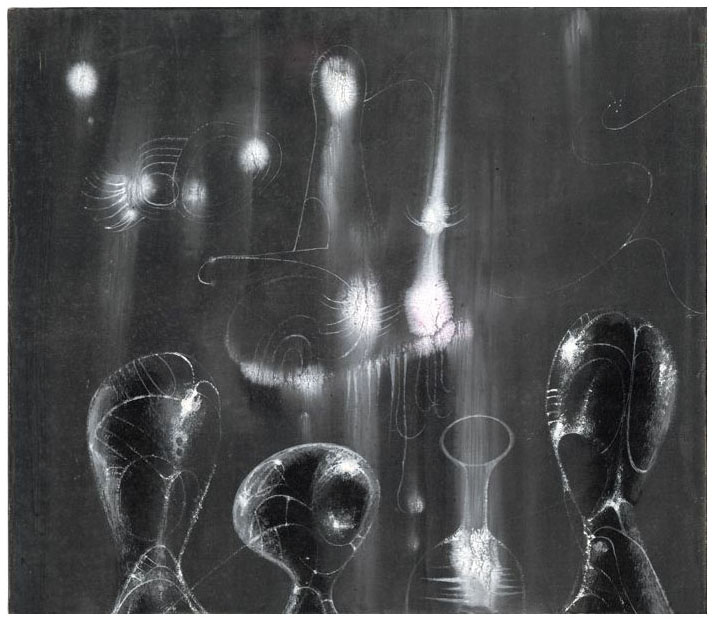
For Ballantine Book’s 1961 paperback edition of Arthur C. Clarke’s Tales From the White Hart, Richard Powers took an approach that was both consistent with and a departure from his usual style:  He depicted a group of subtly outlined creatures in an anthropoid-mechanical style (some floating in the background), yet instead of using contrasting, bold, primary colors, the composition was completed entirely in black and white. 

If not as striking as much of his work, the composition is cleverly consistent with the very title of the book! 

Contents

Preface (essay by Arthur C. Clarke, 1957)

Silence Please (variant of “Silence, Please!”), from Science-Fantasy, Winter, 1950

Big Game Hunt, from Adventure, October, 1956

Patent Pending from Adventure, November, 1954

Armaments Race, from Adventure, April, 1954

Critical Mass, from Space Science Fiction Magazine, August, 1957

The Ultimate Melody, from if – Words of Science Fiction, February, 1957

The Pacifist, from Fantastic Universe, October, 1956

The Next Tenants, from Satellite Science Fiction, February, 1957

Moving Spirit

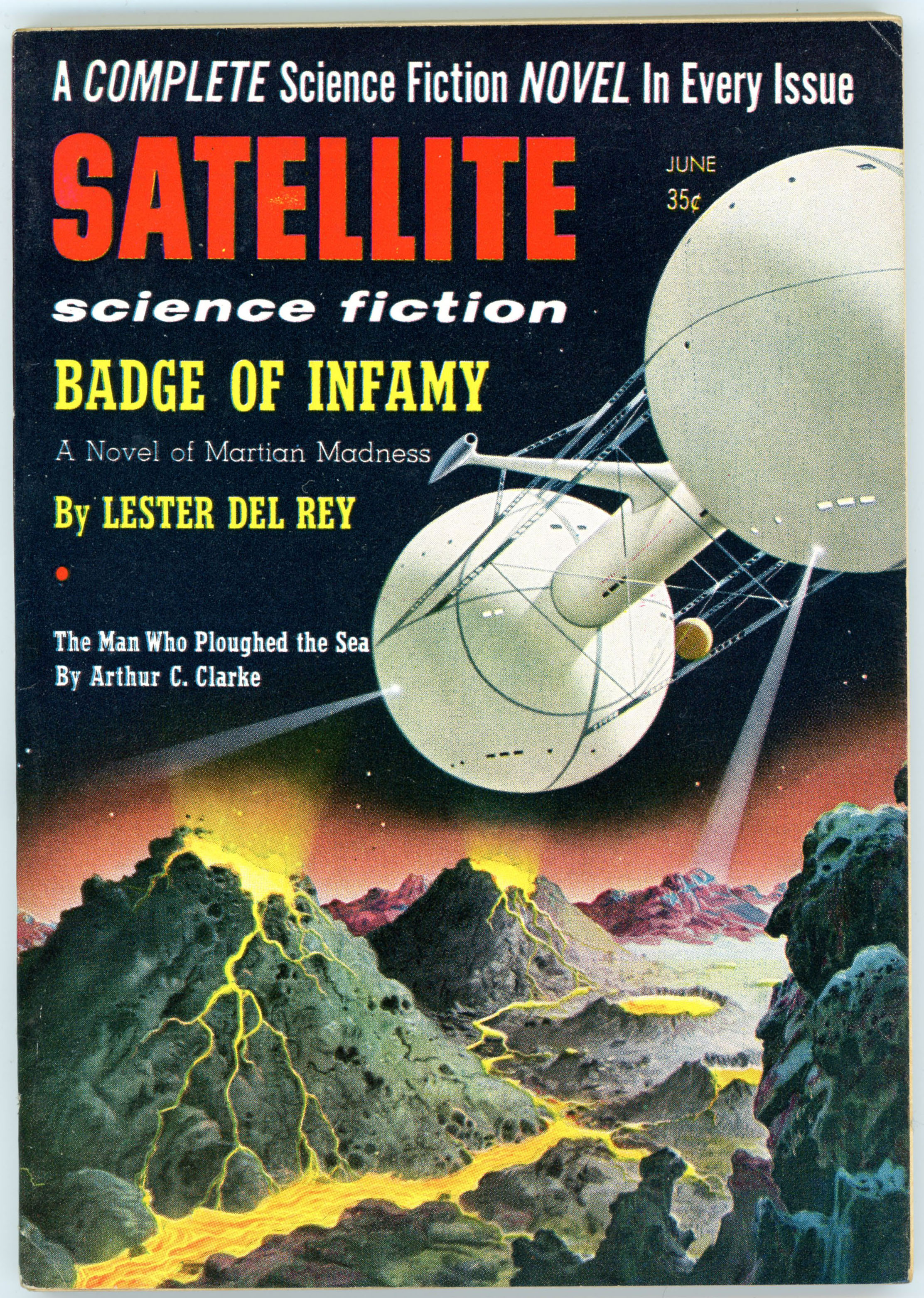
The Man Who Ploughed the Sea from Satellite Science Fiction, June, 1957

The Reluctant Orchid, from Satellite Science Fiction, December, 1956

Cold War, from Satellite Science Fiction, April, 1956

What Goes Up (variant of “What Goes Up…”), from The Magazine of Fantasy and Science Fiction, January, 1956

Sleeping Beauty, from Infinity Science Fiction, April, 1957

The Defenestration of Ermintrude Inch

______________________________

Close-up of Powers’ cover, showing – perhaps?! – the enigmatic denizens of the White Hart…

______________________________

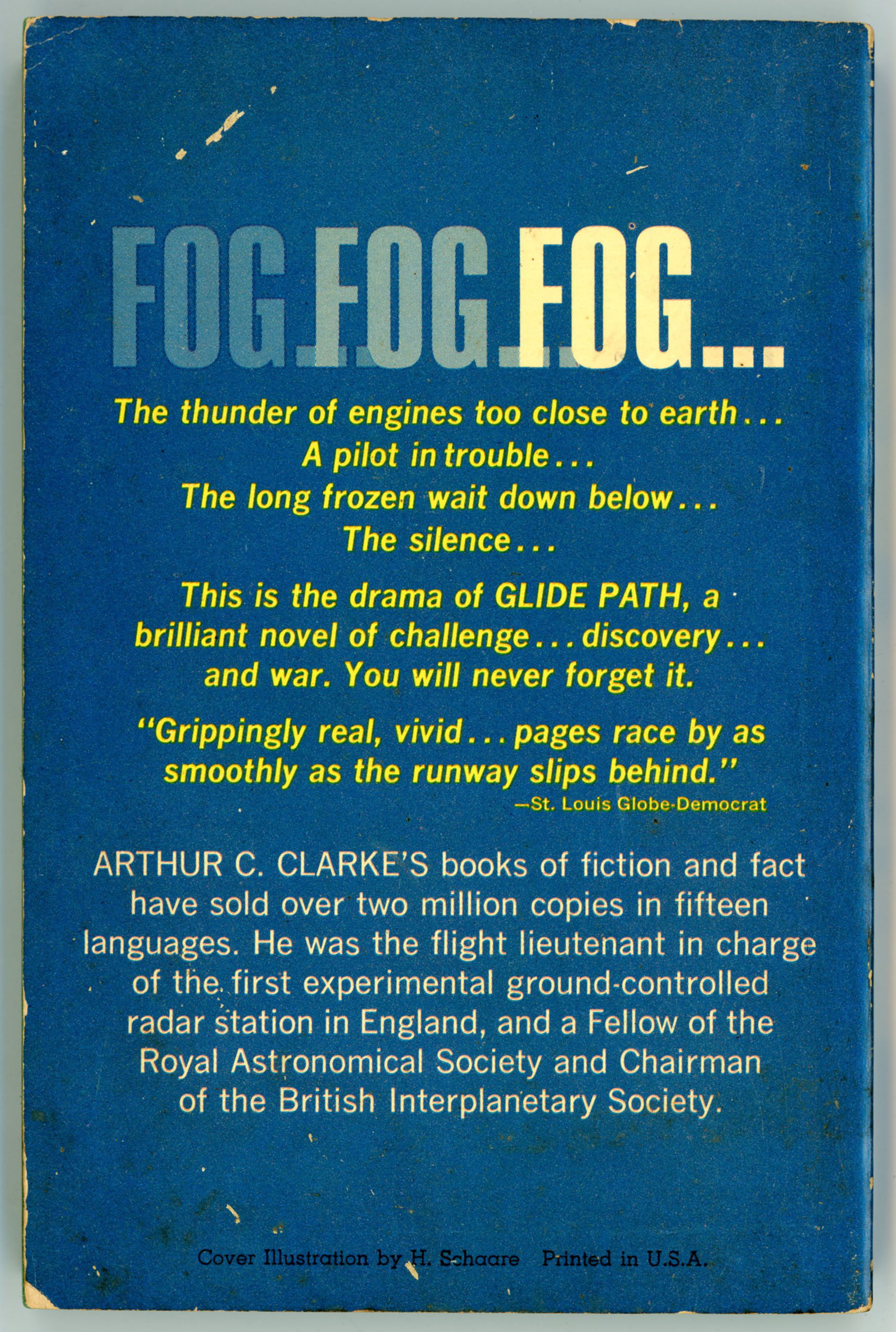
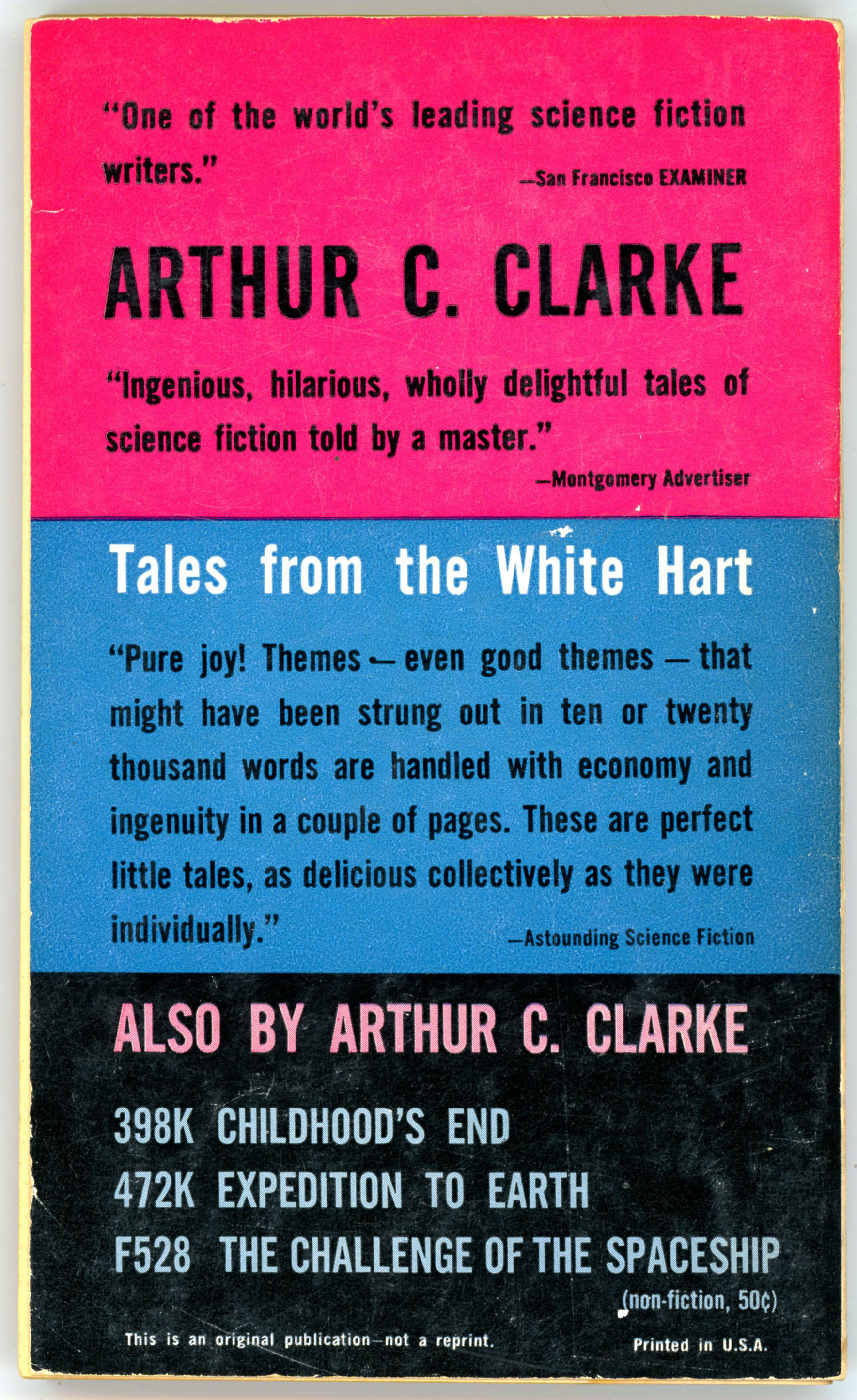
A rather serviceable back cover.  Well, it does the job of telling about the book, while promoting some of Clarke’s other works.
Other things to pleasantly distract you…

Tales From the White Hart, at Internet Speculative Fiction Database

Big Game Hunt (short story by Arthur C. Clarke), at Wikipedia

Patent Pending (short story by Arthur C. Clarke), at Wikipedia

Armaments Race (short story by Arthur C. Clarke), at Wikipedia


Glide Path, by Arthur C. Clarke – 1963 (1965) [Harry Schaare] [Revised post]

“It is strange how the mind can leapfrog across the years,
selecting from a million, million memories for one that is even faintly relevant,
 while rejecting all the others.”

C Charlies was like a fly crawling over this darkened clock face. 
It had been aimed at the narrow illuminated section,
but might already have missed it,
to remain lost in the blackness that covered almost all the dial.

So this, Alan told himself without really believing it,
was probably the most dangerous moment of his life. 
Introspection was not normally one of his vices;
he could worry with the best,
but did not waste time watching himself worrying. 
Yet now, as he roared across the night sky toward an unknown destiny,
he found himself facing that bleak and ultimate question which so few men can answer to their satisfaction. 
What have I done with my life, he asked himself,
that the world will be the poorer if I leave it now?

He had no sooner framed the thought than he rejected it as unfair. 
At twenty-three, no-one could be expected to have made a mark on the world,
or even to have decided what sort of mark he wished to make. 
Very well, the question could be reframed in more specific terms:
How many people will be really sorry if I’m killed now?

There was no evading this. 
It struck too close to home,
brought back too vivid a memory of the tearless gathering around his father’s grave.

______________________________

It is strange how the mind can leapfrog across the years,
selecting from a million,
million memories for one that is even faintly relevant,
 while rejecting all the others. 

10 Story Fantasy – Spring, 1951 (Featuring “The Sentinel,” by Arthur C. Clarke) [Unknown Artist]

Avon Publishing’s 10 Story Fantasy appeared in Spring of 1951 and survived only through – and as – its first edition.

Ironically – well, the world of wiring is characterized by irony – that single issue included a story, the theme of which would become – over a decade later – a plot element of one of the most significant motion pictures ever made: Stanley Kubrick’s 2001: A Space Odyssey, being incorporated in parallel into Clarke’s novel of the same name.

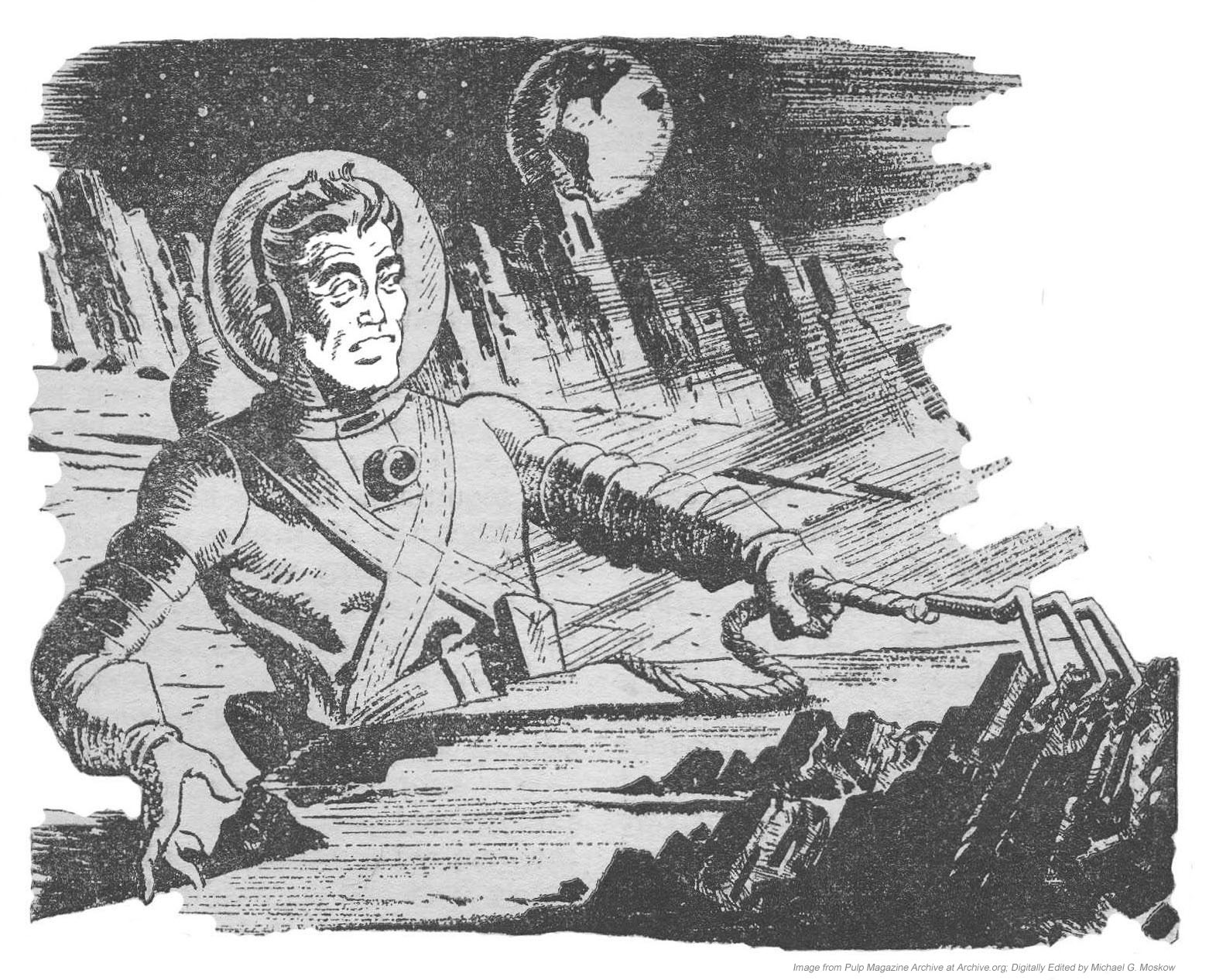
In 10 Story Fantasy, Clarke’s tale is accompanied by an uncredited illustration showing the un-named protagonist as he discovers an alien artifact on the moon’s surface, within the lunar mare Mare Crisium (the “Sea of Crises”), the location of which was changed to Tycho Crater in Clarke’s novel and Kubrick’s film.

That illustration appears below, accompanied with art by Kierale and (possibly) Hannes Bok, for “Friend to Man” and The “Woodworker”, respectively.  All three are adapted and modified from 10 Story Fantasy at Archive.org, contributed by Gerard Arthus.  Unfortunately, the cover artist is unknown, though there is something Earle Bergey-ish going on here!

______________________________

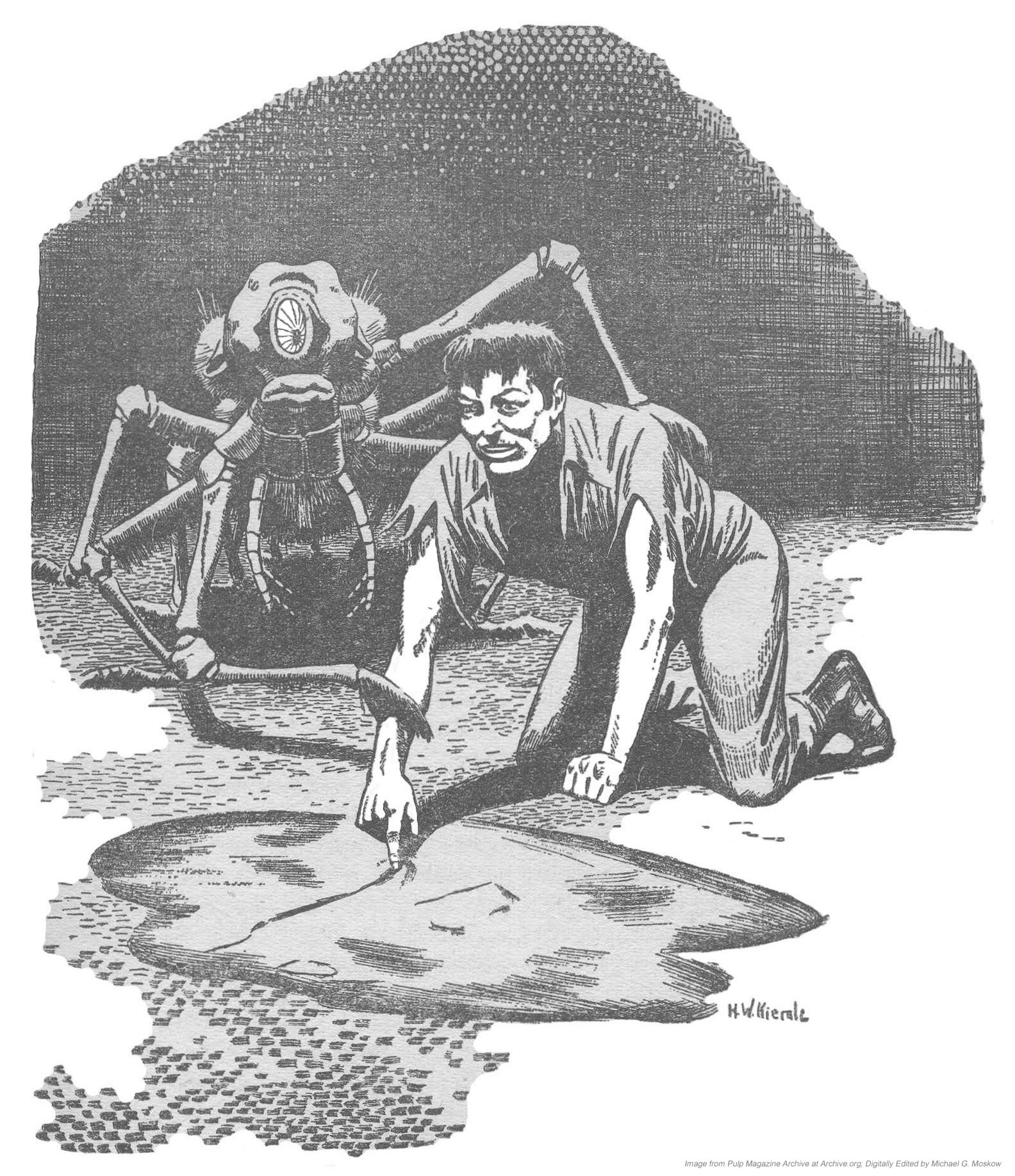
Illustration by H.W. Kierale, for “Friend To Man”, by Cyril M. Kornbluth, p. 27.

A superb writer, thematically and stylistically very distinctive, Kornbluth’s “Friend to Man” has characteristics that, while ostensibly in opposition, are vividly manifested in his work:  An atmosphere of cynicism, ultimately alleviated by the inevitability of cosmic justice.  These qualities are best exemplified in “The Mindworm,” “Two Dooms,” “The Marching Morons,” ‘The Little Black Bag,” and “The Only Thing We Learn”. 

______________________________

Illustration by unknown artist, for “The Sentinel”, by Arthur C. Clarke, p. 41.

______________________________

Illustration – possibly by Hannes Bok (Wayne F. Woodward) – for “The Woodworker”, by Gene A. Davidson, p. 99.

 ______________________________

 ______________________________

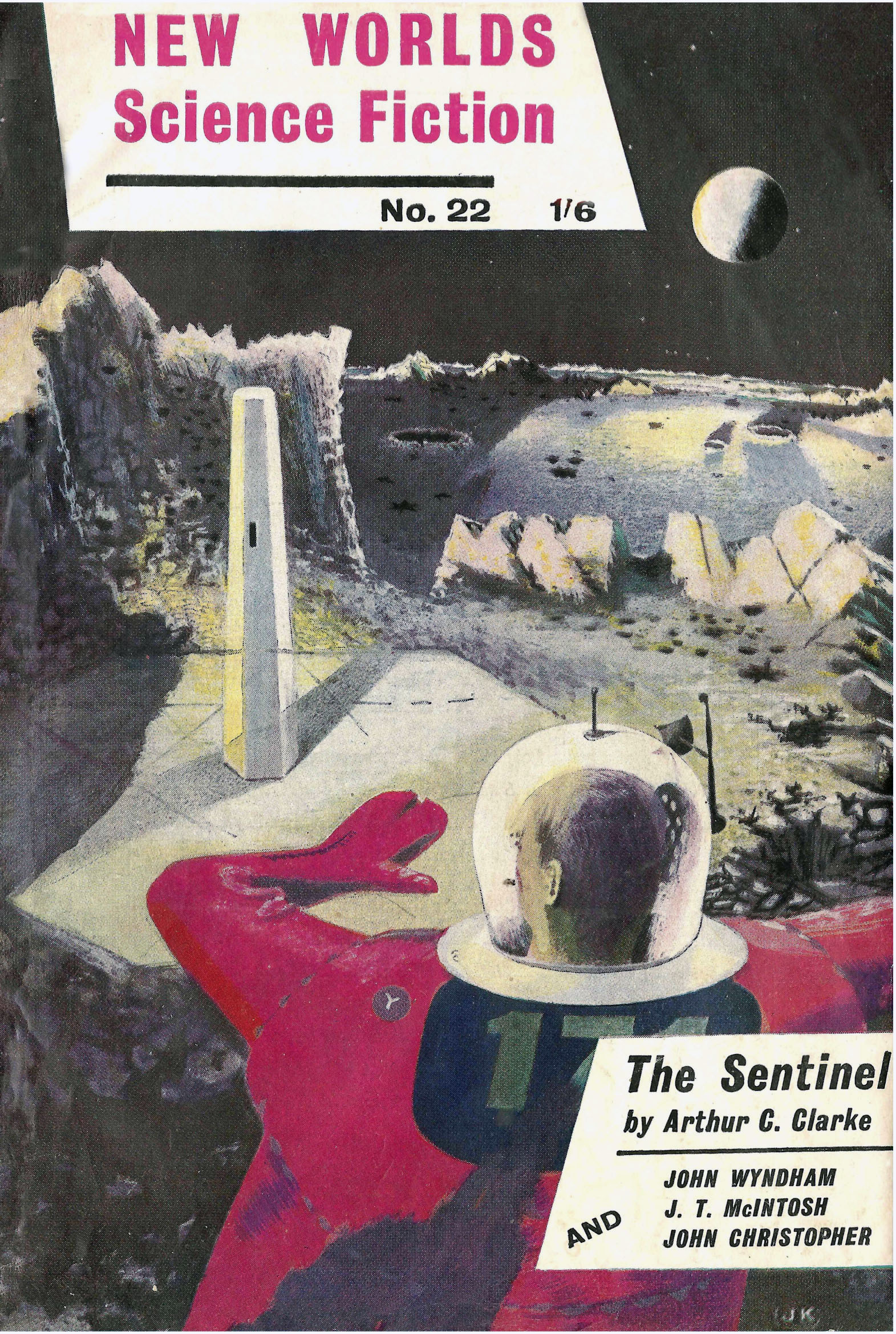
“Sentinel of Eternity” was published three years later, in the April 1954 issue of New Worlds (cover by J. Kinnear), under the title “The Sentinel”.  The story appears on pages 47 through 55 (well, it is a short story, after all!), and lacks any illustrations.  Curiously, in the same way that Cyril Kornbluth’s “Friend to Man” accompanied Clarke’s tale in 10 Story Fantasy, so New Worlds featured another Kornbluth story: “Takeoff”, serialized in three parts.  The image below is from the Luminist Archives.

References

Ash, Brian, The Visual Encyclopedia of Science Fiction, Harmony Books, New York, N.Y., 1977

Szczesuil, Timothy P. (editor), His Share of Glory: The Complete Short Science Fiction of C.M. Kornbluth, The NESFA Press, Framingham, Ma., 1997

“The Sentinel” (description of story, and relationship to film 2001: A Space Odyssey), at Wikipedia

“The Sentinel” (Radio Program, at JR Todd YouTube Channel)

The Exploration of Space, by Arthur C. Clarke – 1954 [Bob Smallman]

the-exploration-of-space-arthur-c-clarke-1954-1It seems unlikely that any culture can advance more than a few centuries at a time,
on a technological front alone. 
Morals and ethics must not lag behind science,
otherwise (as our own recent history has shown)
the social system will breed poisons which will cause its certain destruction.

With superhuman knowledge there must go
equally great compassion and tolerance. 
When we meet our peers among the stars,
we need have nothing to fear save our own shortcomings.


the-exploration-of-space-arthur-c-clarke-1954-2