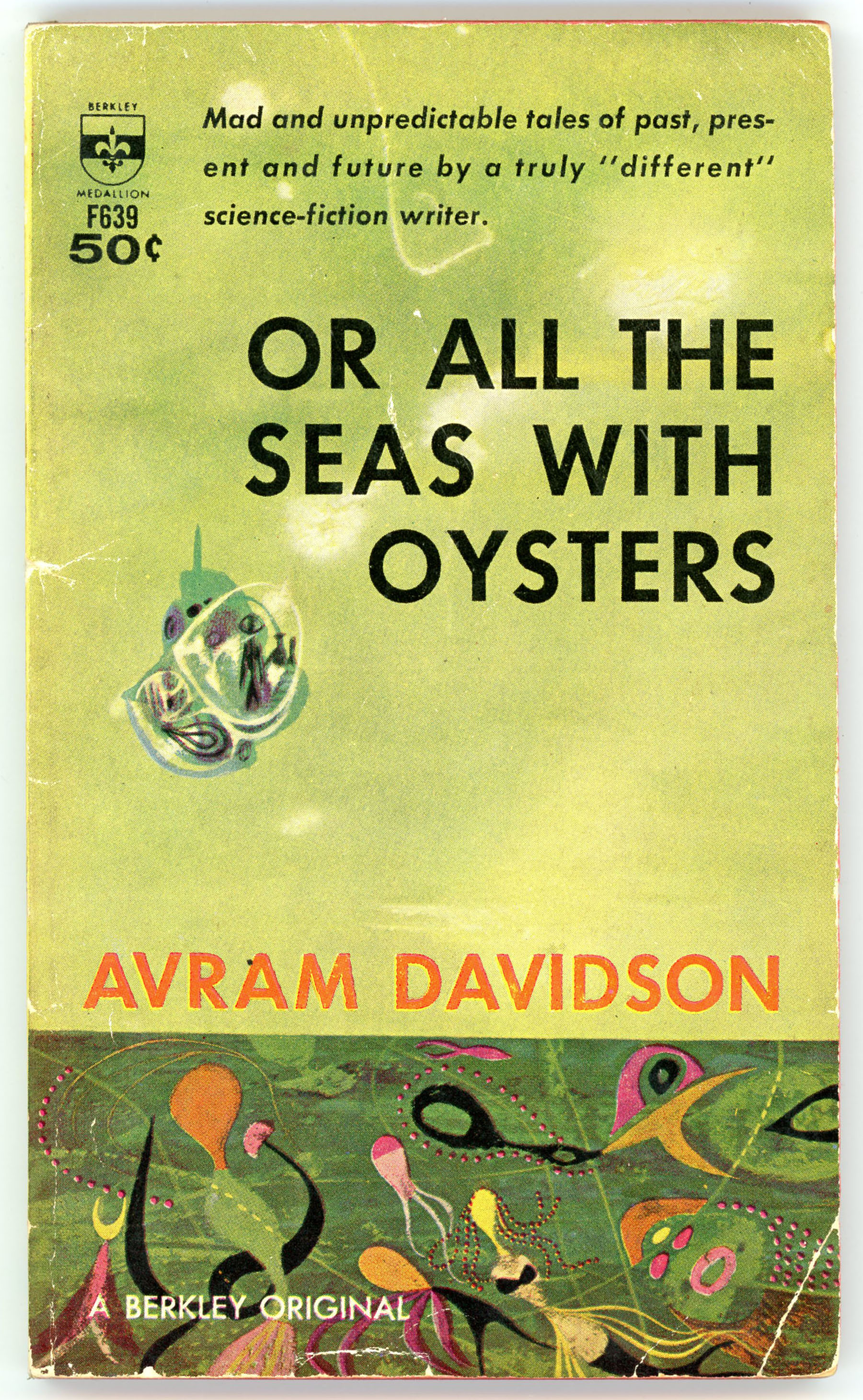
Or All The Seas With Oysters, by Avram Davidson – 1962 [Richard M. Powers]

Another intriguing cover by Richard Powers. 

Rather than creating an image with a single, central image, most of the cover is given over to blank space, upon which the title and author’s name are superimposed.  Only at the “bottom” of the cover (this is a nautically inspired title, after all!) appears a painting of various forms of sea-life, including a kind of mermaid, and a large-headed jellyfish.

And, floating above, a stylized, transparent submarine. 
______________________________

Not a yellow, but a green submarine. 

______________________________

The rear covers bears a photograph of Avram Davidson, by Emsh (Edward Emshwiller).

Contents

Or All the Seas With Oysters, Galaxy Science Fiction, May, 1958

Now Let Us Sleep, Venture Science Fiction, September, 1957

The Grantha Sighting, The Magazine of Fantasy and Science Fiction, April, 1958

Help! I am Dr. Morris Goldpepper, Galaxy Science Fiction, July, 1957

The Sixth Season, The Magazine of Fantasy and Science Fiction, June, 1960

Negra Sum, The Magazine of Fantasy and Science Fiction, November, 1957

My Boy Friend’s Name is Jello, The Magazine of Fantasy and Science Fiction, July, 1954

The Golem, The Magazine of Fantasy and Science Fiction, March, 1955

Summerland, The Magazine of Fantasy and Science Fiction, July, 1957

King’s Evil, The Magazine of Fantasy and Science Fiction, October, 1956

Great Is Diana, The Magazine of Fantasy and Science Fiction, August, 1958

I Do Not Hear You, Sir, The Magazine of Fantasy and Science Fiction, February, 1958

Author, Author, The Magazine of Fantasy and Science Fiction, July, 1959

Dagon, The Magazine of Fantasy and Science Fiction, October, 1959

The Montavarde Camera, The Magazine of Fantasy and Science Fiction, May, 1959

The Woman Who Thought She Could Read, The Magazine of Fantasy and Science Fiction, January, 1959


Tiger by The Tail and Other Science Fiction Stories, by Alan E. Nourse – 1964 [Richard M. Powers]

Richard Powers’ cover of the McFadden Press 1964 edition of Alan Nourse’s Tiger By the Tail typifies Powers’ unique, immediately identifiable, and highly creative approach to science fiction illustration. 

Though eminently capable of creative technically realistic (albeit imaginary!) depictions of space vehicles, as well as the human form and facial expressions, Powers instead presents viewers with a mixture of symbolic visual elements, fragments of landscapes, and  stylized color patterns, only one element of which is actually related to the book’s title:  Orange and black tiger stripes at the lower left, held by tiger-striped, vaguely humanoid and not-really-even-human figure on the right. 

For this edition of Tiger By the Tail, that’s all you’ll see of the “tiger”!  (If you read the original story, you’ll understand the symbolism of Powers’ art…) 

The other really science-fictiony elements on the cover are the silhouette of a figure at the lower right, and, a weirdly oval, semi-transparent spacecraft rising from a crater, in the center. 

Whether or not these elements “fit” the anthology’s stories is not really relevant. 

They set and fit a literary mood, and generate a sense of curiosity…

Contents

Tiger By The Tail, from Galaxy Science Fiction, November, 1951

Nightmare Brother, from Astounding Science Fiction, February, 1953

PRoblem, from Galaxy Science Fiction, October, 1956

The Coffin Cure, from Galaxy Science Fiction, April, 1957

Brightside Crossing, from Galaxy Science Fiction, January, 1956

The Native Soil, from Fantastic Universe, July, 1957

Love Thy Vimp, from The Magazine of Fantasy and Science Fiction, April, 1952

Letter of The Law, from If, January, 1954

Family Resemblance, from Astounding Science Fiction, April, 1953

Rogue Moon, by Algis Budrys – November, 1960 [Richard M. Powers]

“How do you want me to talk about it?”
Hawks answered rapidly. 
A vein bulged down the center of his forehead. 
“Do you want me to talk about what we’re here to do,
or do you want me to say something else? 
Are you going to argue morality with me? 
Are you going to say that,
duplicate man or no duplicate man,
a man dies on the Moon and makes me no less a murderer? 
Do you want to take me to court and from there to a gas chamber? 
Do you want to look in the law books
and see what penalties apply to the repeated crime of systematically driving men insane? 
Will that help us here? 
Will it smooth the way?

“Go to the Moon, Barker.
Die.
And if you do, in fact, find that you love Death as feverishly as you’ve courted her,
then, just perhaps,
you’ll be the first man to come back in condition to claim revenge on me!”
He clutched the edge of the opened chest plate and slammed it shut.
He held himself up with the flats of his palms on it
and leaned down and his face was directly over Barker’s faceplate opening.
“But before you do,
you’ll tell me how I can usefully do it to you again.”

– Algis Budrys –

______________________________

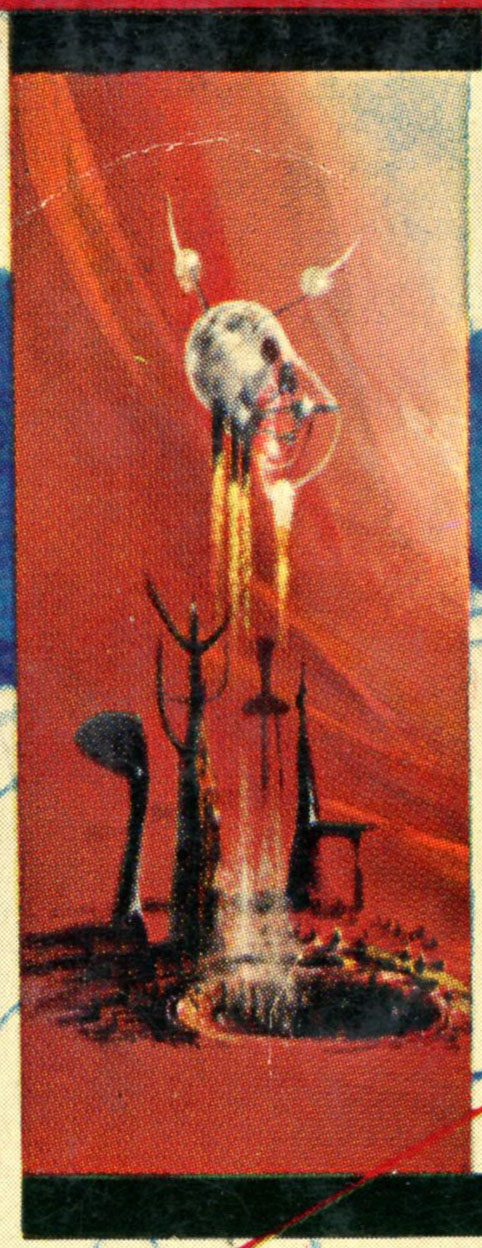
Cover detail: Richard Powers did a remarkable job of capturing the essence of the novel’s plot within a single painting.

______________________________

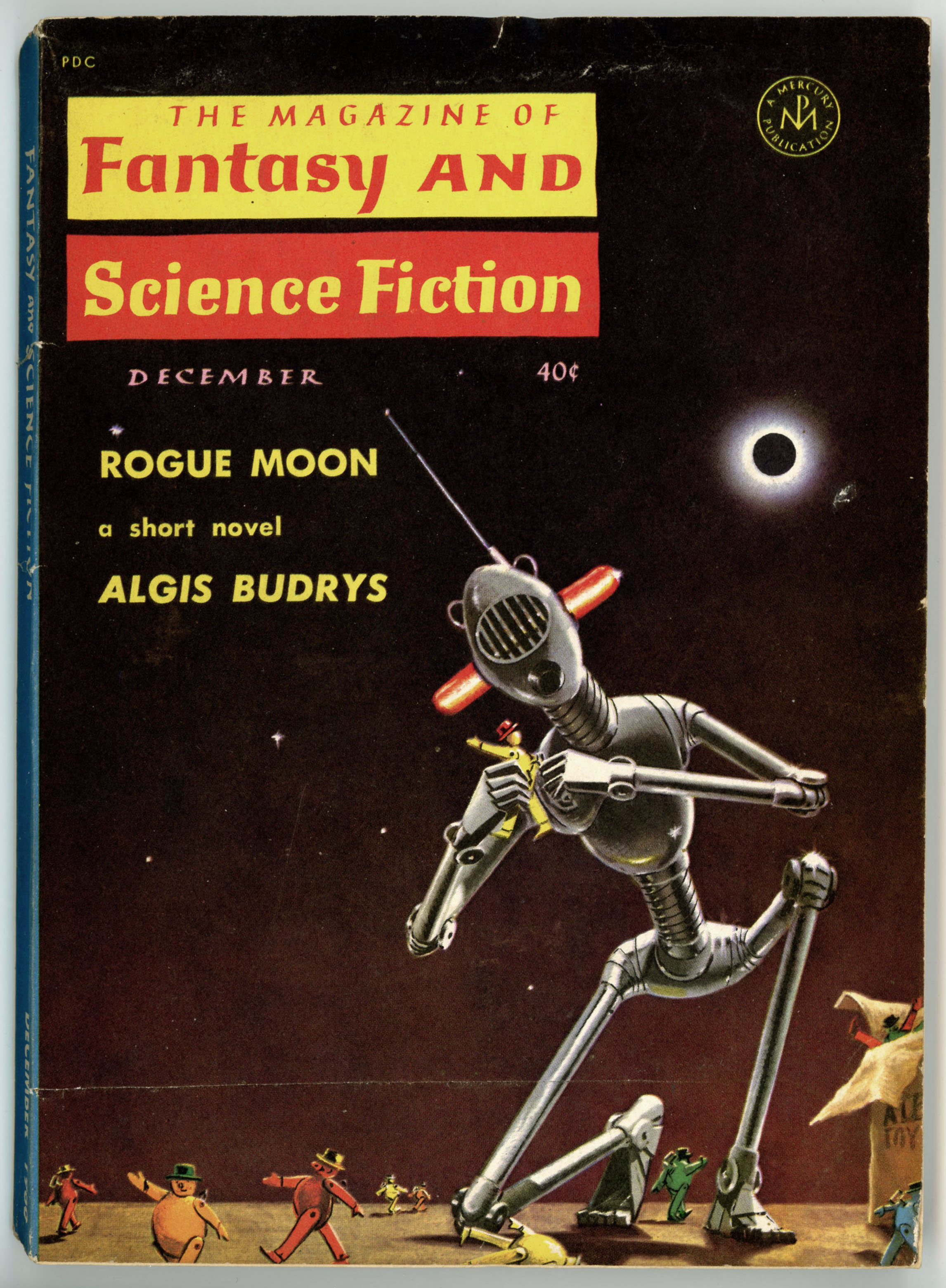
Here’s the another venue of Rogue Moon: The December, 1960, issue of The Magazine of Fantasy and Science Fiction.  Mel Hunter’s whimsical robot, here seen amusing himself (itself?) with wind-up dolls of people-in-pajamas, appeared on a number of TMFSF covers.  

Star Science Fiction Stories No. 1, Edited by Frederik Pohl – 1953 (1961) [Richard M. Powers] [Revised post]

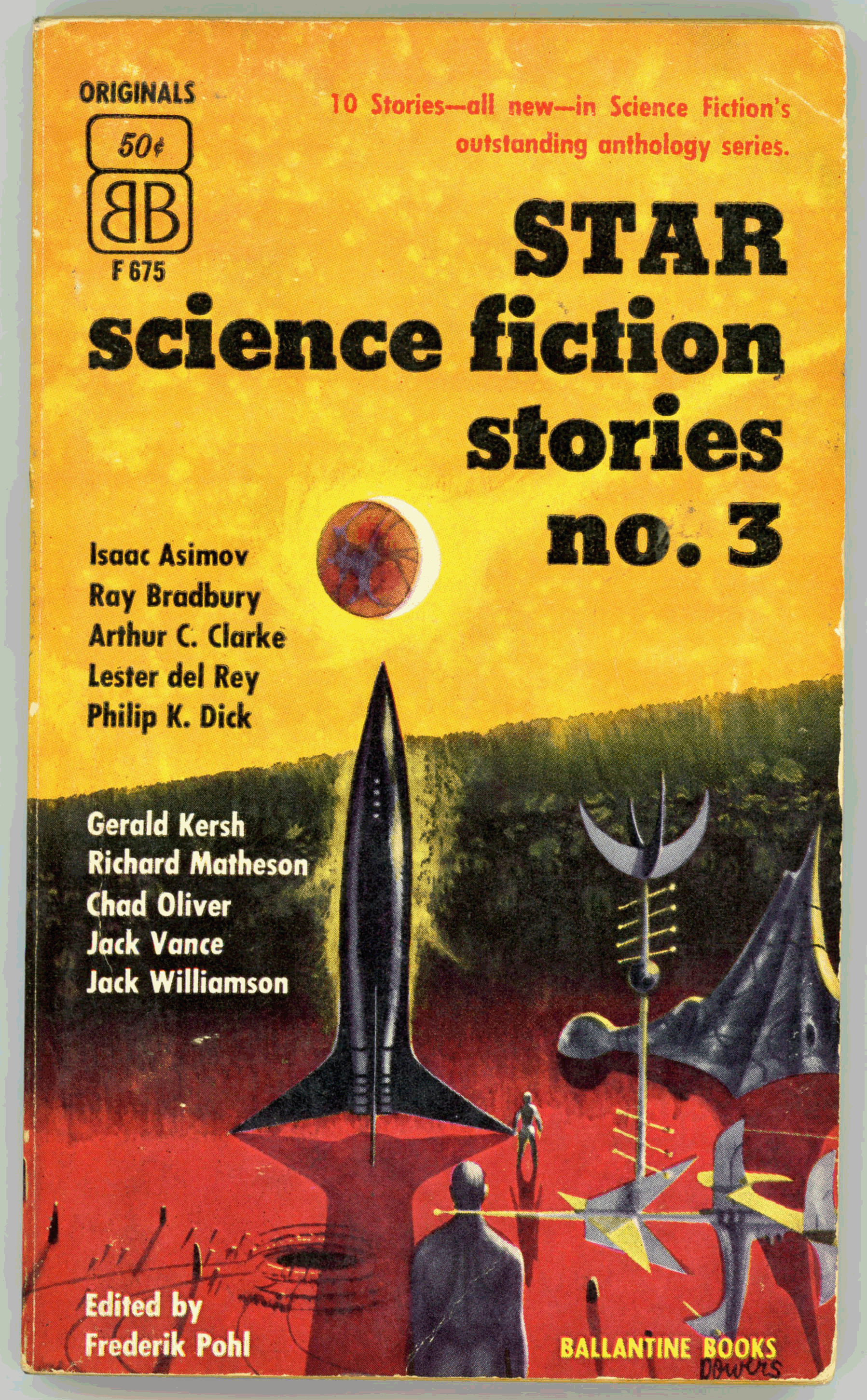
I first posted these cover images in June of 2017.  After “re-visiting” this post, I wanted to display more of the detail in Powers’ art.  So, the two close-ups, below… 

______________________________

A space explorer.  Though Powers incorporates a measure of attention to the astronaut’s suit (note the very fine detail in the antenna, and the orange gripping claw extending from the figure’s left hand), he places more emphasis on shapes, curves, and contrasting colors.  The greenish yellow-hue of the suit is particularly effective against the reddish-purple sky. 

Contents

Country Doctor, by William Morrison

Dominoes, by Cyril M. Kornbluth

Idealist, by Lester del Rey

The Night He Cried, by Fritz Leiber

Contraption, by Clifford D. Simak

The Chronoclasm, by John Wyndham

The Deserter, by William Tenn

The Man With English, by Horace L. Gold

So Proudly We Hail, by Judith Merril

A Scent of Sarsaparilla, by Ray Bradbury

“Nobody Here But”, by Isaac Asimov

The Last Weapon, by Robert Sheckley

A Wild Surmise, by Henry Kuttner and Catherine L. Moore

The Journey, by Murray Leinster

The Nine Billion Names of God, by Arthur C. Clarke

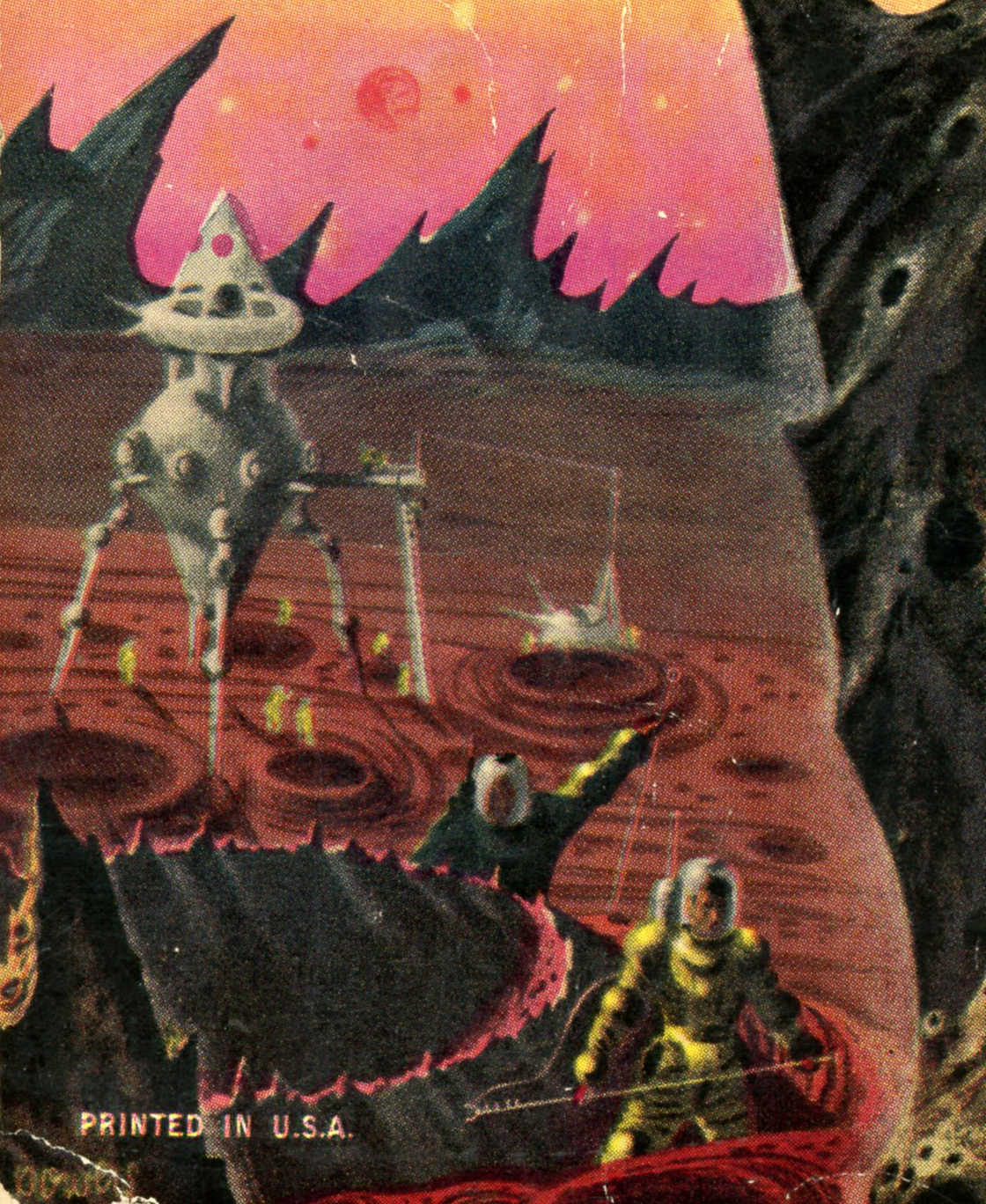
A closer look at the back cover.  A spider-like spacecraft (again, Powers’ emphasis on curved, semi-organic shapes) rests on a crater-pocked surface in shades of red, carmine, and brown, while a group of explorers climb a nearby hillside.  Perhaps they’re joining their friend, on the front cover?

Notice that the sky is finished in tones of purple, through, pink, through orange, unlike the image appearing above.  That’s because this image is actually from the 1953 (first edition) of Volume 1 of Star Science Fiction, while on the rear cover of the 1961 reprint (both of the cover images in this post) the sky is white.

Star Science Fiction Stories No. 4, Edited by Frederik Pohl – 1958 [Richard M. Powers] [Revised Post]

Though Powers’ cover primarily appears in muted shades of gray and brown, a close-up – below – reveals a level of complexity and mystery not readily apparent upon a cursory glance: Two enigmatic figures signal one another across a barren landscape, while a bird-like tower stands in the distance, and a ragged sphere – a planet? – a moon? – rises above the horizon, on the left. 

Above all, the scene imparts an absence of visual and thematic certainty, typical of Powers’ work.

Contents

A Cross of Centuries, by Henry Kuttner

The Advent on Channel Twelve, by Cyril M. Kornbluth

Space-Time for Springers, by Fritz Leiber

Man Working, by Richard Wilson

Helping Hand, by Lester del Rey

The Long Echo, by Miriam Allen deFord

Tomorrow’s Gift, by Edmund Cooper

Idiot Stick, by Damon Knight

The Immortals, by James Gunn

Beyond Fantasy Fiction – July, 1953 [Richard M. Powers] [Revised Post]

(This post has been updated to include closer views of Richard Powers’ cover art.  Scroll to bottom to see more…)

______________________________

____________________

The first issue of Horace Gold’s Beyond Fantasy Fiction featured cover art created by the extraordinarily imaginative Richard Powers.  Typical of much of Powers’ oeuvre, the finished painting features a variety of seemingly organic elements in combination with curved, streamlined, ostensibly mechanical shapes  Akin to many of Powers’ works, any recognizably “human” form is deliberately minimized. 

For another example of Powers’ work, see this post

______________________________

At lower left, a woman with streaming hair flees (?) “stage left”.

______________________________

In the center, an upraised human hand, set against a brilliant yellow sky and partially obscured by clouds, is visible through an archway.  There’s something vaguely Salvador Dali-esque about this scene…

______________________________

…while this panel epitomizes a common element in Powers’ work: A randomly-curved, asymmetrical, seemingly organic “shape”, is covered by a metallic carapace.  A bluish-green sphere – a planet?; a symbol of Mars? – levitates nearby, while a “rope” draped upon both objects – the way in, or the way out? – leads through a raftered ceiling to an orange sky.

Star Science Fiction Stories No. 3, Edited by Frederik Pohl – 1954 (1962) [Richard M. Powers]

It’s Such A Beautiful Day, by Isaac Asimov

The Strawberry Window, by Ray Bradbury

The Deep Range, by Arthur C. Clarke

Alien, by Lester del Rey

Foster, You’re Dead, by Philip K. Dick

Whatever Happened to Corporal; Cuckoo?, by Gerald Kersh

Dance of the Dead, by Richard Matheson

Any More At Home Like You?, by Chad Oliver

The Devil on Salvation Bluff, by Jack Vance

Guinevere for Everybody, by Jack Williamson

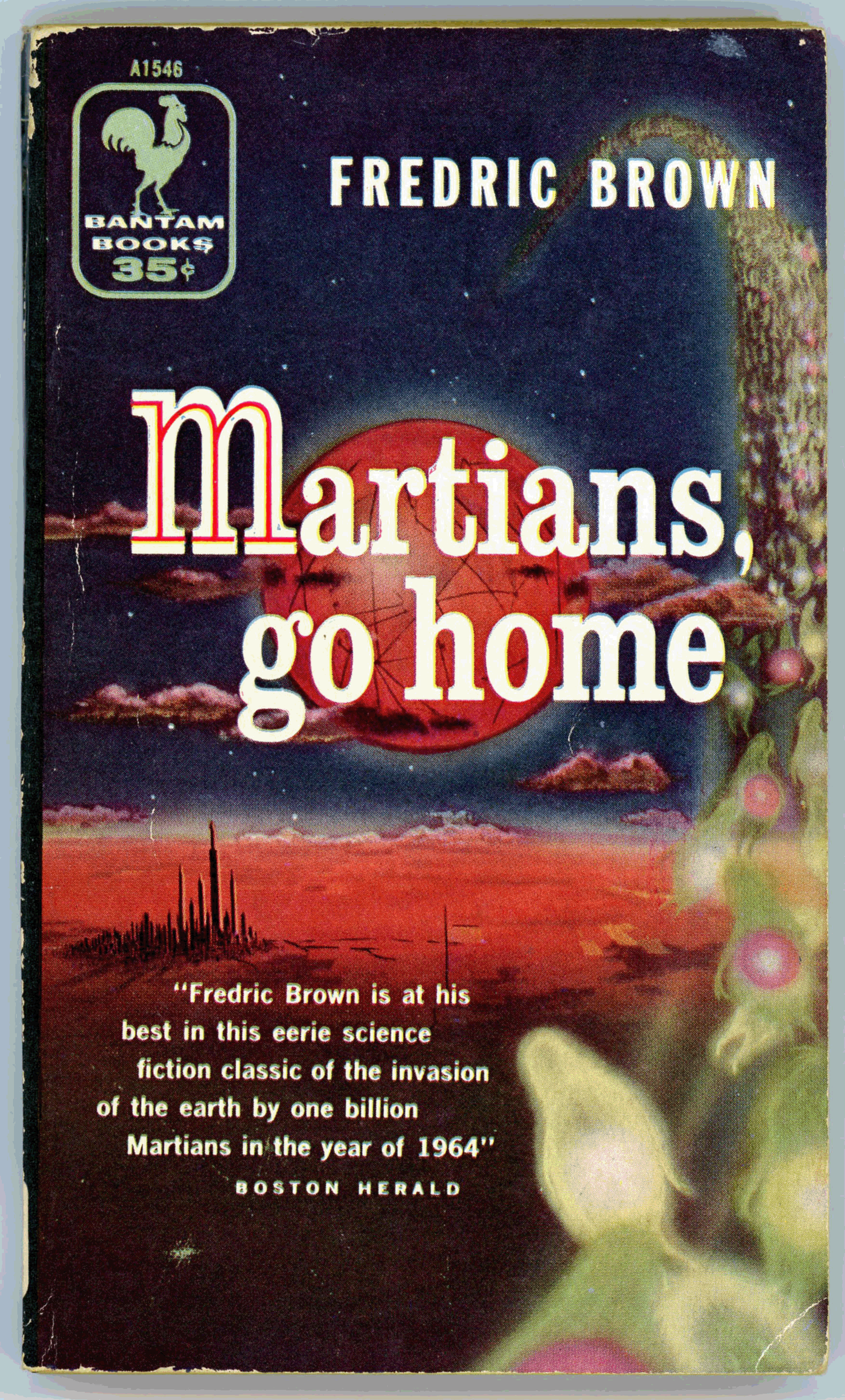
Martians, Go Home, by Fredric Brown – 1955 [Richard M. Powers]

______________________________

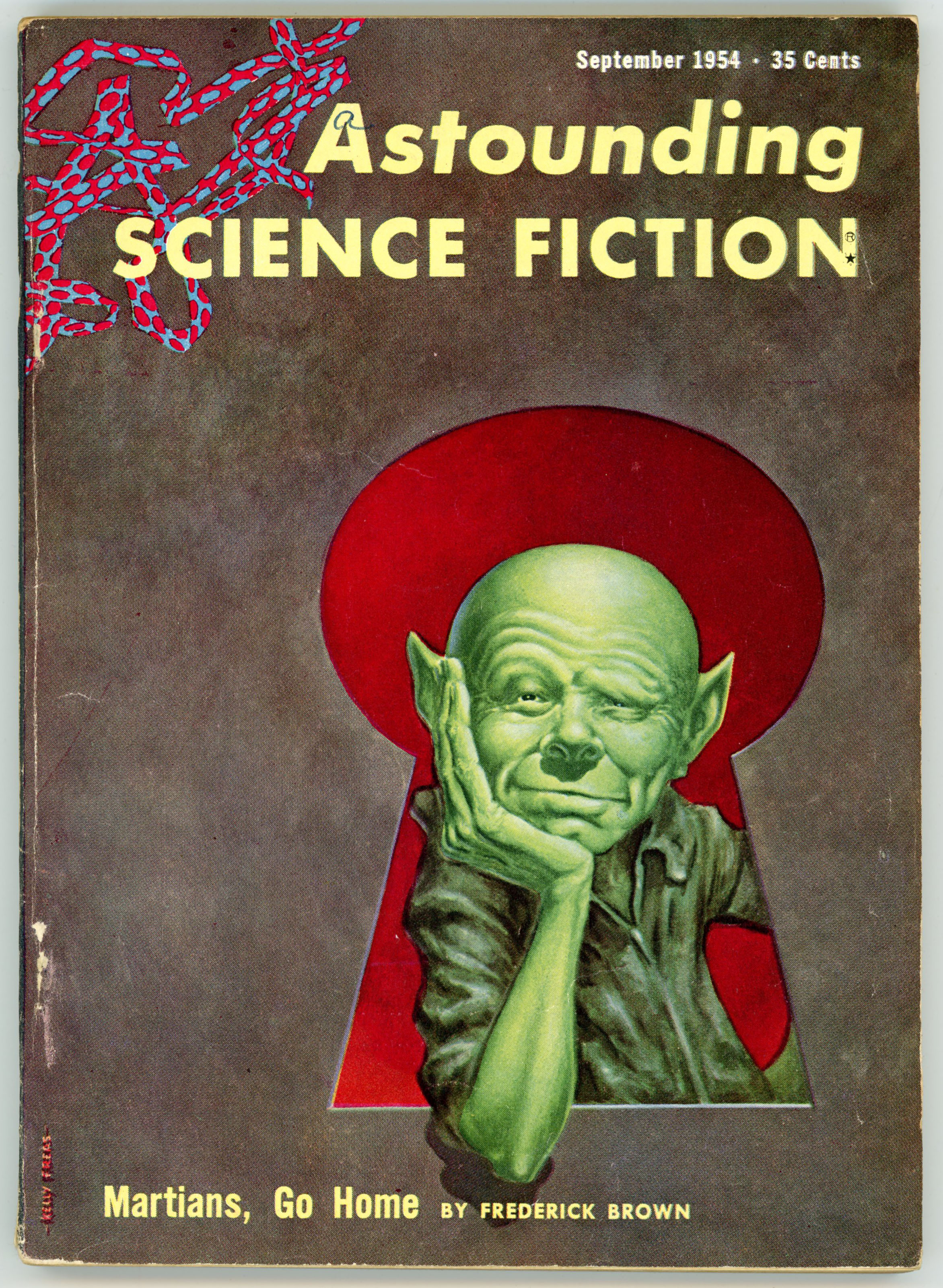
Fredric Brown’s novel – note that his name is presented as “Frederick” – originally appeared as a single installment within the September, 1954 issue of Astounding Science Fiction

The cover of this particular issue of Astounding is representative of the magazine’s cover design for the latter part of the 1950s: The majority of issues published from February, 1954 through November, 1959 featured – always in the upper left corner – a diagram, abstract representation, or symbol of an aspect of the physical sciences (biology, chemistry, physics, and engineering / technology) with a brief explanatory “blurb” within the magazine’s table of contents. 

So, for September of 1954, we have:  “Optical confusion: The eye cannot simultaneously focus on pure red and pure blue.”

Well, I don’t know if it’s really that confusing.  At least, it wouldn’t be for a Martian peering through the oversized keyhole!

My personal favorite is from December of 1957, and needs little explanation…

His Share of Glory – The Complete Short Science Fiction of C. M. Kornbluth, Edited by Timothy P. Szczesuil – 1997 [Richard M. Powers] (Revised post with added detail)

______________________________

Detail from cover

______________________________

Detail from cover

______________________________

Cyril M. Kornbluth, 1939 (Photo by Robert A. Madle)

13 Great Stories of Science-Fiction, edited by Groff Conklin – 1960 [Richard M. Powers]

Contents

The War Is Over, by Algis Burdys, from Astounding Science Fiction, February, 1957

The Light, by Poul Anderson, from Galaxy Science Fiction, March, 1957

Compassion Circuit, by John Wyndham, from Fantastic Universe, December, 1954

Volpla, by Wyman Guin, from Galaxy Science Fiction, May, 1956

Silence, Please!, by Arthur C. Clarke, from Science Fantasy Magazine, Winter, 1950

Allegory, by William T. Powers, from Astounding Science Fiction, April, 1953

Soap Opera, by Alan Nelson, from The Magazine of Fantasy and Science Fiction, April, 1953

Shipping Clerk, by William Morrison, from Galaxy Science Fiction, June, 1952

Technological Retreat, by G.C. Edmondson, from The Magazine of Fantasy and Science Fiction, May, 1956

The Analogues, by Damon Knight, from Astounding Science Fiction, January, 1952

The Available Data on The Worp Reaction, by Lion Miller, from The Magazine of Fantasy and Science Fiction, September, 1953

The Skills of Xanadu, by Theodore Sturgeon, from Galaxy Science Fiction, July, 1958

The Machine, by Richard Gehman, from Collier’s, December, 14, 1946