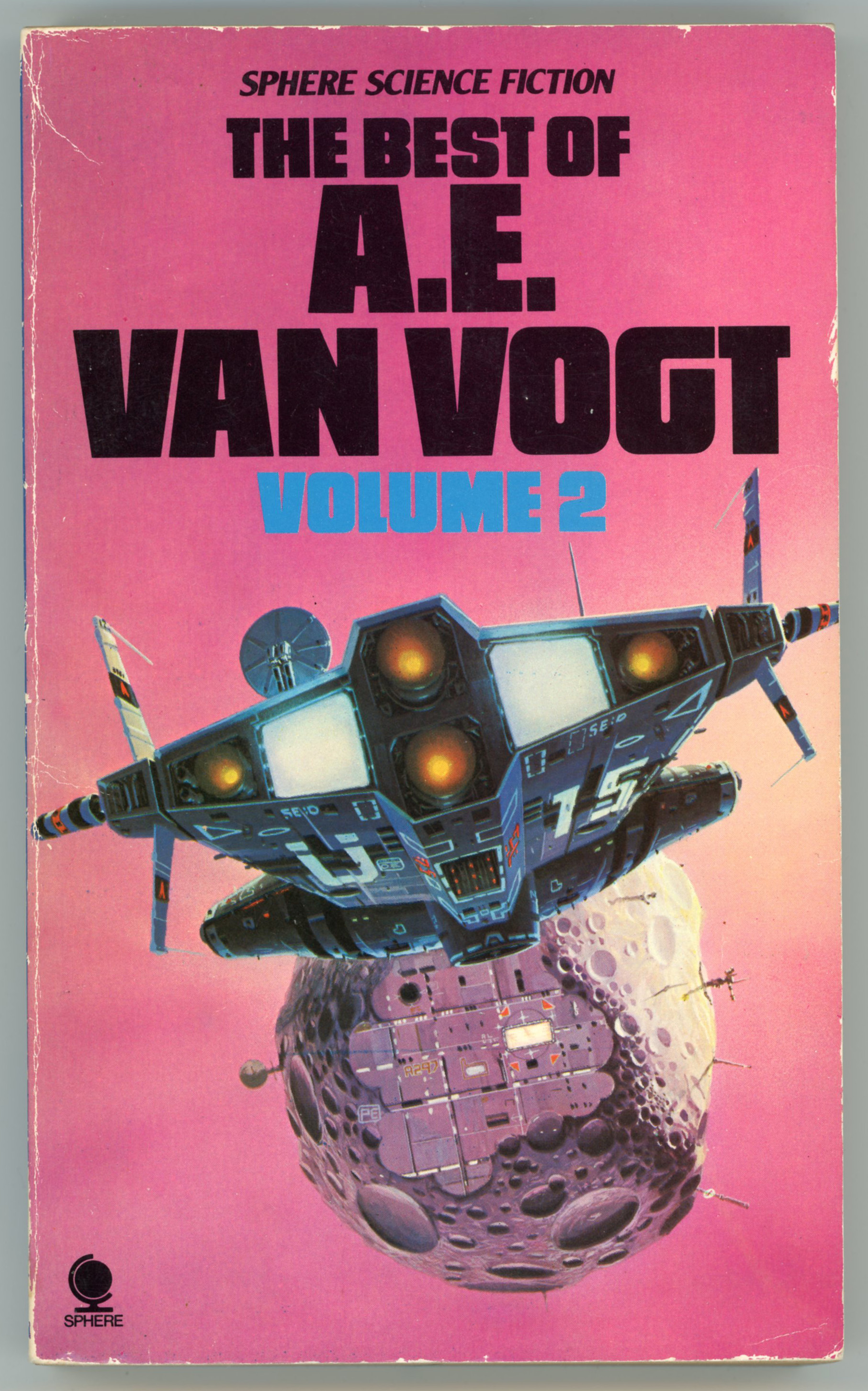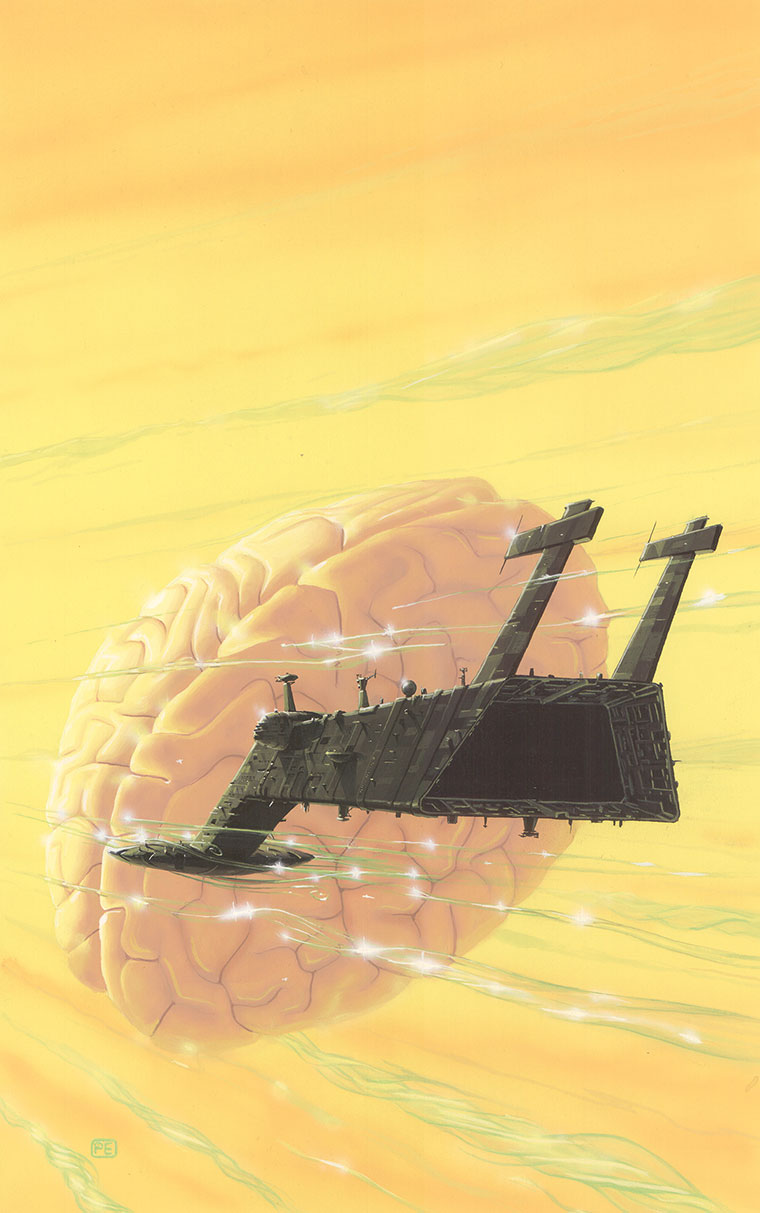
Richard Powers’ three covers for Ballantine Books’ late 1950s editions of Arthur C. Clarke’s novel Childhood’s End, and his two anthologies Expedition to Earth, and Reach for Tomorrow, have a level of originality and entrancing mystery that are unusual even by the standards of that artist’s unique body of work. You can view the cover of the 1956 edition, here. However, when Ballantine republished this trio of books a decade and a half later, their cover art was of a strikingly different, more conventional style. Rather than update versions of Powers’ original art, or use the skills of newly established artists such as Jack Gaughan, Paul Lehr, or John Schoenherr, the covers of all three editions revealed work by a (still) anonymous illustrator. The cover art for each book is more mainstream and representationally “spacey”, differing in format from most science-fiction cover art – then and now – in that it covers only a portion of the book’s “real estate”, the remainder of the cover being left unadorned, blank, and still. (Okay; the title, price, and publisher’s name still show!)
For anybody in the early 70s; for anyone yet today in 2023 … the inspiration for each painting is easily recognizable: Each composition was inspired by a different aspect of the spacecraft appearing in Stanley Kubrick’s 2001: A Space Odyssey. For Expedition to Earth and Reach for Tomorrow, the cover art is inspired by the Jovian expedition ship Discovery One; for Childhood’s End, by the Aries 1b lunar lander.
You can see this below, on the cover of the 1970 edition of Reach for Tomorrow.
The elongated nature of the spacecraft’s design is clearly inspired by the general (admittedly, very general) configuration of the Discovery One, the major difference being that the latter has one only spherical module – the front, control and habitation module, the rear of the craft being allocated for propulsion, communication, and storage. The ship on the cover of this edition instead features two spherical sections – one at each end – connected by two trusses and a connecting tube; there’s no visible means of propulsion. This resemblance comes through at The HAL Project’s Discovery One | 2001: A Space Odyssey Ambience 4K. (Unfortunately, this video can’t be shared in WordPress, so I have to give the link.) However, the clincher revealing the cinematic inspiration for the cover is the combined communications and telemetry antenna unit on the rear module, which is a dead ringer for the unit (that was instrumental to the plot!) of Kubrick’s film. Also, if you look really, really close – to the lower right of the foreground module – you’ll see a tiny, oval craft that’s emerged from a hatch in the bottom of the module. The little ship looks just like a space pod from the movie.
How odd; the Internet Speculative Fiction Database entry for these three early 1970s Ballantine editions indicates (correctly) that the cover art for each is uncredited and unsigned.
What gives? Did Ballantine secure the rights to the paintings? Were the originals saved? Were they discarded?
Pondering, just an idea: The paintings look like (seems to me) the work of Vincent Di Fate.
(Just a possibility)

Here’s Lawrence D. Miller’s 1984 diagram of the components of Discovery One….

At Spacedock’s YouTube channel, the video “2001 A Space Odyssey: Discovery One | Extended Ship Breakdown (May 27, 2011)” shows the spacecraft’s major components, in the context of both that film, and the later 2010: The Year We Make Contact.
And What’s In the Book?
Rescue Party, Astounding Science Fiction, May, 1946
A Walk in the Dark, Thrilling Wonder Stories, August, 1950
The Forgotten Enemy, Avon Science Fiction and Fantasy Reader, January, 1953
Technical Error (“The Reversed Man”), from Thrilling Wonder Stories, June, 1950
The Parasite, from Avon Science Fiction and Fantasy Reader, April, 1953
The Fires Within, from Startling Stories, September, 1949
The Awakening, from Future Science Fiction Stories, January, 1952
Trouble With the Natives, from Marvel Science Stories, May, 1951
The Curse, from Cosmos Science Fiction and Fantasy Magazine, September, 1953
Time’s Arrow, from Science Fantasy, Summer, 1950
Jupiter Five, from If, May, 1953
The Possessed, Dynamite Science Fiction, March, 1953
Some References…
Reach for Tomorrow, at…
… Internet Speculative Fiction Database
Discovery One, at…
… Space Stack Exchange (“Is 2001: A Space Odyssey’s Discovery One still a plausible design for interplanetary travel?”)
… Model Paint Solutions (“Moebius 1/350 XD-1 “Discovery One” from 2001: A Space Odyssey”)
Vincent Di Fate, at…
… Internet Speculative Fiction Database