Astounding Science Fiction, November, 1949 (Featuring “…And Now You Don’t” by Isaac Asimov) [Hubert Rogers]

There are many ways to show the unknown.

Some science fiction illustrations stand out in their depiction of action; some through portrayal of the landscapes of alien worlds; some by imagining technology of the future (or the past, as the case may be); some by presenting aliens in a myriad of variations; some, in capturing the appearance of a tale’s protagonists – male and female; young and old – in the context of adventure, danger, discovery, fear, failure, and (one would hope) triumph

But, science fiction art (and not just the art of science fiction) need not be “literal” in terms of adhering to a story’s original text to have an impact.  Likewise, an illustration that’s largely symbolic and heavily stylized can be more visually arresting than an image literal.  In this regard, the work of Richard Powers immediately comes to mind.  (Well, there are lots of examples of his work at this blog!)

Though his body of work was, stylistically, vastly different from that of Powers, Hubert Rogers, who created many covers, and many, many (very many, come to think of it…) interior illustrations for Astounding Science Fiction from February of 1939 through May of 1952, created art that – while not purely imaginative and fanciful – was often striking in its use of story elements and plot elements as symbols.  (His interior art, far more so.)

His superb cover for the November, 1949 issue of Astounding being a case in point. 

Created for the second of the four installments by Isaac Asimov that, collectively, would eventually comprise and be published as Second Foundation, the cover “illustrates” part one (of three) for “And Now You Don’t”.

The cover doesn’t really depict any specific scene or event from the tale.  Instead, it shows and symbolizes the story’s characters. 

There’s the startled looking face of Arkady Darell in the lower right corner.  To her left, ill-defined in murky shades of green: the Mule.  While I’m not certain about the identity of the figure in red behind Arkady, I’m inclined to think that he’s Homer Munn: A librarian who is among a group of conspirators attempting to locate the Second Foundation, upon whose spaceship Arkady stows away during Munn’s efforts to find such information at the Mule’s palace.  

Well, those are the elements.  But the way that Rogers arranged them is really creative.  First, rather than a simple scene in space, there’s a plain, bold, bright, yellow background.  Against that, a bluish-gray, fog-like shadow extends across the scene, lending an air of concealment and murkiness.  And finally (well, Homer Munn is a librarian, after all) an array of alpha-numeric symbols extends across the scene through a pair of red arrows, which perhaps symbolize a 1949 version of an automated text reader.  Coincidentally, there’s something very “Turing machine reader”-ish in the appearance of this string of characters. 

Seemingly juxtaposed at random, together, everything really works.  The yellow, blue, red, and green “fit” together perfectly, and, and the figures and faces balance each other as well.

A superb job on Rogers’ part.  Well, some of his work is truly stunning, and, I think, as good as if not actually better than that some of his better known near-contemporaries, one of whom received vastly greater accolades.  Overall, the central, consistent, and most distinguishing quality of Roger’s work – especially his black and white interior illustrations – is its deeply mythic, rather than literal, air.

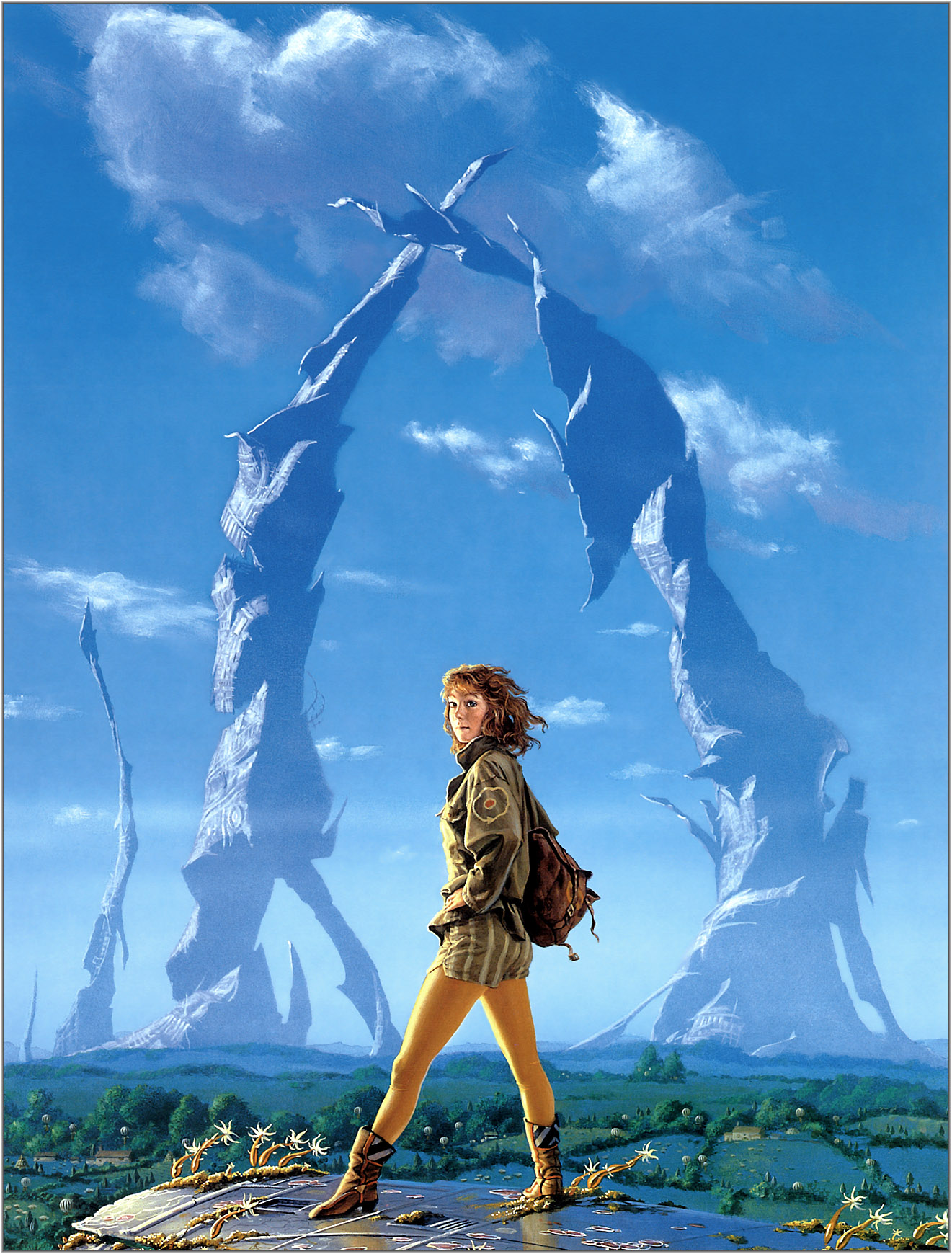
Oh, yes….  The issue’s cover (a nearly-hot-off-the-press-looking copy; the colors have held up beautifully across seven decades) appears below, followed by Michael Whelan’s 1986 beautifully done depiction of Arkady Darell on Trantor, which appeared as the cover of the 1986 edition of Second Foundation.

____________________

Arkady Darell amidst the ruins of Trantor, as depicted by artist Michael Whelan for the cover of the Del Rey / Ballantine 1986 edition of Second Foundation

You can view another Astounding Science Fiction cover – for the magazine’s December, 1945 issue, wherein appeared Part I of “The Mule” – here

________________________________________

The novellas that comprise the Foundation Trilogy are listed below:

Foundation

These four novellas form the first novel of the Foundation Trilogy (appropriately entitled Foundation), which was published by Gnome Press in 1951.  However, the first section of Foundation, entitled “The Psychohistorians”, is unique to the book itself, and as such did not appear in Astounding.

May, 1942 – “Foundation” (in book form as “The Encyclopedists”)

June, 1942 – “Bridle and Saddle” (in book form as “The Mayors”)

August, 1944 – “The Big and The Little” (in book form as “The Merchant Princes”)

October, 1944 – “The Wedge” (in book form as “The Traders”)

________________________________________

Foundation and Empire

Foundation and Empire – the second novel of the Foundation Series, first published in 1952 by Gnome Press, is comprised of “Dead Hand” (retitled “The General”) and “The Mule” (which retained its original title).

April, 1945 – “Dead Hand” (in book form as “The General”)

November, 1945, and, December, 1945 – “The Mule”

_______________________________________

Second Foundation

Second Foundation – the third novel of the Foundation series, first published by Gnome Press in 1953 – is comprised of the novellas “Search By the Mule”, and, “Search By the Foundation”.  The former was published in the January, 1948 issue of Astounding Science Fiction under the title “Now You See It…”, while the latter appeared as three parts in Astounding: in the magazine’s 1949 issues for November and December, and, the January, 1950 issue.

January, 1948 – “Now You See It…” (in book form as “Search By the Mule”)

November, 1949, December 1949, and, January 1950 – “…And Now You Don’t” (in book form as “Search By the Foundation”)

________________________________________

Of the eleven issues of Astounding listed above, six were published with cover art symbolizing or representing the actual Foundation story within that particular issue.  But, the cover art for issues of May, 1942; October, 1944; December, 1945; December, 1949, and January, 1950 was entirely unrelated to Asimov’s trilogy.  

A Bunch of References

“…And Now You Don’t”, at Internet Speculative Fiction Database

Arkady Darell, at Asimov Fandom

Arkady Darell, at Info Galactic

Foundation Series, at Wikipedia

Foundation, at Wikipedia

Foundation and Empire, at Wikipedia

Second Foundation, at Wikipedia

Guide to Wild American Pulp Artists – Hubert Rogers, at Pulp Artists

List of Foundation Series Characters, at Wikipedia

Short Reviews – …And Now You Don’t (Part 1 of 3), by Isaac Asimov, at Castalia House

The Course of Trantor: Covers from Isaac Asimov’s Foundation Trilogy (art by Michael Whelan), at reddit.com (r/pics)

Turing Machine, at Wikipedia

Turing Machine Operation, at University of Cambridge Department of Computer Science and Technology

A Turing Machine – Overview (video of home-made Turing Machine in operation), at Mike Davey’s YouTube channel

Astounding Science Fiction, December, 1945 (Featuring “Beggars in Velvet” by Lewis Padgett [Henry Kuttner and Catherine L. Moore]) [William Timmins]

At the core of all literary genres are stories that are emblematic – in terms of theme, plot, characters, and setting.  Tales of adventure, drama, fantasy, mystery, romance, tragedy, and more, are represented by  particular works, which in the names of their very titles, represent to the reader (or, viewer!) “that” body of literature, without even the briefest need for depiction, description, or explanation.

In the genre of science fiction, one such tale (well, really, a set of tales) continues to remain iconic: Isaac Asimov’s Foundation Trilogy, comprising Foundation, Foundation and Empire, Second Foundation (the trilogy having been expanded with two sequels and two prequels commencing in 1981), which initially appeared as a series of eleven short stories in Astounding Science Fiction from May of 1942, through January of 1950.

As derived from information at the International Science Fiction Database, the Wikipedia entry for the Foundation Series, plus a brief perusal of my own copies of Astounding, the body of stories that comprise the Trilogy are listed below:

May, 1942 – “Foundation” (also known as “The Encyclopedia”)

June, 1942 – “Bridle and Saddle”

August, 1944 – “The Big and The Little” (also known as “The Merchant Princes”)

October, 1944 – “The Wedge” (also known as “The Traders”)

April, 1945 – “Dead Hand”

November, 1945, December, 1945 – “The Mule”

January, 1948 – “Now You See It”

November, 1949, December 1949, January 1950 – “And Now You Don’t” (also known as “Search for The Foundation”)

Of the eleven issues of Astounding listed above, six were published with cover art symbolizing or representing the actual Foundation story within the particular issue.  But, the cover art for issues of May, 1942; October, 1944; December, 1945; December, 1949, and January, 1950 was unrelated to Asimov’s story. 

An example appears below.  It’s the cover of Astounding for December, 1945, with art by William Timmins for Lewis Padgett’s (Henry Kuttner and Catherine L. Moore’s) “Beggars in Velvet”.  While I’ve not yet read the story, the juxtaposition of archers garbed in “Daniel Boonish” attire in the left foreground, with a crowd of seeming civilian hostages to the right – with a futuristic cityscape behind – presents an unusual sight.

Within appears part two of “The Mule”, the text of both parts of which was later incorporated into “Foundation and Empire”.

______________________________

The story is illustrated with five drawings by Paul Orban, two of which – the most “science-fictiony” – you can view below.  

This image – the leading illustration of the story – shows the spacecraft Bayta, crewed by Toran and Bayta Darell, Ebling Mis, and Magnifico (the Mule himself, unbeknownst to the other three) as they search for the Great Library of Trantor.   The year: 12,376, by Galactic Era chronology.

(Illustration on page 60)

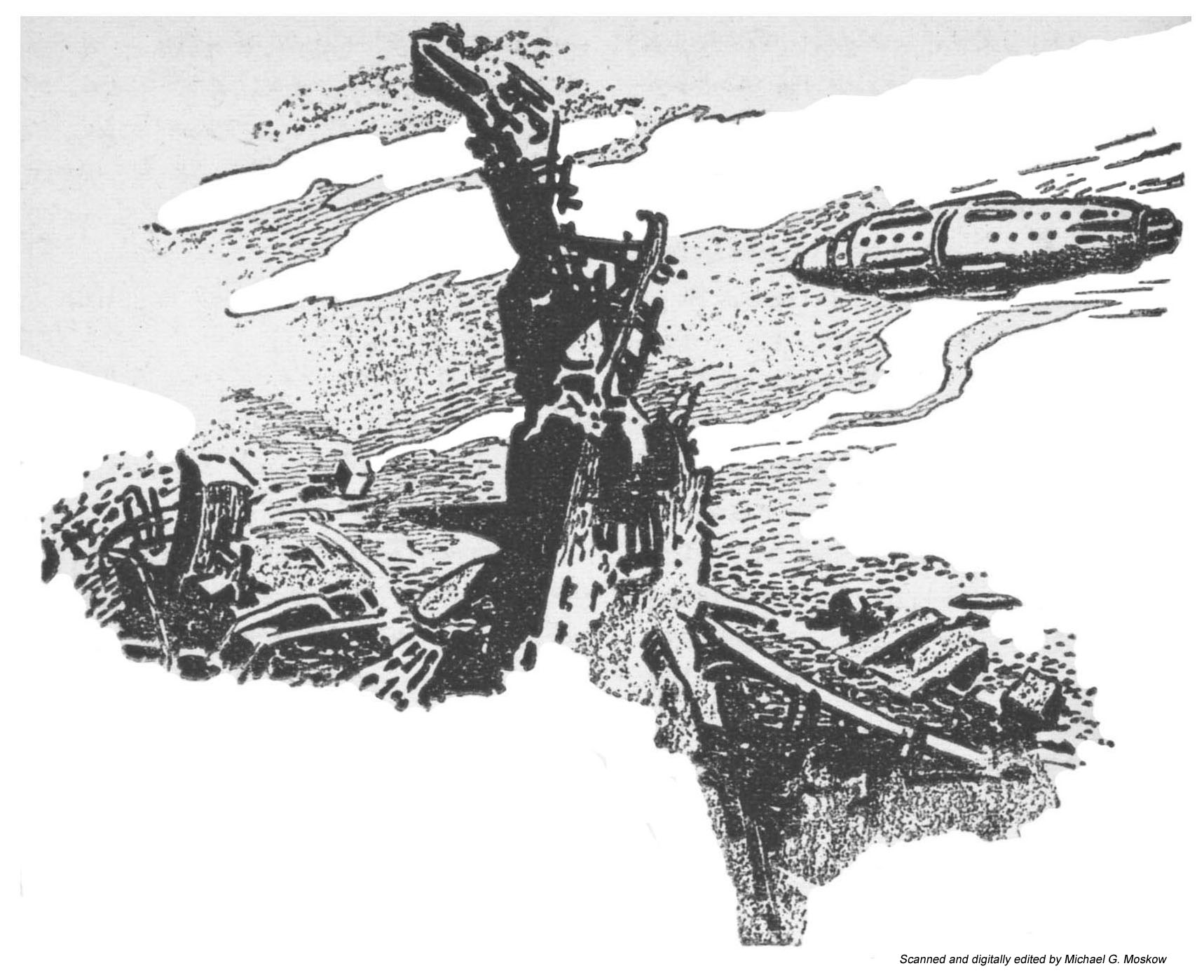
“The location of an objective area the great world of Trantor presents a problem unique in the Galaxy.  There are no continents of oceans to locate from a thousand miles distance.  There are no rivers, lakes, and islands to catch sight of through the cloud rifts.

The metal-covered world was – had been – one colossal city, and only the old Imperial palace could be identified readily from outer space by a stranger.  The Bayta circled the world at almost air-car height in repeated painful search.

From polar regions, where the icy coating of the metal spires were somber evidence of the weather-conditioning machinery, they worked southwards.  Occasionally they could experiment with the correlations – (or presumable correlations) – between what they saw and what the inadequate map obtained at Neotrantor showed.

But it was unmistakable when it came.  The gap in the metal coat of the planet was fifty miles.  The unusual greenery spread over hundreds of square miles, inclosing the mighty grace of the ancient Imperial residences.

The Bayta hovered and slowly oriented itself.  There were only the huge super-causeways to guide them.  Long straight arrows on the map; smooth, gleaming ribbons there below them.

What the map indicated to be the University area was reached by dead reckoning, and upon the flat area of what once must have been a busy landing-field, the ship lowered itself.

It was only as they submerged into the welter of metal that the smooth beauty apparent from the air dissolved into the broken, twisted near-wreckage that had been left in the wake of the Sack.  Spires were truncated, smooth walls gouted and twisted, and just for an instant there was the glimpse of a shaven area of earth – perhaps several hundred acres in extent – dark and plowed.”  (pp. 93-94)

______________________________

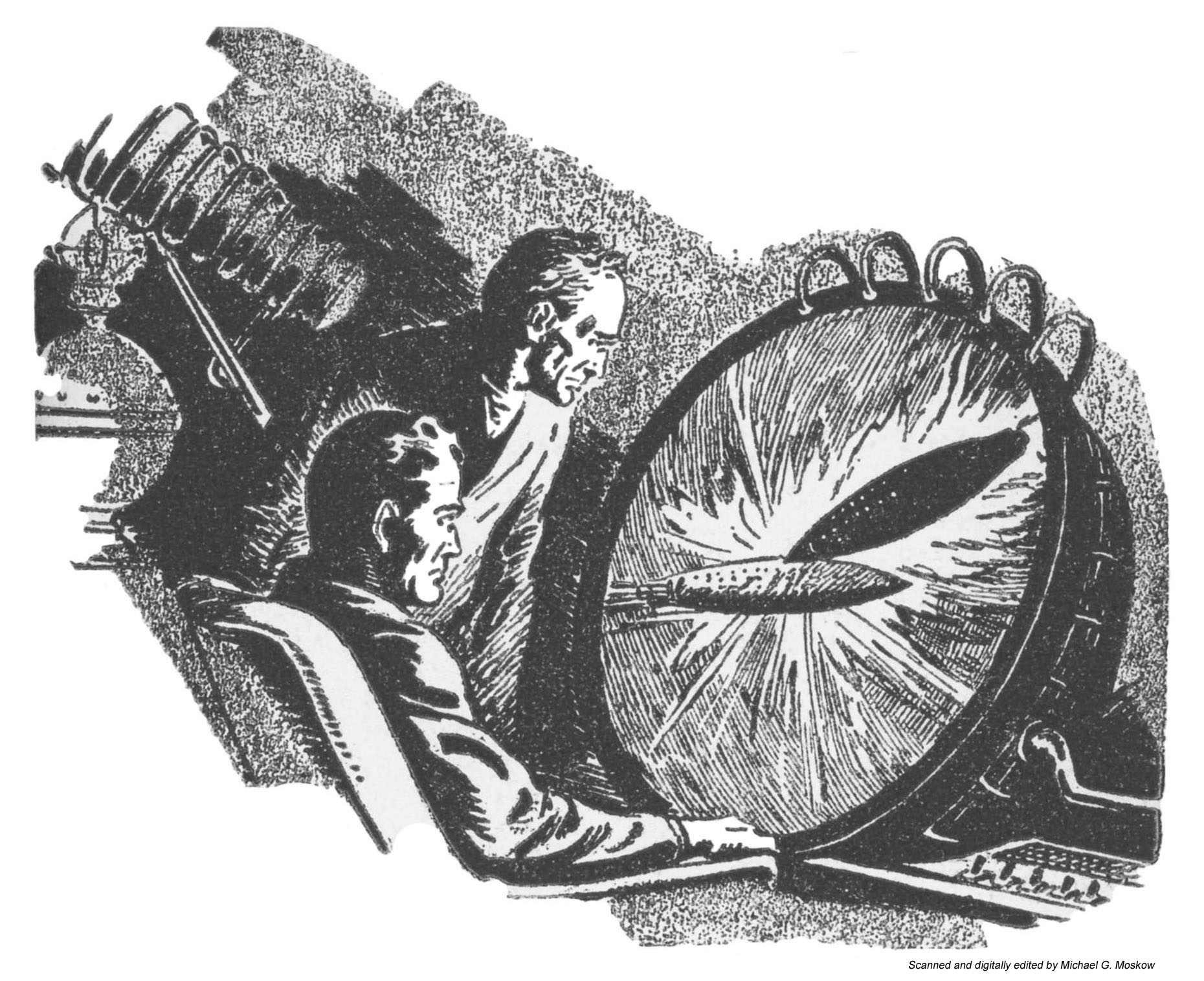
This image shows an Empire spacecraft ramming the Foundation spaceship Cluster, during a battle between space fleets of the Foundation and the Empire.  The events are watched live (evidently, the time-lag inherent to speed-of-light communication over intragalactic distances is not an issue – oh, well!) by Toran Darell and Ebling Mis. 

(Illustration on page 151)

“Toran sat down upon the cot that served as Magnifico’s bed, and waited.  The propaganda routine of the Mule’s “special bulletins” were monotonously similar.  First the martial music, and then the buttery slickness of the announcer.  The minor news items would come, following one another in patient lock step.  Then the pause.  Then the trumpets and the rising excitement and climax.

Toran endured it.  Mis muttered to himself.

The newscaster spilled out, in conventional war-correspondent phraseology, the unctuous words then translated into sound the molten metal and blasted flesh of a battle in space.

“Rapid cruiser squadrons under Lieutenant General Sammin hit back hard at the task force striking out from Iss – ”  The carefully expressionless face of the speaker upon the screen faded into the blackness of a space cut through by the quick swaths of ships reeling across the emptiness in deadly battle.  The voice continued through the soundless thunder –

“The most striking action of the battle was the subsidiary combat of the heavy cruiser Cluster against three enemy ships of the ‘Nova’ class – ”

The screen’s view veered and closed in.  A great ship sparked and one of the frantic attackers glowed angrily, twisted out of focus, swung back and rammed.  The Cluster bowed wildly and survived the glancing blow that drove the attacker off in twisting reflection.

The newsman’s smooth unimpassioned delivery continued to the last blow and the last hulk.

Then a pause, and a largely similar voice-and-picture of the fight off Mnemom, to which the novelty was added of a lengthy description of a hit-and-run landing – the picture of a blasted city – huddled and weary prisoners – and off again.”  (pp. 77-78)

_____________________

When I first saw Orban’s drawing of the viewing screen (on page 151), I was intrigued: A large-diameter viewing scope, with a set of cables attached to its periphery, mounted at an angle to a seated viewer’s line of sight?  Hmmm…

Where did I see such image – or its inspiration – before?

Then, I remembered.

The design of Orban’s view-screen – or, at least the front of it – bears a similarity to cathode-ray tube of the World War Two era H2X ground-mapping radar unit, which was primarily utilized in heavy bombers (B-17 Flying Fortresses and B-24 Liberators) of the United States Army Air Force.

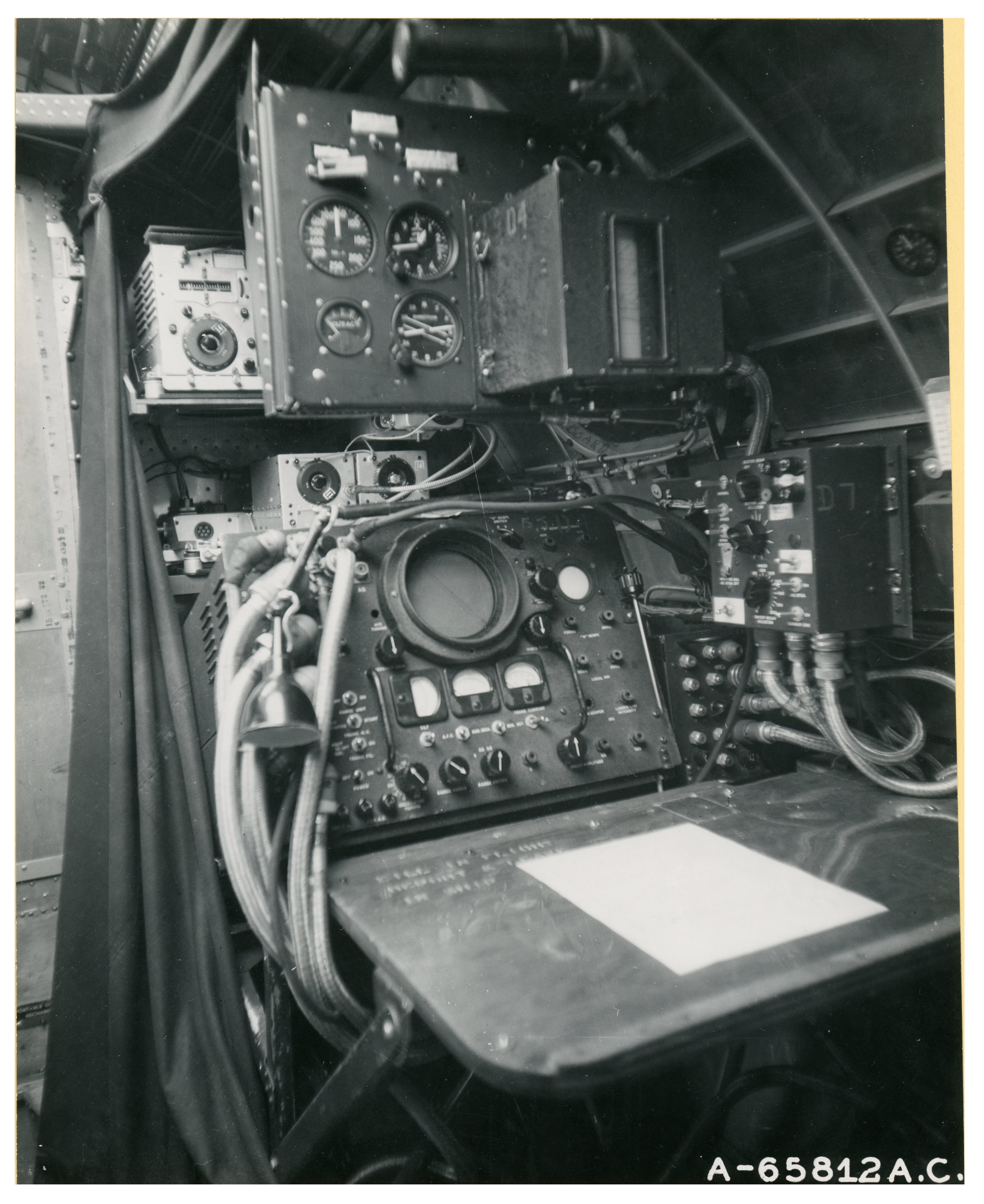
Photographs of H2X units in two B-17 Flying Fortress bombers of the 401st Bomb Group of the British-based Eighth Air Force – taken in England on December 5, 1944 – were received in June of 1945, and presumably released to the news media after that date, months before the publication of Orban’s illustrations in the December issue of Astounding.

Given the timing of the photographs’ distribution, and their presumed availability to the general public, could Paul Orban have been inspiration for his illustration in Astounding have been these photographs?

I don’t really know.  Just pure speculation.

But, it’s an idea.

You can view the two images of the H2X radar unit below.  They’re among the nearly 89,000 images in NARA’s Records Group 342 (Black and White and Color Photographs of U.S. Air Force and Predecessor Agencies Activities, Facilities, and Personnel – World War II ) now available to the public through Fold3.com.  Since I scanned both pictures at 400 dpi, a “full-screen” / enlarged view will reveal detailed views of the units’ buttons, switches, control panels and associated equipment.

Army Air Force Photo 65812AC / A12719

Based on this set’s location relative to the bulkhead and fuselage, this unit is probably located in the navigator’s station of the B-17.

______________________________


Army Air Force Photo A-65812AC / A12720

Based on the location of the door (to the left) and curvature of the fuselage wall (on the right), this unit is situated within the B-17’s radio compartment.  Note the curtain on the left and above the H2X unit, giving the radar operator a view of his scope unimpeded by sunlight.

 References

Foundation Series – at Wikipedia

Foundation and Empire – at Wikipedia

Isaac Asimov Short Stories Bibliography – at Wikipedia

International Science Fiction Database – Foundation (Original Stories)

World War Two German Technical Analysis of Captured R-78 / APS-15A Radar (featuring Photo A-68512AC) – at Foundation for German Communication and Related Technologies

R-78A Receiver-Indicator, AN/APS-15 Radar Equipment – Two color images from Smithsonian National Air and Space Museum

Astounding Science Fiction – June, 1942 (Featuring “Bridle and Saddle”, by Isaac Asimov) [Hubert Rogers]

______________________________

Illustration by Charles Schneeman, for Isaac Asimov’s cover story “Bridle and Saddle” (p. 24).

______________________________

Illustration by Paul Orban, for Hal Clement’s story “Proof” (p. 101).

______________________________

Illustration by Paul Orban, for Hal Clement’s story “Proofr” (p. 105).

______________________________