Unknown – May, 1940, featuring “The Roaring Trumpet”, by L. Sprague de Camp and Fletcher Pratt [M. Isip]

The them of parallel worlds has long been prominent in science-fiction and fantasy, with some works – such as Poul Anderson’s entrancing “Three Hearts and Three Lions” (published as a novella in the September, 1953 issue of The Magazine of Fantasy and Science Fiction) combining these themes to marvelous and entertaining effect.  As vastly more of a devotee of science-fiction than fantasy, I was truly impressed by Anderson’s story, particularly in terms of world-building, pace of action, the refreshing delineation and individuation of characters, and the subtle undercurrent of pathos that courses through the tale.  

An earlier embodiment of this dual-genre – “science-fantasy” – is L. Sprague de Camp and Fletcher Pratt’s “The Roaring Trumpet”, which appeared in the May, 1940 issue of UnknownLike the Anderson tale, “Trumpet” has a lengthy entry at Wikipedia.  Therein, it’s revealed that the story is the first of the five Harold Shea stories penned by the dual authors, which – albeit Wikipedia’s a little confusing on the point! – comprise the “Incomplete Enchanter” series which, together with the complimentary “Complete Enchanter” series, form the – ahem, wait for it… “Enchanter” series.  (I think I got it right!)

And yet…

True confession!…  I’ve not actually read “The Roaring Trumpet”.  Rather, I discovered the story by not-so-randomly perusing Unknown at Archive.org in order to view the illustrations that appeared in the magazine during its late ’30s – early 40s existence.  I was (I remain) especially taken by Edd Cartier’s illustration on page 17, which depicts the first (and random, though instrumental to the story!) meeting between the unknowing protagonist Harold Shea and Odinn, who as drawn by Cartier has an incredible Ian McKellen-ish / Gandolf-ish “vibe” about him. 

(On first perusal, before I actually read about and skimmed the story, I assumed that Shea had chanced across a wizard or warlock.  What, with the long, gaunt and cloaked figure; the lengthy black cloak; the hoary, untrimmed beard; the look of annoyed detachment (with compassion underneath).  “Ah-hah,” I imagined, “it’s Gandolf’s ne’er do well half-brother Blandolf, making an appearance in the world of human myth!”)

Here’s how their encounter went down:

“Welcome to Ireland!” Harold Shea murmured to himself, and looked around. The snow was not alone responsible for the grayness. There was also a cold, clinging mist that cut off vision at a hundred yards or so. Ahead of him the track edged leftward around a little mammary of a hill, on whose flank a tree rocked under the melancholy wind. The tree’s arms all reached one direction, as though the wind were habitual; its branches bore a few leaves as gray and discouraged as the landscape itself. The tree was the only object visible in that wilderness of mud, grass and fog. Shea stepped toward it and was dumfounded to observe that the serrated leaves bore the indentations of the Northern scrub oak.

But that grows only in the Arctic Circle, he thought, and was bending closer for another look when he heard the clop-squash of a horse’s hoofs on the muddy track behind him.

He turned. The horse was very small, hardly more than a pony, and shaggy, with a luxuriant tail blowing round its withers. On its back sat a man who might have been tall had he been upright, for his feet nearly touched the ground. But he was hunched before the icy wind driving in behind. From saddle to eyes he was enveloped in a faded blue cloak. A formless slouch hat was polled tight over his face, yet not so tight as to conceal the fact that he was both full-bearded and gray.

Shea took half a dozen quick steps to the roadside and addressed the man with the phrase he had carefully composed in advance for his first human contact in the world of old Ireland:

“The top of the morning to you, my good man, and would it be far to the nearest hostel?” He had meant to say more, but paused a trifle uncertainly as the man on the horse lifted his head to reveal a proud, unsmiling face in which the left eye socket was horribly vacant. Shea smiled weakly, then gathered his courage and plunged on: “It’s a rare bitter December you do he having in Ireland.”

The stranger looked at him. Shea felt; with much of the same clinical detachment he himself would have given to an interesting case of schizophrenia, and spoke in slow, deep tones: “I have no knowledge of hostels, nor of Ireland; but the month is not December. We are in May, and this is the Fimbulwinter.”

A little prickIe of horror filled Harold Shea, though the last word was meaningless to him. Faint and far, his ear caught a sound that might be the howling of a dog – or a wolf. As he sought for words there was a flutter of movement. Two big black birds, like oversize crows, slid down the wind past him and came to rest on the dry grass, looked at him for a second or two with bright, intelligent eyes, then took the air again.

“Well, where am I?”

“At the wings of the world, by Midgard’s border.”

“Where in hell is that?”

The deep voice took on an edge of annoyance. “For all things there is a time, a place, and a person. There is none of the three for ill-judged questions and empty jokes.” He showed Shea a blue-clad shoulder, clucked to his pony and began to move wearily ahead.

“Hey!” cried Shea. He was feeling good and sore. The wind made his fingers and jaw muscles ache. He was lost in this arctic wasteland, and this old goat was about to trot off and leave him stranded. He leaped forward, planting himself squarely in front of the pony. “What kind of a runaround is this, anyway? When I ask someone a civil question-”

The pony had halted, its muzzle almost touching Shea’s coat. The man on the animal’s back straightened suddenly so that Shea could see he was very tall indeed, a perfect giant. But before he had time to note anything more he felt himself caught and held with an almost physical force by that single eye. A stab of intense, burning cold seemed to run through him, inside his head, as though his brain bad been pierced by an icicle. He felt rather than heard a voice which demanded, “Are you trying to stop me, niggeling?”

For his life. Shea could not have moved anything but his lips, “N-no,” he stammered. “That, is, I just wondered if you could tell me how I could get somewhere where it’s warm-”

The single eye held him unblinkingly for a few seconds. Shea felt that it was examining his inmost thoughts. Then the man slumped a trifle so that the brim of his hat shut out the glare and the deep voice was muffled. “I will be tonight at the house of the bonder Sverre, which is the Crossroads of the World. You may follow.” The wind whipped a fold of his blue cloak, and as it did so there came, apparently from within the cloak itself, a little swirl of leaves. One clung for a moment to the front of Shea’s coat. He caught it with numbed fingers, and saw it was an ash leaf, fresh and tender with the bright green of spring – in the midst of this howling wilderness, where only arctic scrub oak grew!

L. Sprague de Camp

“A weird and tingling chill bore into Shea’s mind
as the old man’s single eye glared down at him…”

(page 17)

And otherwise…

“The Roaring Trumpet”, at ...

Wikipedia (has detailed plot summary)

L. Sprague de Camp photo, from …

Gunn, James E., Alternate Worlds – The Illustrated History of Science Fiction, A&W Visual Library, Prentice-Hall, Inc., Englewood Cliffs, N.J., 1975

Gandalf (both Grey and White), at …

Wikipedia

Rogue Queen, by L. Sprague de Camp – 1951 [Richard M. Powers and Edmund A. Emshwiller]

Well!

Sometimes it’s hard to figure out how to begin a blog post.  

After all, what can possibly be said about L. Sprague de Camp’s 1951 science-fiction novel “Rogue Queen”?!

Except perhaps…

In the same way that readers and reviewers can have markedly different interpretations of the same work of literature, so can artists.  Such is so for successive editions of L. Sprague de Camp’s novel Rogue Queen, which was first published by Doubleday in 1951 with a cover by Richard Powers, and was most recently reprinted in 2014.  Neither abstract nor ambiguous like much of his later body of work, his painting – while stylized – is directly representational of an aspect of the book’s plot, which pertains to humanoid bipeds (biologically, very much like us) of the planet Ormazd, the organization of whose civilization is analogous to that of social insects: the bees, of our Earth.  Powers’ cover – the fourth work of his massive oeuvre – combines central elements of de Camp’s novel – a revolt by the female workers of Ormazd (they do look a little insect-like, don’t they, what with the Vulcan ears and eyebrows?!), and, the influence of explorers from Earth (notice the helicopter and spaceship?), set against very “earthy” tones of orange and brown.  

(This example is via L.W. Currey booksellers.)

I don’t know the specific month when the book was released, but a very brief review by “A.B.” (Alfred Bester?) appeared in The New York Times Book Review on July 29, 1951, under the title “Men of the Hive”, where it’s accompanied by reviews of Groff Conklin’s Possible World of Science Fiction, and, Jack Williamson’s Dragons Island, all enlivened by an illustration of fluffy extraterrestrial something-or-others on an alien planetscape.  Though I don’t know the time-frame, it seems that the Times Book Review featured numerous such science-fiction mini-reviews during the mid-1950s, perhaps attributable to science-fiction by then – post WW II – finally moving into the mainstream of literary acceptability.   

ROGUE QUEEN, By L. Sprague de Camp.  222 pp.  New York: Doubleday & Co., $2.75.

MR. DE CAMP has made up for the lapse of his colleagues by producing a science-fiction narrative which is entirely about sex, and, surprisingly, non-pornographic.  Imagine a civilization of mammalian bipeds not unlike us who have developed a society like that of the bees, in which all males are drones (that is, stallions) and all females, save for a few hypersexed queens, are de-sexed workers.  Then let an expedition from Earth accidentally foster the concept of romantic love, and you have that rarest of collector’s items: a completely new science-fiction plot.  A.B.

The Author: L. Sprague de Camp

And now, for something different.  Er, completely different.  Um, dramatically different: Ed Emshwiller’s startling take on Iroedh, the protagonist of de Camp’s story.  While this cover shares the elements of Powers’ painting – female workers in revolt, earth spaceship, and spacey planet a-floating-in-the-sky – Ed Emshwiller really pushed the boundaries of 1950s paperback science fiction art in his depiction of the novel’s heroine.  The sunset backlighting, purple cast to her skin, and yellow highlights lend a lurid and near-photographic mood to the cover.         

As for the novel itself?  I confess!…  I’ve not actually read it (yet), ironically due to the near-mint condition and fragility of this copy.  However, it does have two overarching similarities with a subsequent 1950s science-fiction novel: Philip José Farmer’s The Lovers, which first appeared in the August, 1952 issue of Startling Stories: A planet inhabited by a human – or near-human (spoiler alert!) – species which has complete – or near-complete – physical compatibility with humans, and, the result of human interaction with that alien species. 

Given the timing of release of the two novels, I wonder – as I type this post – if de Camp’s book in any way influenced Farmer’s effort one year later.  The answer to that question I do not know.  What I do know is that despite the superficial parallels in plot of the two books, the The Lovers is (well, admittedly only compared with my reading about and not of Rogue Queen) an entirely different tale, the tone, mood, theme, and weighty conclusion of which are completely serious, addressing questions about the nature of love (not solely physical or erotic love, though those certainly are central to the story), society, and religion.  In the hands of a skilled producer, director, and team of writers, The Lovers has more than enough substance to serve as the basis for a feature film, or even a miniseries.  Would that this should happen!     

As for Rogue Queen, the nature of de Camp’s book is well summarized in the following two blurbs from the flyleaf:

On outer flyleaf…

HE BROUGHT HER
A NEW KIND OF LOVE

This oddly alluring creature wouldn’t have made a bad-looking girl among human females – if your tastes run to pink six-footers with cat’s eyes!  But being a neuter-female on the strange planet Ormazd, Iroedh had a lot to learn about the pleasures of love – and sex!

When Dr. Winston Bloch and his party arrived in their sky ship, Iroedh’s first duty as a loyal neuter worker was to line him up on her side in the planet’s inter-Community war.

But Iroedh was strangely (and illicitly) in love with the drone Antis, whose sole function was to fertilize the egg-laying Queen.  Since the Earth-men had the power to save Antis from imminent liquidation, Iroedh had no choice but to join them and become an outlaw – a rogue.

Then she learned the amazing secrets of sex and fertility, how a neuter-worker can be transformed – in mind and body – into a flesh-and-blood functional female.

She and Antis take it from there, gaily changing the whole structure of Ormazdian life with the slogan –

“EVERY WORKER A QUEEN –
A QUEEN FOR EVERY DRONE!”

I found this version of Emshwiller’s cover art for Rogue Queen – sans text and title – “somewhere” in the digital world.

On inner flyleaf…

THEY INHABITED A STRANGE WORLD

Iroedh was a sexless worker in the far-off planet of Ormazd – but hunger made her a woman!  Antis was a drone, the professional consort of a Queen – but love stirred strange emotions in his heart.  Their extraordinary love affair turned the planet topsy-turvy after they met.

VISITORS FROM THE EARTH

Doctor Winston Bloch, who had sex problems of his own, and beautiful Barbe Dulac, who gave Iroedh her first abnormal (for her!) lessons in love.

The lovers learned many strange things from each other in the course of their adventures, and they met many strange beings, such as Wythias, the outlaw drone; Gildakk, the phony Oracle; and Queens Intar and Estir, who fought a duel for the succession to the throne only to lose it in the end to a new and exciting

ROGUE QUEEN

On back cover…

SHE WAS BEAUTIFUL – BUT SHE WASN’T A WOMAN

At least she wasn’t a complete woman.

But in her heart there was love for the drone Antis – strange love, strictly unlawful and delightfully unconquerable. At first it made her an outcast. Later the Earthman taught her the facts of full womanhood, and manhood too – and her body responded in strangle pleasing fashion.

Like all workers on the distant planet Ormazd, she had been a neuter-female, forced to leave the business of love – and sex! – to the Queens and the drones. Now armed with new knowledge, she opens thrilling possibilities for all the people of the planet, and proves – most divertingly – that love conquers all even in the heart of a

ROGUE
QUEEN

Harrrumphhh!

We’ll conclude right where we began.

In light of the above, there’s only one thing to be said about all this!

A Roguish Queen, at…

Wikipedia

Archive.org

editoreric

GoodReads

Internet Speculative Fiction Database

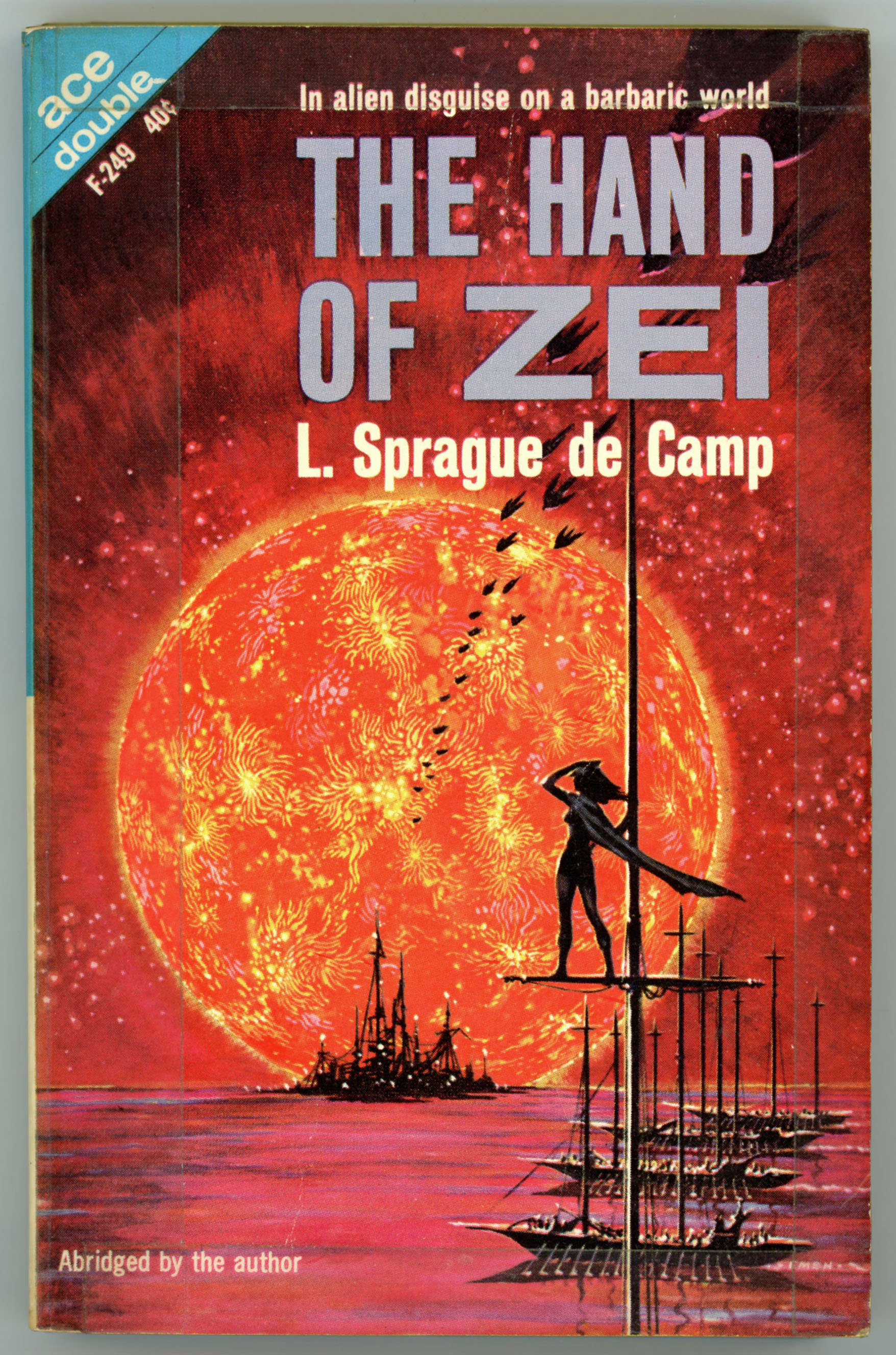
The Hand of Zei, by L. Sprague de Camp – 1963 (Astounding Science Fiction 1950-1951) [Edmund A. Emshwiller]

In space, they say, 
Lies The Hand of Zei.
A strange adventure,
Far, far away!

The Search For Zei is found this way

The Search for Zei, by L. Sprague de Camp – 1963 (Astounding Science Fiction, 1950-1951) [Edmund A. Emshwiller]

What can one say,
About The Search for Zei?
A colorful cover,
On display!

The Hand of Zei, not far away

Startling Stories – April, 1952 (Featuring “The Glory That Was”, by L. Sprague de Camp) [Alex Schomburg] [Updated post…!]

[Update, May, 2021! …  I recently learned from Mike Chomko, publisher of The Pulpster (affiliated with PulpFest), that the cover artist of this issue of Startling Stories was Alex Schomburg.  So, the text of this post has been updated accordingly.  Thanks for the tip, Mike.]

I’ve recently had the good fortune to acquire several issues of Startling Stories, giving me the opportunity to present my own scans of this magazine, rather than images randomly found on the ‘net. 

This post is the first such example:  Originally created on February 17, 2018, it’s been updated to include images of the front and rear covers of the the magazine’s issue of April, 1952.

Though no artist’s names appear in the issue’s table of contents, this softly-pink-horizoned-moonscape-with-cloudless-earth-floating-in-the-distance was created by Alex Schomburg.  It looks as if the light gray to silver to dark gray to black shadings of the lunar mining machine were done via airbrush…     

So, the front cover:

…and the back cover, with an advertisement for The Collected Works of Zane Grey

________________________________________

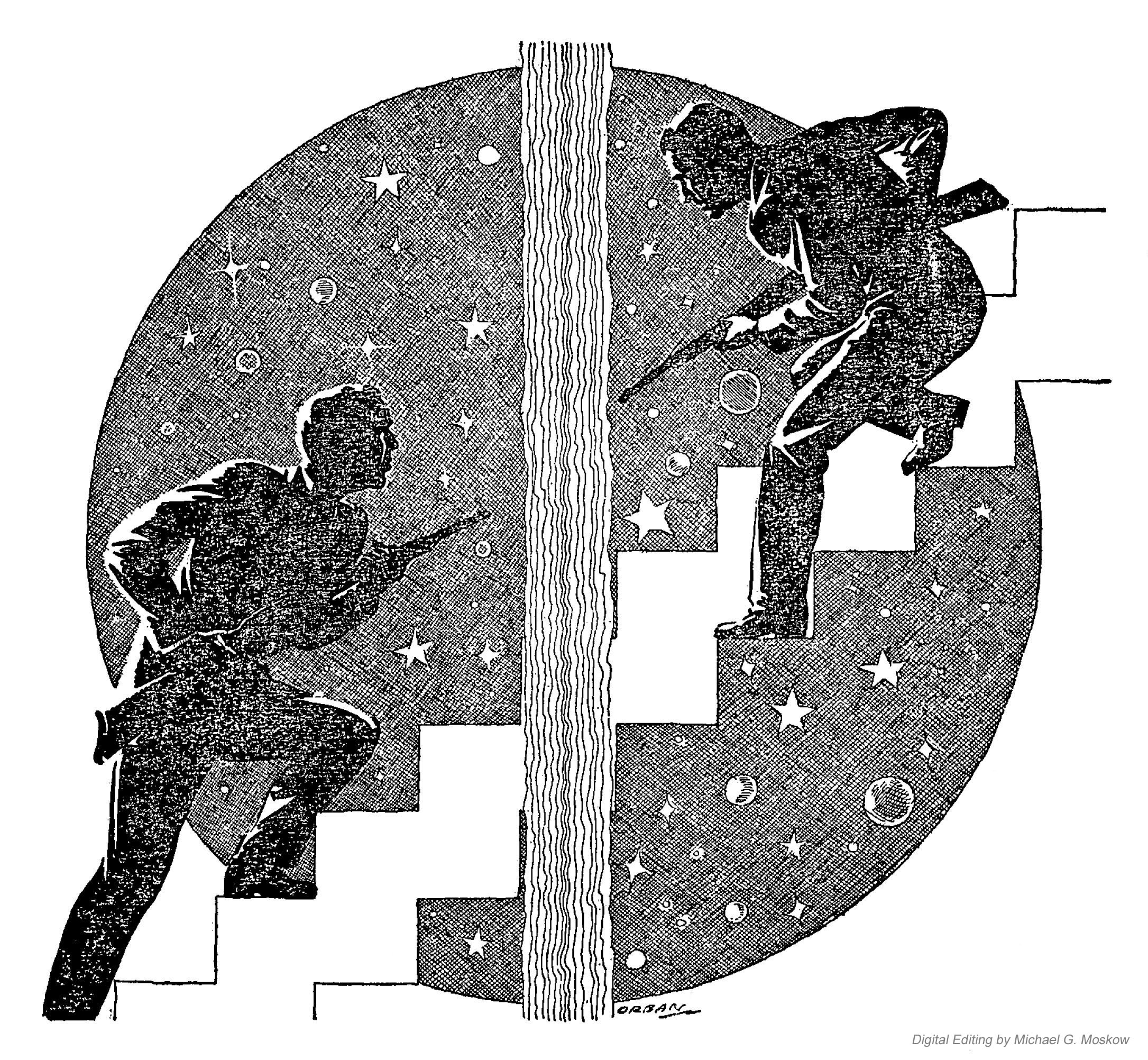
Here’s Paul Orban’s Illustration  – on page 89 – for “The Intruder”, by Oliver E. Saari, whose life encompassed the realms of engineering and science fiction

I’ve not read Saari’s story, but the theme of the “header” blurb – below – reminds me of episode six from (the otherwise sadly and highly uneven) season four of The Man in The High Castle: (“All Serious Daring“). 

The concept is also highly reminiscent of Fritz Leiber, Junior’s, “Destiny Times Three” – one of the most brilliantly executed tales of parallel universes I’ve ever read!  Then again, Leiber was an extraordinary writer! – which appeared in Astounding Science Fiction in March and April of 1945. 

“To have an exact duplicate of yourself show up and take over your business, your wife? … brother, it’s murder!”

________________________________________

Here’s the cover image – from Archive.org – that originally appeared in this post.

Astounding Science Fiction, October, 1950 (Featuring “The Hand of Zei”, by L. Sprague de Camp) [Edd Cartier]

Though he created many wonderful interior illustrations for Astounding Science Fiction, let alone a tremendous body of work in general, I believe that the magazine’s issue of October, 1950 – above – marked Edd Cartier’s only cover for that publication.  Fittingly, he created the over twenty illustrations that accompanied “The Hand of Zei”, which was serialized in Astounding from October, 1950, through January, 1951.

______________________________

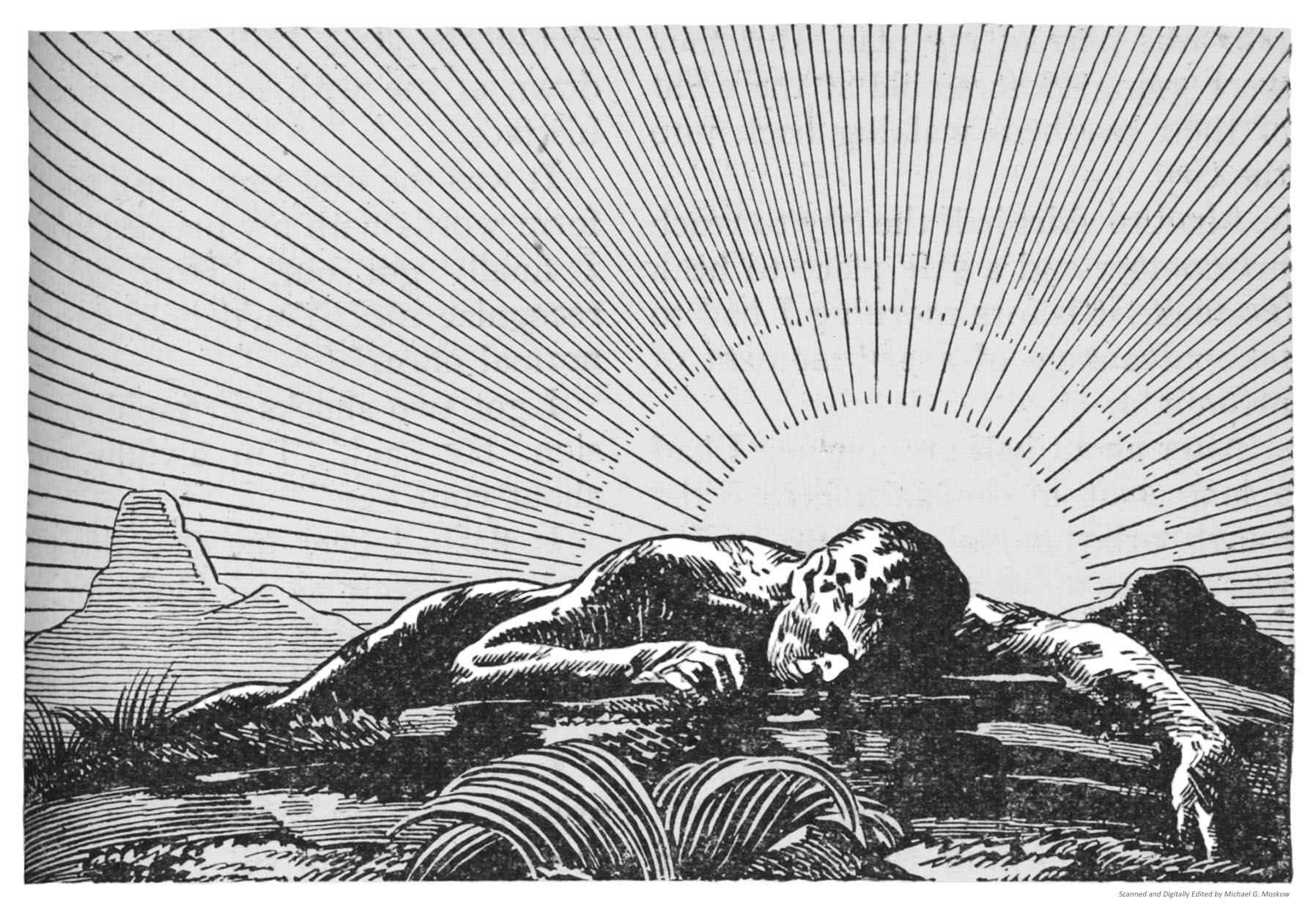
Illustration by Paul Orban, for Norman Menasco’s story “Trigger Tide” (p. 65)

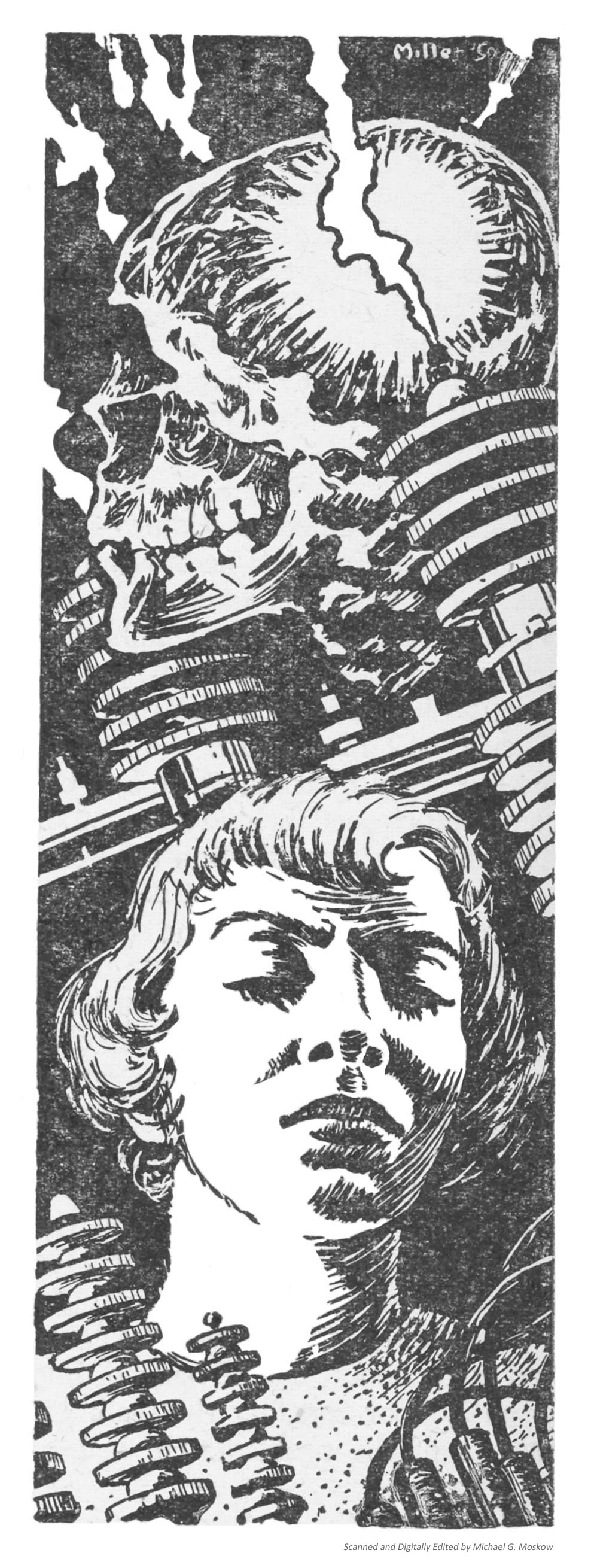
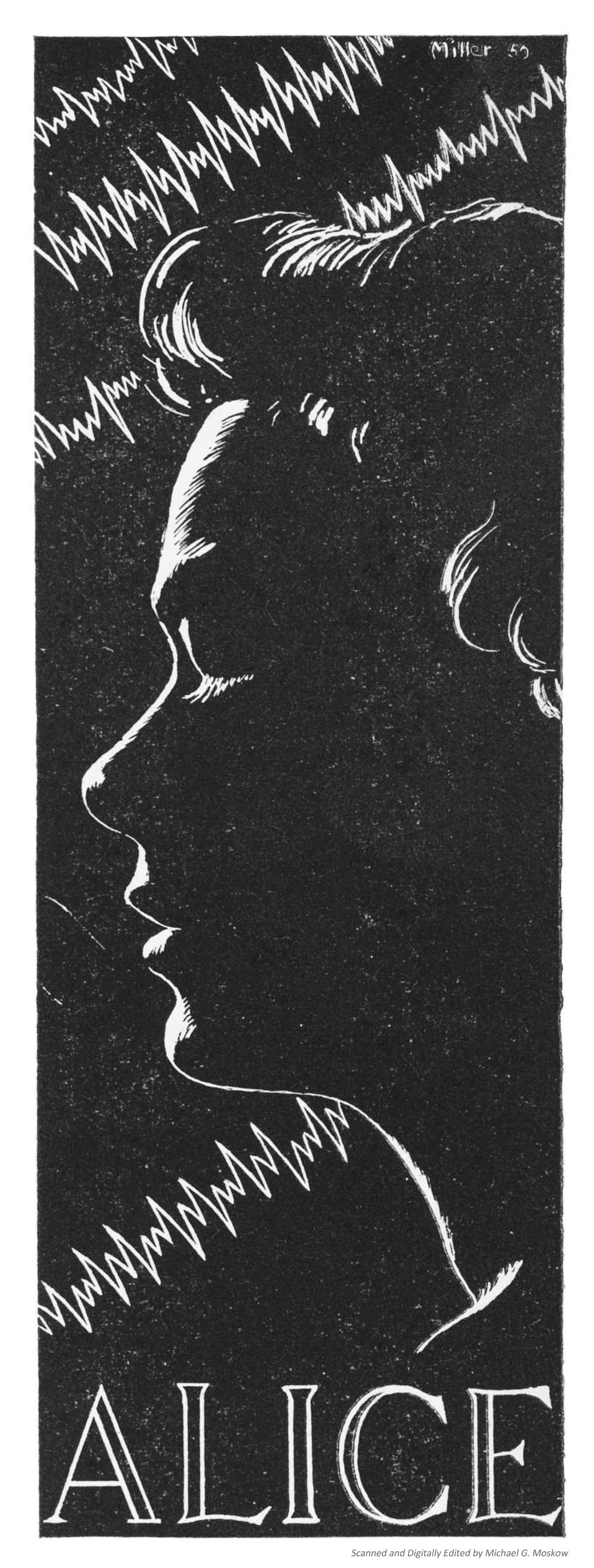
Illustration by Miller, for Raymond F. Jones’ story “Discontinuity” (p. 85)

Illustration by Miller, for Raymond F. Jones’ story “Discontinuity” (p. 103)