Out Of This World – An Anthology of Fantasy, Edited by Julius Fast – 1944 (1946) [Unknown Artist] [[Updated Post]]

(First created in March of 2018, this post has been updated to present greater detail about Out of This World’s contents…)

Evening Primrose, by John Collier, from Presenting Moonshine (book), 1941

Laura, by Saki (H.H. Munro), from Beats and Super-Beasts (book), 1914

Sam Small’s Tyke, by Eric Knight, from Sam Small Flies Again: The Amazing Adventures of the Flying Yorkshireman (book), 1940

Satan and Sam Shay, by Robert Arthur, from The Elks Magazine, August, 1942

A Disputed Authorship (excerpt from A House-Boat on the Styx), by John Kendrick Bangs, 1895

Mr. Mergenthwirker’s Lobblies, by Nelson S. Bond, Scribners Magazine, November, 1937

A Vision of Judgement, by H.G. Wells, from The Country of The Blind and Other Stories (book), 1911

Thus I Refute Beelzy, by John Collier, from Presenting Moonshine (book), 1941

The King of the Cats, by Stephen Vincent Benet, from Harper’s Bazar, February, 1929

The Canterville Ghost, by Oscar Wilde, from Court and Society Review, February 23, 1887

My Friend Merton, by Julius Fast

And Adam Begot, by Arch Oboler

The Club Secretary, by Lord Dunsany, from The Atlantic Monthly, August, 1934

The Scarlet Plague, by Jack London, from The London Magazine, June, 1912

Reference

Out of This World, at Internet Speculative Fiction Database

Budrys’ Inferno, by Algis Budrys – July, 1963 [Richard M. Powers]

The cover of the Berkley Medallion edition of Budrys Inferno, typifying the work of Richard Powers: Two medusa-like shapes (for lack of a better word) float above the surface of a planet (well, there’s one crater in the foreground), against a sky of pale red, pink, and tan.  The only solidly human representations appear as the form of two stylized, silhouetted figures fighting (or dancing?) in the lower left.  

In the foreground looms the stylized head (well, I guess it’s a head – it certainly looks like it’s viewed from behind!) of an alien observer.  But, is the observer viewing the horizon, or looking at us? 

Like much of the art of Richard Powers, answers, explanations, and identification are uncertain. 

Contents

Introduction – essay by Algis Budrys

Silent Brother, from Astounding Science Fiction, February, 1956

Between the Dark and the Daylight, from Infinity Science Fiction, October, 1958

And Then She Found Him …, from Venture Science Fiction, July, 1957

The Skirmisher, from Infinity Science Fiction, November, 1957

The Man Who Tasted Ashes, from if Science Fiction, February, 1959

Lower Than Angels, from Infinity Science Fiction, October, 1956

Contact Between Equals, from Venture Science Fiction, July, 1958

Dream of Victory, from Amazing Stories, August-September, 1953

The Peasant Girl, from Astounding Science Fiction, June, 1956

A Planet Named Shayol (Planeetta Nimeltä Shajol), by Cordwainer Smith (Translated by Matti Rosvall) – 1985 [Unknown Artist]

“I want you there,” she said as solemnly as a witch. 
“I want you there to wear the helmet of the pinlighters and ride with me into hell itself.
That soul is lost. 
It is frozen by a force I do not know,
frozen out beyond the stars,
where the stars caught it and made it their own,
so that the poor man and brother that thou seest is truly among us,
but his soul weeps in the unholy pleasure between the stars
where it is lost to the mercy of God and to the friendship of mankind. 
Wilt thou, O brave man, sir and doctor, Chief and Leader, ride with me to hell itself?”

What could I say but yes?

From “The Colonel Came Back from the Nothing-at-All”
in The Instrumentality of Mankind, 1979

_______________________________________

The overwhelming number of images displayed at this blog present cover and interior art of books and magazines in my own collection, or, texts to which I have direct physical access for scanning.  However, this image is an exception: The cover of a Finnish-language anthology of stories by Cordwainer Smith, it was discovered entirely at digital random. 

Chanced upon at https://kauppa.kierratyskeskus.fi, “The Metropolitan Area Recycling Center for Used Goods” of Espoo, Finland’s second largest city, the image shows the cover of Planeetta nimeltä Shajol (A Planet Named Shayol), published by WSOY (Werner Söderström Ltd.) in the city of Juva in 1985.  (ISBN numbers 9510129100 and 9789510129104; OCLC number 57810714)  Originally published in 1975 with Finnish translation by Matti Rosvall, Planeetta nimeltä Shajol is profiled at Rising Shadow – Beyond the Reality, a Finnish-language science-fiction and fantasy book database, from which the following is quoted:

Sisältää valikoiman alkuperäisteoksen novelleja:

Translation: “Includes a selection of original short stories:”

Neito joka purjehti Sielua (The Lady Who Sailed The Soul (1960))
Kuinka aivot poltettiin (The Burning of the Brain (1958))
Komentaja Suzdalin rikos ja riemuvoitto (The Crime and the Glory of Commander Suzdal (1964))
Naurutalon kuollut rouva (The Dead Lady of Clown Town (1964))
Matami Hittonin Kisumisut (Mother Hitton’s Littul Kittons (1961))
Balladi C’mellistä (The Ballad of Lost C’mell (1962))
Planeetta nimeltä Shajol (A Planet Named Shayol (1961))

“Vavahduttavan kauniita balladeja ja hyytäviä kauhunäkyjä seitsemän novellin kokoelmassa.  Cordwainer Smith luo kertomuksissaan täysin omaleimaisen maailmankaikkeuden.  Hänen avaruutensa on julma, ärjyvä kaaos, jossa ihminen voi voittaa vain turvautumalla epätoivoisiin keinoihin.  Yksi osa tarinoita kertoo alaihmisistä, jotka kamppailevat tasa-arvosta ihmisen rinnalla.  Tähän kamppailuun ja kaikkeen universumissa tapahtuvaan ihmiskunnan kehitykseen vaikuttaa salaperäisin valtuuksin toimiva Ihmistaidon neuvosto, Smithin kosmoksen jumalavastine.”

Translation: Astonishingly beautiful ballads and scenes of chilling horror in a collection of seven novellas.  In his stories, Cordwainer Smith creates a completely unique universe.  His space is cruel, which man can overcome only by resorting to desperate means.  Part of the story is about the under-people who are fighting for equality alongside human beings.  This struggle and the evolution of all humanity in the universe is influenced by the mysterious Council of Humanity, Smith’s divine counterpart of the cosmos.”

Alas! – Despite extensive searches, the artist remains anonymous:  I’m unable to identity the creator’s name, and don’t expect to discover this person’s identity any time soon, for a search of Worldcat reveals that the book is unavailable in the United States.

(Alas!)

Regardless, I think the image is aesthetically lovely and technologically intriguing, representing the combination of familiarity and strangeness that is inherent to the world (worlds?) created by Smith.  Equally, through the seemingly direct connection of man and machine (those thick orange cables directly connected to the man’s head…) the scene creates undercurrents of unease and oddness so characteristic of many of Smith’s tales. 

(Who is this man?)

Go-Captain Alvarez?

Captain of the Navy and Instrumentality, Commander Suzdal?  Is the planet before him the dread world Arachosia?  Is he about to hurl his supply of genetically coded cats into the past?

Colonel Harkening, on his first planoforming voyage?

Scanner Martel?  (No, he’s almost certainly not Scanner Martel.)

Captain Magno-Taliano, aboard the bridge of the Wu-Feinstein?

Mercer, before he was sentenced to the planet named Shayol?

(Who is this man?)

It doesn’t matter.  Perhaps we’re not supposed to know.

References

Planeetta nimeltä Shajol – Cordwainer Smith, at kauppa kierratyskeskus.fi

Planeetta nimeltä Shajol – Cordwainer Smith, at Rising Shadow Science Fiction and Fantasy

WSOY (Werner Söderström Ltd), Publishers of Finland, at WSOY.fi

Mann, James A. (Editor), The Rediscovery of Man – The Complete Short Fiction of Cordwainer Smith, The NESFA Press, Framingham, Ma., 1993

Landscape of Darkness, by Sara Light-Waller (Lucina Press, 2018)

Most of the posts at WordsEnvisioned present images from books past, but sometimes, the present should be present.  And so with the book below, Sarah Light-Waller’s 2018 Landscape of Darkness

Hearkening back to the “golden age” of science-fiction – the small myriad (can a myriad be small?) of pulp magazines published from the 1930s through the late 1950s (many forgotten, some inspirational, every one memorable in their own way) Landscape of Darkness – in plot, tempo, and especially characters – was inspired by authors such as Henry Kuttner, Catherine L. Moore, Murray Leinster, and Edmond Hamilton.  While an animating aspect of the book is the threat of technological dystopia (is this not so even in reality?) this challenge is overcome – albeit not easily – through human strength, human courage, and ultimately the human spirit.  In this, Ms. Light-Waller’s work has the potential expansion into a tale of even greater depth and length. 

You can purchase your own copy of Landscape of Darkness (sample chapters available here) directly from Lucina Press, or via Amazon.

Galaxy Science Fiction – October, 1962 (Featuring “The Ballad of Lost C’Mell”, by Cordwainer Smith) [Virgil Finlay] [Updated post…]

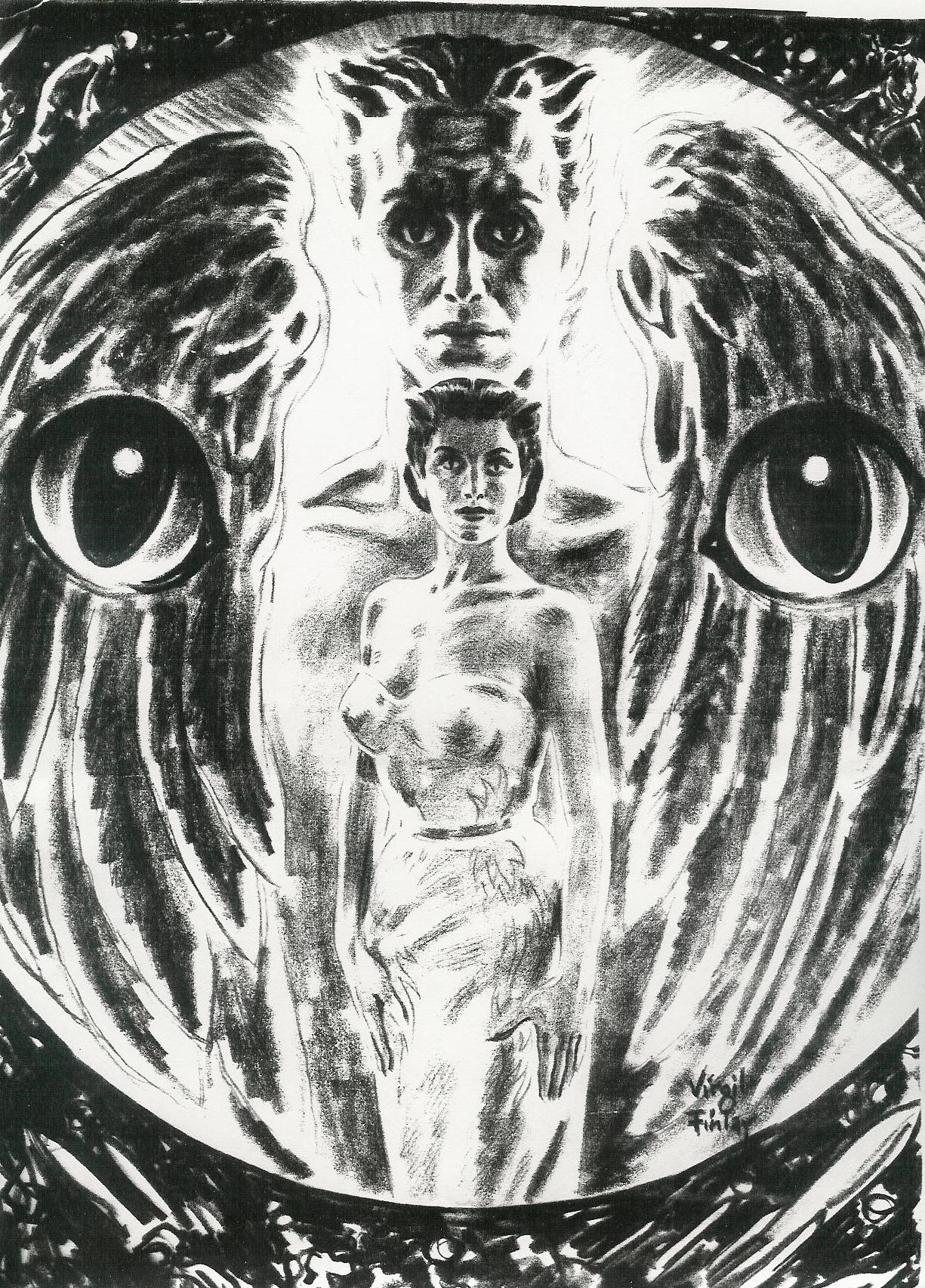
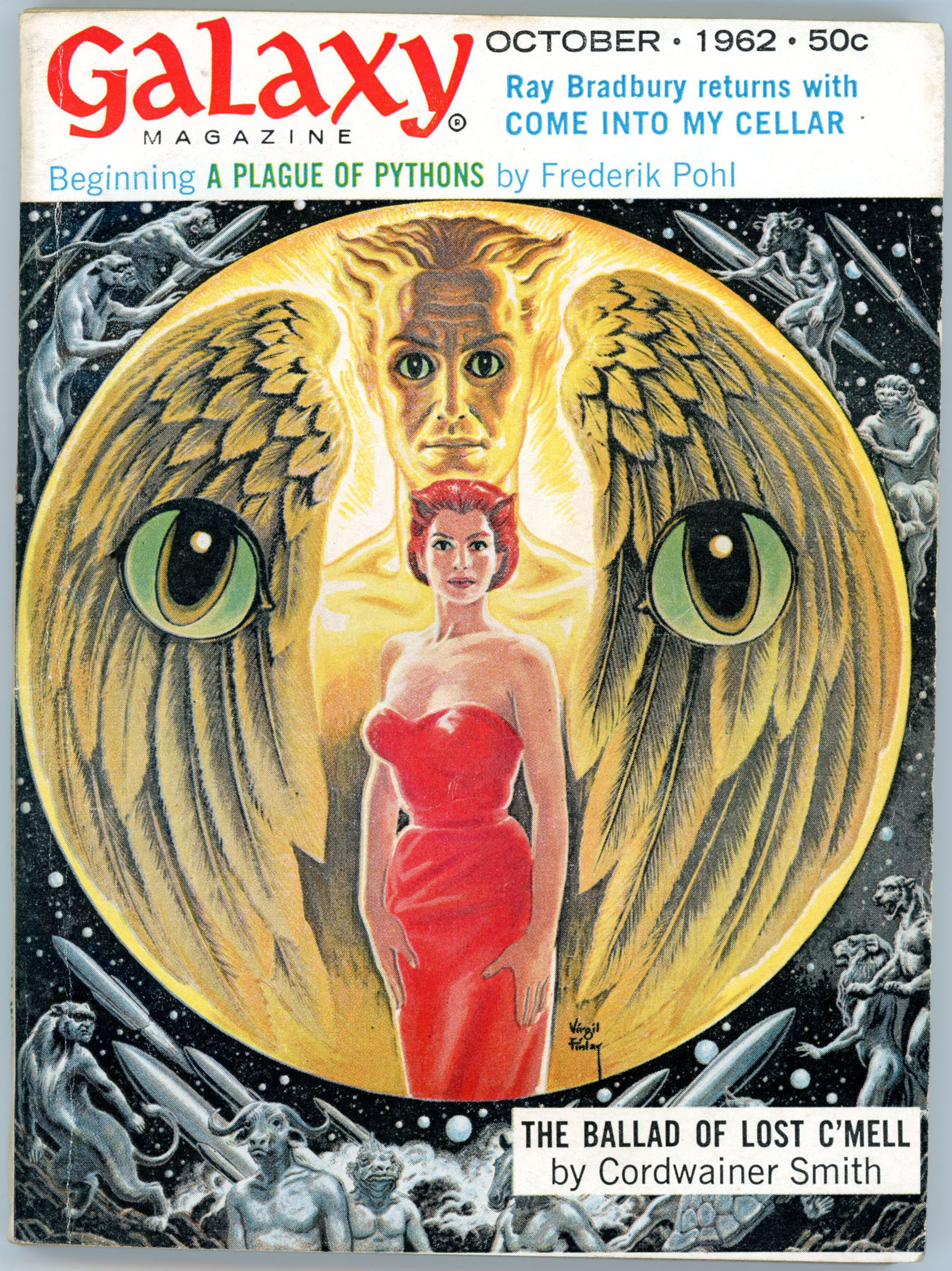
The images below present Virgil Finlay’s interpretation of Cordwainer Smith’s character C’Mell, from the wonderful tale “The Ballad of Lost C’Mell”, as depicted on the cover and as the lead interior illustration of the October, 1962, issue of Galaxy Science Fiction.     

“This” post being one of my earlier (earliest?) at WordsEnvisioned (dating back to April of 2017 – hey, time not only flies, it accelerates!), I thought it worthy of revision. 

So, I perused the web for other images of C’Mell, of which there are many, inevitably varying in style, quality, and appeal. 

And, I found what I was searching for. 

One of the most interesting interpretations of C’Mell can be viewed at BlueTyson’s Cordwainer Smith (ology).  The site features an imaginative and subtle portrait of Smth’s character, which – with a kind of animae look – strikingly emphasizes C’Mell’s cat origin, specifically via brilliantly green feline eyes.  (Pointed cat ears? – not so much!)  The portrait, created by artist Lia Chan, appears (?) to have been created using a combination of colored pencils and water color.       

Lia Chan’s depiction of C’Mell has been appended to this post, and appears below Finlay’s black & white interior illustration from Galaxy

Scroll on down… 

She got the which of the what-she-did,
Hid the bell with a blot, she did,
But she fell in love with a hominid.
Where is the which of the what-she-did?

(Cordwainer Smith)

______________________________

Illustrations by Virgil Finlay

______________________________

Preliminary sketch for cover art.  Source unknown – possibly (!) from “Virgil Finlay-Beauty (& occ. beast)“, at pinterest.

______________________________

Image from “Tomorrow & Beyond – Images from other worlds, other dimensions and other times.”

______________________________

The finished product, published as the cover of Galaxy Science Fiction, October, 1962.

______________________________

C’mell: page 9

______________________________

C’Mell, by Lia Chan

Mockingbird, by Walter S. Tevis – April, 1981 (1980) [Unknown Artist]

“When the drugs and the television were perfected by the computers that made and distributed them, the cars were no longer necessary. 
And since no one had devised a way of making cars safe in the hands of a human driver,
it was decided to discontinue them.”

“Who made that decision?” I said.

“I did.  Solange and I. 
It was the last time I saw him. 
He threw himself off of a building.”

“Jesus,” I said. 
“And then, “When I was a little girl there were no cars. 
But Simon could remember them. 
So that was when thought buses were invented?”

“No.  Thought-buses had been around since the twenty-second century. 
In fact there had been buses, driven by human drivers in the twentieth. 
And trolley cars and trains. 
Most big cities in North America had what were called streetcars at the start of the twentieth century.”

“What happened to them?”

“The automobile companies got rid of them. 
Bribes were paid to city managers to tear up the streetcar tracks,
and advertisements were bought in newspapers to convince the public that it should be done. 
So more cars could be sold, and more oil would be made into gasoline, to be burned in the cars. 
So that corporations could grow,
and so a few people could become incredibly rich,
and have servants, and live in mansions. 
It changed the life of mankind more radically than the printing press. 
It created suburbs and a hundred other dependencies –
sexual and economic and narcotic –
upon the automobile. 
And the automobile prepared the wat for the more profound –
more inward –
dependencies upon television and then robots and, finally,
the ultimate and predictable conclusion of all of it:
the perfection of the chemistry of the mind. 
The drugs your fellow humans use are named after twentieth-century ones;
but they are far more potent,
far better at what they do,
and they are all made and distributed –
distributed everywhere there are human beings – by automatic equipment.” 
He looked over at me from his armchair. 
“It all began, I suppose, with learning to build fires –
to warm the cave and keep the predators out. 
And it ended with time-release Valium.”
I looked at him for a minute. 
“I don’t take Valium,” I said.  (176-177)

Rendezvous With Rama, by Arthur C. Clarke – September, 1974 [Vincent di Fate – ?]

Though not as well known as the novel 2001: A Space Odyssey, which in 1968 was released in parallel with Stanley Kubrick’s groundbreaking film of the same name, Arthur C. Clarke’s 1973 Rendezvous With Rama is still based upon a basic theme of the former: Humanity’s first encounter with an extraterrestrial civilization.  However, Rendezous is vastly simpler in terms of plot and “story-line”, lying much more in the realm of straightforward exploration and purely descriptive “hard” science fiction than 2001.  Nevertheless, the product of Clarke’s literary skill and imagination was (and is) an engrossing, fast-paced, fascinating story, albeit a tale without a definitive conclusion or transformation – whether physical or psychological – of its central characters.

Ballantine Books followed an interesting route for the design of the 1974 (September publication; the hardcover edition was published in 1973) paperback edition of Rama.  Rather than using rectangular / vertical format cover art, so typical of and natural to the typical book, Rama’s cover (bearing the author’s name, book title, and reference to Clarke’s earlier works) features a circular “window” showing a glimpse of the interior of Rama (the alien spacecraft, not the book!). 

Upon opening the cover, the not-so-cover art visible through the circular “window” is revealed to be part of a square-format foldout showing Rama’s interior.

Here’s the book’s cover…*

….and, here’s the book’s interior art, fully opened.  Note the figures of the three astronauts in the left foregound.  Based on the image’s perspective and the scale of features in the scene, the figures seem vastly too large, but, they do impart a sense of wonder.

Unfortunately, neither the book’s title page nor the art itself present the artist’s name.  (Why – ? – ! – ?)  However – – – based on the painting’s combination of technology and human figures, and visually literal (rather than abstract / stylistic, such as the works of John Schoenherr or Jack Gaughan) rendering of the scene, it seems – that the painting was created by Vincent Di Fate.

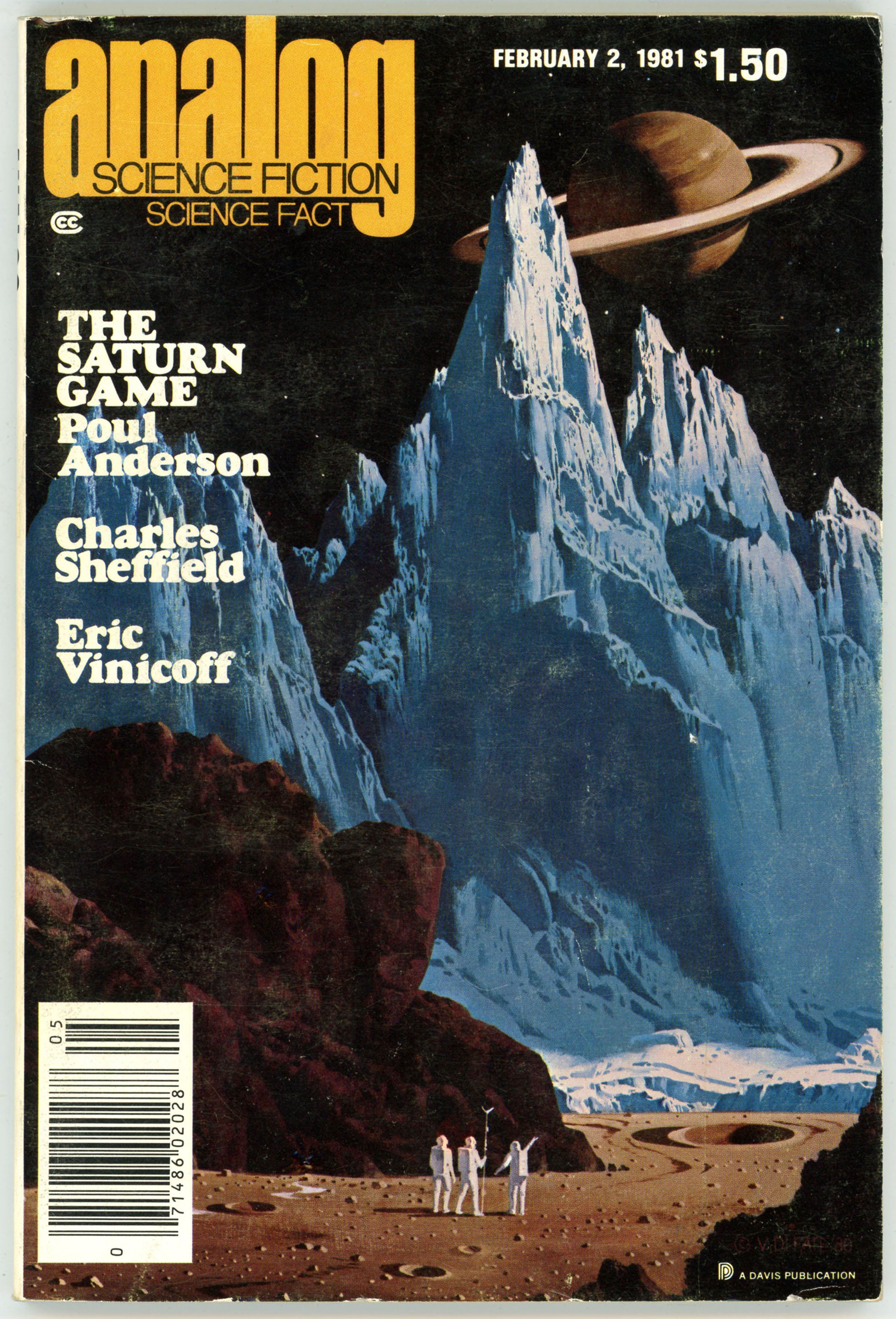
If so (I think so…) as evidence, here are two DiFate covers from Analog Science Fiction – Science Fact, the first from March of 1980 and the second from February of 1981, that have the same general style as the cover of Rama.

Analog Science Fiction – Science Fact, March, 1980

“Worlds in the Clouds”, by Bob Buckley

________________________________________

Analog Science Fiction – Science Fact, February, 1981

“The Saturn Game”, by Poul Anderson

I hope to rendezvous with the works of other science-fiction artists in future posts…

Reference

Rendezvous with Rama (Ballantine Books catalog number 25288), at Internet Speculative Fiction Database

* I’m using “this” image, found via Duck-Duck-Go, instead of my personal copy of the book, because my copy has become rather – ? – ragged around the edges (and beyond!) – over the past 45 years!

Men, Martians and Machines, by Eric Frank Russell – May, 1965 (1958) [Paul Lehr?]

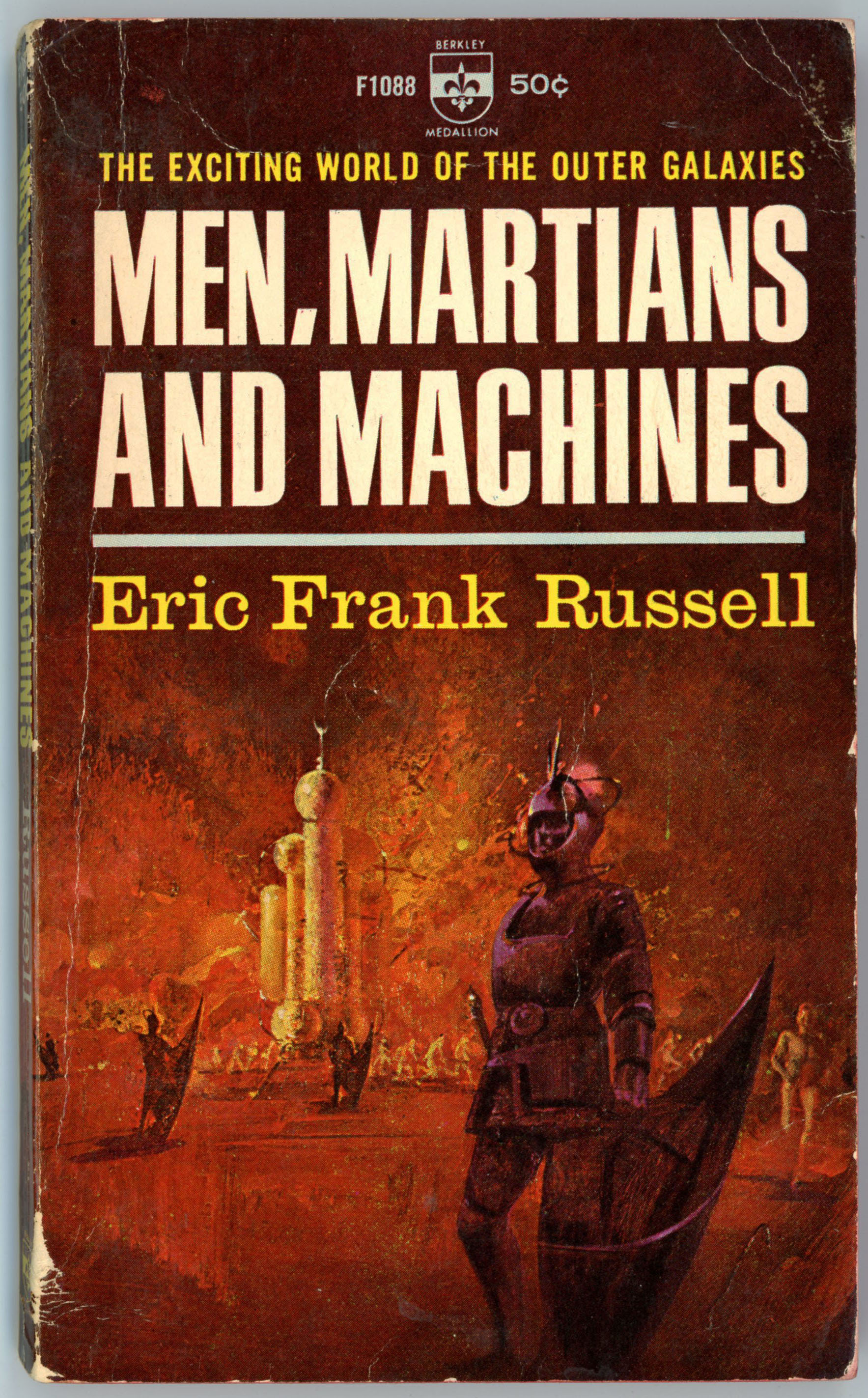
“The exciting world of the outer galaxies”

Though the artist’s name is absent from both the cover and copyright pages of Eric Frank Russell’s Men, Martians and Machines, the cover art is almost certainly by Paul Lehr. 

The appearance and presentation of the human figures (only one figure in the foreground, with several vaguely defined figures in the background), the scene’s limited range of colors, and the visual “softness” – versus the crispness and detail inherent to the works of Emsh (Edmund Emshwiller) – is consistent with Lehr’s art. 

Contents

Jay Score, from Astounding Science Fiction, May, 1941

Mechanistria, from Astounding Science Fiction, January, 1942

Symbiotica, from Astounding Science Fiction, October, 1943

Mesmerica (first publication)

VOYAGE OF THE MARATHON

“Even at the time when space ships were making regular voyages across the universe, the MARATHON was a remarkable craft.  Powered by the Flettner system, its speed was so great that for the first time exploration of the outer galaxies was made possible.

MEN, MARTIANS AND MACHINES describes some of the great voyages made by the MARATHON.  There was, for example, the planet which was solely inhabited by machines – survivors, perhaps, from a civilization in which the first machine-makers had perished.  On another planet, the inhabitants had developed the power of hypnotism to a fantastic degree, so that the observer saw only what he was willed to see.”

References

Men, Martians and Machines, at Internet Speculative Fiction Database

Men, Martians and Machines, at Wikipedia

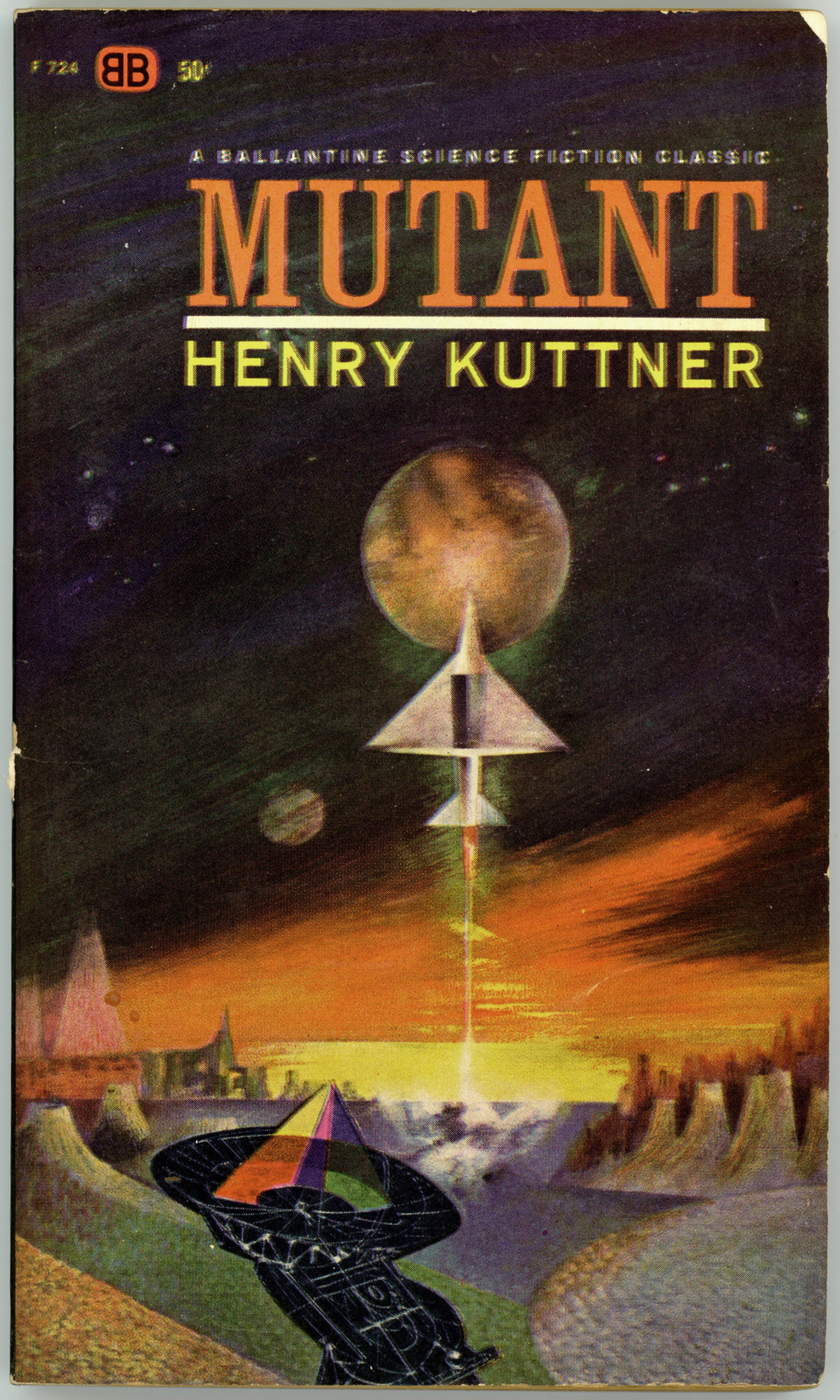
Mutant, by Henry Kuttner – 1963 (1953) [Unknown Artist]

This cover, for Ballantine’s 1963 edition of Henry Kuttner’s Mutant, is a bit of a mystery: The artist’s name is absent from both the book’s exterior and interior, while his (her?) identity is similarly absent in the Internet Speculative Fiction Database.

The radio telescope at the bottom of the cover appears in a style – simple lines and bold colors – somewhat akin to that seen in the works of wildlife artist Charley Harper.  But, there’s no way to tell, for sure.  Regardless, though the cover is certainly not the most striking science-fiction paperback cover, it is representative of the genre’s art of the early 1960s.

On a side note, only after scanning the cover was it noticed that the cover art – specifically the very text “A Ballantine Science Fiction Classic”, “Mutant”, and “Henry Kuttner” – were all printed out of alignment.  (Oops!)

Otherwise, curiously, while the author’s name is given on the cover as Henry Kuttner, within the issues of Astounding Science Fiction where the book’s five stories first appeared, the author’s name is given as – “Lewis Padgett” – the pen-name for the collaborative efforts of Henry Kuttner and his wife, Catherine L. Moore (the latter, one of my favorite authors).
Here’s a close-up of the radio telescope…

Contents (credited to Lewis Padgett)

The Piper’s Son, from Astounding Science Fiction, February, 1945

Three Blind Mice, from Astounding Science Fiction, June, 1945

The Lion and The Unicorn, from Astounding Science Fiction, July, 1945

Beggars in Velvet, from Astounding Science Fiction, December, 1945

Humpty Dumpty, from Astounding Science Fiction, September, 1953

The cover art of the original, hardcover, Gnome Press, Inc., edition of Mutant is show below, while the descriptive text inside the front and rear covers follows.  Note that this cover was done by the (relatively) little-known Ric Binkley, who created the cover art for the 1953 Gnome Press edition of Isaac Asimov’s Second Foundation.  (This image was found via a web search, thus, this particular book, unlike the great majority displayed at this blog, isn’t actually in my collection.)  A small reproduction of this cover also appears on page 195 of Brian Ash’s 1977 The Visual Encyclopedia of Science Fiction.

From jacket of hardcover edition…

Sometime during the next century a mutant will crash high up in a chain of snowcapped mountains. 
He will crawl from the wreckage of his ship,
frown at the jagged ridge of cliffs that surrounds him,
and then send out his thoughts, probing,
seeking he reassuring touch of the minds which unite with his to give life its fullest meaning. 
And he will touch … nothing … but the echoing emptiness of his own isolated thoughts. 
Alone. 
He will lie in the snows, delirious, semi-conscious,
and try to keep from freezing by calling up,
from the deepest wells of his race’s memories,
the cherished stories of the great Baldy minds who led their kind out of the valley of danger.

And he will remember, as though it happened before his weary eyes,
how the great Blowup came and wiped out mankind’s civilization almost overnight,
leaving only huge radioactive sores (the graves of cities) over the face of the earth. 
How, near these shunned areas, were born the first Baldies,
hated and feared by normal human survivors
because they were completely hairless and telepathic.

In his delirium the castaway will relive the tense lives of the first sane Baldies,
like Al Burkhalter, who tried to live peacefully
by wearing a big smile and respecting the intimate privacy of their minds. 
How other menacing Baldies appeared, paranoids,
who insisted that all the normal humans must be wiped out for the survival of the Baldy race.

He will recall how this incredibly tense,
secret struggle between the sane and paranoid Baldies threatened,
at any time,
to ignite the great pogrom – the wiping out of all Baldies by the normal kind. 

And how this silent conflict gave meaning to the life of the piper’s son;
to David Barton, Baldy naturalist, collector of big and little game,
who had to destroy the menace of the three blind mice;
to McNey who found a way to combat the powerful paranoids and died to conceal it;
to Harry Burkhalter, grandson of Al Burkhalter,
who became a Mute to aid his people’s cause when the great pogrom took place;
and to the Baldies who sought desperately for the means to give the power of telepathy –
the Baldy’s cross, and yet his crown – to the normal humans,
so that both kinds might live peaceful and trusting lives.

The mutant will life frozen in the mountain-snows
and know the outcome of that great attempt as his life fades like a dying flame
and as rescuing helicopters descend to extend a helping hand.

– MUTANT is probably one of the most important and skillful science fiction novels written yet by a contemporary author.

______________________________

And, Mutant’s rear cover, showing 1953 prices for books written by such authors as Arthur C. Clarke (Against the Fall of Night), Hal Clement (Iceworld), Isaac Asimov (Second Foundation), Clifford D. Simak (City), and A.E. van Vogt (The Mixed Men), as well as several anthologies. 

All between $2.50 and $3.95…!  (? – !)

References

Mutant, at Internet Speculative Fiction Database

Ash, Brian (editor), The Visual Encyclopedia of Science Fiction, Harmony Books, New York, N.Y., 1977
Star Science Fiction Stories No. 1, Edited by Frederik Pohl – 1953 (1961) [Richard M. Powers] [Revised post]

I first posted these cover images in June of 2017.  After “re-visiting” this post, I wanted to display more of the detail in Powers’ art.  So, the two close-ups, below… 

______________________________

A space explorer.  Though Powers incorporates a measure of attention to the astronaut’s suit (note the very fine detail in the antenna, and the orange gripping claw extending from the figure’s left hand), he places more emphasis on shapes, curves, and contrasting colors.  The greenish yellow-hue of the suit is particularly effective against the reddish-purple sky. 

Contents

Country Doctor, by William Morrison

Dominoes, by Cyril M. Kornbluth

Idealist, by Lester del Rey

The Night He Cried, by Fritz Leiber

Contraption, by Clifford D. Simak

The Chronoclasm, by John Wyndham

The Deserter, by William Tenn

The Man With English, by Horace L. Gold

So Proudly We Hail, by Judith Merril

A Scent of Sarsaparilla, by Ray Bradbury

“Nobody Here But”, by Isaac Asimov

The Last Weapon, by Robert Sheckley

A Wild Surmise, by Henry Kuttner and Catherine L. Moore

The Journey, by Murray Leinster

The Nine Billion Names of God, by Arthur C. Clarke

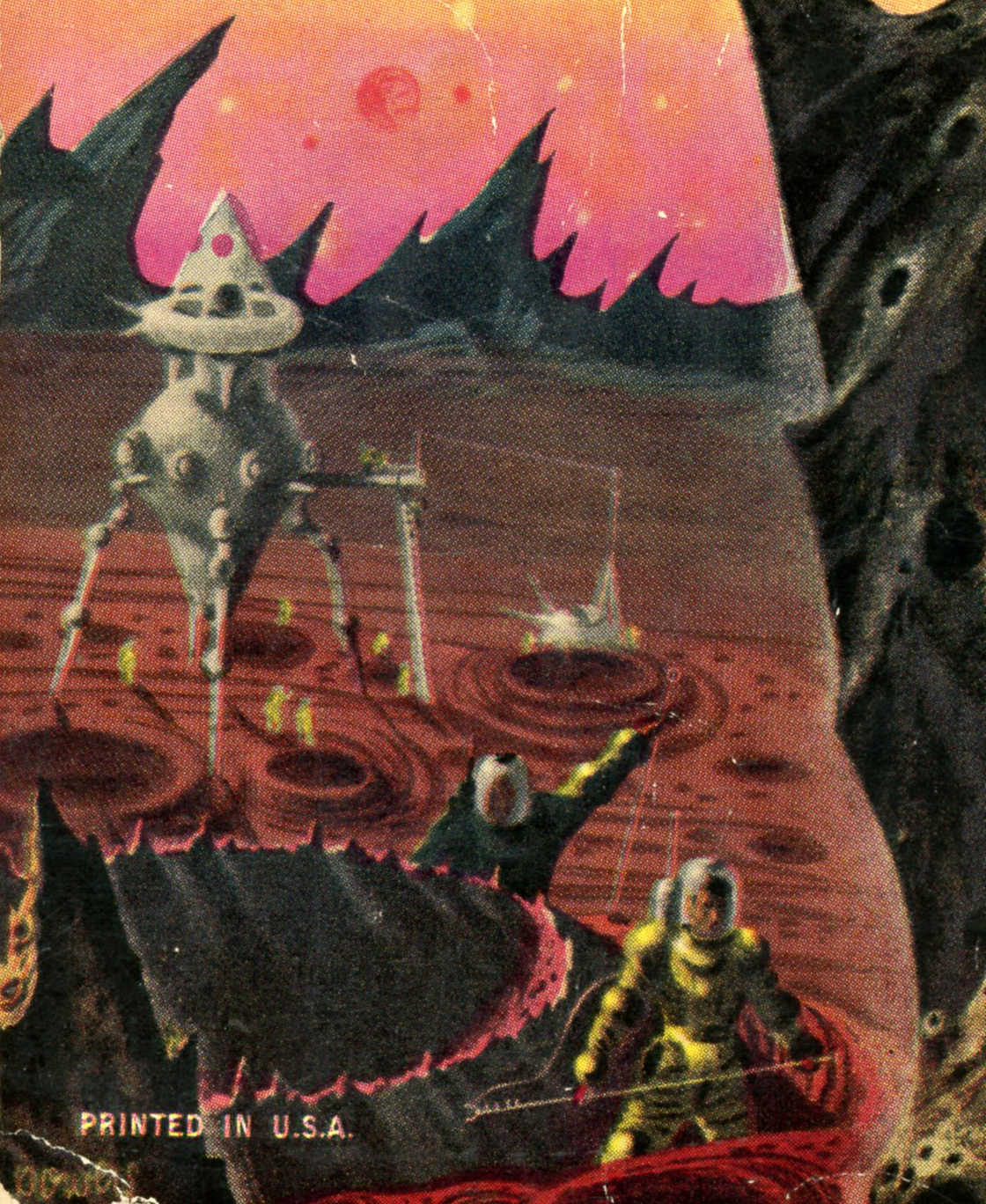
A closer look at the back cover.  A spider-like spacecraft (again, Powers’ emphasis on curved, semi-organic shapes) rests on a crater-pocked surface in shades of red, carmine, and brown, while a group of explorers climb a nearby hillside.  Perhaps they’re joining their friend, on the front cover?

Notice that the sky is finished in tones of purple, through, pink, through orange, unlike the image appearing above.  That’s because this image is actually from the 1953 (first edition) of Volume 1 of Star Science Fiction, while on the rear cover of the 1961 reprint (both of the cover images in this post) the sky is white.