Mockingbird, by Walter S. Tevis – April, 1981 (1980) [Unknown Artist]

“When the drugs and the television were perfected by the computers that made and distributed them, the cars were no longer necessary. 
And since no one had devised a way of making cars safe in the hands of a human driver,
it was decided to discontinue them.”

“Who made that decision?” I said.

“I did.  Solange and I. 
It was the last time I saw him. 
He threw himself off of a building.”

“Jesus,” I said. 
“And then, “When I was a little girl there were no cars. 
But Simon could remember them. 
So that was when thought buses were invented?”

“No.  Thought-buses had been around since the twenty-second century. 
In fact there had been buses, driven by human drivers in the twentieth. 
And trolley cars and trains. 
Most big cities in North America had what were called streetcars at the start of the twentieth century.”

“What happened to them?”

“The automobile companies got rid of them. 
Bribes were paid to city managers to tear up the streetcar tracks,
and advertisements were bought in newspapers to convince the public that it should be done. 
So more cars could be sold, and more oil would be made into gasoline, to be burned in the cars. 
So that corporations could grow,
and so a few people could become incredibly rich,
and have servants, and live in mansions. 
It changed the life of mankind more radically than the printing press. 
It created suburbs and a hundred other dependencies –
sexual and economic and narcotic –
upon the automobile. 
And the automobile prepared the wat for the more profound –
more inward –
dependencies upon television and then robots and, finally,
the ultimate and predictable conclusion of all of it:
the perfection of the chemistry of the mind. 
The drugs your fellow humans use are named after twentieth-century ones;
but they are far more potent,
far better at what they do,
and they are all made and distributed –
distributed everywhere there are human beings – by automatic equipment.” 
He looked over at me from his armchair. 
“It all began, I suppose, with learning to build fires –
to warm the cave and keep the predators out. 
And it ended with time-release Valium.”
I looked at him for a minute. 
“I don’t take Valium,” I said.  (176-177)

Rendezvous With Rama, by Arthur C. Clarke – September, 1974 [Vincent di Fate – ?]

Though not as well known as the novel 2001: A Space Odyssey, which in 1968 was released in parallel with Stanley Kubrick’s groundbreaking film of the same name, Arthur C. Clarke’s 1973 Rendezvous With Rama is still based upon a basic theme of the former: Humanity’s first encounter with an extraterrestrial civilization.  However, Rendezous is vastly simpler in terms of plot and “story-line”, lying much more in the realm of straightforward exploration and purely descriptive “hard” science fiction than 2001.  Nevertheless, the product of Clarke’s literary skill and imagination was (and is) an engrossing, fast-paced, fascinating story, albeit a tale without a definitive conclusion or transformation – whether physical or psychological – of its central characters.

Ballantine Books followed an interesting route for the design of the 1974 (September publication; the hardcover edition was published in 1973) paperback edition of Rama.  Rather than using rectangular / vertical format cover art, so typical of and natural to the typical book, Rama’s cover (bearing the author’s name, book title, and reference to Clarke’s earlier works) features a circular “window” showing a glimpse of the interior of Rama (the alien spacecraft, not the book!). 

Upon opening the cover, the not-so-cover art visible through the circular “window” is revealed to be part of a square-format foldout showing Rama’s interior.

Here’s the book’s cover…*

….and, here’s the book’s interior art, fully opened.  Note the figures of the three astronauts in the left foregound.  Based on the image’s perspective and the scale of features in the scene, the figures seem vastly too large, but, they do impart a sense of wonder.

Unfortunately, neither the book’s title page nor the art itself present the artist’s name.  (Why – ? – ! – ?)  However – – – based on the painting’s combination of technology and human figures, and visually literal (rather than abstract / stylistic, such as the works of John Schoenherr or Jack Gaughan) rendering of the scene, it seems – that the painting was created by Vincent Di Fate.

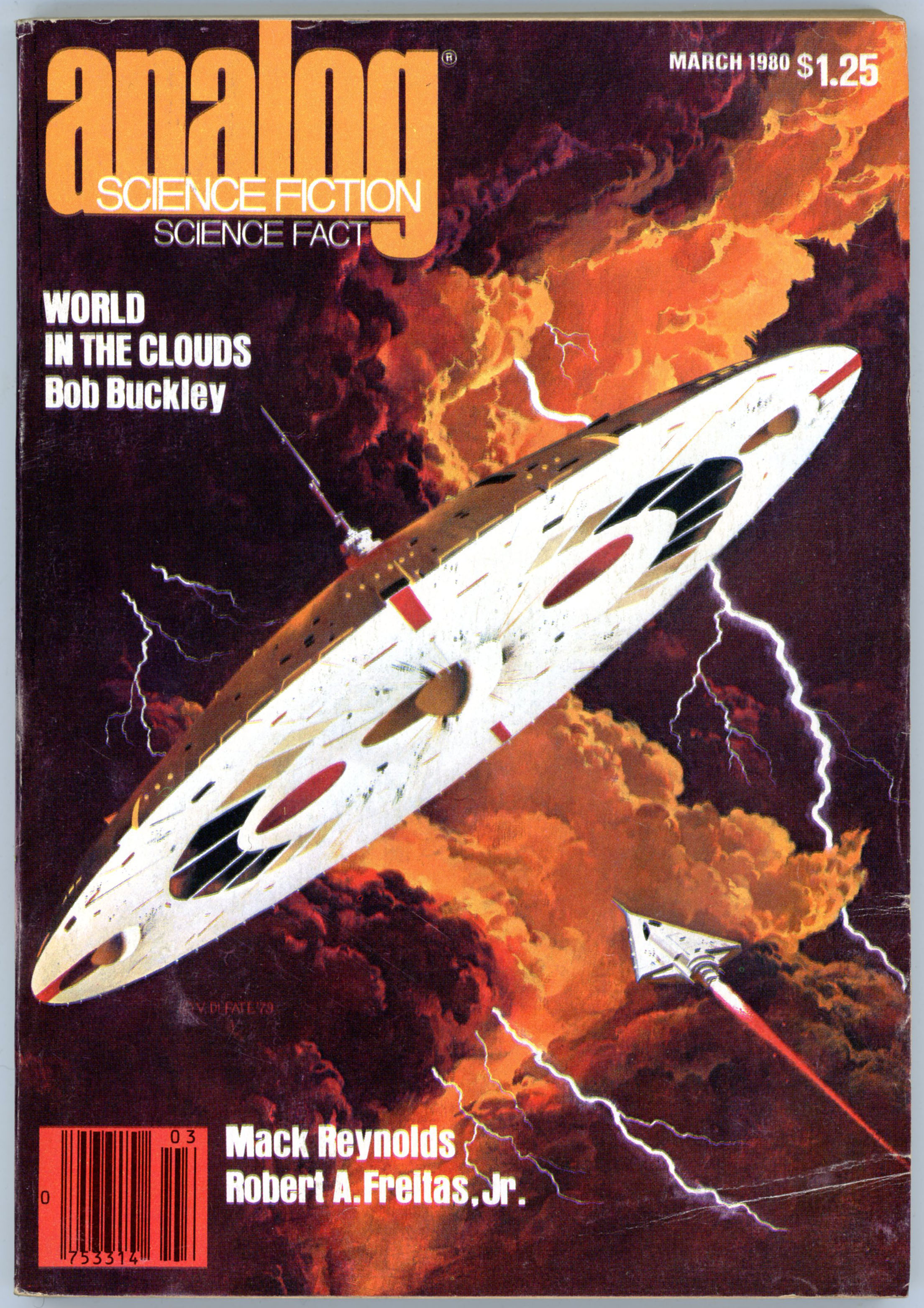
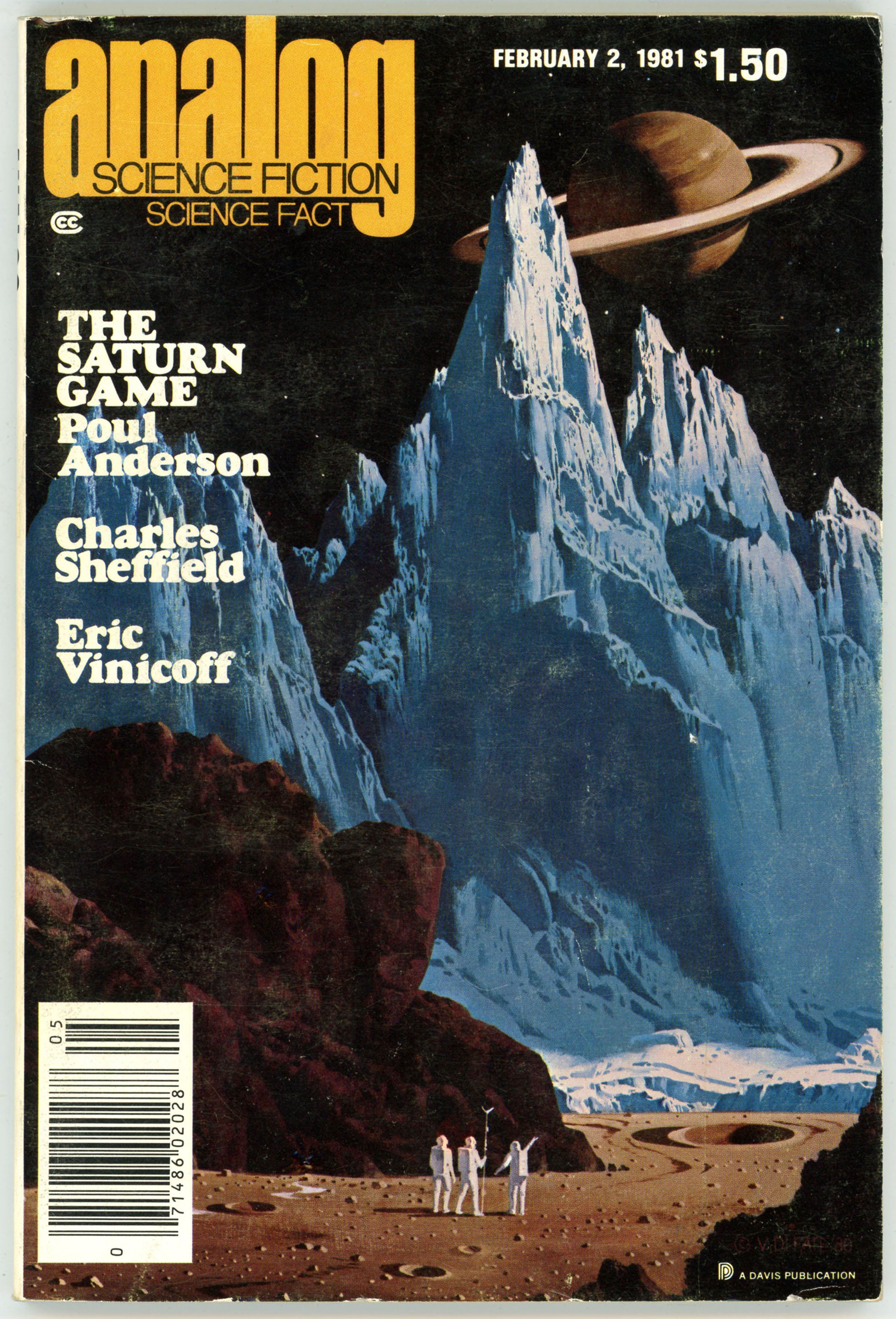
If so (I think so…) as evidence, here are two DiFate covers from Analog Science Fiction – Science Fact, the first from March of 1980 and the second from February of 1981, that have the same general style as the cover of Rama.

Analog Science Fiction – Science Fact, March, 1980

“Worlds in the Clouds”, by Bob Buckley

________________________________________

Analog Science Fiction – Science Fact, February, 1981

“The Saturn Game”, by Poul Anderson

I hope to rendezvous with the works of other science-fiction artists in future posts…

Reference

Rendezvous with Rama (Ballantine Books catalog number 25288), at Internet Speculative Fiction Database

* I’m using “this” image, found via Duck-Duck-Go, instead of my personal copy of the book, because my copy has become rather – ? – ragged around the edges (and beyond!) – over the past 45 years!

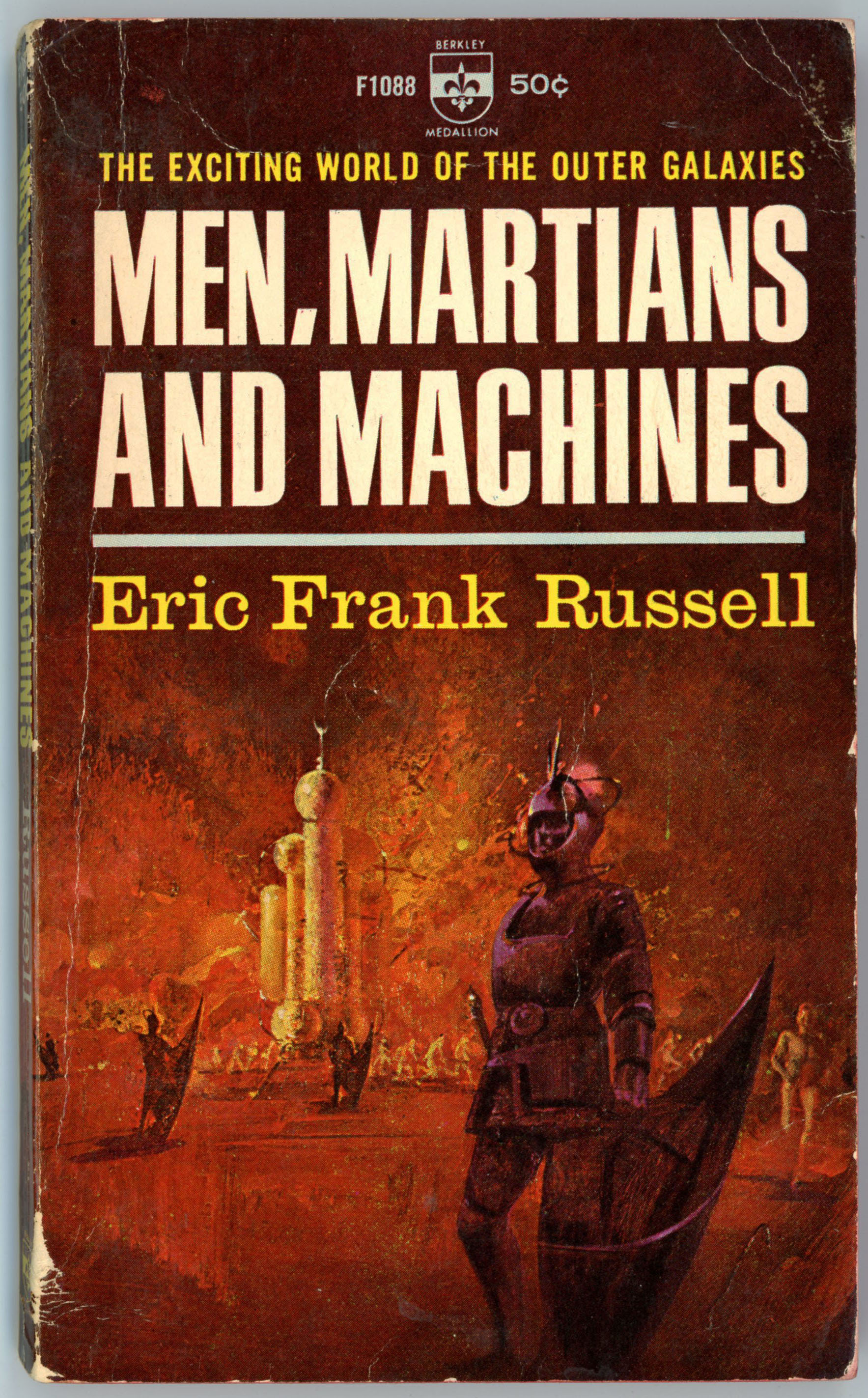
Men, Martians and Machines, by Eric Frank Russell – May, 1965 (1958) [Paul Lehr?]

“The exciting world of the outer galaxies”

Though the artist’s name is absent from both the cover and copyright pages of Eric Frank Russell’s Men, Martians and Machines, the cover art is almost certainly by Paul Lehr. 

The appearance and presentation of the human figures (only one figure in the foreground, with several vaguely defined figures in the background), the scene’s limited range of colors, and the visual “softness” – versus the crispness and detail inherent to the works of Emsh (Edmund Emshwiller) – is consistent with Lehr’s art. 

Contents

Jay Score, from Astounding Science Fiction, May, 1941

Mechanistria, from Astounding Science Fiction, January, 1942

Symbiotica, from Astounding Science Fiction, October, 1943

Mesmerica (first publication)

VOYAGE OF THE MARATHON

“Even at the time when space ships were making regular voyages across the universe, the MARATHON was a remarkable craft.  Powered by the Flettner system, its speed was so great that for the first time exploration of the outer galaxies was made possible.

MEN, MARTIANS AND MACHINES describes some of the great voyages made by the MARATHON.  There was, for example, the planet which was solely inhabited by machines – survivors, perhaps, from a civilization in which the first machine-makers had perished.  On another planet, the inhabitants had developed the power of hypnotism to a fantastic degree, so that the observer saw only what he was willed to see.”

References

Men, Martians and Machines, at Internet Speculative Fiction Database

Men, Martians and Machines, at Wikipedia

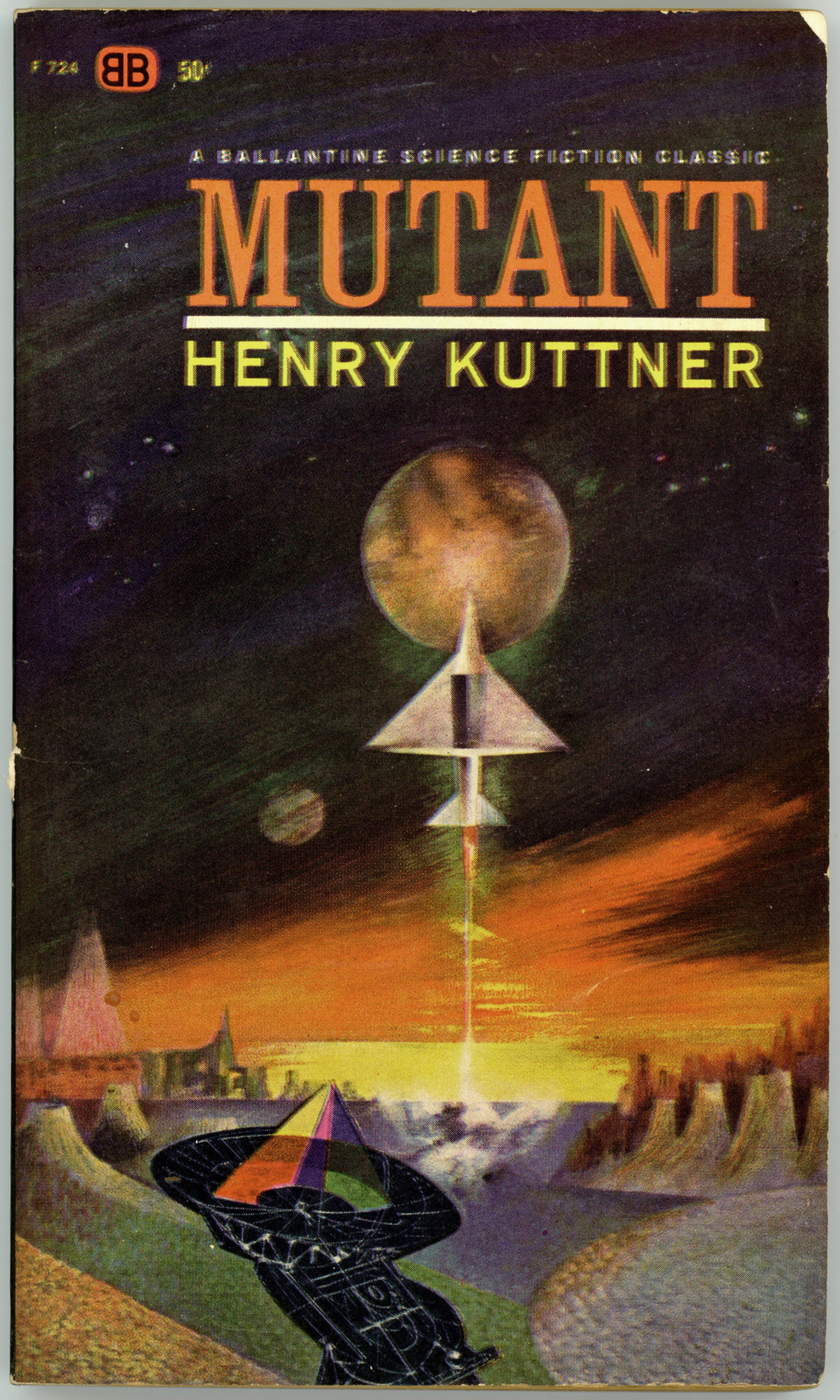
Mutant, by Henry Kuttner – 1963 (1953) [Unknown Artist]

This cover, for Ballantine’s 1963 edition of Henry Kuttner’s Mutant, is a bit of a mystery: The artist’s name is absent from both the book’s exterior and interior, while his (her?) identity is similarly absent in the Internet Speculative Fiction Database.

The radio telescope at the bottom of the cover appears in a style – simple lines and bold colors – somewhat akin to that seen in the works of wildlife artist Charley Harper.  But, there’s no way to tell, for sure.  Regardless, though the cover is certainly not the most striking science-fiction paperback cover, it is representative of the genre’s art of the early 1960s.

On a side note, only after scanning the cover was it noticed that the cover art – specifically the very text “A Ballantine Science Fiction Classic”, “Mutant”, and “Henry Kuttner” – were all printed out of alignment.  (Oops!)

Otherwise, curiously, while the author’s name is given on the cover as Henry Kuttner, within the issues of Astounding Science Fiction where the book’s five stories first appeared, the author’s name is given as – “Lewis Padgett” – the pen-name for the collaborative efforts of Henry Kuttner and his wife, Catherine L. Moore (the latter, one of my favorite authors).
Here’s a close-up of the radio telescope…

Contents (credited to Lewis Padgett)

The Piper’s Son, from Astounding Science Fiction, February, 1945

Three Blind Mice, from Astounding Science Fiction, June, 1945

The Lion and The Unicorn, from Astounding Science Fiction, July, 1945

Beggars in Velvet, from Astounding Science Fiction, December, 1945

Humpty Dumpty, from Astounding Science Fiction, September, 1953

The cover art of the original, hardcover, Gnome Press, Inc., edition of Mutant is show below, while the descriptive text inside the front and rear covers follows.  Note that this cover was done by the (relatively) little-known Ric Binkley, who created the cover art for the 1953 Gnome Press edition of Isaac Asimov’s Second Foundation.  (This image was found via a web search, thus, this particular book, unlike the great majority displayed at this blog, isn’t actually in my collection.)  A small reproduction of this cover also appears on page 195 of Brian Ash’s 1977 The Visual Encyclopedia of Science Fiction.

From jacket of hardcover edition…

Sometime during the next century a mutant will crash high up in a chain of snowcapped mountains. 
He will crawl from the wreckage of his ship,
frown at the jagged ridge of cliffs that surrounds him,
and then send out his thoughts, probing,
seeking he reassuring touch of the minds which unite with his to give life its fullest meaning. 
And he will touch … nothing … but the echoing emptiness of his own isolated thoughts. 
Alone. 
He will lie in the snows, delirious, semi-conscious,
and try to keep from freezing by calling up,
from the deepest wells of his race’s memories,
the cherished stories of the great Baldy minds who led their kind out of the valley of danger.

And he will remember, as though it happened before his weary eyes,
how the great Blowup came and wiped out mankind’s civilization almost overnight,
leaving only huge radioactive sores (the graves of cities) over the face of the earth. 
How, near these shunned areas, were born the first Baldies,
hated and feared by normal human survivors
because they were completely hairless and telepathic.

In his delirium the castaway will relive the tense lives of the first sane Baldies,
like Al Burkhalter, who tried to live peacefully
by wearing a big smile and respecting the intimate privacy of their minds. 
How other menacing Baldies appeared, paranoids,
who insisted that all the normal humans must be wiped out for the survival of the Baldy race.

He will recall how this incredibly tense,
secret struggle between the sane and paranoid Baldies threatened,
at any time,
to ignite the great pogrom – the wiping out of all Baldies by the normal kind. 

And how this silent conflict gave meaning to the life of the piper’s son;
to David Barton, Baldy naturalist, collector of big and little game,
who had to destroy the menace of the three blind mice;
to McNey who found a way to combat the powerful paranoids and died to conceal it;
to Harry Burkhalter, grandson of Al Burkhalter,
who became a Mute to aid his people’s cause when the great pogrom took place;
and to the Baldies who sought desperately for the means to give the power of telepathy –
the Baldy’s cross, and yet his crown – to the normal humans,
so that both kinds might live peaceful and trusting lives.

The mutant will life frozen in the mountain-snows
and know the outcome of that great attempt as his life fades like a dying flame
and as rescuing helicopters descend to extend a helping hand.

– MUTANT is probably one of the most important and skillful science fiction novels written yet by a contemporary author.

______________________________

And, Mutant’s rear cover, showing 1953 prices for books written by such authors as Arthur C. Clarke (Against the Fall of Night), Hal Clement (Iceworld), Isaac Asimov (Second Foundation), Clifford D. Simak (City), and A.E. van Vogt (The Mixed Men), as well as several anthologies. 

All between $2.50 and $3.95…!  (? – !)

References

Mutant, at Internet Speculative Fiction Database

Ash, Brian (editor), The Visual Encyclopedia of Science Fiction, Harmony Books, New York, N.Y., 1977
The Science Fiction Stories of Rudyard Kipling, edited by John Brunner – 1994 [Kevin Kelly]

Unlike the majority of science fiction paperbacks that I’ve thus far presented, Citadel Twilight’s the Science Fiction Stories of Rudyard Kipling is a trade paperback, of physically larger format than a conventional paperback.

More importantly, the book’s content: Given the era during which the stories in the book were composed – the late 1880s through 1930 – Rudyard Kipling’s tales have a strikingly different literary style than “Golden Age”, let alone contemporary, science fiction.  The stories emphasize descriptions of technology and physical setting far more than a narrative of action (albeit, action there is), and place less emphasis on character development than character interaction. 

While I cannot characterize the stories as memorable, I certainly can characterize them as interesting.   

In terms of the book’s art, none of Kipling’s stories mention, allude to, or remotely hint at a trio of flying saucers (let alone a solitary flying dinner plate) as illustrated on the cover.  Perhaps this art was chosen to simply lend the book’s cover a dramatic and attractive “science fiction” air. 

Otherwise, the skyline of the flaming city reminds me vastly less of London, than – perhaps?! – an early twentieth century American metropolis…

Contents

Kipling’s Major Publications – uncredited essay

About Rudyard Kipling – essay by John Brunner

“A Matter of Fact”, from The People, January 24, 1892, later in Many Inventions (1893)

“The Ship That Found Herself”, from The Idler, December, 1895, later in The Day’s Work (1898)

“.007”, first published as “.007: The Story of an American Locomotive”, in Scribner’s Magazine, August, 1897, later in The Day’s Work (1898)

“Wireless”, from Traffics and Discoveries, 1904 (possibly first published August, 1902)

“With the Night Mail”, from McClure’s, November, 1905

“As Easy As A.B.C.”, first published as “As Easy as A.B.C.”: A Tale of 2150 A.D.”, from The London Magazine, March – April, 1912, later in A Diversity of Creatures, April 17 and 27, 1917

“In the Same Boat”, from a Diversity of Creatures, April 17 and 27, 1917 (possibly first published December, 1911)

“The Eye of Allah”, from The Strand Magazine, September, 1926

“Unprofessional”, from Limits and Rewards, 1932 (possibly first published October, 1930)

“The Fairies’ Siege”, 1901, first published in John Brunner Presents Rudyard Kipling’s Science Fiction, October, 1992

Reference

The Science Fiction Stories of Rudyard Kipling, at Internet Speculative Fiction Database

Six Great Short Science Fiction Novels, edited by Groff Conklin – November, 1960 [Richard M. Powers]

This colorful cover to a Groff Conklin 1960 anthology (one of his many anthologies) is a nice representation of Richard Powers’ work.  The layout of his cover design was probably designed to allow for open space for the names of Simak, MacLean, Merril, Asimov, Knight, and Budrys.  

On the cover?  The figure of an astronaut, set against an alien sky in hues of blue, green, and violet, with a few busy red stars in the background, occupies the center of the page.  Like many of the human figures featured in Powers’ science-fiction covers, on close inspection, the astronaut – carrying a long-something-or-other, actually resembles a medieval knight far more than a space explorer. 

The remainder of the cover is simpler:  There are three swirls of red, orange, and yellow (they look like they were done in water-color), while one of Powers’ trademark organic-looking metalloids floats in the upper left corner, perhaps examining the “DELL First Edition” logo.      

Notably, Katherine MacLean’s “Incommunicado” in the June, 1950, Astounding Science Fiction, was the subject of spectacular cover art by Ron Miller.

Contents

Introduction, by Groff Conklin

“Galley Slave”, by Isaac Asimov, from Galaxy Science Fiction, December, 1957

“Project Nursemaid”, by Judith Merril, from The Magazine of Fantasy and Science Fiction, October, 1955

“Final Gentleman”, by Clifford D. Simak, from The Magazine of Fantasy and Science Fiction, January, 1960

“Chain Reaction”, by Algis Budrys, from Astounding Science Fiction, April, 1957

“Rule Golden”, by Damon Knight, from Science Fiction, Adventures, May, 1954

“Incommunicado”, by Katherine MacLean, from Astounding Science Fiction, June, 1950

Reference

Six Great Short Science Fiction Novels, at Internet Speculative Fiction Database

Norstrilia, by Cordwainer Smith (Paul M. Linebarger) – 1994 (1975) [John Berkey]

Here’s the late John Berkey’s striking art for Cordwainer Smith’s only novel, Norstrilia.

Albeit not an anthology, and thus, not featuring a series of thematically linked, individual stories (unlike many of the science fiction books featured at this blog), I’ve nonetheless listed the book’s chapter headings to give you a suggestion of the book’s “feel”, and, the originality of Smith’s literary style. 

(Well, he is one of my favorite science-fiction authors!)

Introduction, by Alan Elms

Theme and Prologue

At the Gate of the Garden of Death

The Trial

Anger of the Onseck

The Old Broken Treasures in the Gap

The Quarrel at the Dinner Table

The Palace of the Governor of Night

The Eye Upon the Sparrow

FOE Money, SAD Money

Traps, Fortunes and Watchers

The Nearby Exile

Hospitality and Entrapment

The High Sky Flying

Discourses and Recourses

The Road to the Catmaster

The Department Store of Hearts’ Desires

Everybody’s Fond of Money

Tostig Amaral

Birds, Far Underground

His Own Strange Altar

Counsels, Councils, Consoles and Consuls

Appendix: Variant Texts

The Best of Randall Garrett, Edited by Robert Silverberg – January, 1982 [Roewna A. Morrill]

When this post was originally created – in September of 2017 – it only consisted of the book’s cover – as seen below. 

I’ve now updated the post to include the table of contents of The Best of Randall Garrett…  (See, below (below)!)

Contents

The Man Who Came for Christmas, by Philip Jose Farmer

The Hunting Lodge, by Randall Garrett, from Astounding Science Fiction, July, 1954

Randall, by Marion Zimmer Bradley

The Waiting Game, by Randall Garrett, from Astounding Science Fiction, January, 1951

Randall and I, by Isaac Asimov

Isaac Asimov’s The Caves of Steel: A Review in Verse, by Randall Garrett, from Science Fiction Stories, March, 1956

Alfred Bester’s The Demolished Man: A Review in Verse, by Randall Garrett, from Science Fiction Stories, January, 1956

Of Pastiche and Parody, by Poul Anderson

Poul Anderson’s Three Hearts and Three Lions: A Calypso in Search of a Rhyme, by Randall Garrett and Vicki Ann Heydron, from Takeoff, 1978

How I Stole the Belt Civilization, by Larry Niven

No Connections, by Randall Garrett, from Astounding Science Fiction, June, 1958
Randall Garrett – Big Heart, by Ben Bova

The Best Policy, by Randall Garrett, from Astounding Science Fiction, July, 1957

How Randall Garrett Changed World History, by Norman Spinrad

Time Fuze, by Randall Garrett, from if – Worlds of Science Fiction, March, 1954
Randall Garrett, by Frank Herbert

A Little Intelligence, by Randall Garrett, from Future Science Fiction, October, 1958

Randall Garrett, by Anne McCaffrey

The Eyes Have It, by Randall Garrett, Analog, January, 1964

Randall, Henry and John, by Harry Harrison

The Spell of War, by Randall Garrett, from The Future at War I: Thor’s Hammer, 1978

Morgen Rot, by Gordon R. Dickson

Frost and Thunder, by Randall Garrett, from Asimov’s Science Fiction Adventure Magazine, Summer, 1979

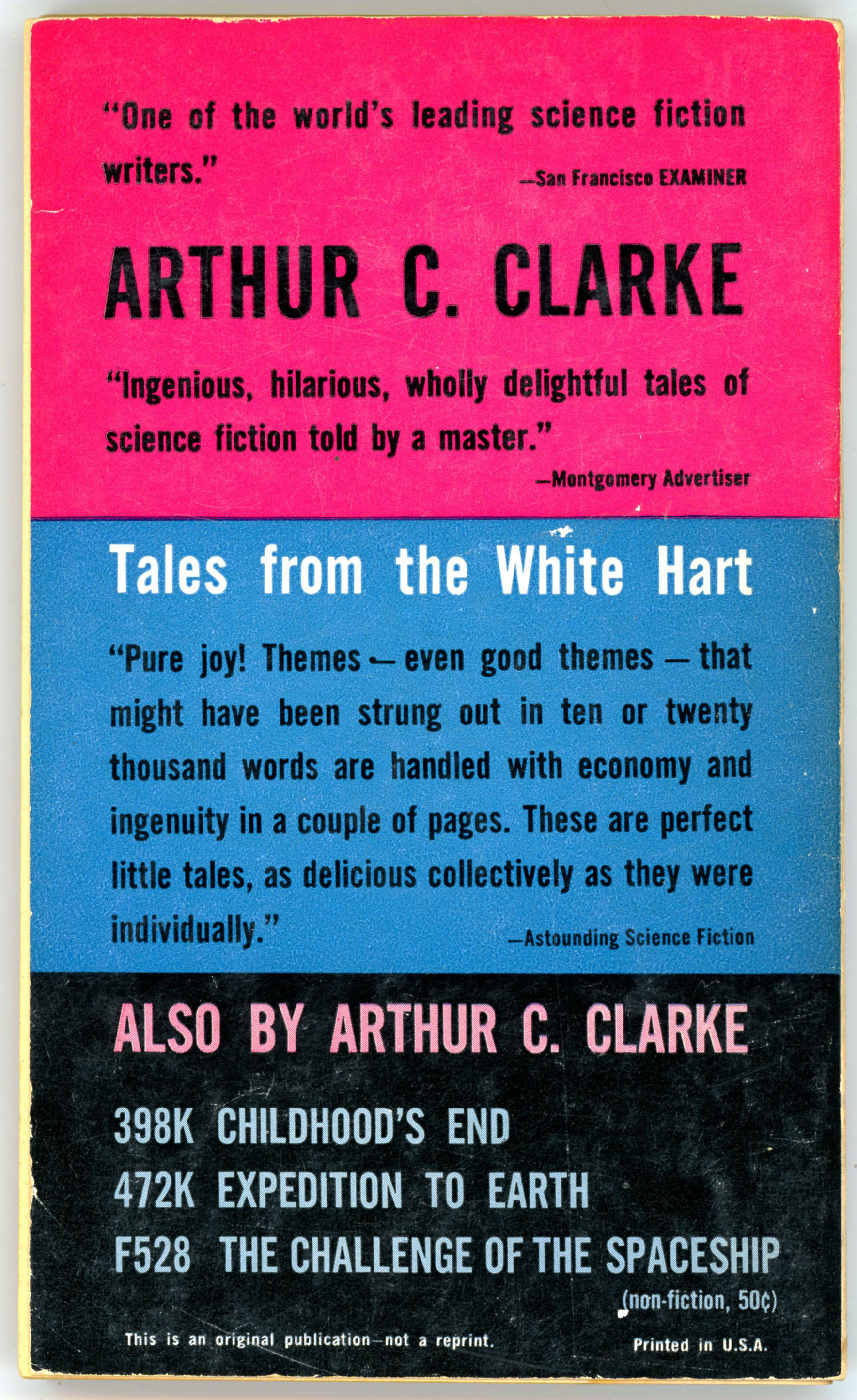
Tales From the White Hart, by Arthur C. Clarke – October, 1961 (1957) [Richard M. Powers]

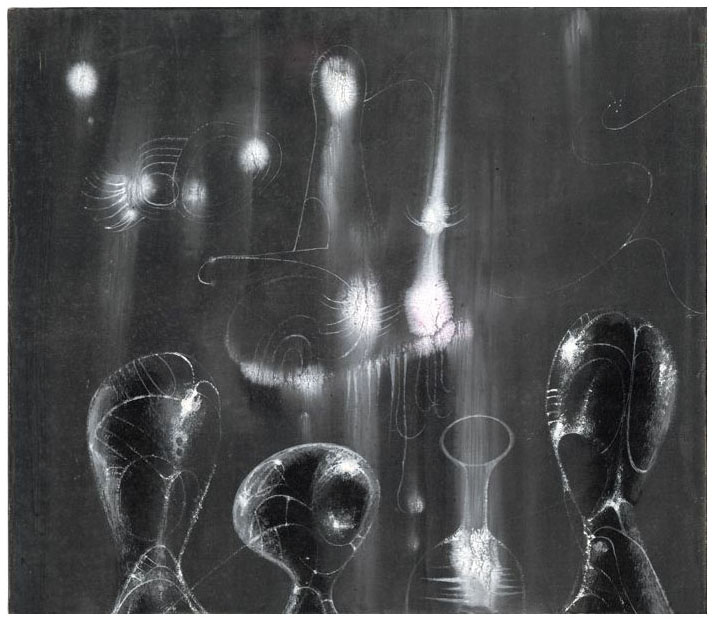
For Ballantine Book’s 1961 paperback edition of Arthur C. Clarke’s Tales From the White Hart, Richard Powers took an approach that was both consistent with and a departure from his usual style:  He depicted a group of subtly outlined creatures in an anthropoid-mechanical style (some floating in the background), yet instead of using contrasting, bold, primary colors, the composition was completed entirely in black and white. 

If not as striking as much of his work, the composition is cleverly consistent with the very title of the book! 

Contents

Preface (essay by Arthur C. Clarke, 1957)

Silence Please (variant of “Silence, Please!”), from Science-Fantasy, Winter, 1950

Big Game Hunt, from Adventure, October, 1956

Patent Pending from Adventure, November, 1954

Armaments Race, from Adventure, April, 1954

Critical Mass, from Space Science Fiction Magazine, August, 1957

The Ultimate Melody, from if – Words of Science Fiction, February, 1957

The Pacifist, from Fantastic Universe, October, 1956

The Next Tenants, from Satellite Science Fiction, February, 1957

Moving Spirit

The Man Who Ploughed the Sea from Satellite Science Fiction, June, 1957

The Reluctant Orchid, from Satellite Science Fiction, December, 1956

Cold War, from Satellite Science Fiction, April, 1956

What Goes Up (variant of “What Goes Up…”), from The Magazine of Fantasy and Science Fiction, January, 1956

Sleeping Beauty, from Infinity Science Fiction, April, 1957

The Defenestration of Ermintrude Inch

______________________________

Close-up of Powers’ cover, showing – perhaps?! – the enigmatic denizens of the White Hart…

______________________________

A rather serviceable back cover.  Well, it does the job of telling about the book, while promoting some of Clarke’s other works.

Other things to pleasantly distract you…

Tales From the White Hart, at Internet Speculative Fiction Database

Big Game Hunt (short story by Arthur C. Clarke), at Wikipedia

Patent Pending (short story by Arthur C. Clarke), at Wikipedia

Armaments Race (short story by Arthur C. Clarke), at Wikipedia


The Saturday Evening Post Reader of Fantasy & Science Fiction – January, 1964 (October, 1963) – No Editor Credited [Richard M. Powers]

Among the twenty stories in Popular Library’s 1964 edition of The Saturday Evening Post Reader of Fantasy & Science Fiction, the most significant may be Stephen Vincent Benay’s 1937 “The Place of the Gods”, and Robert Heinlein’s 1947 “The Green Hills of Earth”. 

I well remember Benay’s story, for it was deemed significant enough to have been included among works of American short fiction assigned as reading in my high school, some years ago.  As to its topicality in 2019, some eighty-two years after its original publication – with all that transpired in the world during those eight decades; with all that may yet transpire in the world – I have no idea. 

In any event, the story’s theme of a civilizational collapse quietly and gently yielding to the implied rebirth of culture and technology, comports well with and has anticipated the plot of many a work of science-fiction, let alone contemporary pseudo-science (such as the ancient-astronaut / paleo-contact hypothesis, which actually harks back to the works of H.P. Lovecraft, and, the millenarian apocalyptic religious cult – ostensibly in secular garb! – based on the myth of “anthropogenic climate change“), in historical and contemporary cinema and literature.     

Though I’ve been generally well-acquainted with Heinlein’s early works (not much at all his later writing!), “The Green Hills of Earth” escaped my attention until I actually read the story, in the pages of this particular book.  Entertaining (albeit with the dated implication of a habitable planet Venus, and, discussion of the use of a tape recorder – ? – ! – to preserve the songs of dying protagonist “Noisy” Rhysling), the story was adapted for NBC’s Dimension X radio series, where it was broadcast as episode 10 (of 50 total episodes)  on June 10, 1950

You can listen to The Green Hills of Earth at NewThinkable, or, Vulkan Channel.   

Contents

Doctor Hanray’s Second Chance, by Conrad Richter (June 10, 1950)

Fallout Island, by Robert Murphy (March 24, 1962)

The Green Hills of Earth, by Robert A. Heinlein (February 8, 1947)

Doomsday Deferred, by William F. Jenkins (“Murray Leinster”) (September 24, 1949)

Test-Tube Terror, by Robert Standish (September 13, 1958)

Island of Fear, by William Sambrot (June 18, 1958)

Sinister Journey, by Conrad Richter (September 26, 1953)

The Place of the Gods (alternate title “By the Waters of Babylon”), by Stephen Vincent Benet (July 31, 1937)

The Phantom Setter, by Robert Murphy (June 17, 1961)

The Big Wheel, by Fred McMorrow (July 29, 1961)

The Death Dust, by Frank Harvey (August 8, 1959)

The Lost Continent, by Geoffrey Household (September 3, 1960)

The Trap, by Kem Bennett (January 7, 1956)

Space Secret, by Wiliam Sambrot (February 21, 1959)

The Unsafe Deposit Box, by Gerald Kersh (April 14,1962)

The Second Trip to Mars, by Ward Moore (August 28, 1954)

The Voice in the Earphones, by William Schramm (March 29, 1947)

Moon Crazy, by William Roy Shelton (June 25, 1949)

The Little Terror, by William F. Jenkins (“Murray Leinster”) (August 22, 1953)

Novelette

The Answer, by Philip Wylie (May 7, 1955)

______________________________

Especially notable is the book’s cover art by Richard Powers, which, though uncredited in the text, bears Powers’ name in the lower left corner.  The composition bears two major hallmark’s of Powers’ work: The near-afterthought-like presence of a human figure visible only in silhouette, and, a variety of curved, ovoid, elongated objects rising vertically, or floating in the background.  Like many of Powers’ compositions that appeared on the covers of science-fiction anthologies, rather than pertaining to or having elements of a specific story, his art instead sets a mood and feeling. 

And, in this it succeeds superbly.