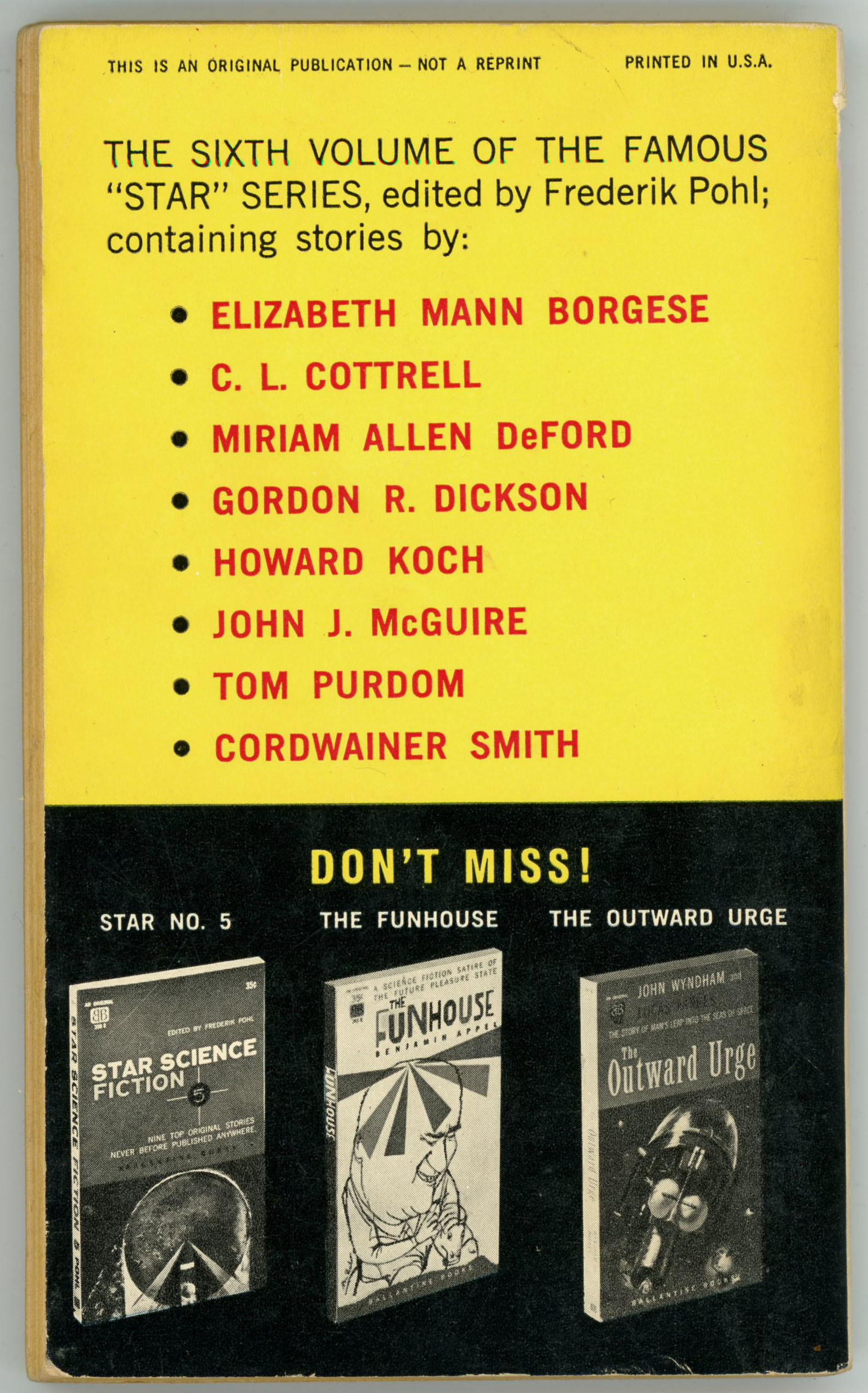
Star Science Fiction Stories No. 5, Edited by Frederik Pohl – 1959 [Unknown Artist]

This fifth Star is a little different than the rest:  Though the cover art of every other volume in the series was created by Richard Powers and displays some of the best examples of his style and creativity, Number 5 is an exception:  The artist is anonymous, his name absent from both the book, and, the Internet Speculative Fiction Database. 

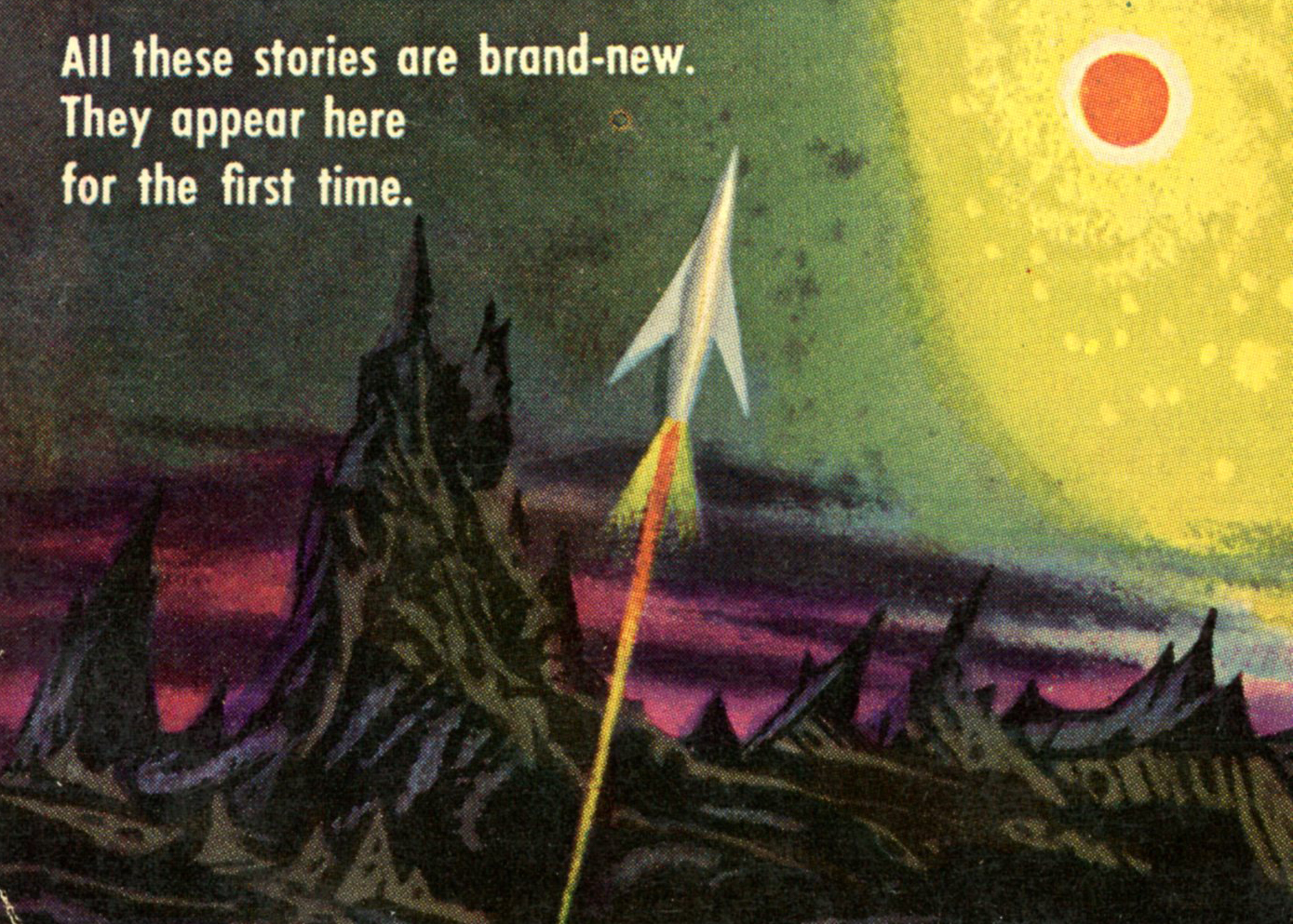
Well, the cover is still “sciency” enough:  A rocket with satellite inside flies past a something-or-other satellite – or is it the moon? – as it creates a shock-wave.  

Oh yes, as for the stories inside the book?  (!)  Though I recognize most of the authors, I confess to having read only one of these tales – “Adrift on the Policy Level” – was appeared in Asimov and Greenberg’s Isaac Asimov Presents The Great SF Stories 21 (1959)

Contents

Trouble with Treaties, by Tom Condit and Katherine MacLean

A Touch of Grapefruit, by Richard Matheson

Company Store, by Robert Silverberg

Adrift on the Policy Level, by Chan (Chandler) Davis

Sparkie’s Fall, by Gavin Hyde

Star Descending, by Algis Budrys

Diplomatic Coop, by Daniel F. Galouye

The Scene Shifter, by Arthur Sellings

Hair-Raising Adventure, by Rosel George Brown

Perelandra, by C.S. Lewis (Clive Staples Lewis) – 1957 (1943) [Art Sussman] – Avon # T-157

Following the theme of C.S. Lewis Space Trilogy, here’s Art Sussman’s cover for Perelandra, the second book of the series, as published by Avon in 1957.  Sussman also created the cover of Avon’s 1960 edition of Out of the Silent Planet.

You can view the cover of Macmillan’s 1965 edition of Perelandra here. The large human figures in yellow-orange are probably symbolic representations of Tindril, the Queen of Perelandra (a.k.a. to we inhabitants of Earth as “Venus”), and her un-named King.  There’s also a science-fiction element on the cover in the form of a rocket-plane, but no such craft figures in the story!

And as always, to give you a literary “taste” of the novel’s contents, here’s an excerpt:  A conversation between the hero, Dr. Elwin Ransom, and his antagonist, Dr. Weston. 

“My dear Ransom,
I wish you would not keep relapsing on to the popular level.
The two things are only moments in the single, unique reality.
The world leaps forward through great men
and greatness always transcends mere moralism.
When the leap has been made our ‘diabolism’
as you would call it becomes the morality of the next stage;
but while we are making it, we are called criminals, heretics, blasphemers…”

“How far does it go?
Would you still obey the Life-Force
if you found it prompting you to murder me?”

Yes.”

“Or to sell England to the Germans?”

“Yes.”

“Or to print lies as serious research in a scientific periodical?”

“Yes.”

“God help you!” said Ransom.

* * * * * * * * * * *

As the novel progresses, Dr. Weston is transformed into some thing no longer quite human, although physically human in superficial appearance.  Here are Dr. Ransom’s observations of what remains of Weston – physically, intellectually, and spiritually – after the latter has succumbed (voluntarily?) to demonic possession. 

It [Weston] looked at Ransom in silence and at last began to smile. 
We have all often spoken –
Ransom himself had often spoken –
of a devilish smile. 
Now he realized that he had never taken the words seriously. 
The smile was not bitter, nor raging, nor, in an ordinary sense, sinister;
it was not even mocking. 
It seemed to summon Ransom, with horrible naivete of welcome,
into the world of its own pleasures,
as if all men were at one in those pleasures,
as if they were the most natural thing in the world
and no dispute could ever have occurred about them. 
It was not furtive, nor ashamed, it had nothing of the conspirator in it. 

It did not defy goodness, it ignored it to the point of annihilation.

Ransom perceived that he had never before seen anything
but half-hearted and uneasy attempts at evil. 
This creature was whole-hearted. 
The extremity of its evil had passed beyond all struggle
into some state which bore a horrible similarity to innocence. 
It was beyond vice as the Lady was beyond virtue.

________________________________________

Note: December 2, 2020 – Having created this post only six days ago, I was happily surprised to discover Dr. Pedro Blas González’ essay, “Good and Evil in C.S. Lewis’ Space Trilogy“, at NewEnglishReview

Out of the Silent Planet, by C.S. Lewis (Clive Staples Lewis) – 1956 (1938) [Everett Raymond Kinstler] – Avon # T-27

C.S. Lewis’ Space Trilogy – Out of the Silent Planet, Perelandra, and That Hideous Strength – has had a long and continuous publishing history, extending from the appearance of the series’ “first” novel in 1938, through the HarperOne / HarperCollins  release of the three novels in a single volume as recently as 2013.  (And of course, now in ebook format.)

Among the series’ many imprints over the past eight-odd decades, perhaps the most immediately “recognizable” – in terms of duration of publication and (therefore!) especially cover art – has been the Macmillan edition.  Published from 1967 through 1979, all Space Trilogy books with that imprint bore cover illustrations by Bernard Symancyk, about whose career little information is available – albeit Terence E. Hanley at TellersofWeirdTales presents a brief biography at “From Things To Come into The Space Trilogy-Part One“. 

Well, Macmillan wasn’t alone.  In 1949, 1956, and 1960, Avon Books released its own edition of the Space Trilogy, with unique cover art for each “set”, and within each set, the cover illustrations having been created by different artists.

Certainly the art of the Space Trilogy is varied, but even moreso is the vast commentary the books have engendered across the decades.  While the Trilogy can ostensibly be categorized as science fiction, the tropes associated with that literary genre are far secondary to the ideas actually animating the books.  These are theological, though not purely couched in the verbiage of theology (the books’ ethos is clearly expressed in a allegorical manner), and concern the nature of good and evil; collectivism versus the worth of the individual as an individual; the nature, exercise, and temptation of power – whether that power be technological, biological, or governmental; the destiny of men as individuals and humanity as a civilization. 

Well…  The above sentences merely superficially (and ever so tangentially!) scratch the surface of depths vastly deeper.   

Well…  I can recommended these two discussions concerning the final novel of the series – That Hideous Strength (Avon’s awkward title The Tortured Planet) – at ChicagoBoyz, both by David Foster.  They are “Summer Rerun – Book Review: That Hideous Strength” (September 15, 2017), and, “Summer Rerun – Lewis vs. Haldane” (August 31, 2019).  These discussions can also serve as a sort-of-segue to the Trilogy’s other two novels. 

As a matter of fact, these two ChicagoBoyz posts are what let me to read the first two novels.  That Hideous Strength is in my “queue”, for the “world” depicted in Lewis’ final Space Trilogy novel has striking resonance with the world of 2020. 

And perhaps – depending on the winds of history and the choices of men – alas, beyond.

Oh, yes, as for cover art?

Here are the covers, front and back, of the 1956 edition of Avon’s first novel in the trilogy – Out of the Silent Planet – by artist Everett Raymond Kinstler. 

You can view the cover of Macmillan’s 1965 edition of Out of the Silent Planet here.

Here’s a brief excerpt from Out of The Silent Planet:  A conversation between the hero of both “this” first novel of the trilogy and the second, Perelandra: Between Dr. Elwin Ransom, and his (our?) nemesis, “Dr. Weston”, whose religion (if any) seems to be a variation on the theme of what is known to us as “scientism” – not science, which is altogether a thing quite different.

Or, put it another way, deification of rationality.  

Thus:

Weston: “…We are only obeying orders.”

Ransom: “Whose?”

There was another pause.
“Come,” said Weston at last,
“there is really no use in continuing this cross-examination. 
You keep on asking me questions I can’t answer;
in some cases because I don’t know the answers,
in other because you wouldn’t understand them. 
It will make things very much pleasanter during the voyage
if you can only resign your mind to your fate and stop bothering yourself and us. 
It would be easier if your philosophy of life
were not so insufferably narrow or individualistic. 
I had thought no one could fail to be inspired
by the role you are being asked to play:
that even a worm, if it could understand, would rise to the sacrifice. 
I mean, of course, the sacrifice of time and liberty, and some little risk. 
Don’t misunderstand me.”

“Well,” said Ransom, “You hold all the cards, and I must make the best of it.
I consider your philosophy of life raving lunacy.
I suppose all that stuff about infinity and eternity means
that you think you are justified in doing anything
– absolutely anything –
here and now,
on the off chance
that some creatures or other descended from man as we know him
may crawl about a few centuries longer in some part of the universe.”

________________________________________

Note: December 2, 2020 – Having created this post only six days ago, I was happily surprised to discover Dr. Pedro Blas González’ essay, “Good and Evil in C.S. Lewis’ Space Trilogy“, at NewEnglishReview

Ray Bradbury Interview by Charles Platt, in “Dream Makers” [November, 1980]

My prior post, regarding Ray Bradbury’s The Fireman (later Fahrenheit 451), presented musings about his novel viewed in the context of the events of the year 2020, and, in terms of the effect of “information technology” in the contemporary world, which seem to have been anticipated in his novel.  This serves as an introduction to images of the magazine and book cover art associated with Fahrenheit 451’s first appearance:in Galaxy Magazine (under the title The Fireman), and next, as Ballantine Books’ publication of the novel under that much-more-familiarly-known title.  In turn, the post includes excerpts from some of the novel’s passages that are the most powerful, descriptive, and relevant to the world we now live in.

This post is quite different in nature:  It’s the text of an interview with Ray Bradbury that appeared in Charles Platt’s Dream Makers – The Uncommon People Who Write Science Fiction, published in November of 1980 by Berkley Books.  The author’s conversation with his Ray Bradbury occurred in Los Angeles in May of 1979.

Platt’s book is excellent, for the reader gains an appreciation through exchanges with 29 authors of not only their relationship with the world of writing, but simply about their personal histories (sometimes their families, too) and lives, as “people”.  Albeit, the profile of Cyril Kornbluth is by definition and nature not an interview as such, Kornbluth having died in 1958!  Thus, Kornbluth’s brief biographical profile is based on Charles Platt’s taped interview with Kornbluth’s widow Mary, which occurred in November of 1973. 

(Alas, I so wish that something had been included about Cordwainer Smith or Catherine L. Moore!) 

Profiled in the book are:

Brian W. Aldiss
Isaac Asimov
J.G. Ballard
Gregory Benford
Alfred Bester
Ray D. Bradbury
John Brunner
Edward Bryant
Algis Budrys
Samuel R. Delaney
Philip K. Dick
Thomas M. Disch
Harlan Ellison
Philip Jose Farmer
Frank Herbert
C.M. (Cyril M.) Kornbluth
Damon Knight
Barry N. Malzberg
Michael Moorcock
Frederik Pohl
Robert Scheckley
Robert Silverberg
Norman Spinrad
Hank Stine
E.C. Tubb
A.E. (Alfred Elton) van Vogt (…see more at the Kenneth Spencer Research Library, at the University of Kansas…)
Kurt Vonnegut, Jr.
Ian Watson
Kate Wilhelm
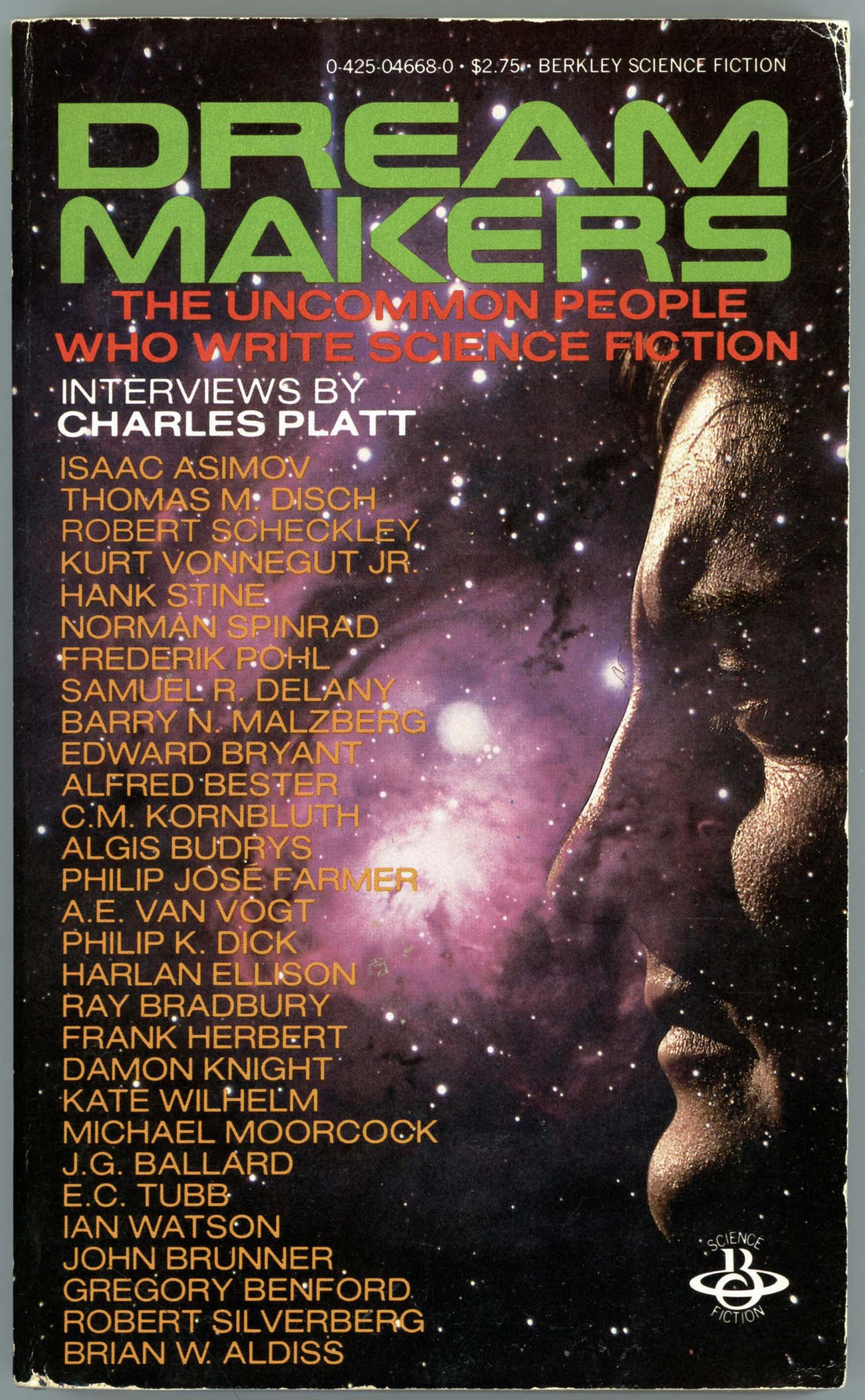
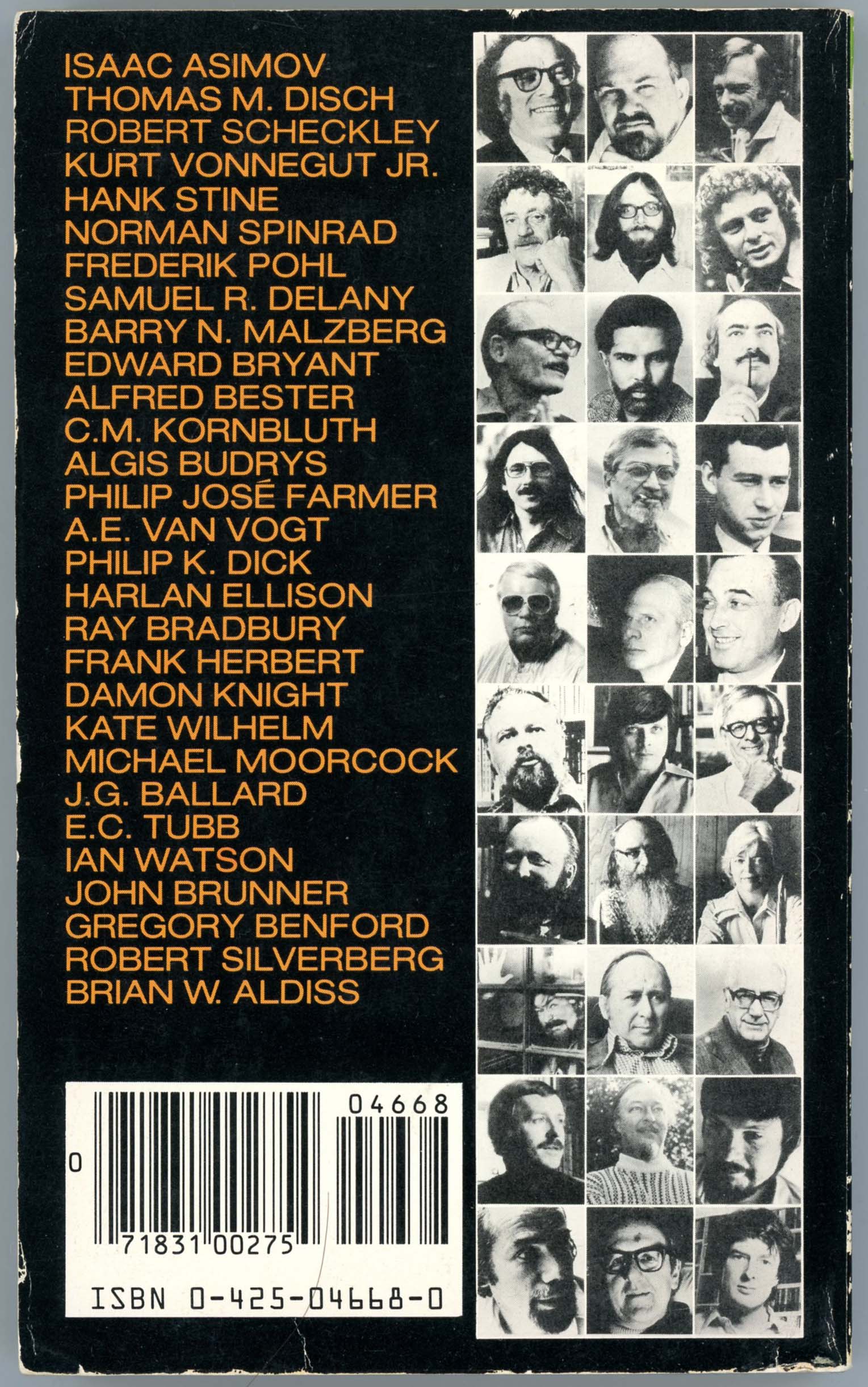
So, here’s Charles Platt’s interview with Ray Bradbury.  If I emerged from reading Fahrenheit 451 with an appreciation of Bradbury’s literary skill, I emerged from reading Platt’s interview with a solid appreciation of Bradbury as “a person”.  A person, most impressive, at that.

________________________________________

Ray Bradbury

Ray Bradbury’s stories speak with a unique voice.  They can never be confused with the work of any other writer.  And Bradbury himself is just as unmistakable: a charismatic individualist with a forceful, effusive manner and a kind of wide-screen, epic dedication to the powers of Creativity, Life, and Art.

He has no patience with commercial writing which is produced soullessly for the mass market:

“It’s all crap, it’s all crap, and I’m not being virtuous about it; I react in terms of my emotional, needful self, in that if you turn away from what you are, you’ll get sick some day.  If you go for the market, some day you’ll wake up and regret it.  I know a lot of screenwriters; they’re always doing things for other people, for money, because it’s a job.  Instead of saying, ‘Hey, I really shouldn’t be doing this,’ they take it, because it’s immediate, and because it’s a credit.  But no one remembers that credit.  If you went anywhere in Los Angeles among established writers and said, ‘Who wrote the screenplay for Gone With the Wind?” they couldn’t tell you.  Or the screenplay for North by Northwest.  Or the screenplay for Psycho – even I couldn’t tell you that, and I’ve seen the film eight times.  These people are at the beck and call of the market; they grow old, and lonely, and envious, and they are not loved, because no one remembers.  But in novels and short stories, essays and poetry, you’ve got a chance of not having, necessarily, such a huge audience, but having a constant group of lovers, people who show up in your life on occasion and look at you with such a pure light in their faces and their eyes that there’s no denying that love, it’s there, you can’t fake it.  When you’re in the street and you see someone you haven’t seen in years – that look!  They see you and, that light, it comes out, saying, My God, there you are, Jesus God it’s been five years, let me buy you a drink…  And you go into a bar, and – and that beautiful thing, which friendship gives you, that’s what we want, hah?  That’s what we want.  And all the rest is crap.  It is.  That’s what we want from life – “  He pounds his fist on the glass top of his large, circular coffee table.  “ – We want friends.  In a lifetime most people only have one or two decent friends, constant friends.  I have five, maybe even six.  And a decent marriage, and children, plus the work that you want to do, plus the fans that accumulate around that work – Lord, it’s a complete life, isn’t it – but the screenwriters never have it, and it’s terribly sad.  Or the Harold Robbinses of the world – I mean, probably a nice gent.  But no one cares, no one cares that he wrote those books, because they’re commercial books, and there’s no moment of truth that speaks to the heart.  The grandeur and exhilaration of certain days is missing – those gorgeous days when you walk out and it’s enough just to be alive, the sunlight goes right in your nostrils and out your ears, hah?  That’s the stuff.  All the rest – the figuring out of the designs, for how to do a bestseller – what a bore that is.  Lord, I’d kill myself, I really would, I couldn’t live that way.  And I’m not being moralistic.  I’m speaking from the secret wellsprings of the nervous system.  I can’t do those things, not because it’s morally wrong and unvirtuous, but because the gut system can’t take it, finally, being untrue to the gift of life.  If you turn away from natural gifts that God has given you, or the universe has given you, however you want to describe it in your own terms, you’re going to grow old too soon.  You’re going to get sour, get cynical, because you yourself are a sublime cynic for having done what you’ve done.  You’re going to die before you die.  That’s no way to live.”

He speaks in a rich, powerful voice-indeed, a hot-gospel voice – as he delivers this inspirational sermon.  He may be adopting a slightly more incisive style than usual, for the purposes of this interview, and he may be using a little overstatement to emphasize his outlook; but there can be no doubt of his sincerity.  Those passages of ecstatic prose in his fiction, paying homage to the vibrant images of childhood, the glorious fury of flaming rockets, the exquisite mystery of Mars, the all-around wonder-fullness of the universe in general – he truly seems to experience life in these terms, uninhibitedly, unreservedly.

Intellectual control and cold, hard reason have a place, too; but they must give way to emotion, during the creative process:

“It takes a day to write a short story.  At the end of the day, you say, that seems to work, what parts don’t?  Well, there’s a scene here that’s not real, now, what’s missing?  Okay, the intellect can help you here.  Then, the next day, you go back to it, and you explode again, based on what you learned the night before from your intellect.  But it’s got to be a total explosion, over in a few hours, in order to be honest.

“Intellectualizing is a great danger.  It can get in the way of doing anything.  Our intellect is there to protect us from destroying ourselves – from falling off cliffs, or from bad relationships – love affairs where we need the brains not to be involved.  That’s what the intellect is for.  But it should not be the center of things.  If you try to make your intellect the center of your life you’re going to spoil all the fun, hah?  You’re going to get out of bed with people before you ever get into bed with them.  So if that happens – the whole world would die, we’d never have any children!”  He laughs.  “You’d never start any relationships, you’d be afraid of all friendships, and become paranoid.  The intellect can make you paranoid about everything, including creativity, if you’re not careful.  So why not delay thinking till the act is over?  It doesn’t hurt anything.”

I feel that Bradbury’s outlook, and his stories, are unashamedly romantic.  But when I use this label, he doesn’t seem at all comfortable with it.

“I’m not quite sure I know what it means.  If certain things make you laugh or cry, how can you help that?  You’re only describing a process.  I went down to Cape Canaveral for the first time three years ago.  I walked into it, and yes, I thought, this is my home town!  Here is where I came from, and it’s all been built in the last twenty years behind my back.  I walk into the Vehicle Assembly Building, which is 400 feet high, and I go up in the elevator and look down – and the tears burst from my eyes.  They absolutely burst from my eyes!  I’m just full of the same awe that I have when I visit Chartres or go into the Notre Dame or St. Peter’s.  The size of this cathedral where the rockets take off to go to the moon is so amazing, I don’t know how to describe it.  On the way out, in tears, I turn to my driver and I say, ‘How the hell do I write that down? It was like walking around in Shakespeare’s head.’  And as soon as I said it I knew that was the metaphor.  That night on the train I got out my typewriter and I wrote a seven-page poem, which is in my last book of poetry, about my experience at Canaveral walking around inside Shakespeare’s head.

“Now, if that’s romantic, I was born with romantic genes.  I cry more, I suppose – I’m easy to tears, I’m easy to laughter, I try to go with that and not suppress it.  So if that’s romantic, well, then, I guess I’m a romantic, but I really don’t know what that term means.  I’ve heard it applied to people like Byron, and in many ways he was terribly foolish, especially to give his life away, the way he did, at the end.  I hate that, when I see someone needlessly lost to the world.  We should have had him for another five years – or how about twenty?  I felt he was foolishly romantic, but I don’t know his life that completely.  I’m a mixture; I don’t think George Bernard Shaw was all that much of a romanticist, and yet I’m a huge fan of Shaw’s.  He’s influenced me deeply, along with people like Shakespeare, or Melville.  I’m mad for Shaw; I carry him with me everywhere.  I reread his prefaces all the time.”

Quite apart from what I still feel is a romantic outlook, Bradbury is distinctive as a writer who shows a recurring sense of nostalgia in his work.  Many stories look back to bygone times when everything was simpler, and technology had not yet disrupted the basics of small-town life.  I ask him if he knows the source of this affection for simplicity.

“I grew up in Waukegan, Illinois, which had a population of around 32,000, and in a town like that you walk everywhere when you’re a child.  We didn’t have a car till I was twelve years old.  So I didn’t drive in automobiles much until I came west when I was fourteen, to live in Los Angeles.  We didn’t have a telephone in our family until I was about fifteen, in high school.  A lot of things, we didn’t have; we were a very poor family.  So you start with basics, and you respect them.  You respect walking, you respect a small town, you respect the library, where you went for your education – which I started doing when I was nine or ten.  I’ve always been a great swimmer and a great walker, and a bicyclist.  I’ve discovered every time I’m depressed or worried by anything, swimming or walking or bicycling will generally cure it.  You get the blood clean and the mind clean, and then you’re ready to go back to work again.”

He goes on to talk about his early ambitions: “My interests were diverse.  I always wanted to be a cartoonist, and I wanted to have my own comic strip.  And I wanted to make films, and be on the stage, and be an architect – I was madly in love with the architecture of the future that I saw in photographs of various world’s fairs which preceded my birth.  And then, reading Edgar Rice Burroughs when I was ten or eleven, I wanted to write Martian stories.  So when I began to write, when I was twelve, that was the first thing I did.  I wrote a sequel to an Edgar Rice Burroughs book.

“When I was seventeen years old, in Los Angeles, I used to go to science-fantasy meetings, downtown.  We’d go to Clifton’s Cafeteria; Forrest Ackerman and his friends would organize the group there every Thursday night, and you could go there and meet Henry Kuttner, and C.L. Moore, and Jack Williamson, and Edmond Hamilton, and Leigh Brackett – my God, how beautiful, I was seventeen years old, I wanted heroes, and they treated me beautifully.  They accepted me.  I still know practically everyone in the field, at least from the old days.  I love them all.  Robert Heinlein was my teacher, when I was nineteen…  but you can’t stay with that sort of thing, a family has to grow.  Just as you let your children out into the world – I have four daughters – you don’t say, ‘Here is the boundary, you can’t go out there.’ So at the age of nineteen I began to grow.  By the time I was twenty I was moving into little theater groups and I was beginning to experiment with other fictional forms.  I still kept up my contacts with the science-fiction groups, but I mustn’t stay in just that.

“When I was around twenty-four, I was trying to sell stories to Colliers and Harper’s and The Atlantic, and I wanted to be in The Best American Short Stories.  But it wasn’t happening.  I had a friend who knew a psychiatrist.  I said, ‘Can I borrow your psychiatrist for an afternoon?’  One hour cost twenty dollars!  That was my salary for the whole week, to go to this guy for an hour.  So I went to him and he said, ‘Mr.  Bradbury, what’s your problem?’  And I said, ‘Well, hell, nothing’s happening.’  So he said, ‘What do you want to happen?’  And I said, ‘Well, gee, I want to be the greatest writer that ever lived.’ And he said, “That’s going to take a little time, then, isn’t it?’  He said, ‘Do you ever read the encyclopedia?  Go down to the library and read the lives of Balzac and Du Maupassant and Dickens and Tolstoy, and see how long it took them to become what they became.’  So I went and read and discovered that they had to wait, too.  And a year later I began to sell to the American Mercury, and Collier’s, and I appeared in The Best American Short Stories when I was twenty-six.  I still wasn’t making any money, but I was getting the recognition that I wanted, the love that I wanted from people I looked up to.  The intellectual elite in America was beginning to say, “Hey, you’re okay, you’re all right, and you’re going to make it.’  And then my girlfriend Maggie told me the same thing.  And then it didn’t matter whether the people around me sneered at me.  I was willing to wait.”

In fact, Bradbury must have received wider critical recognition, during the late 1950s and into the 1960s, than any other science-fiction author.  His work used very little technical jargon, which made it easy for “outsiders” to digest, and he acquired a reputation as a stylist, if only because so few science-fiction authors at that time showed any awareness of style at all.

Within the science-fiction field, however, Bradbury has never received as much acclaim, measured (for example) by Hugo or Nebula awards.  Doe this irk him?

“That’s a very dangerous thing to talk about.”  He pauses.  Up till this moment, he has talked readily, with absolute confidence.  Now, he seems ill-at-ease.  “I left the family, you see.  And that’s a danger…  to them.  Because, they haven’t got out of the house.  It’s like when your older brother leaves home suddenly – how dare he leave me, hah? My hero, that I depended on to protect me.  There’s some of that feeling.  I don’t know how to describe it.  But once you’re out and you look back and they’ve got their noses pressed against the glass, you want to say, ‘Hey, come on, it’s not that hard, come on out.’  But each of us has a different capacity for foolhardiness at a certain time.  It takes a certain amount of – it’s not bravery – it’s experimentation.  Because I’m really, basically, a coward.  I’m afraid of heights, I don’t fly, I don’t drive.  So you see I can’t really claim to be a brave person.  But the part of me that’s a writer wanted to experiment out in the bigger world, and I couldn’t help myself, I just had to go out there.

“I knew that I had to write a certain way, and take my chances.  I sold newspapers on a street comer, for three or four years, from the time I was nineteen till I was twenty-two or twenty-three years old.  I made ten dollars a week at it, which was nothing, and meant that I couldn’t take girls out and give them a halfway decent evening.  I could give them a ten-cent malted milk and a cheap movie, and then walk them home.  We couldn’t take the bus, there was no money left.  But, again, this was no virtuous selection on my part.  It was pure instinct.  I knew exactly how to keep myself well.

“I began to write for Weird Tales in my early twenties, sold my short stories there, got twenty or thirty dollars apiece for them.  You know everything that’s in The Martian Chronicles, except two stories, sold for forty, fifty dollars apiece, originally.

“I met Maggie when I was twenty-five.  She worked in a bookstore in downtown Los Angeles, and her views were so much like mine – she was interested in books, in language, in literature – and she wasn’t interested in having a rich boyfriend; which was great, because I wasn’t!  We got married two years later and in thirty-two years of marriage we have had only one problem with money.  One incident, with a play.  The rest of the time we have never discussed it.  We knew we didn’t have any money in the bank, so why discuss something you don’t have, hah?  We lived in Venice, California, our little apartment, thirty dollars a month, for a couple of years, and our first children came along, which terrified us because we had no money, and then God began to provide.  As soon as the first child arrived my income went up from fifty dollars a week to ninety dollars a week.  By the time I was thirty-three I was making $110 a week.  And then John Huston came along, and gave me Moby Dick [the film for which Bradbury wrote the screenplay] and my income went up precipitously in one year – and then went back down the next year, because I chose not to do any more screenplays for three years after that, it was a conscious choice and an intuitive one, to write more books and establish a reputation.  Because, as I said earlier, no one remembers who wrote Moby Dick for the screen.

“Los Angeles has been great for me, because it was a collision of Hollywood – motion pictures – and the birthing of certain technologies.  I’ve been madly in love with film since I was three years old.  I’m not a pure science-fiction writer, I’m a film maniac at heart, and it infests all of my work.  Many of my short stories can be shot right off the page.  When I first met Sam Peckinpah, eight or nine years ago, and we started a friendship, and he wanted to do Something Wicked This Way Comes, I said, ‘How are you going to do it?’  And he said, ‘I’m going to rip the pages out of your book and stuff them in the camera.’ He was absolutely correct.  Since I’m a bastard son of Erich von Stroheim out of Lon Chaney – a child of the cinema – hah! – it’s only natural that almost all of my work is photogenic.”

Is he happy with the way his stories have been made into movies?

“I was happy with Fahrenheit 451: I think it’s a beautiful film, with a gorgeous ending.  A great ending by Truffaut.  The Illustrated Man I detested; a horrible film.  I now have the rights back, and we’ll do it over again, some time, in the next few years.  Moby Dick – I’m immensely moved by it.  I’m very happy with it.  I see things I could do now, twenty-five years later, that I understand better, about Shakespeare and the Bible – who, after all, instructed Melville at his activities.  Without the Bible and Shakespeare, Moby Dick would never have been born.  Nevertheless, with all the flaws, and with the problem of Gregory Peck not being quite right as Ahab – I wanted someone like Olivier; it would have been fantastic to see Olivier – all that to one side, I’m still very pleased.”

In the past few years Bradbury has turned increasingly toward writing poetry as opposed to short stories.  Not all of this poetry has been well-received.  I ask him if he suffers from that most irritating criticism – people telling him that his early work was better.

“Oh, yes, and they’re – they’re wrong, of course.  Steinbeck had to put up with that.  I remember hearing him say this.  And it’s nonsense.  I’m doing work in my poems, now, that I could never have done thirty years ago.  And I’m very proud.  Some of the poems that have popped out of my head in the last two years are incredible.  I don’t know where in hell they come from, but – good God, they’re good!  I have written at least three poems that are going to be around seventy years, a hundred years from now.  Just three poems, you say?  But the reputation of most of the great poets are based on only one or two poems.  I mean, when you think of Yeats, you think of Sailing to Byzantium, and then I defy you, unless you’re a Yeats fiend, to name six other poems.

“To be able to write one poem in a lifetime, that you feel is so good it’s going to be around for a while…  and I’ve done that, damn it, I’ve done it – at least three poems – and a lot of short stories.  I did a short story a year ago called Gotcha, that is, damn it, boy, that’s good.  It’s terrifying!  I read it and I say, oh, yes, that’s good.  Another thing, called The Burning Man, which I did two years ago …  and then some of my new plays, the new Fahrenheit 451, a totally original new play based on what my characters are giving me, at the typewriter.  I’m not in control of them.  They’re living their lives all over again, twenty-nine years later, and they’re saying good stuff.  So long as I can keep the channels open between my subconscious and my outer self, it’s going to stay good.

“I don’t know how I do anything that I do, in poetry.  Again, it’s instinctive, from years and years and years of reading Shakespeare, and Pope – I’m a great admirer of Pope – and Dylan Thomas, I don’t know what in hell he’s saying, a lot of times, but God it sounds good, Jesus, it rings, doesn’t it, hah? It’s as clear as crystal.  And then you look closely and you say, it’s crystal – but I don’t know how it’s cut.  But you don’t care.  Again, it’s unconscious, for me.  People come up and say.  Oh, you did an Alexandrian couplet here.  And I say, Oh, did I? I was so dumb, I thought an Alexandrian couplet had to do with Alexander Pope!

“But from reading poetry every day of your life, you pick up rhythms, you pick up beats, you pick up inner rhymes.  And then, some day in your forty-fifth year, your subconscious brings you a surprise.  You finally do something decent.  But it took me thirty, thirty-five years of writing, before I wrote one poem that I liked.”

There is no denying this man’s energy and his enthusiasm.  It’s so directly expressed, and so guileless, it makes him a likeable and charming man regardless of whether you identify with his outlook or share his opinions.  He projects a mixture of innocence and sincerity; he looks at you directly as he speaks, as if trying to win you over and catalyze you into sharing his enthusiasm.  He is a tanned, handsome figure, with white hair and.  often, white or light-colored clothing; the first time I ever saw him, at a science-fiction convention, he seemed almost regal, standing in his white suit, surrounded by a mass of scruffy adolescent fans in dowdy T-shirts and jeans.  Yet he seemed to empathize with them; despite his healthy ego he is not condescending toward his younger admirers, perhaps because he still feels (and looks) so young at heart himself.  In a way he is forever living the fantasies he writes, about the nostalgic moments of childhood.  He has a child’s sense of wonder and naive, idealistic spirit, as he goes around marveling at the world.  He has not become jaded or disillusioned either about science fiction or about its most central subject matter, travel into space.

“We have had this remarkable thing occurring during the last ten years, when the children of the world began to educate the teachers, and said, ‘Here is science fiction, read it’; and they read it and they said, ‘Hey, it’s not bad,’ and began to teach it.  Only in the last seven or eight years has science fiction gotten respectable.

“Orwell’s 1984 came out thirty years ago this summer.  Not a mention of space travel in it, as an alternative to Big Brother, a way to get away from him.  That proves how myopic the intellectuals of the 1930s and 1940s were about the future.  They didn’t want to see something as exciting and as soul-opening and as revelatory as space travel.  Because we can escape, we can escape, and escape is very important, very tonic, for the human spirit.  We escaped Europe 400 years ago and it was all to the good, and then from what we learned, by escaping, we could come back and say, ‘Hey, we’re going to refresh you, we got our revolution, now maybe we can all revolt together against certain things.’  My point is that intellectual snobbishness permeated everything, including all the novels, except in science fiction.  It’s only in the last ten years we can look back and say, ‘Oh, my God, we really were beat up all the time by these people, and it’s a miracle we survived.’“

But, I suggest, a lot of the mythic quality of space travel has been lost, now that NASA has made it an everyday reality.

“I believe that any great activity finally bores a lot of people,” he replies, “and it’s up to us ‘romantics’ – hmm?” (he makes it clear, he still dislikes the term) “to continue the endeavor.  Because my enthusiasm remains constant.  From the time I saw my first space covers on Science and Invention, or Wonder Stories, when I was eight or nine years old – that stuff is still in me.  Carl Sagan, a friend of mine, he’s a ‘romantic,’ he loves Edgar Rice Burroughs – I know, he’s told me.  And Bruce Murray, who’s another friend of mine, who’s become president of Jet Propulsion Laboratories – first time I’ve ever known someone who became president of anything! – and he’s a human being, that’s the first thing, and he happens, second, to be the president of a large company that’s sending our rockets out to Jupiter and Mars.  I don’t think it’s been demystified.  I think a lot of people were not mystified to begin with, and that’s a shame.”

Is Bradbury happy with the growth of science fiction? Does he like modem commercial exploitation of the genre – as in movies like Star Wars?

Star Wars – idiotic but beautiful, a gorgeously dumb movie.  Like being in love with a really stupid woman.”  He gives a shout of laughter, delighted by the metaphor.  “But you can’t keep your hands off her, that’s what Star Wars is.  And then Close Encounters comes along, and it’s got a brain, so you get to go to bed with a beautiful film.  And then something like Alien comes along, and it’s a horror film in outer space, and it has a gorgeous look to it, a gorgeous look.  So wherever we can get help we take it, but the dream remains the same: survival in space and moving on out, and caring about the whole history of the human race, with all our stupidities, all the dumb things that we are, the idiotic creatures, fragile, broken creatures.  I try to accept that; I say, okay, we are also the ghosts of Shakespeare, Plato, Euripedes and Aristotle, Machiavelli and Da Vinci, and a lot of amazing people who cared enough to try and help us.  Those are the things that give me hope in the midst of stupidity.  So what we are going to try and do is move on out to the moon, get on out to Mars, move on out to Alpha Centauri, and we’ll do it in the next 500 years, which is a very short period of time; maybe even sooner, in 200 years.  And then, survive forever, that is the great thing.  Oh, God, I would love to come back every 100 years and watch us.

“So there it is, there’s the essence of optimism – that I believe we’ll make it, and we’ll be proud, and we’ll still be stupid and make all the dumb mistakes, and part of the time we’ll hate ourselves; but then the rest of the time we’ll celebrate.”

(Los Angeles, May 1979)

BIBLIOGRAPHICAL NOTES

Ray Bradbury is probably best known for The Martian Chronicles (1950), his enduring collection of stories which use off-the-shelf science-fiction hardware (rocket ships, the planet Mars colonized by man), but explore these ideas in a spirit of fantasy as opposed to predictive reality.  Bradbury’s vision of the ‘lost race’ of Martians was powerful enough to eclipse all others and become a tradition, followed in many subsequent science-fiction novels by other writers.

The Illustrated Man (1951) presents fantasy and horror stories linked by the slightly artificial device of embodying key scenes in tattoos on the body of a man who has supposedly journeyed through the various events.  Fahrenheit 451 (1953) is a novel depicting a repressive future where all books must be burned, and firemen start the fires rather than put them out.  The October Country (1955) is a collection of fantasy and macabre stories.  Something Wicked This Way Comes (1962) is a novel depicting a peaceful, innocent small town, visited by a sinister carnival which brings pure evil.

Bradbury’s recent poetry, much of it dealing with science-fiction themes, appears in a couple of recent collections.
The Best of Henry Kuttner, Introduced by Ray Bradbury – April, 1975 [Dean Ellis]

Whatever the truth of the hackneyed expression “imitation is the sincerest form of flattery”, imitation most definitely characterizes other aspects of life: Ways of thought; similarities in the “mood” of an age, whether that mood be artistic and intellectual; technological or theatrical; parallels in language and speech.  And especially, similarities in literature.

In the literature of science fiction, a striking similarity occurred from the 1970s through the 1990s, in the form of anthologies issued by two different publishing houses: Donald A. Wollheim Books, and, Ballantine Books.

Wollheim Books (for short!) took the approach, under the dual aegis of Isaac Asimov and Martin H. Greenberg, of publishing a series entitled “Isaac Asimov Presents the Great SF Stories,” from 1939 through 1963.  Each book in the series – the sequential number of each volume appearing as part of its very tile – was devoted to short stories and novellas published during each successive calendar year over that twenty-five year time-frame.  In effect (I don’t know about intent!) the Wollheim approach resulted in a not-so-indirect eye upon the literary and cultural development of science fiction, as it moved from the semi-eyebrows-raised / not-necessarily-in-polite-company / harrumph! periphery of culturally acceptable literature to (well, by 1963) its increasing and open acceptance by the general public.  And even; and eventually, beyond.

Ballantine Books chose a different approach.

From 1974 through 1995, that company published its own set of anthologies, under the series title “Ballantine’s Classic Library of Science Fiction”, albeit the “header” on the cover page of each book simply used the verbiage (in rather small font, at that) “Classic Science Fiction”.  Rather than approach the genre on a year-by-year, stylistic, or topical basis, Ballantine chose to allocate each of its books to the stories of one author only, eventually resulting in anthologies of the works of 22 writers.  Most volumes included about sixteen stories, with a “low” of 11 for the works of Catherine L. Moore and Hal Clement, all the way up to 31 (!) for Fredric Brown.  Given that the books were generally of the same length – from 350 to 400 pages – these “story counts” were an indirect reflection of the authors’ writing styles.  Some writers preferred to pack a “punch” into relatively few(er) pages, while for others – like the extraordinarily talented Catherine Moore or the uncannily imaginative Cordwainer Smith, both of whose creativity equaled their originality (or was it the other way around?) – the power of a tale remained undiminished throughout the entirety of its text.

Unlike the approach of Wollheim, with Asimov and Greenberg being dual editors / commentators for every volume of the “Isaac Asimov Presents…” series, Ballantine presented their books’ contents in a way that was ultimately far more expressive, creative, and therefore less rote.  Regardless of whether each book’s stories were selected by the actual author of the stories within it (some authors, like John W. Campbell, Jr., and Cyril Kornbluth having passed away years before), each volume included an introduction and overview by an already-established author of science fiction, who approached the subject author’s collected work from vantages literary, cultural, and especially biographical.  In some books, every story is prefaced by a brief but substantive blurb about the literary origins or cultural context of the tale, while other books (like that devoted to stories by Henry Kuttner – check it out below…) are bereft of any “intros” at all.  In at least one book, that devoted to the wonderful tales of the aforementioned Cordwainer Smith (Paul M. Linebarger), the introduction is preceded by a diagram of the timeline of the “universe” created by the author, a touch utterly unlike the Wollheim series.

Having read every book in the Wollheim series, and some of the Ballantine series, I think that Ballantine’s approach was better.  Though the commentary by Asimov and Greenberg was – welllll, I’ll be charitable – en-ter-tain-ing as it were – the presence of introduction and commentary by different, recognized writers, each with their own perspective, writing style, and “world-view”, lent to the Ballantine volumes a deeper, more solid, and substantive literary and historical “heft” – by far – than the Wollheim series.  Within the latter, Asimov’s and Greenberg’s lightly humorous introductions and comments became – as you moved through the series – as predictable as they were empty.  (Entirely consistent with the shallowness of most of Asimov’s fiction.  But, that’s another topic…)

As for the cover art of the Ballantine series?  That, too, took a different approach from the Wollheim series.  For every book in the Ballantine series, the cover art occupied the entirety of the cover.  For the Wollheim series, the books started with “full” cover art, switched to small illustrations set within a solid color background, and for the last eleven books in the series, returned to full cover art.

So…

Like the post about the Wollheim series, “this” post summarizes the publishing history of the Ballantine series, all titles of which, arranged alphabetically by author’s surname, are listed below.  After the title, you’ll see the name of the introductory author, date of publication, name of cover artist, cover price, Ballantine or Del Rey-Ballantine book serial number, and ISBN.  Whew.  (Those books for which I’ve already created posts are linked, as well.) 

Here they are:

The Best of James Blish, Robert A.W. Lowndes, August, 1979 (H.R. Van Dongen), $1.95, 25600 / 0-345-25600-X

The Best of Robert Bloch, Lester Del Rey, November, 1977 (Paul Alexander), $1.95, 25757 / 0-345-25757-X

The Best of Leigh Brackett, Edmond Hamilton, September, 1977 (Boris Vallejo), $1.95, 25954 / 0-345-25954-8
(Republished June, 1986 (Boris Vallejo), $3.95, 33247 / 0-345-33247-4)

The Best of Fredric Brown, Robert Bloch, May, 1977 (H.R. Van Dongen), $1.95, 25700 / 0-345-25700-6

The Best of John Brunner, Joe Haldeman, November, 1988 (Barclay Shaw), $3.95, 35307 / 0-345-35307-2

The Best of John W. Campbell, Jr., Lester Del Rey, June, 1976 (H.R. Van Dongen), $1.95, 24960 / 0-345-24960-7
(Republished February, 1995 (H.R. Van Dongen) $5.99, 24960 / 0-345-24960-7)

The Best of Hal Clement, Lester Del Rey, June, 1979 (H.R. Van Dongen), $1.95, 27689 / 0-345-27689-2

The Best of L. Sprague de Camp, May, 1978 (Darrell Sweet), $1.95, 24574 / 0-345-25474-0

The Best of Lester del Rey, Poul Anderson, September, 1978 (H.R. Van Dongen), $1.95, 27336 / 0-345-27336-2

The Best of Philip K. Dick, John Brunner, March, 1977 (Vincent Di Fate), $1.95, 25359 / 0-345-25359-0
(Republished March, 1978 (Vincent Di Fate), $1.95, 25359 / 0-345-25359-0)

The Best of Raymond Z. Gallun, J.J. Pierce, August, 1978 (H.R. Van Dongen), $1.95, 25273 / 0-345-25273-X

The Best of Edmond Hamilton, Leigh Brackett, August, 1977 (H.R. Van Dongen), $1.95, 25900 / 0-345-25900-9

The Best of C.M. Kornbluth, Frederick Pohl, January, 1977 (Dean Ellis), $1.95, 25461 / 0-345-25461-9

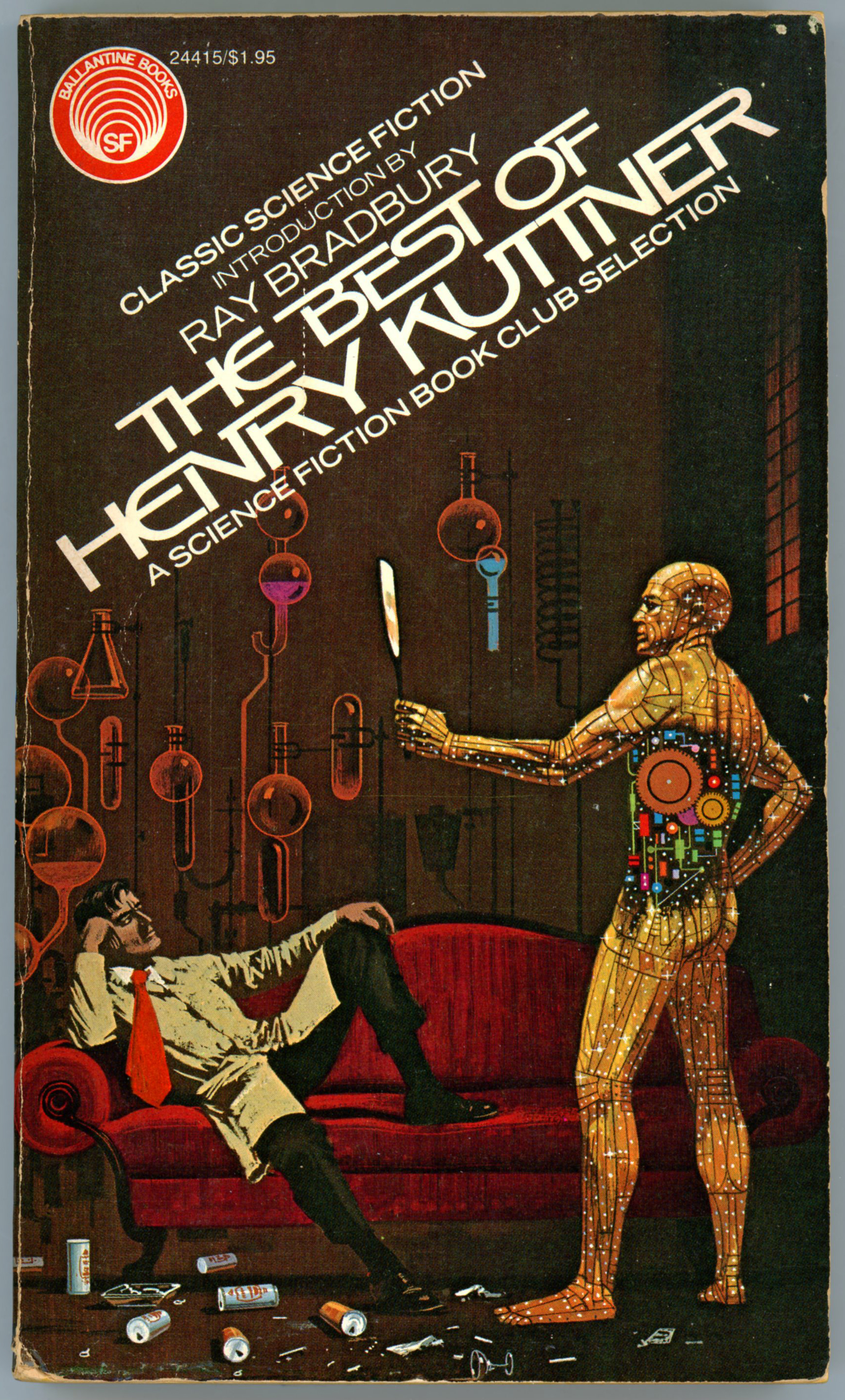
The Best of Henry Kuttner (this post!), Ray Bradbury, April, 1975 (Dean Ellis), $1.95, 24415 / 0-345-24415-X

The Best of Fritz Leiber, Poul Anderson, September, 1979 (Michael Herring), $2.25, 28351 / 0-345-28351-1

The Best of Murray Leinster, J.J. Pierce, April, 1978 (H.R. Van Dongen), $1.95, 25800 / 0-345-25800-2

The Best of C.L. Moore, Lester Del Rey, March, 1976 (Tim and Greg Hildebrandt), $1.95, 24752 / 0-345-24752-3
(Republished, December, 1980, $2.25, 28952 / 0-345-28952-8, and…

January, 1981, $2.25, 28952 / 0-345-28952-8,
…both covers by Tim and Greg Hildebrandt)

The Best of Frederik Pohl, Lester Del Rey, April, 1976 (Dean Ellis), $1.95, 24607 / 0-345-24507-5

The Best of Eric Frank Russell, Alan Dean Foster, October, 1978 (H.R. Van Dongen), $1.95, 27700 / 0-345-27700-7
(Republished July, 1986 (Barclay Shaw), $3.95, 33223 / 0-345-33223-7)

The Best of Cordwainer Smith, J.J. Pierce, September, 1975 (Darrell Sweet), $1.95, 24581 / 0-345-24581-4
(Republished October, 1977 (Darrell Sweet), $2.25, 27202 / 0-345-27202-1)

The Best of Stanley G. Weinbaum, Isaac Asimov, June, 1974 (Dean Ellis), $1.65, 23890 / 0-345-23890-7
(Republished January, 1979 (Dean Ellis), $1.95, 27965 / 0-345-27965-4)

The Best of Jack Williamson, Frederik Pohl, June, 1978 (Ralph McQuarrie), $1.95, 27335 / 0-345-27335-4

________________________________________

Here’s the cover of the first published volume in the series and the inspiration for this post: The Best of Henry Kuttner, with Dean Ellis’ cover illustration inspired by the story “The Proud Robot”.  All stories in this volume were co-authored with Kuttner’s wife Catherine L. Moore, except for “The Proud Robot”, “Misguided Halo”, “The Voice of the Lobster”, and, “The Big Night”.

Contents

Mimsy Were the Borogoves, from Astounding Science Fiction, February, 1943

Two-Handed Engine, from The Magazine of Fantasy and Science Fiction, August, 1955

The Proud Robot, from Astounding Science Fiction, October, 1943

The Misguided Halo, from Unknown, August, 1939

The Voice of The Lobster, from Thrilling Wonder Stories, February, 1950

Exit the Professor, from Thrilling Wonder Stories, October, 1947

____________________

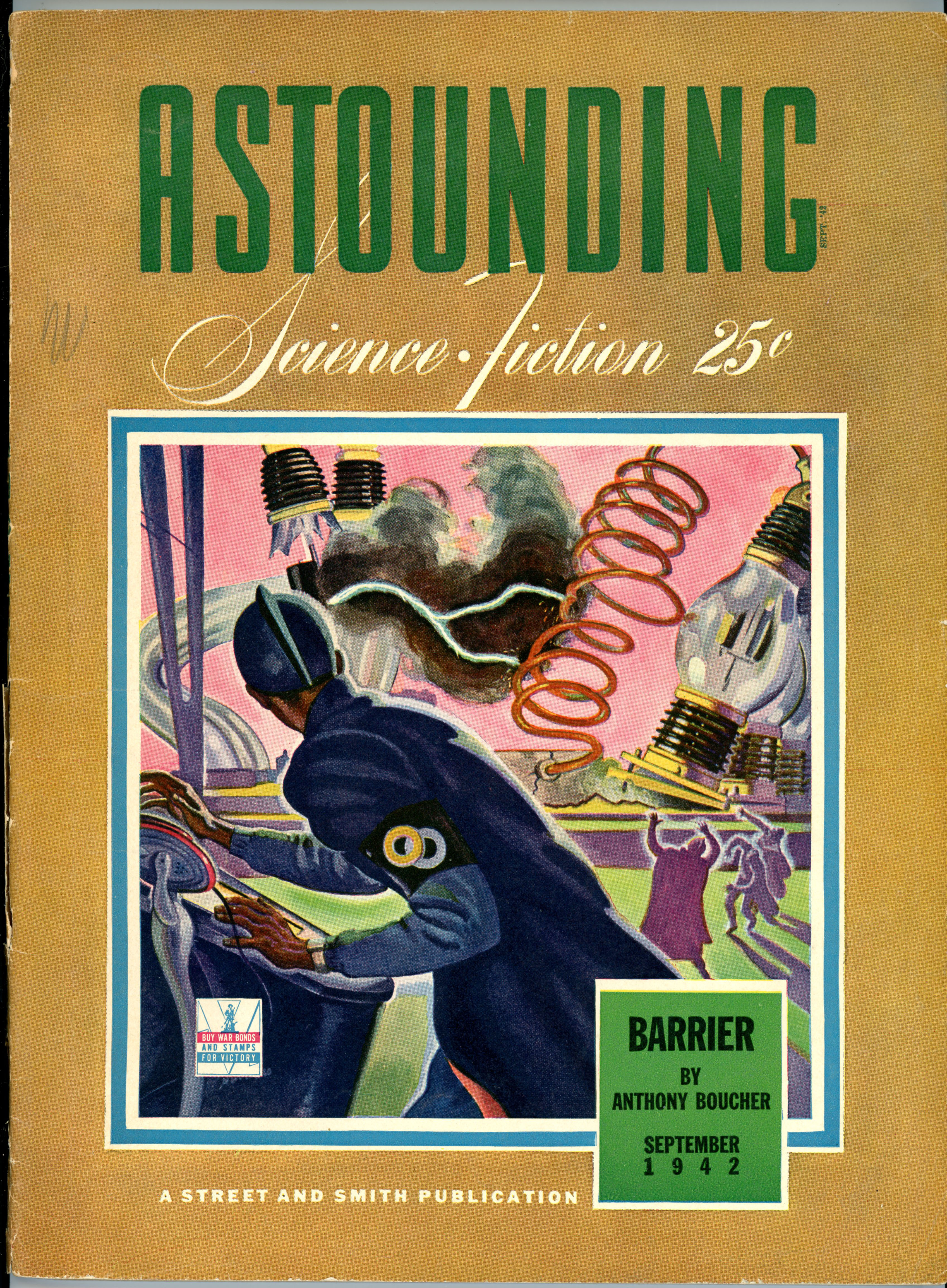
The Twonky, from Astounding Science Fiction, September, 1942

Here’s the cover of the September, 1942, issue of Astounding…

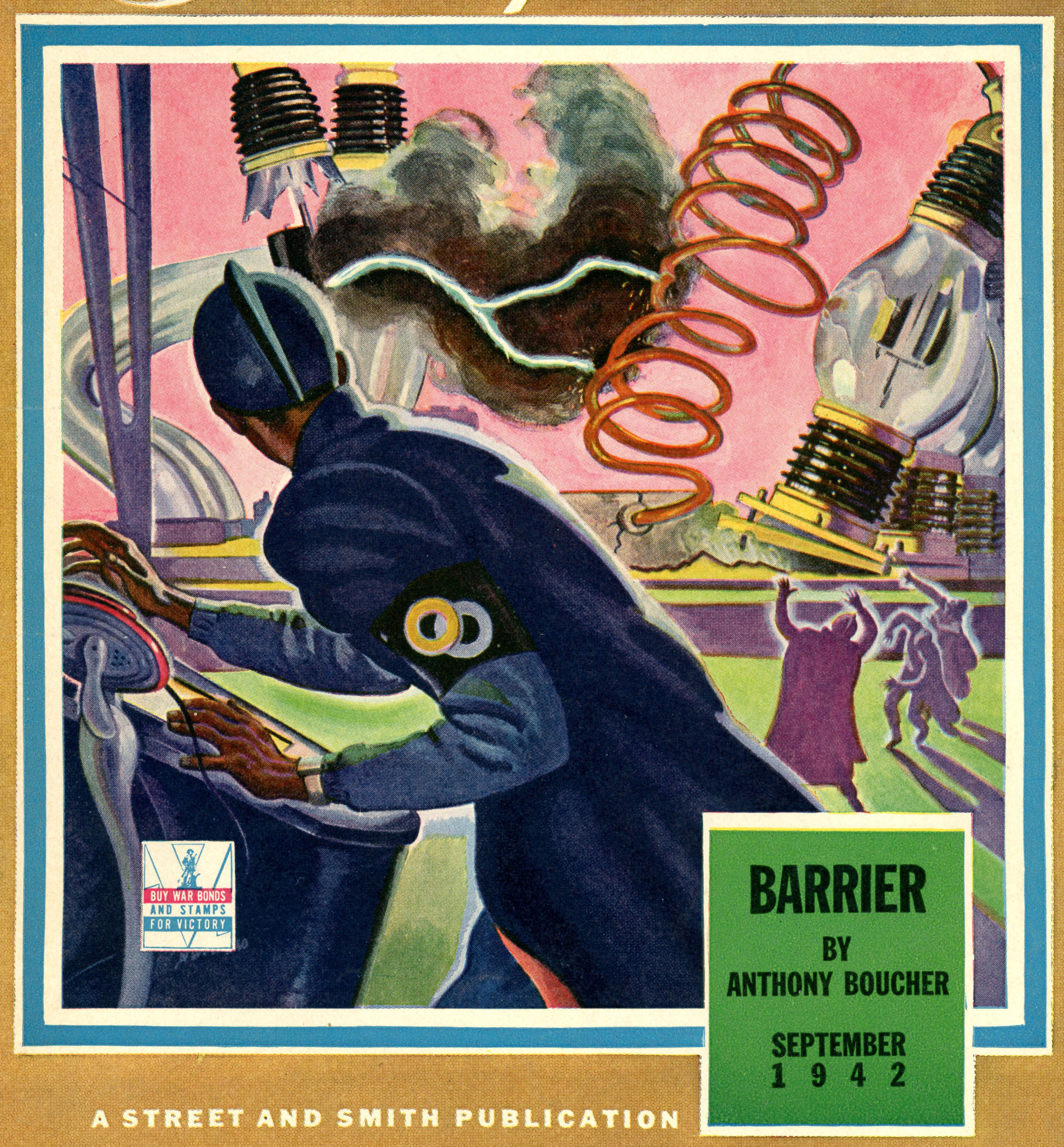
…and, a close-up of William Timmins’ cover art.  Giant light-bulbs a-bursting?  Well, it gets the point across!

The film adaptation of “The Twonky” (1953) can be found at Ayako Edwina’s YouTube channel.

____________________

A Gnome There Was, from Unknown Worlds, October, 1941

The Big Night, from Thrilling Wonder Stories, June, 1947

Nothing But Gingerbread Left, from Astounding Science Fiction, January, 1943

The Iron Standard, from Astounding Science Fiction, December, 1943

Cold War, from Thrilling Wonder Stories, October, 1949

Or Else, from Ahead of Time, 1953

Endowment Policy, from Astounding Science Fiction, August, 1943

Housing Problem, from Charm, October, 1944

____________________

What You Need, from Astounding Science Fiction, October, 1945

The basis of the identically-titled episode 12 of The Twilight Zone, first broadcast on December 25, 1959, profiled at the Internet Movie Database, “What You Need” is the subject of Twilight Tober-Zone’s critique, which also covers Tales of Tomorrow’s 1952 version of the story.

Absalom, from Startling Stories, Fall, 1946

____________________

References and What-Not

Publication History of Ballantine Books / Del Rey-Ballantine, “The Best of…” science fiction series, via Internet Speculative Fiction Database

Library of Congress Online Catalog (Advanced Search)

Biography of Dean Ellis, at askArt

Works by Dean Ellis, at Science Fiction Book Art

Works by Dean Ellis, at Artnet

6 Great Short Novels of Science Fiction, edited by Groff Conklin – 1954 [Richard M. Powers]

A very nice example of Richard Powers’ work from the mid-1950s.  Like the covers of Star Science Fiction Number One and Number Two but even more stylized than those illustrations, the book depicts a jagged alien landscape which actually “wraps” around all four sides of the cover.  It seems as if the cover was deliberately designed – both front and back – to allow “empty” areas for the presentation of the title, editor’s name, authors’ names, and a short blurb about each of the six stories.

This time, however, there is no space-suited explorer.  Rather, the symbolic figure of a man holds a ringed-planet.

An interesting aspect of this book is that the title of each story includes an illustration by artist David Stone, all of which are original to this book.  (I’d like show scans of these images, but I don’t want to risk breaking the binding in my scanner!)

As for the stories themselves, I read “Surface Tension” some years ago, and found the premise to be quite innovative, though the “science” behind the story is another question!

Contents

“The Blast”, by Stuart Cloete, from Colliers, April, 1946

“Coventry”, by Robert A. Heinlein, from Astounding Science Fiction, July, 1940

“The Other World”, by Murray Leinster, from Startling Stories, November, 1949

“Barrier”, by Anthony Boucher, from Astounding Science Fiction, September, 1942

“Surface Tension”, by James Blish, from Galaxy Science Fiction, August, 1952

“Maturity”, by Theodore Sturgeon, from Astounding Science Fiction, February, 1947

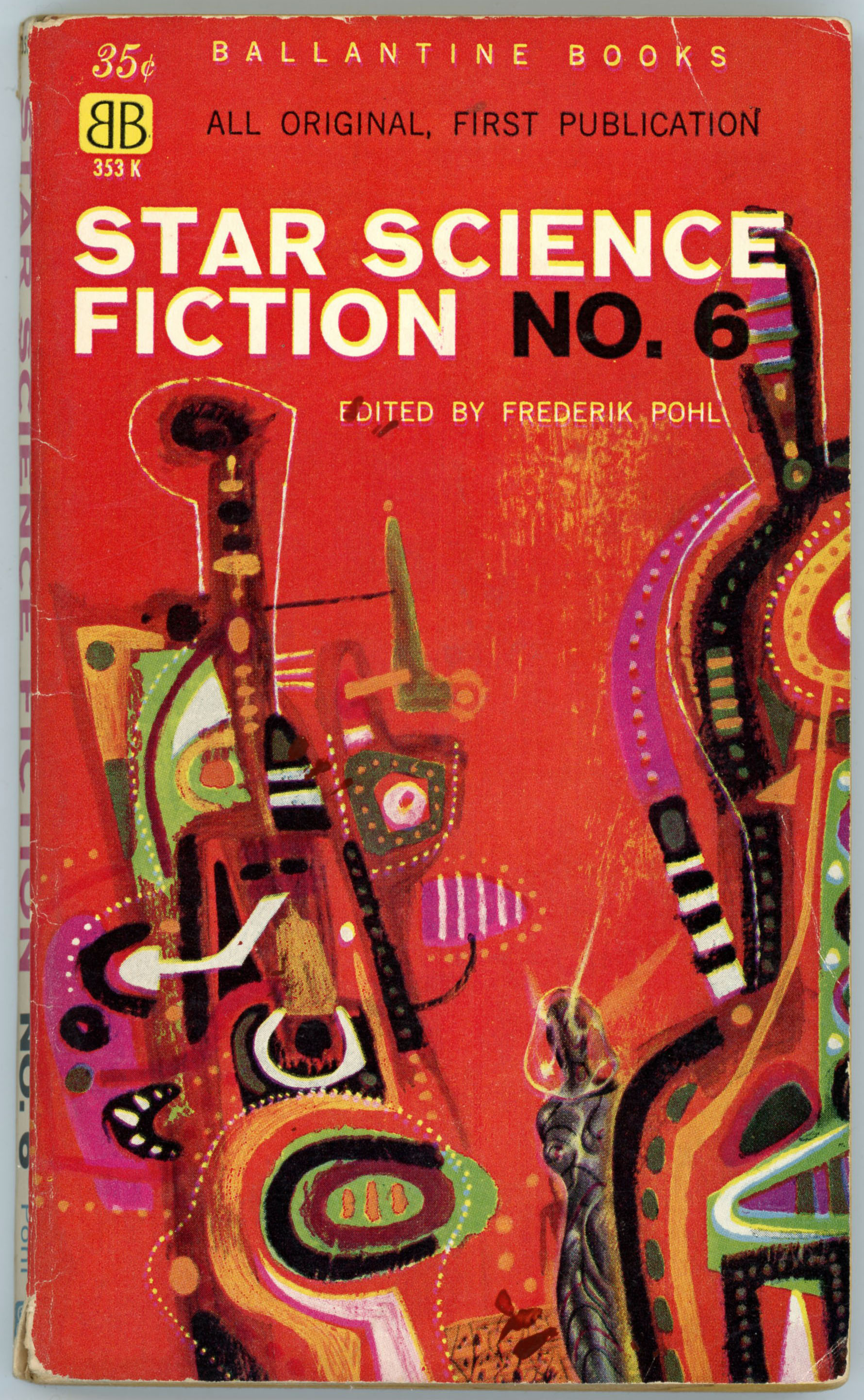
Star Science Fiction Stories No. 6, Edited by Frederik Pohl – 1959 [Richard M. Powers]

Star Science Fiction No. 6, the final volume of Ballantine Books’ “Star Science Fiction” anthologies published from 1953 to 1959, presents a notable example of the evolution of Richard Powers’ art.  His earlier cover illustrations for the series are straightforwardly representational, albeit stylistically distinctive in terms of the use of color, and, the depiction of human figures and technology.  (See particularly Volumes 1 and 2.)  This cover, however, akin to some of Powers’ other illustrations from the late 50s and early 60s, marks a strong turn toward the abstract.  Three human-like forms are present, with the two largest figures painted in a style bearing a odd resemblance to wandjina figures of Australian Aboriginal mythology:  These have a vaguely humanoid shape, being formed of concentric patterns of contrasting colors.

Against these, the only genuinely human form appears as a small female figure in the lower center of the image.  But, this figure too, is symbolic:  There are no facial features, and “she” wears only the vaguest representation of a space helmet.  And, unlike Powers’ earlier science fiction covers which present alien skies and strange extraterrestrial landscapes in a variety of colors and patterns, the background here is simple:  Red, red, and more red, with just a hint of brown land at the very bottom. 

As for the stories within?  Oh, yeahhh…  (!)  Well – * ahem * – the book is in my literary “queue”.  (At least, somewhere.)  Though – Cordwainer Smith being one of my favorite science fiction authors – I did at least read “Angerhelm” some years ago!

 Contents

Danger! Child at Large, by C.L. Cottrell (Charles Cottrell)

Twin’s Wail, by Elizabeth Mann Borgese

The Holy Grail, by Tom Purdom

Angerhelm, by Cordwainer Smith

The Dreamsman, by Gordon R. Dickson

To Catch an Alien, by John J. McGuire

Press Conference, by Miriam Allen deFord

Invasion from Inner Space, by Howard Koch


A Mile Beyond the Moon, by Cyril M. Kornbluth – 1958 [Abraham Remy Charlip]; January, 1962 (1958) [Richard M. Powers]

Doubleday’s 1958 A Mile Beyond The Moon was the last of three collections of Cyril M. Kornbluth stories to have been published before his death on May 21, 1958.  The anthology comprises fifteen stories, of which all but two (“Kazam Collects” and “The Word of Guru”) date from the 1950s.

Though all the stories are emblematic of Kornbluth’s tight, direct, focused writing style, the most memorable are “The Little Black Bag”, “The Words of Guru”, and “Shark Ship”.

Of all the stories within the volume, my favorite is easily “The Little Black Bag”, which – accompanied by Edd Cartier’s great illustrations – first appeared in the July, 1950, issue of Astounding Science Fiction, albeit I first read the story in Volume I of the Science Fiction Hall Of Fame.  The story succeeds due to Kornbluth’s clear and uncomplicated plot, adept use of science fiction tropes (time travel and advanced technology), steady and skilled pacing, and crisp – albeit not too deep – character development and individuation, which in combination lead to a conclusion with a jarring and fitting “punch”.  Over all, the story reflects the inexorable nature and reach of justice – cosmic justice – regardless of the fact that theology plays no direct role in the tale.  This parallels some of Kornbluth’s other works, such as the superb Two Dooms (his much under-appreciated variation on the theme of The Man In The High Castle), and the much shorter Friend To Man.

Fittingly, the story has been adapted for television. 

Triply fittingly, it’s been adapted thrice.

Written for broadcast by Kornbluth and Mann Rubin, starring Joseph Anthony as Doctor Arthur Fulbright and Vicki Cummings as “Angie”, it was broadcast on Tales of Tomorrow on May 30, 1952.  You can view the program here, at Bobby Jamieson’s YouTube Channel.

Next adapted for the BBC’s science-fiction series Out Of The Unknown (1965-1971), it was broadcast in February of 1969.  Though you can read a review of the episode at Archive Television Musings, I don’t believe that it’s available on the Internet.  However, perusing the few available stills of the episode suggests that it’s likely the most version most faithful to Kornbluth’s original story.

Later, Rod Serling adapted the story for Night Gallery.  Starring the superbly talented Burgess Meredith as Doctor Fulbright, the story was the second of three segments comprising the season’s second episode, broadcast on December 23, 1970.

You can view Night Gallery version (with Spanish subtitles) in three segments (first, second, and third) via Metatube.

Though I’ve not fully viewed the Tales and Tomorrow and Night Gallery versions of the story, it seems clear that – along with character changes – the story in those two productions was substantially softened from the disconcerting (shall we say…?!) “events” in the original tale in Astounding.

Well, he never flinched with words.

And so, the book’s cover…

(Hardback – “Hard Landing!”)

Abraham R. Charlip’s cover fits the title perfectly:  A symbolic moonscape with a strangely greenish hue, filled with meteor craters, is viewed from directly above – from a mile above? – albeit the height of the crater walls is greatly exaggerated!  Unusually for science fiction art of this era, neither astronauts nor spacecraft nor aliens are part of the picture.

Here’s the blurb from the anthology’s rear cover, which – along with the rocket, and emblem in the lower right corner – was a regular feature on the covers of hardbound science fiction published by Doubleday during the 1950s.  (You can view a similar example on the cover of A.E. Van Vogt’s Triad.)  Thus, the blurb: 

TODAY’S FICTION –
TOMORROW’S FACTS

LIFE Magazine says there are more than TWO MILLION science fiction fans in this country.  From all corners of the nation comes the resounding proof that science fiction has established itself as an exciting and imaginative NEW FORM OF LITERATURE that is attracting literally tens of thousands of new readers every year!

     Why?  Because no other form of fiction can provide you with such thrilling and unprecedented adventures!  No other form of fiction can take you on an eerie trip to Mars … amaze you with a journey into the year 3000 A.D. … or sweep you into the fabulous realms of unexplored Space!  Yes, it’s no wonder that this exciting new form of imaginative literature has captivated the largest group of fascinated new readers in the United States today!

Note the lack of reference to the book’s content, let alone other works of science fiction published by Doubleday.  Instead, the cover blurb does something very different:  It validates the cultural and literary legitimacy of science fiction as a form of literature, and indirectly (hint-hint, wink-wink, nod-nod!) praises – albeit tangentially – those readers who have an interest in the genre.  Though you’d never see such verbiage today – some sixty years later – in the 1950s this would actually have made sense, in terms of culturally validating a form of literature long steeped in negative stereotypes.  

And so, the anthology’s includes are listed below.  I’ve included illustrations for the June, 1941 issue of Stirring Science Stories, and the May, 1953, issue of Space Science Fiction, which has a stunning and imaginative cover by Alex Ebel, and interior art by Frank Kelly Freas. 

Contents

Make Mine Mars, from Science Fiction Adventures, November, 1952

The Meddlers, from Science Fiction Adventures, September, 1953

The Events Leading Down to the Tragedy, from The Magazine of Fantasy and Science Fiction, January, 1958

The Little Black Bag, from Astounding Science Fiction, July, 1950

Everybody Knows Joe, from Fantastic Universe, October-November, 1953

Time Bum, from Fantastic, January-February, 1953

Passion Pills, from A Mile Beyond the Moon (this volume)

Virginia, from Venture Science Fiction, March, 1958

The Slave, from Science Fiction Adventures, September, 1957

Kazam Collects, from Stirring Science Stories, June, 1941 (as S.D. Gottesman) (Cover by Hannes Bok)

The Last Man Left in the Bar, from Infinity Science Fiction, October, 1957

The Adventurer, from Space Science Fiction, May, 1953 (Cover by Alex Ebel)

Interior illustration (p. 45) by Frank Kelly Freas

The Words of Guru, from Stirring Science Stories, June, 1941 (as Kenneth Falconer)

Shark Ship, from A Mile Beyond the Moon (this volume; variant of “Reap the Dark Tide”, from Vanguard Science Fiction, June, 1958 (First issue, last issue, only issue! – alas!)

Two Dooms, from Venture Science Fiction, July, 1958

______________________________

Also in Stirring Science Stories, June, 1941 but not included in this anthology:

Forgotten Tongue (as Walter C. Davies)

Mr. Packer Goes to Hell (as Cecil Corwin), related to “Thirteen O’Clock”, in Stirring Science Stories, February, 1941

______________________________

(Paperback – “Soft Landing!”)

The anthology was republished in 1962 by Macfadden Books, the paperback imprint of the Macfadden-Bartell Corporation, itself a subsidiary of the Bartell Media Corporation. 

Cover painting?  Though not specifically listed, the ISFDB indicates that the work was by Richard Powers.  If so (okay, it has some elements of Powers’ style!) – alas – this was one of Powers’ weaker (dare I say weakest?) efforts within his otherwise magnificent oeuvre.  Well, neither sculptor nor painter nor writer can bat three hundred every time!

Here’s the anthology’s cover blurb, which unlike the Doubleday edition is both entirely relevant to the book’s contents and at the same time perceptive of Kornbluth’s work.  One senses that Macfadden’s compiler or editor actually read Kornbluth’s work, to begin with!

DEFT AND FUNNY, WICKED AND WISE…

     Here is science fiction at its peak.

     C.M. Kornbluth was one of the great masters of the form: gathered here are his best short stories.

     This posthumous collection takes you on wild excursions past unexplored boundaries of time and space, society, morals, customs and science.  Here are the dilemmas – comic or tragic, ironic or fantastic – that confront the individual when technology advances relentlessly past humanity’s capacity to absorb it.

     These stories are never horse-operas with Martian settings.  They are sensitive, superbly written, humanity-conscious tales of people struggling in a world they might have made – but never mastered.

I wonder how Kornbluth would have treated smartphones (oxymoron…), Twitter, Facebook, Instagram, and all the chaotic melange that comprises “social media”…

______________________________

For your further enjoyment, enlightenment, and distraction…

Internet Speculative Fiction Database, for A Mile Beyond the Moon

Abraham Remy Charlip, at Wikipedia

Cyril M. Kornbluth, at Internet Speculative Fiction Database

Night Gallery – The Little Black Bag, with Spanish Subtitles (part 1), at Metatube

Night Gallery – The Little Black Bag, with Spanish Subtitles (part 2), at Metatube

Night Gallery – The Little Black Bag, with Spanish Subtitles (part 3), at Metatube

Night Gallery, at Wikipedia

Night Gallery – List of Episodes, at Wikipedia

Tales of Tomorrow, at Internet Movie Database

Tales of Tomorrow – Little Black Bag, at Bobby Jamieson’s YouTube Channel

Star Science Fiction Stories No. 2, Edited by Frederik Pohl – 1953 (1962) [Richard M. Powers] [Revised post]

In terms of color, detail, and symbolism, this is the best (well, seems so to me!) of Richard Powers’ Star Science Fiction covers.

The space explorer and landscape are similar to those appearing on the cover of Star Science Fiction Stories Number 1, but here, Powers has exaggerated aspects of that edition’s cover to great effect. 

Like most of Powers’ representations of astronauts, his depiction of a space explorer is more symbolic than technical, the astronaut’s spacesuit having taken on the appearance of a jointed carapace, or, a bulbous suit of medieval armor, while the terrain is even more forbidding and jagged than in Star Science Fiction Stories Number 1.  Note the use of shades of green and red in the spacesuit, horizon, and, alien horizon. 

____________________

Here’s more detail from the back cover.  Again, note the emphasis on shapes and colors, rather than detailed presentation of technology 

Taken as a whole, the presence of a solitary astronaut and departing spaceship suggest a story in and of itself.

Contents

Disappearing Act, by Alfred Bester

The Clinic, by Theodore Sturgeon

The Congruent People, by A.J. Budrys

Clinical Factor, by Hal Clement

It’s A Good Life, by Jerome Bixby

A Pound of Cure, by Lester del Rey

The Purple Fields, by Robert Crane

F Y I, by James Blish

Conquest, by Anthony Boucher

Hormones, by Fletcher Pratt

The Odor of Thought, by Robert Sheckley

The Happiest Creature, by Jack Williamson

The Remorseful, by Cyril M. Kornbluth

Friend of the Family, by Richard Wilson

102 6/22/17 10/1/18

The Explorers, by Cyril M. Kornbluth – August, 1954 [Jack Faragasso]

A nice selection of Cyril Kornbluth’s stories can be found in Ballantine Books’ 1954 paperback The Explorers.

The cover is straightforward and simple in subject matter, yet highly effective:  A rocket rises from a launch pad, mountainous terrain behind, with a view of the moon’s looming crater-pocked surface as the background. 

The rocket’s shape is interesting:  It’s kind of German WW II V-2-ish in general configuration, but its Coke-bottle profile is reminiscent of the fuselage of America’s F-106 Delta Dart interceptor fighter of the Cold War, the aircraft having been designed in accordance with the aerodynamic design known as the area rule.  This is readily apparent in the vertical (top-down) view of the aircraft, as seen below. 

The rocket appears once more on the rear cover, as a sketch derived from the painting.  For this, artist Jack Faragasso has added a few details to the spacecraft’s body.

Interestingly and happily, while creating this post I discovered that Mr. Faragasso – also a writer and photographer – continues to be active some sixty-six years after the creation of his illustration for Kornbluth’s book.  You can view examples of his science-fiction / fantasy illustrations here, purchase some of his books (of poetry and on art instruction) here, and likewise purchase samples of his art, here.  Intriguingly, his body of work also includes an album of early photographs of Bettie Page

From the rear cover…

C.M. Kornbluth

…has produced some of the most satisfying suspense and the keenest satire to be found in science fiction.

THE SPACE MERCHANTS, the novel of a huckster’s utopia on which he collaborated with Frederik Pohl, was hailed by the New York Times as “a book so rewarding that it should henceforth show up on all lists of science-fiction classics.”

His solo flights – from the memorable TAKE-OFF to his most recent novel, THE SYNDIC – have been no less successful and have firmly established the name of C.M. Kornbluth among the brightest lights in this field.

The present collection – the first ever published of his shorter fiction – includes both one of his earliest stories (“Thirteen O’Clock”) and a brand-new novelette, “Gomez,” which appears here in print for the first time.  Told with excitement and power, these stories display the delightfully ironic imagination of a writer who is master of his craft.

________________________________________

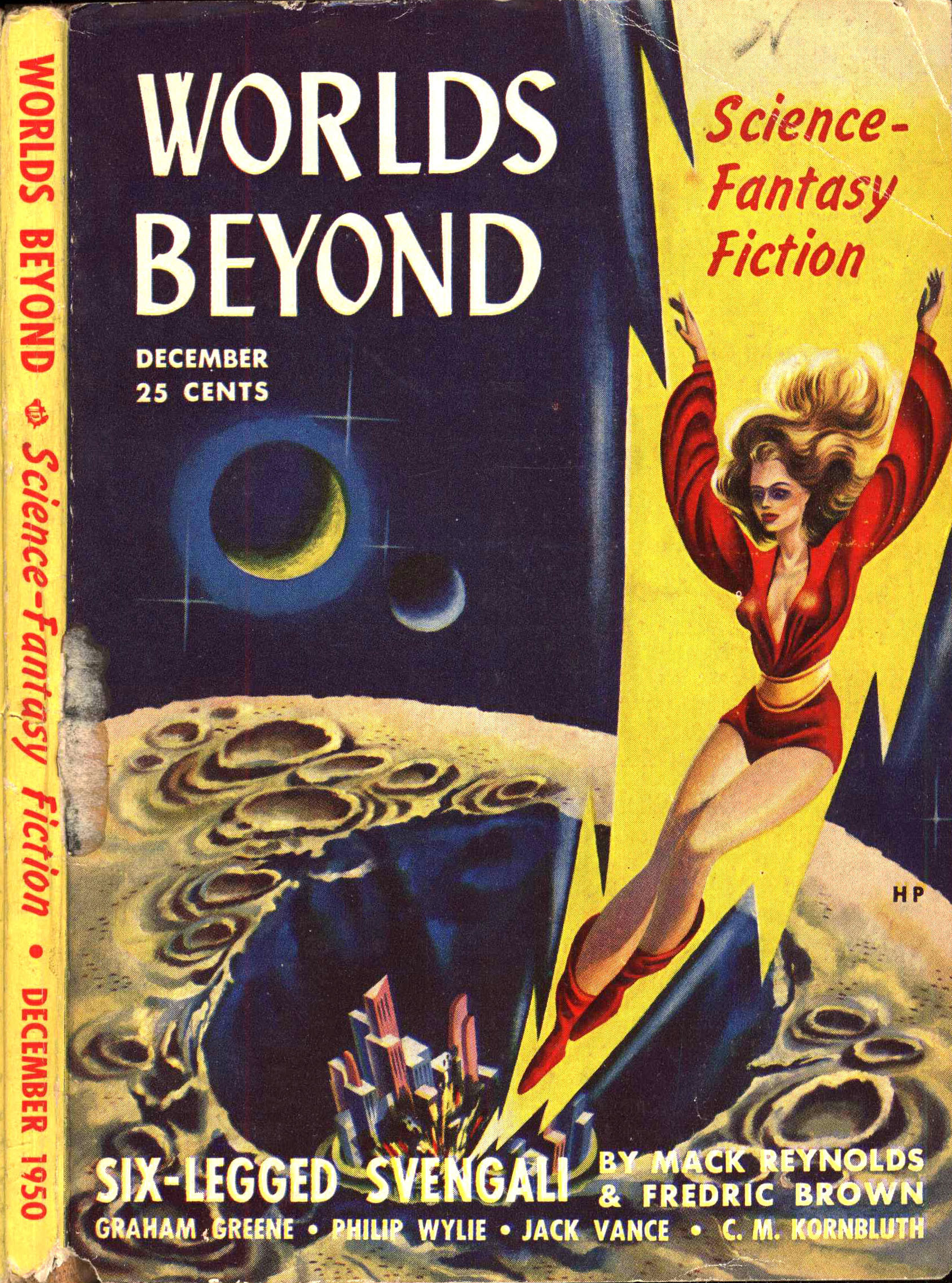
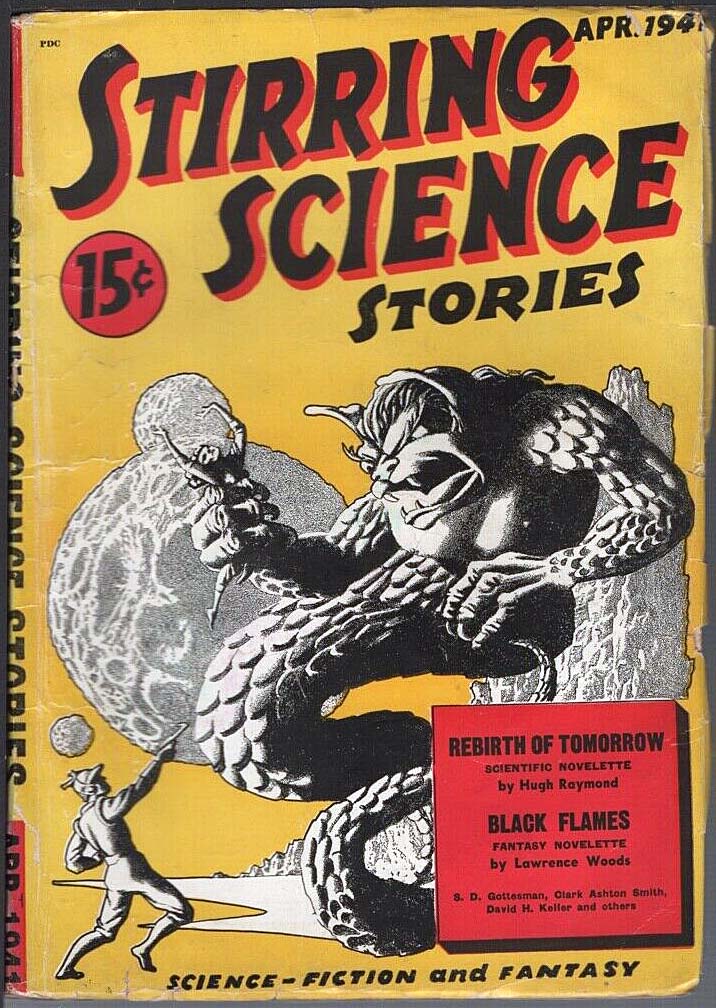
A list of the book’s contents appears below.  For three stories (“The Mindworm“, “The Rocket of 1955“, and “Thirteen O’Clock“) I’ve added images of the cover art of the magazine in which these stories originally appeared.  (Alas, found on the Internet; not part of my collection!)  I particularly liked the originality of “The Mindworm”, a very clever variation on the theme of vampires. 

Contents

Gomez, from this volume

The Mindworm, from Worlds Beyond, December, 1950 (Cover by Paul Callé)

The Rocket of 1955, from Stirring Science Stories, April, 1941 (as Cecil Corwin) (Cover by Hannes Bok)

The Altar at Midnight, from Galaxy Science Fiction, November, 1952

Thirteen O’Clock, later as “Mr. Packer Goes to Hell”, from Stirring Science Stories, February, 1941 (author as “Cecil Corwin”) (Cover by Leo Morey)

The Goodly Creatures, from The Magazine of Fantasy and Science Fiction, December, 1952

Friend to Man, from 10 Story Fantasy, Spring, 1951

With These Hands, from Galaxy Science Fiction, December, 1951

That Share of Glory, from Astounding Science Fiction, January, 1952

About C.M. Kornbluth, essay by C.M. Kornbluth, from this volume

References

Internet Speculative Fiction Database, for The Explorers

Jack Faragasso – His Own Website!