The Voices of Time and Other Stories, by J.G. Ballard – February, 1962 [Richard M. Powers]

I’ve read very little in the way of J.G. Ballard, with the solitary exception of the anthology Billenium, and his novel The Wind From Nowhere.  Though I read both long ago, what still stands out in my memory is the sheer originality, in terms of plot and theme, of these literary works.  Within Billenium, I was particularly impressed by the short story “Chronopolis”, which originally appeared in New Worlds back in June of 1960.  Overall, I remember that neither the novel nor that anthology were undergirded by grandiose, sweeping, (space) operatic concepts.  Instead, the foundation of both works both lay in taking an idea, event, or technology, indefinitely extrapolating its effects and implications in order to focus on the reactions of “man” – or, individual men and women – to worlds that have been transformed in unexpected, unanticipated directions. 

Kind of like today.  Now.  2023.  (And beyond.)

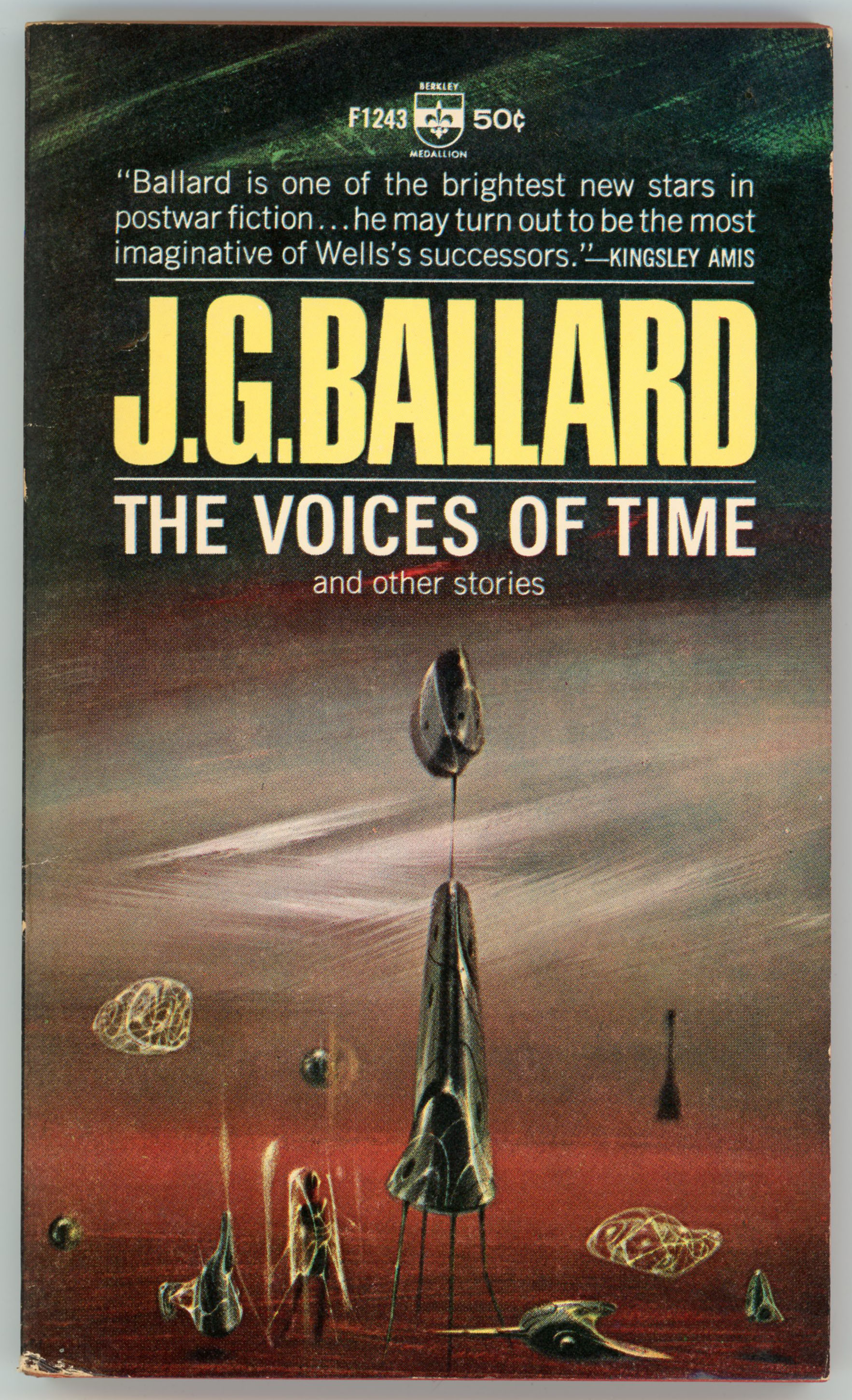
So, here’s a Ballard anthology which I have yet to read: The Voices of Time from 1962, featuring cover art by Richard Powers.  As for other anthologies, Powers’ painting has neither a central them nor really a single, main, primary (and major?!) subject.  Instead, its only theme are abstractness and ambiguity.  Within a haze of wavy red, then, gray, then olive, and finally dark green fog stand (and, float) shining, elongated objects (kind of lava-lamp-like, eh?).  Some are solid; other are delicate lattices.  And, a vertical shape in the background gives a sense of distance. 

The only human form is a small anthropomorphic profile surrounded by a shining shield, in the left foreground.   

Maybe I’ll get around to reading this one some day…

Contents, Contents, Contents

“The Voices of Time”, from New Worlds Science Fiction (#99), October, 1960

“The Sound-Sweep”, from Science Fantasy (#39), February, 1960

“The Overloaded Man”, from New Worlds Science Fiction (#108), July, 1961

“Zone of Terror”, from New Worlds Science Fiction (#92), March, 1960

“Manhole 69”, from New Worlds Science Fiction (#65), October, 1957

“The Waiting Grounds” from New Worlds Science Fiction (#88), November, 1959

“Deep End”, from New Worlds Science Fiction (#106), May, 1961

J.G. (James Graham) Ballard, at…

J.G. Ballard.ca

Internet Speculative Fiction Database

Internet Movie Database

Wikipedia

GoodReads

The Guardian

Reach for Tomorrow, by Arthur C. Clarke – March, 1956 [Richard M. Powers] [Updated post – with new detail!…]

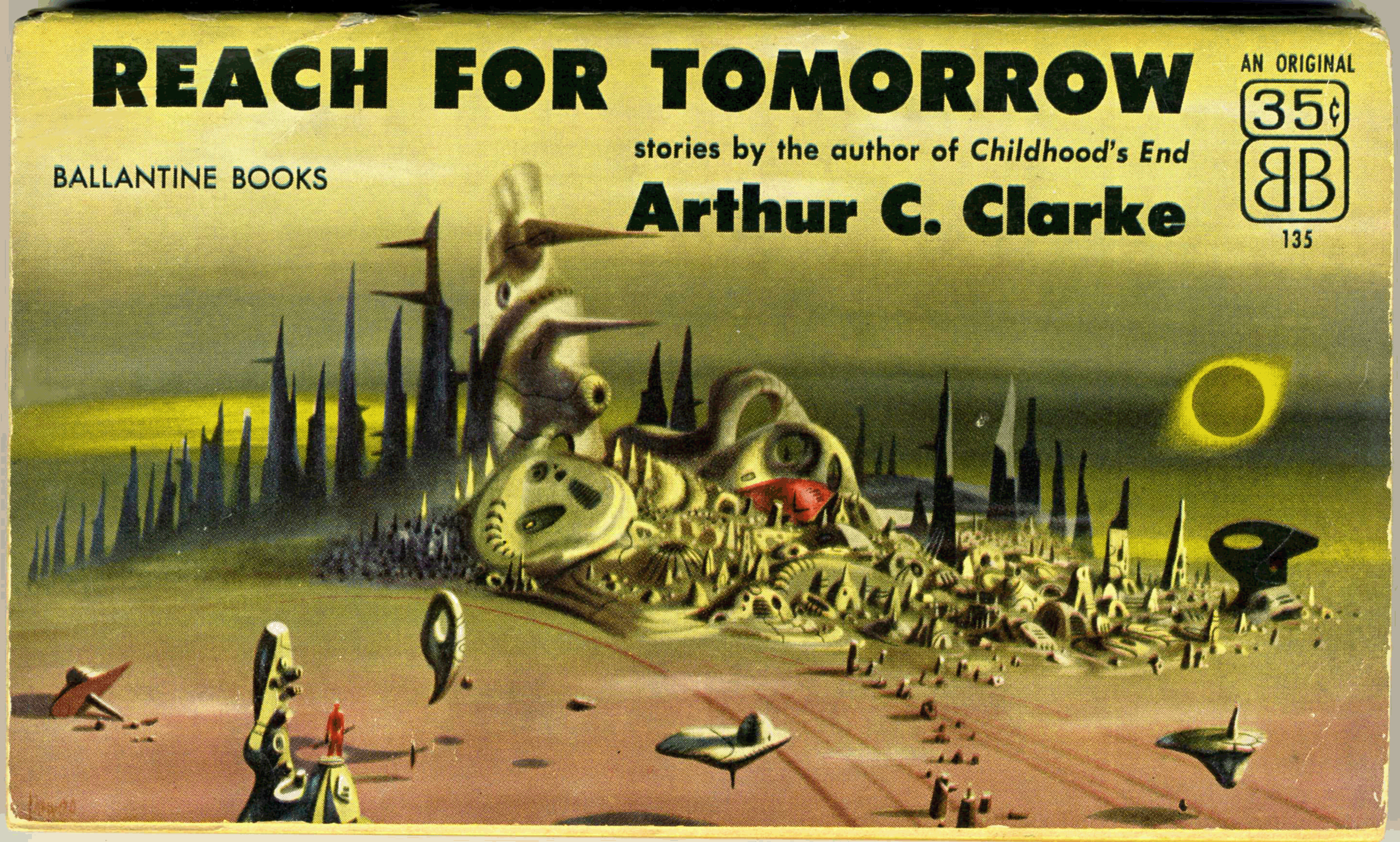
From January of 2017, this is one of my earlier posts.  Since then, I’ve been able to acquire a copy of Reach For Tomorrow in better condition than my “first”, this newer copy being presented below.  Though I’ve used the same scanner (Epson V600, to be specific) to create images of both copies, note the difference in hues between the the covers of the two books.

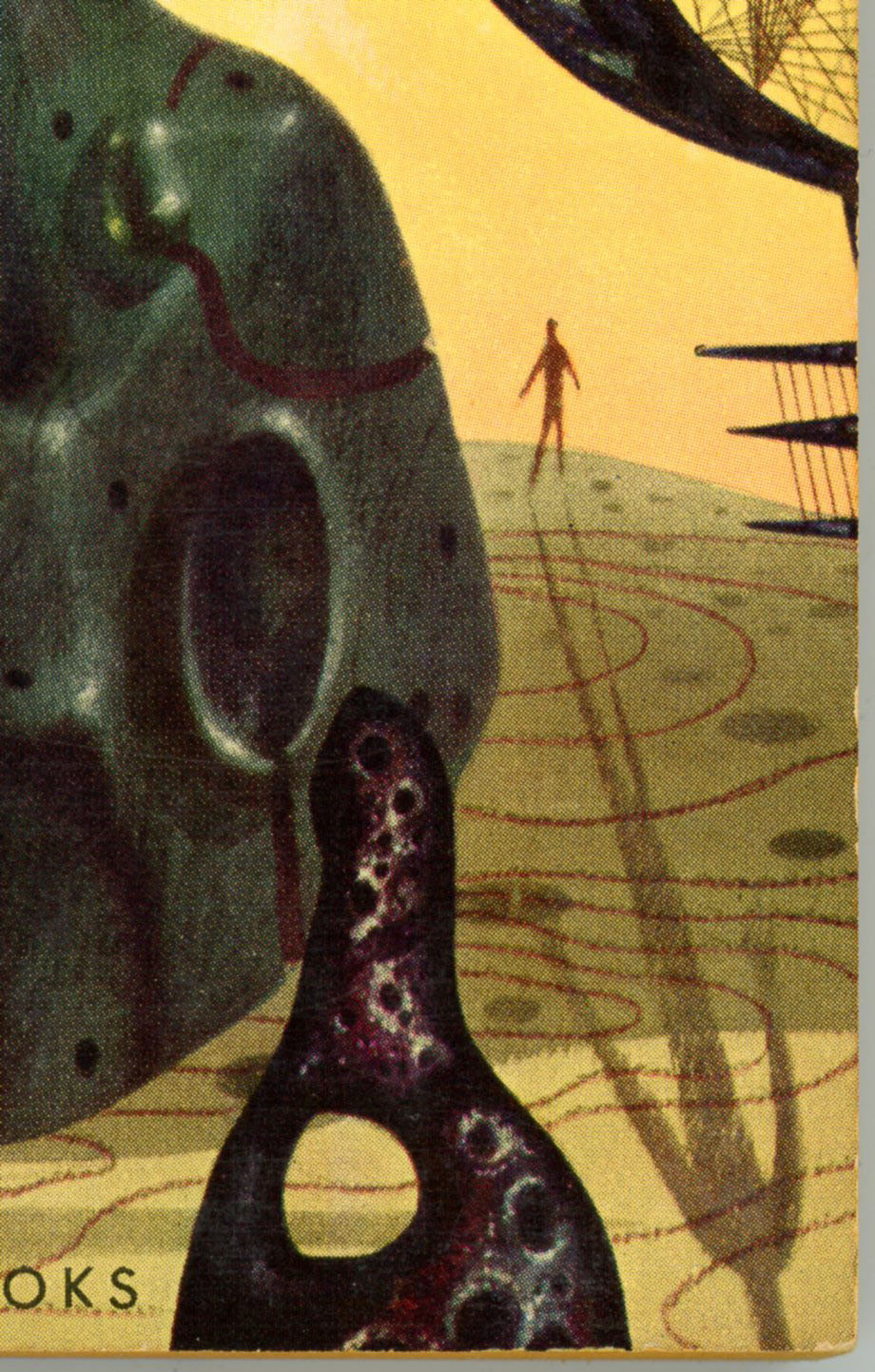
I’ve also scanned specific areas of the cover at a ridiculously high resolution (600 dpi! – you can see the halftone printing in mesmerizing clarity) to present a larger image in your browser, and to give a better appreciation for the nature of Richard Powers’ art. 

Like many of his compositions, the only human presence in this scene is denoted by a solitary, miniscule man: A simple figure in red stands atop a pillar in the left foreground, holding some sort of enigmatic object. 

Otherwise, the view includes three floating and one fallen “objects”, another feature common to Powers’ cover illustrations for works of science fiction.  Clearly, Powers (and perhaps the art department of Ballantine Books?) seem to have accorded a great deal of forethought and planning in the creation of this unusual cover, which – in terms of originality and impact – is strikingly like that of Ballantine’s 1965 release of Expedition to Earth.  Which, along with Prelude to Space, I hope to bring you in a future post.

Note that the book’s rear cover has a horizontal format identical to the front, and includes illustrations of four other science fiction works by Clarke published by Ballantine.  (Childhood’s End, Expedition to Earth, Prelude to Space, and Earthlight.) 

Reach for Tomorrow was published by Ballantine in 1970 in a conventional vertical format, with cover art that – while nice – was equally conventional.  You can view the later edition here.  

Contents

Rescue Party, Astounding Science Fiction, May, 1946

A Walk in the Dark, Thrilling Wonder Stories, August, 1950

The Forgotten Enemy, Avon Science Fiction and Fantasy Reader, January, 1953

Technical Error (“The Reversed Man”), from Thrilling Wonder Stories, June, 1950

The Parasite, from Avon Science Fiction and Fantasy Reader, April, 1953

The Fires Within, from Startling Stories, September, 1949

The Awakening, from Future Science Fiction Stories, January, 1952

Trouble With the Natives, from Marvel Science Stories, May, 1951

The Curse, from Cosmos Science Fiction and Fantasy Magazine, September, 1953

Time’s Arrow, from Science Fantasy, Summer, 1950

Jupiter Five, from If, May, 1953

The Possessed, Dynamite Science Fiction, March, 1953

______________________________

– Cover detail – right –

______________________________

– Cover detail – lower center –

______________________________

– Cover detail – lower left –

______________________________

Reference

Reach for Tomorrow, at Internet Speculative Fiction Database

From original post of January, 2017.  A little on the green side, eh?

1/1/18 – 141; 1/29/20 518

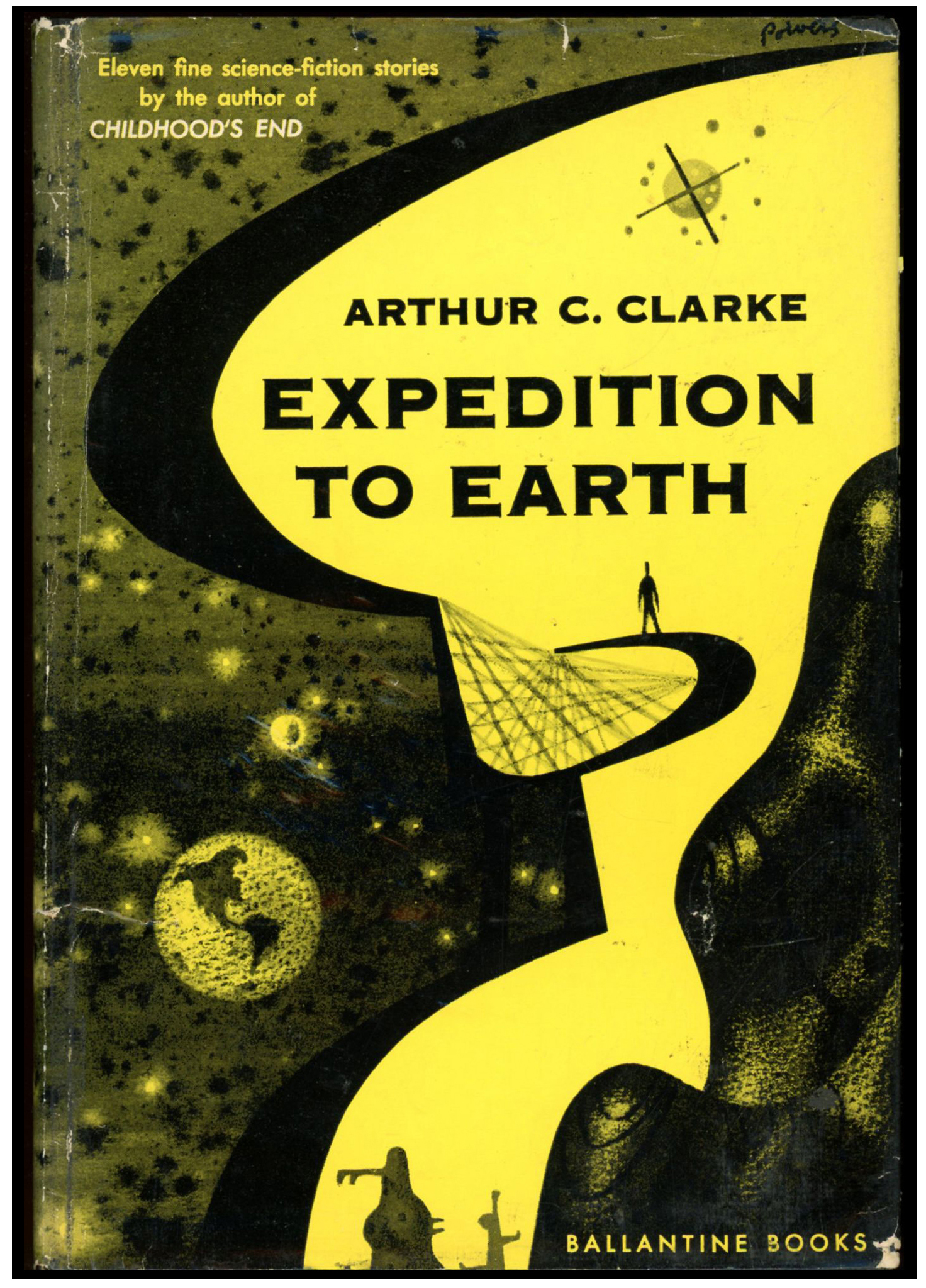
Expedition to Earth, by Arthur C. Clarke – February, 1961 (December, 1954) [Richard M. Powers]

Some book covers are outstanding, while others stand out.  

A few, do both.  

Case in point, Richard Powers’ covers for two anthologies of stories by Arthur C. Clarke – Expedition to Earth, and, Reach for Tomorrow – published by Ballantine Books in 1956 and 1961, respectively.  Even in comparison with the visual impact and riveting symbolism characteristic of Powers’ work, these compositions are truly outstanding.  They suggest a level of planning, focus, attention to detail, and originality that truly went “one step beyond” (double entendre, there!…) the typically singular nature of his painting.  Perhaps – just an idea – the quality of these works was a testimony to Clarke’s by then significance as an author, or, a decision by Ballantine to help generate even greater recognition for Clarke.    

So, here’s the cover of Ballantine’s paperback 1961 Expedition to Earth, which is apparently based on and adapted from the cover of the anthology’s 1954 hardback edition. (At bottom of this post!)  

Note that while the front cover depicts a massive reddish-brown “thing” (whatever the thing is!…), the rear cover isn’t “vacant”: A latticed sculpture on a curved framework occupies most of the landscape, and could easily be switched to the book’s front cover – the red massif going to the back cover – without losing any impact.  

___________________

Here’s a closer view of the massif.  Notice the cloudless earth floating in the background?  This, and the diminutive figure of a man (we’ll get to him in a moment!), are the only objects that are actually recognizable in the painting, which is bereft even of spacecraft.    

___________________

Two things here.  

First, the object in the foreground is, I think, actually an anthropomorphic figure; a symbolized man.  Though Powers was more than capable of rendering the human figures and faces – whether male or female – in dramatic realism, “people” in many of his paintings from the 50s and 60s were instead represented as elongated, vertically oriented shapes, with legs, torsos, and heads indicated by curves in a figure’s outline.  Though I’ve not yet presented examples of his work from the 70s and 80s, a cursory internet search strongly suggests that realistic representations of the human form were by those decades increasingly incorporated into his work.    

Second, the tiny, featureless human silhouette in the background – casting a shadow that extends across the cover – figured in a number of Powers’ paintings from this era.  Conjecture:  Perhaps this was the artist’s way of connoting the insignificance of a man – or mankind – in the face of the unknown, or, in terms of the physical immensity of the universe.  Perhaps it’s a way of suggesting awe, wonder, and transcendence.  Perhaps – just maybe? – it’s a tiny way of linking the imagined landscape to our reality.

The silhouette reminds me of something else:  Brief moments in the latter part of the dream sequence in Alfred Hitchcock’s 1945 Spellbound.  I’m certain the resemblance is purely coincidental, and I doubt these few seconds of the movie would have influenced Powers’ work nine years later.  But, the similarity is interesting. 

You can view the Spellbound dream sequence, care of Passthejointplease, below…

You can be fully spellbound by Spellbound via Old Time Movies, here.    

___________________

This close-up of the rear cover shows a smaller version of the massif, set behind the framework supporting the latticed sculpture.  The pale green landscape is covered by concentric sets of curves, but, there’s no topography: It’s entirely flat.  

___________________

Here’s the cover art of the 1961 Ballantine Paperback, sans paperback.  Found at Pinterest, this image reveals that the book’s cover art, as published, didn’t fully reflect the range of shades of orange, yellow, and tan in Powers’ original painting.  What’s also apparent is that Powers limited the range of colors for land and sky to shades of red, orange, yellow, and olive green, while all other objects are in tones of purple and black. 

___________________

Now that we’ve viewed the paperback, let’s take a look at the cover of the hardback first edition. 

This image, from John W. Knott Jr. Bookseller, clearly shows that the 1954 hardback cover design was the precursor for that of the 1961 paperback edition.  In this version, the earth is very prominently displayed, while the “lattice” occupies the center of the image.  Our diminutive silhouette-of-a-man stands nearby, yet virtue of being set against the yellow sky he’s nonetheless prominent.  A part of that big red massif stands to the right.  And, the sky to the left is speckled with stars.  However, unlike the paperback, the first edition’s cover isn’t a wraparound.  As you can see at DustJackets.com, the rear cover simply has a few endorsements.  Perhaps this “first” cover, as printed by Ballantine in only two shades of color (guess they saved a few bucks that way?), revealed only a small portion of Powers’ original canvas. 

When came time for the paperback, his composition could finally be printed – with a few features shifted, enlarged, or deleted – in all its color.      

Expedition to Earth was published by Ballantine in 1971 with cover art that – while nice – was conventional.  You can view the later edition here.  

What’s Inside? (from Internet Speculative Fiction Database)

“Second Dawn”, from Science Fiction Quarterly, August, 1951
“If I Forget Thee, Oh Earth …, from Future, combined with Science Fiction Stories, September, 1951
“Breaking Strain”, from Thrilling Wonder Stories, December, 1949
“History Lesson”, from Startling Stories, May, 1949
“Superiority”, from The Magazine of Fantasy and Science Fiction, August, 1951
“Exile of the Eons”, (variant of “Nemesis”), from Super Science Stories, March, 1950
“Hide and Seek”, from Astounding Science Fiction, September, 1949
“Expedition to Earth”, (variant of “Encounter in the Dawn”), from Amazing Stories, June-July, 1953
“Loophole”, from Astounding Science Fiction, April, 1946
“Inheritance”, from New Worlds #3, October, 1947
“The Sentinel”, from 10 Story Fantasy, Spring, 1951
“About Arthur C. Clarke”, uncredited essay

12/11/22 – 90

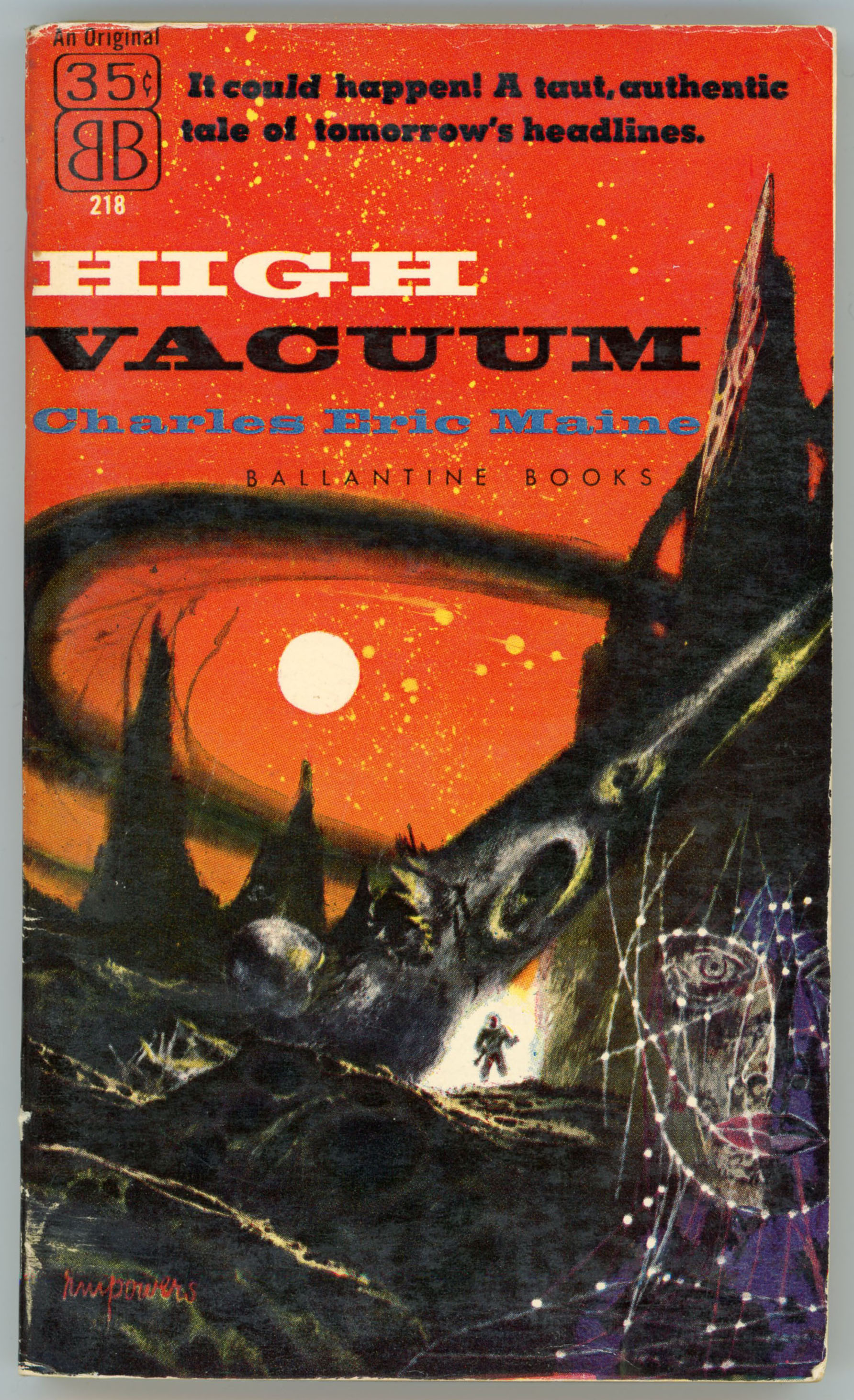
High Vacuum, by Charles Eric Maine (David McIlwain) – 1957 [Richard M. Powers]

A straightforward example of Richard Powers’ late 1950s science fiction cover art….

With colors ranging from white, to bright orange, to dark greenish gray, to black, the cover shows the surface of the moon in (highly) imaginary, (very) exaggerated, (strongly) symbolic fashion:  There are neither craters nor chain-like walls of jagged-peaked mountains, nor flat plains of dust, but spires projecting from an irregular foreground.  A woman’s face, formed from a lined pattern of dots, is at lower right.  Near the center is the only conventional element in the painting: The diminutive figure of an astronaut in a dark spacesuit, only visible because he’s backlit by a background glowing white.    

Regardless of the cover’s originality, the novel itself – having gone through nine printings since 1957, the latest having been in 2021, is fairly straightforward and conventional.  As described by Andrew Darlington [spoiler alert!], “1956 – ‘High Vacuum’ (Hodder & Stoughton, 12/6d, 192pp, Corgi, 1959, USA Ballantine), the ‘Operational Programme’ of the ‘Ministry of Astronautics’ undertakes the first lunar landing in Moonship Alpha.  Three of the four crewmen survive the initial wreck, plus the female stowaway, the second, Russian ship is sabotaged, Kenneth F Slater says ‘although there is a survivor, there is not a ‘happy ending’ to the story.  It is all the more realistic for that’ (‘Nebula’ no.25, October 1957).  Leslie Flood adds ‘the story collapses into formula melodrama’ until ‘a dream glimpse into the future of the moon-base involving the stowaway’s spaceman son – immediately belied by the child being stillborn’ (‘New Worlds’ no.66, December 1957).

So, it seems that the novel is primarily plot and character driven, rather than being founded in hard SF.

SURVIVAL…

“Vacuum is the first and last enemy of the astronaut. In space, vacuum is normal. In space, therefore, air is abnormal, and life forms depending on air for survival in space are in abnormal state. The establishment and maintenance of the abnormal is therefore the beginning and the end of interplanetary flight.”

The Handbook of the
Ministry of Astronautics

     Charles Eric Maine, author of The Timeliner and The Isotope Man, writes a tale of a grim race with time. The Alpha rocket is the first manned expedition from Earth to get to the Moon. It makes a crash-landing, and facilities for “the maintenance of the abnormal” are sharply cut. There is enough oxygen to support the four survivors for five weeks – or two for ten, or one for twenty…
     Nerve-wracking because it is so matter-of-fact, this is a high tension story of ordinary men in an extraordinary situation, of decisions quietly made that are literally of life and death importance, and, in the end, of the naked determination of the human will to survive – at any cost.

Otherwise…

High Vacuum, at…

GoodReads

Wikipedia

Internet Speculative Fiction Database

Charles Eric Maine (David McIlwain), at…

Internet Speculative Fiction Database

Wikipedia

The Encyclopedia of Science Fiction

Andrew Darlington Blogspot (Includes reviews, biography. and filmography. (Indeed, a filmography.))

The Alley God (“The Alley Man”), by Philip José Farmer – The Magazine of Fantasy and Science Fiction – June, 1959 [Edmund A. Emshwiller] / Ballantine Books – 1962 [Richard M. Powers]

Ballantine Books’ 1962 edition of Philip José Farmer’s The Alley God bears a singular example of Richard Powers’ cover art.  But, before we get to that… 

Here’s the cover of the June, 1959, issue of The Magazine of Fantasy and Science Fiction where the story first appeared, under the title “The Alley Man“.  This cover’s by EMSH – Edmund Emshwiller.  As described in Brian Ash’s The Visual Encyclopedia of Science Fiction, “…[the story] is in some ways akin to “Flowers For Algernon”, though on a more personal level.  A mental and physical throwback, who believes himself to be the last of the Neanderthals, tries to come to terms with the modern world, and, in particular, with the intellectual superiority of the girl he loves.”  

______________________________

Sidgwick and Jackson’s imprint (the only hardcover printing featuring the story), with cover art by David Hardy, appeared in 1970.  This is the only appearance of the story in English-language book format other than Ballantine’s paperback edition.  As in Ballantine’s prior imprint, the title is The Alley God.  Via the ISFDB, “Sidgwick and Jackson was originally established in 1908 and acquired by Macmillan in the 1980s.  It’s now an imprint of Pan Macmillan.”

This edition also includes “The Captain’s Daughter” and “The God Business”.  The former is a variant of “Strange Compulsion” from the October, 1953 issue of Hugo Gernsback’s Science Fiction +, which is accompanied by six (count ’em, six) illustrations by Virgil Finlay, two of which are particularly outstanding, with a level of – um – er – uh – s y m b o l i s m (yeah, that’s it, symbolism!) that’s rather direct and unambiguous.  I’ve not actually read the tale, but from what I vaguely know of it anecdotally and elsewhere – and as much as I admire Farmer’s body of work – I don’t think I’d want to. (!)  As for “The God Business”, the story originally appeared in the March, 1954 issue of Beyond Fantasy Fiction.  

______________________________

And so, we come to Ballantine Books 1962 Edition, which has content identical to that of the later Sidgwick and Jackson printing.  

______________________________

Amidst a scene of urban desolation (notice the pebbles and stones scattered across the landscape?), under a violet and ochre sky – the colors work marvelously together! – the sun fixed above, are two human-like figures.  One, kneeling, resembles the shattered remnants of a demolished building.  The figure to the left is altogether different:  Unlike anything else in the scene, it’s formed of a single, multiply folded bronze-like sheet, and props itself against the kneeling figure, to face the sun.  (With longing?  With fear?  In worship?  In wonder?)  Where did it come from?  Where is it going?  For what is it searching? 

Is it the only one of its kind? 

Alley, (lower case) god, and man.

Easily one of Powers’ best works, I’m glad Ballantine’s design department left the image “as is”, without title or publisher’s logo printed upon it.  Suitable for framing?

______________________________

There is no classifying PHILIP JOSE FARMER…

He has moved with equal ease from the rollicking adventures of “The Green Odyssey” to the weird ingenuity of “Strange Relations” to the sensitive poignancy of “The Lovers”.

Now, in the three novelets that comprise THE ALLEY GOD, he combines something of each of those qualities, using as central themes the universal concept of worship and the taboos that surround the human reproductive process.

Some people have, in the past, been shocked by the frankness of Farmer’s writing – but then, human experience is itself frequently shocking, and Farmer’s stories are of the very essence of human experience. No matter how wild the setting, nor how imaginative the circumstances, reality – human reality – is the motive power behind the foibles exposed, the shibboleths exploded, the secret dreams recalled.

______________________________

______________________________

Other Neat Places to Visit

The God of the Alley… 

…at GoodReads

… at Wikipedia (“The Alley Man”)

…at Philip José Farmer Philip José Farmer International Bibliography

…at The Hugo Awards (1960)

…at L.W. Currey, Inc. (…going for $350!…)

A Book…

Ash, Brian, The Visual Encyclopedia of Science Fiction, Harmony Books, New York, N.Y., 1977

Philip José Farmer…

…at Wikipedia

…at pjfarmer.com

…at Philip Jose Farmer

…at Internet Speculative Fiction Database

Spectrum, Edited by Kingsley Amis and Robert Conquest – March, 1963 (1961) [Richard M. Powers]

Though their literary oeuvres extended well beyond the field of science-fiction, Kingsley Amis and Robert Conquest collaborated as editors of the Spectrum anthologies, which were published in hardback format from 1961 through 1966 (except for 1964, when no such title appeared), and paperback from 1963 through 1968.  Otherwise, the bulk of their work in the genre was in the realm of essays, reviews, and poems. 

Spectrum – shown below – was listed under that title for editions published from 1961 through 1963, and reissued until the title Spectrum I for volumes published from 1964 through 1971.  Richard Powers was the cover artist for this first volume of the series – Spectrum – while Paul Lehr’s paintings were featured on the covers of Spectrum II.

Powers’ cover art for this volume has the hallmarks of his covers of other anthologies dating from this period: Floating unindefinable objects, a distant sort of city-scape, diminutive anthropomorphic figures, and, rather than a person with a recognizable face and physiognomy, a vaguely metallic, vaguely organic, vaguely human, bulbous-eyed figure walking across the foreground.  Where’s it going?  

And, here’s the floater…

What is it doing?

Truly, I do not know. 

I don’t think anybody else does, either.

So, what’s in the book?

The Midas Plague“, by Frederik Pohl, from Galaxy Science Fiction, April, 1954

“Limiting Factor”, by Clifford D. Simak, from Startling Stories, November, 1949

“The Executioner”, by Algis Budrys, from Astounding Science Fiction, January, 1956

“Null-P”, by William Tenn, from Worlds Beyond, January, 1951

“Inanimate Objection”, by H. Chandler Elliott, from Galaxy Science Fiction, February, 1954

“Pilgrimage to Earth”, by Robert Sheckley, from Playboy, September, 1956

By His Bootstraps, by Robert Heinlein, from Astounding Science Fiction, October, 1941 

Robert Conquest…

…at Internet Speculative Fiction Database

… at Wikipedia

Kingsley Amis…

…at Internet Speculative Fiction Database

…at Wikipedia

Travel In Time, Travel Through Time: “Bring the Jubilee”, by Ward Moore – The Magazine of Fantasy and Science Fiction – November, 1952 [Edmund A. Emshwiller] / Ballantine Books – 1953 [Richard M. Powers]

A central theme of science-fiction and fantasy has long been time travel, which – if a story of that genre is fully developed – can entail an exploration of the nature and implications of parallel universes, in terms both literary and historical.  Among the myriad of such stories, one of the best by far (well, the best I’ve ever read) is Ward Moore’s Bring the Jubilee, which takes a very novel approach (pardon the pun!) to the concepts of time travel and alternate history. 

The novel is very well described at Wikipedia and elsewhere, so I won’t rehash it in detail here.  Suffice to say that in terms of plot – taking for granted the reality of time travel, of course! – the most original aspect of Moore’s story is that the world we “know” from 1863 onwards – and thus the very world are living in, here, now, today in 2023 and thus into our future, exists because of the irrevocable alteration of a pre-existing and now-extinguished timeline in which the Confederacy achieved victory over the Union.  This change – the novel’s Jonbar hinge – commences in that timeline’s year of 1952, when protagonist Hodgins “Hodge” McCormick Backmaker travels back to July 2, 1863 with the intention of observing the Battle of Gettysburg in general, and the fight for Little Round Top, in particular.  Fully interacting with the world of the past – his past – not a passive observer, his presence changes the Confederate Victory of his timeline to the Union victory of ours, eventuating in a course of events – both domestic and international; for good, ill, and yet unknown – that we know today.  And with this, Backmaker is forever trapped in our world, the involuntary, tragic, and solitary exile from a timeline and universe that no longer exists, and which from our perspective never existed to begin with:  Even if a time machine were to be invented in our world, there is nothing for him to return to. 

All Backmaker knew is gone; all those he has known only exist in memory: His memory.

One could write far more about this exceptional work.  Suffice to say that in terms of plot, world-building, historical insight (welll… at least insight into the history of our world!), character development, philosophical depth, and straightforward literary quality, Bring the Jubilee is more than excellent.  Unlike the sense of humorous novelty inherent to some time-travel and alternate universe stories, Moore’s book is serious, philosophical, and ends on a note of true and deep pathos.  (Which shouldn’t dissuade you from reading it – it’s that good!) 

To the best of my knowledge it has never been adapted for film or video, but it would be more than worthy of such treatment.  

____________________

Edmund Emshwiller’s cover art for the November, 1952 issue of The Magazine of Fantasy and Science Fiction – Ward’s novel encompassing pages 24 through 112, and thus most of this issue’s content – is somewhat different in style from other examples of his paintings, where human facial expressions and technology are presented in great detail.  Here, protagonist Hodgins Backmaker’s face is hidden from us.  We see him backlit from behind as as he enters the time machine, illuminated by a glowing ring of light suspended in the device’s center.   This shadowed anonymity lends the scene an aura of adventure, power, and above, connotes the awareness of an impending step into the unknown.  And, around the door to the time machine?  Symbols of the Civil War and Confederacy: foggy silhouettes of soldiers; cavalry; artillery pieces; a steam-powered minibile.  

____________________

Here are the covers of Moore’s story in novel form, issued by Ballantine Books one year later.  You can immediately tell that it’s by Richard Powers, while his signature is at the bottom left corner of the rear cover).  Neither an anthology nor a work of science-fiction based on themes like space exploration or extraterrestrials, Powers created a image comprised of symbols and themes directly drawn from the Civil War era: Soldiers in battle, bursting artillery shells, and a map the divided North America in Backmaker’s timeline of 1951.  Given that most of the story transpires in the imagined Confederacy of the 1950s – the world descended from the Union defeat at Gettysburg – the advancing soldiers shown on the cover are all Southerners, with the Confederate flag flying above.  Another touch: 

This is one of the very few covers in which Powers includes a recognizable person – Backmaker himself (I suppose…!) at lower right, looking on, looking back, from the future.  Whose future?  His, or, ours?  

____________________

Here’s the full cover, composited via Photoshop… (My own copy.)

The Appeal of Alternate History
Gavriel Rosenfeld

The Forward
April 20, 2007

Few subgenres of literature have been subjected to such longstanding critical scorn as alternate history.  Despite the occasional publication of such masterpieces as Philip K. Dick’s 1962 novel, “The Man in the High Castle,” the more frequent appearance of duds like Newt Gingrich and William Forstchen’s much-maligned 1995 novel, “1945,” has reinforced alternate history’s reputation as the domain of armchair historians and literary hacks.

Of late, however, alternate history’s appeal has begun to grow.  Historian Niall Ferguson’s 1997 edited volume of counterfactual essays, “Virtual History,” lent the genre new credibility within the field of history, while Philip Roth’s best-selling 2004 novel, “The Plot Against America,” greatly enhanced its reputation within the American literary establishment.  Now, Michael Chabon’s provocative new novel, “The Yiddish Policemen’s Union” (HarperCollins), promises to help the genre of alternate history take yet another important step toward mainstream legitimacy.  But while Chabon’s novel is an intricately plotted, wonderfully imaginative and ultimately successful work of literature, it is a weaker exercise in counterfactual speculation.  Indeed, the novel resembles a “lite” version of alternate history that may leave connoisseurs of the real thing less than satisfied.

The best literary examples of alternate history — like Ward Moore’s 1953 novel, “Bring the Jubilee” (where the South wins the Civil War), or Robert Harris’s 1992 best-seller, “Fatherland” (where the Nazis win World War II) — combine a variety of elements: a clear point of divergence from the established historical record; clever and well-paced exposition of the reasons for history’s altered course; a convincing degree of plausibility, and a discernible stance on the question of whether the altered past is better or worse than the course of real history.

But whereas the most convincing works of alternate history tend to concentrate on a single point of divergence (the South wins the Civil War; JFK survives his assassination attempt), “The Yiddish Policemen’s Union” features several: The United States decides in 1940 to establish a territorial home for European Jewish refugees in Alaska; the Russians are defeated by the Nazis in World War II (though the Nazis ultimately lose to the Americans anyway); the Cold War never ensues, and the state of Israel is never created, as the Jews lose the 1948 War of Independence and are “driven into the sea.”  Aficionados of alternate history will probably carp at the implausibility of the United States staying in the war for very long against a victorious Nazi Germany without the Soviet Union doing most of the heavy lifting on the eastern front.  Others will view with skepticism the ideologically fanatical Nazis permitting millions of Jews to leave Europe, unmolested, for their Alaskan refuge.

But perhaps the most telling weakness about “The Yiddish Policemen’s Union” as a work of alternate history is the fact that arguably, its basic plot could have unfolded in nearly the same way as a conventional work of historical fiction.  While Chabon’s basic allohistorical premise certainly lends the novel its distinctive mood, it is inessential to its basic plot — a noirish, detective-drama-cum-political-thriller whose fundamental contours (as most readers will deduce) have been inspired by today’s real historical headlines.

Few of these criticisms will bother Chabon’s many devoted fans (I remain an enthusiastic one).  Most will be absorbed by the book’s engrossing narrative and won’t be bothered much by its diluted allohistorical dimensions.  But devotees of alternate history will probably dissent.  However much they may welcome the fact that some of America’s most celebrated writers are beginning to appreciate alternate history’s allure, they will likely insist that the genre still awaits its contemporary masterpiece.

Gavriel Rosenfeld is an associate professor of history at Fairfield University and is the author of “The World Hitler Never Made: Alternate History and the Memory of Nazism” (Cambridge University Press, 2005).

Other Stuff to Delight, Distract, and Divert You…

Ward Moore (Joseph Ward Moore)…

… at Wikipedia

… at Internet Speculative Fiction Database

…at FindAGrave

Edmund A. Emshwiller…

… at Wikipedia

… at Internet Speculative Fiction Database

“Bring the Jubilee”…

…at Wikipedia

… at GoodReads

…at The Alternate Historian (“Bring the Jubilee: A Misunderstood Alternate History Masterpiece”)

If the Confederacy had Won the Civil War…

…at History Answers (“American Civil War | How The South Could Have Won”) 

…at AlternateHistoryHub (“What if the South Won the American Civil War?”)

Crossroads in Time, edited by Groff Conklin – November, 1953 [Richard M. Powers]

Richard Powers science fiction oeuvre commenced in 1950 with a cover illustration for Doubleday’s publication of Isaac Asimov’s Pebble in The Sky.  By the end of 1953, he’d completed cover illustrations for nearly forty books and magazines.  Among these paintings was the cover of Groff Conklin’s eleventh anthology, the 1953 Crossroads in Time.

Powers’ cover for this collection was comprised of four science-fictionty elements that would appear in different combinations, colors, shapes, and sizes in his other works:  A spinning yellow sun, a spaceship, a weirdly asymmetric trapeze-like elevated city (so very unlike the Jetson family’s residence at the Skypad Apartments of Orbit City!), upon a star and planet-filled indigo-to-black star-filled background, all broken up by lanes of red.  And, a robot.  (Playing hide-and-seek from the upper right corner.) 

____________________

Here’s a closer view of “the robot”.  Is it my imagination, or is there a familial resemblance to Frank The Robot, who appeared on the cover of the October, 1953 issue of Astounding Science Fiction, and moonlights as the opening act for Queen + Adam Lambert?

____________________

Contents

Introduction (Crossroads in Time), by Groff Conklin

“Assumption Unjustified” (Astounding Science Fiction, October, 1946), by Hal Clement

“The Eagles Gather” (Astounding Science Fiction, April, 1942), by Joseph E. Kelleam

“The Queen’s Astrologer” (Thrilling Wonder Stories, October, 1949), by Murray Leinster

““Derm Fool”“ (Unknown Fantasy Fiction, March, 1940), by Theodore Sturgeon (variant of “Derm Fool”)

“Courtesy” (Astounding Science Fiction, August, 1951), by Clifford D. Simak (Broadcast on NBC’s X Minus One on August 18, 1955)

“Secret” (Astounding Science Fiction, January, 1953), by Lee Cahn

“Thirsty God” (The Magazine of Fantasy and Science Fiction, March, 1953), by Margaret St. Clair

“The Mutant’s Brother” (Astounding Science Fiction, August, 1943), by Fritz Leiber

“Student Body” (Galaxy Science Fiction, March, 1953), by F.L. Wallace (Floyd Lee Wallace)

“Made in U.S.A.” (Galaxy Science Fiction, April, 1953), by J.T. McIntosh (James Murdoch MacGregor)

“Technical Advisor” (The Magazine of Fantasy and Science Fiction, February, 1953), by Chad Oliver

“Feedback” (Astounding Science Fiction, July, 1951), by Katherine MacLean

“The Cave” (Astounding Science Fiction, January, 1943), by P. Schuyler Miller

“Vocation” (Astounding Science Fiction, April, 1945) by George O. Smith

“The Time Decelerator” (Astounding Stories, July, 1936), by A. Macfadyen, Jr.

“Zen” (Galaxy Science Fiction, October, 1952), by Jerome Bixby

“Let There Be Light” (if, November, 1952), by H.B. Fyfe (as by Horace B. Fyfe)

“The Brain” (Crossroads in Time), by Norbert Wiener (as by W. Norbert)

References and What-Not

Crossroads in Time, at Internet Speculative Fiction Database

Groff Conklin, at Wikipedia

Groff Conklin, at at Internet Speculative Fiction Database

Shield, by Poul Anderson – April, 1963 and July, 1970 [Richard M. Powers]

Among the most well-known plot devices of science fiction is the concept of an impenetrable, non-material barrier that can be used for defense or protection, or, as a tool to enhance the effectiveness of offensive weapons.  Or to put it quite simply, a “shield”. 

Shields first made their appearance in E.E. Smith’s “Spacehounds of I.P.C.”, which was serialized in the July, August (great cover art by Leo Morey!), and September 1931 issues of Amazing Stories, and has been published in book form since 1947.  However, the technology is perhaps best known in popular culture from Star Trek, and, Frank Herbert’s Dune, the latter of which reveals serious and impressive thought about the impact and eventual pervasiveness of personal shield technology on warfare and social mores.  In both cases, while shields – per se – aren’t entirely central to a story’s theme, they are critical to its plot, specifically in terms of the arc of a character’s experiences, actions, and (one hopes!) survival.

Another appearance of shields – or, should I more correctly say “a” shield? – occurred with the 1962 publication of Poul Anderson’s two-part serial by that name in the June and July issues of Fantastic Stories, the latter of which I purchased some decades ago (seriously – it’s been that long) from a used bookstore near Easton College.  Not among Anderson’s strongest or most powerful works, Shield – while an entertaining diversion – is a straightforward tale of physicist Peter Koskinen’s escape, pursuit, adventure, and survival in the face of daunting odds, in which the full implications of shield technology aren’t developed nearly as deeply or strongly as they otherwise might be.  Perhaps this arises from the novel’s plot, because the shield unit in Koskinen’s possession – developed by Martians – is the only such device in existence.  And so, in the world created by Anderson, shields haven’t yet wrought technological and social change upon civilization that they have in Dune.  

However, what Anderson’s story lacks – in either magazine or book form – it makes up for in art.  While neither issue of Fantastic bears cover art inspired by the story, Dan Adkins’ leading, interior, and rear cover illustrations for the June issue (see below…) – especially page 60, in all its imagined technical complexity – directly and clearly represent the elements of the tale.  The leading illustration from pages 48 and 49 of the June Fantastic was created by downloading the magazine in CBR (Comic Book Reader) format via the Pulp Magazine Archive, splicing the images on those pages, and then editing them as one picture.  I’ve included a brief video showing this process step by step, the theme music – pretty recognizable, ain’t it, doc?! – being from Raymond Scott’s Powerhouse.    

But wait, there’s more…!

Go to the bottom of this postYou’ll see two of the three covers of Berkley Medallion’s paperback editions of Shield, all of which were created by Richard Powers…

____________________

____________________

TARGET: INVULNERABILITY

     Koskinen had returned to earth with a strange new “Shield” – a device which enclosed the wearer in a force screen which absorbed all energies below a certain level.  Light could come through the Shield, but no weapon known man could penetrate it…

Koskinen had developed the Shield in collaboration with the Martians.  From the moment of his return to earth he was in deadly danger.  His own country sent men to kill him to prevent the Shield from falling into Chinese hands…

Soon the whole civilized world was searching for this one man – a man armed with the greatest potential military weapon mankind had ever seen…  The only question was which power would possess the Shield as its very own?

____________________

Fantastic Stories of Imagination – June, 1962 (George E. Barr)

____________________

Pages 48-49

____________________

Page 60

“His left hand batted out, knocked the gun aside. 
It went off with a hiss, startlingly loud beside Koskinen’s ear.”

____________________

Rear cover

“SUDDENLY he realized what he’d not stopped to think before —
he was over a densely populated area. 
At his speed he was a bomb. 

God, he cried wildly, or Existence, or whatever you are, don’t let me kill anyone!”

____________________

The car jerked. 
A square of deeper blackness opened in the hull above – no, there were lights  –
“They’re taking us aboard!”  Sawyer gasped. 

His companion sat rigid, hardly seeming alive except for the blood that trickled from his nose. 
“Yeah,” he said.  “I was afraid of that.”

His gun swung about. 
Koskinen looked down the muzzle. 
“I’m sorry, kid,” the agent murmured. 

“What do you mean?” a stranger cried through Koskinen’s head. 

“We can’t let them have you. 
Not if you’re as important as I gather you are.”

“No!”

“Goodbye, kid.”

IT was not Koskinen’s will which responded. 
That would have been too slow. 
But he had practiced judo on Mars for fun and exercise. 
The animal of him took over the learned reflexes. 

He had twisted around in the seat to face the agent. 
His left hand batted out, knocked the gun aside. 
It went off with a hiss, startlingly loud beside Koskinen’s ear. 
His right fist was already rocketing upward. 
It struck beneath the nose. 
The agent’s face seemed to disintegrate. 

Koskinen snapped his skull backward. 
It banged against Sawyer’s chin. 
The man barked. 
Koskinen reached over his shoulder, got Sawyer by the neck,
and hauled the agent’s larynx across his collarbone. 
He bore down, brutally. 
Already oxygen starved, Sawyer made a choking noise and went limp. 

Koskinen sagged. 
Blackness whirled and buzzed around him. 
A quiver through the car stabbed awareness back into his brain. 
The hatch was just above the canopy now, like an open mouth. 
He glimpsed a man on the edge of it, thermsuited, airhelmeted, and armed with a rifle. 
The car would be in the ship’s hold in one more minute. 
Then, unencumbered, the ship would have a chance of escaping to wherever it had come from. 

Sawyer and the other agent stirred. 
For a fractional second, Koskinen thought:

My God, what am I doing?  I attacked two MS men …
I’m leaving them here to be captured —

But they meant to kill me.  And I haven’t time to help them. 

He had already, somehow, unbuckled his safety belt. 
He scrambled over the seatback. 
The parcel lay on the rear seat. 
He snatched it. 
His free hand fumbled with the door catch. 
The sound of air, whistling from the interior toward stratospheric thinness, filled his universe. 

The car bumped over the hatch frame. 
Koskinen got the door unlocked. 
Swords rammed through his eardrums as he encountered the full pressure differential. 
The thermsuited man aimed the rifle at him. 

He jumped from the open door, out through the hatch, and started falling. 

FIRST you protect your eyeballs.  They can freeze. 

Koskinen buried his face in the crook of his left arm. 
Darkness enclosed him, weightlessness, and savage cold. 
His head whirled with pain and roarings. 
The last lean breath he had drawn in the car was still in his lungs,
but clamoring to get out. 
If he gave way to that pressure, reflex would make him breathe in again. 
And there wasn’t much air at this height,
but there was enough that its chill would sear his pulmonary system. 

Blind, awkward with a hand and a half available to him,
aided only by a little space experience with free fall —
very little, since the Franz Boas made the crossing at one-fourth gee
of nuclear-powered acceleration — 
he tore the paper off his shield unit. 
He and it would have different terminal velocities,
but as yet there was so tenuous an atmosphere that everything fell at the same rate. 
He fumbled the thing to him. 
Now … where was the damn right shoulder strap?

… the unit was adjusted for one-man wear,
and he couldn’t make readjustments while tumbling through heaven — 
Panic snatched at him. 
He fought it down with a remnant of consciousness and went on groping. 

There!

He slipped his arm through,
put his head over against that biceps,
and got his left arm into the opposite loop. 
The control panel flopped naturally across his chest. 
He felt about with fingers gone insensible until he found the master switch, and threw it. 
In one great gasp he breathed out and opened his eyes. 

Cold smote like a knife. 

He would have screamed,
but his lungs were empty and he had just enough sense left not to try filling them. 

Too high yet, too high, he thought in his own disintegration.
Got to get further down.
How long?  Square root of twice the distance divided by gee —
Gee, Elkor, I miss you, Sharer-of-Hopes,
when you sink your personality into the stars these nights do you include the blue star Earth?
No, it’s winter now in your hemisphere,
you’re adream, hibernation, hiber, hyper, hyperspace,
is the shield really a section of space folded through four extra dimensions, dimens, dim, dimmer,
OUT!

At the last moment of consciousness, he turned off the unit. 

He was too numb to feel if there was any warmth around him. 
But there must be, for he could breathe again. 
Luckily his attitude wasn’t prone,
or the airstream pounding into his open mouth could have done real damage. 
He sucked greedily, several breaths, before he remembered to turn the field back on. 

Then he had a short interval in which to fall. 
He saw the night sky above him,
not the loneliness and wintry stars of the stratosphere,
which reminded him so much of Mars,
but Earth’s wan sparks crisscrossed by aircar lights. 
The sky of the eastern American megapolis, at least; they lay below him still,
though he had no idea what archaic city boundaries he had crossed. 
He didn’t see the stratoship. 
Well, naturally. 
He’d taken the crew by surprise when he jumped,
and by the time they reacted he was already too far down for them to dare give chase. 

SUDDENLY he realized what he’d not stopped to think before —
he was over a densely populated area. 
At his speed he was a bomb. 

God, he cried wildly, or Existence, or whatever you are, don’t let me kill anyone!

The city rushed at him.  It swallowed his view field.  He struck. 

To him it was like diving into thick tar. 
The potential barrier made a hollow shell around his body,
and impact flung him forward with normal,
shattering acceleration until he encountered that shell. 
Momentum carried him a fractional inch into it. 
Then his kinetic energy had been absorbed,
taken up by the field itself and shunted to the power pack. 
As for the noise, none could penetrate the shield. 
He rebounded very gently, rose to his feet, shaky-kneed,
stared into a cloud of dust and heard his own harsh breath and heartbeat. 

The dust settled. 
He sobbed with relief. 
He’d hit a street — hadn’t even clipped a building. 
There were no red human fragments around,
only a crater in the pavement from which cracks radiated to the sidewalks. 
Fluoro lamps, set far apart, cast a dull glow on brick walls and unlighted windows. 
A neon sign above a black, shut doorway spelled uncle’s pawn shop. 

“I got away,” Koskinen said aloud, hardly daring to believe. 
His voice wobbled. 
“I’m free.  I’m alive.”

Two men came running around a corner. 
They were thin and shabbily dressed. 
Ground-level tenements were inhabited only by the poorest. 
They halted and gaped at the human figure and the ruined pavement. 
A bar of purulent light fell across one man’s face. 
He began jabbering and gesturing, unheard by Koskinen. 

I must have made one bong of a racket when I hit.  Now what do I do?

Get out of here.  Till I’ve had a chance to think!

He switched off the field. 
His first sensation was warmth. 
The air he had been breathing was what he had trapped at something like 20,000 feet. 
This was thick and dirty. 
A sinus pain jabbed through his head; he swallowed hard to equalize pressures. 
Sound engulfed him — machines pounding somewhere,
a throb underfoot, the enormous rumble as a train went by not far away,
the two men’s shout, “Hey, what the hell, who the hell’re you – ?”

A woman’s voice joined theirs. 
Koskinen spun and saw more slum dwellers pouring from alleys and doorways. 
A dozen, two dozen, excited, noisy, gleeful at any excitement in their gray lives. 
And he must be something to see, Koskinen realized. 
Not only because he’d come down hard enough to smash concrete. 
But he was in good, new, upper-level clothes. 
On his back he carried a lumpy metal cylinder;
the harness included a plastic panel across his chest, with switches, knobs, and three meters. 
Like some science fiction hero on the 3D. 
For a second he wondered if he could get away with telling them a film was being shot, special effects and — 
No. 
He began to run. 

____________________

Fantastic Stories of Imagination – July, 1962 (“EMSH” – Edmund A. Emshwiller)

____________________

____________________

From April of 1963, here’s the first edition of Shield.  Since the basis of this painting is a single story; a novel, rather than a collection of tales, Powers’ composition isn’t a melange of spacey, science-fictiony, ambiguous elements as in many of his other works.  Rather, the image is directly inspired by Anderson’s story: Sharply outlined shapes (or, is it just one shape, vibrating back and forth? – can’t tell!) in the vague form of human bodies, in red, blue, and, green, are enclosed within a bubble.  Surrounding this on all sides are jagged, irregular rods in gray and black.  They touch the bubble; the rest against it; they cling to its sides.  But, nothing gets through.  

____________________

A closer view…

____________________

____________________

____________________

When Berkley republished Shield seven years later, the artist was the same but his art very different; completely different; utterly different: The shield took on a new shape and appeared in a new setting.  Instead of a simple barrier to the outside world, there’s a dark quadrilateral with angular shapes – in purple, red, green, and brown – inside, all cross-crossed by delicate groups of almost spider-web-like lines, almost mathematically placed.  The shape floats in a red and yellow sky, above a crowd of people depicted as streamlined, metallic, shining, anthropomorphic shapes in dark gray and greenish black.

And, one shape (if you look closely!) stands out from the rest:  The tallest figure – in the middle of the group – more crisply defined than all the others, finished in gold and silver, with a distinct face.  Is this the hero of the novel, Peter Koskinen? 

No way to tell.   

So, here’s the book’s full cover:

____________________

Here’s a cropped view of Powers art:

____________________

Going one step beyond…  (Heh heh, double entendre!)  The true complexity of this painting is only revealed by tweaking contrast and brightness of the original scan.  Otherwise, the cover painting simply looks like a bunch of shiny marbles below a red sky, with a dark brown misshapen kite floating above.    

____________________

But wait, there’s more…!

Here’s a scan of Powers’ original art, from Pinterest…

____________________

For Your Distraction and Entertainment…

“Shield”…

…at Internet Speculative Fiction Database

…at GoodReads

Energy Shield…

…at Quora (“Can we make force shield/energy shield like in the science fiction series into the real life?”)

Force Field (Technology)…

…at Wikipedia

Poul Anderson…

…at Internet Speculative Fiction Database

…at Wikipedia

George Barr (George Edward Barr)…

…at Internet Speculative Fiction Database

…at Wikipedia

EMSH (Edmund A. Emshwiller)…

…at Internet Speculative Fiction Database

…at Wikipedia

Dan Adkins (Danny L. Adkins)…

…at Internet Speculative Fiction Database

…at Wikipedia

…at The Comics Journal

…at Comic Art Fans

….at The Beat – The Blog of Comics Culture

…at Two Tomorrows

February 17, 2017
Worlds of Tomorrow, Edited by August Derleth – October, 1958 (1953) [Richard M. Powers]

Unlike The Other Side of The Moon (1959) and A Treasury of Science Fiction (July, 1957), two late 1950s science-fiction anthologies published by Berkley Books, August Derleth’s 1958 Worlds of Tomorrow takes a different approach to cover art.  Rather than a single illustration spanning the entirety of the book’s cover, Richard Powers’ three compositions – small, larger, and largest – are situated in the cover’s corners, leaving much room free for the book’s title, the names of story authors, and, August Derleth, the editor. 

Why did Berkley choose this approach to cover design?  (I have no idea.)  Perhaps Berkley sought a diversion from a routine single-image cover art format, with multiple scenes suggesting multiple stories.  Or, maybe artistic compositions of different sizes implied the idea of windows looking upon different themes and ideas.  Or, maybe it was just a random whim.  (I have no idea.) 

Regardless, even two of these diminutive paintings (okay, there’s a really tiny third, but we’ll ignore that) have the hallmarks of Richard Powers’ 1950s illustrations.  The largest depicts a city set within brightly colored desert dunes, underneath a sky that ranges from white to orange to gray to black.  Two enigmatic figures stand upon a rocky foreground.  One’s human (okay, it looks human), and the other…  Well, it looks like a stylized representation of a human head and shoulders, but it’s hard tell for sure.  (Maybe it’s supposed to be hard to tell.)

And, one of Powers’ wirey biomechanical objects floats nearby.

As for another painting – the small one, at the upper left?  It looks like Jupiter, with a nicely asymmetrical spaceship passing by, a feature in many of Powers’ ’50s paintings. 

As far as the book’s contents go, the stories – nine of the nineteen that featured in Pellegrini & Cudahy’s March, 1953 hardback edition of the same title – span the mid-thirties through the early fifties, with most from the latter time range.  Like the other two books, they’re representative of the Golden Age of Science Fiction, but certainly not the era’s most impactful stories.  Of these stories, I’ve only read Fritz Leiber’s “The Enchanted Forest”, a tale not too spectacular but still entertaining, thought-provoking, are nicely done.  

As for the book’s title – Worlds of Tomorrow?  It’s unrelated to the pulp magazine by that name, which commenced publication in April of 1963.  Then again, was the magazine’s title inspired by the title of the 1953 hardback, or, this 1959 paperback?

(I have no idea.)

Inside What Resides?

“The Dead Planet”, by Edmond Hamilton (from Startling Stories, Spring, 1946)

“McIlvaine’s Star”, by Tex Harrigan (August Derleth) (from If, July, 1952)

“The Great Cold”, by Frank Belknap Long (from Astounding Stories, February, 1935)

“The Fires Within”, by Arthur C. Clarke (from Fantasy No. 3, August, 1947)

“Brothers Beyond the Void”, by Paul W. Fairman (from Fantastic Adventures, March, 1952)

“The Gentleman Is an Epwa”, by Carl Jacobi (specifically for this book)

“The Enchanted Forest”, by Fritz Leiber (from Astounding Science Fiction, October, 1950)

“The Business, As Usual”, by Mack Reynolds (from The Magazine of Fantasy and Science Fiction, June, 1952)

“The Martian and the Moron”, by Theodore Sturgeon (from Weird Tales, March, 1949)

“Null-P”, by William Tenn (from Worlds Beyond, January, 1951)

A look closer…

A reference or two…

Worlds of Tomorrow, at…

March 1953 Hardback, at Internet Speculative Fiction Database

Berkley 1958 Paperback, at Internet Speculative Fiction Database

August Derleth (August William Derleth), at…

Internet Speculative Fiction Database

Wikipedia