This second volume of Judith Merril’s SF anthology – for 1957 – displays, like volume one, a cover by Richard M. Powers. Emblematic of his work are a distant city-scape comprised of elongated, tapered towers silhouetted against a distant, misty horizon, a “floating”, ovoid metallic shape at upper left (obscured by the “SF” in the title!), and, a random set of diminutive shapes at lower right – organic? machines? both? – dancing in a nondescript foreground. I think this cover so significantly epitomizes Powers’ work that I’ve featured it in the post “A Suspension of Belief: Alexander Calder’s Mobiles and the Art of Richard M. Powers“.
So, what’s in the book?
Though I certainly read each and every story in the volume, at this point in time – some years later – the only tale that really strikes a chord of memory is Zenna Henderson’s “Anything Box”, a wonderful tale from her “The People” saga. Like the majority (all?) of her stories and reflective of her vocation as a public school teacher, the tale centers around the interaction between a female schoolteacher and a certain highly unusual and shy child, who possesses a most unusual toy. That is not, really, a toy at all.
“The Man Who Liked Lions”, by John Bernard Daley, from Infinity Science Fiction, October, 1956
“The Cosmic Charge Account”, by C.M. Kornbluth, from The Magazine of Fantasy and Science Fiction, January, 1956
“The Far Look”, by Theodore L. Thomas, from Astounding Science Fiction, August, 1956
“When Grandfather Flew to the Moon”, by E.L. Malpass [Eric Lawson Malpass], (variant of “Return of the Moon Man”, originally from A.D. 2500: The Observer Prize Stories 1954) specifically for this volume
“The Doorstop”, by Reginald Bretnor, from Astounding Science Fiction, November, 1956
“Silent Brother”, by Algis Budrys, from Astounding Science Fiction, February, 1956
“Stranger Station”, by Damon Knight, from The Magazine of Fantasy and Science Fiction, December, 1956
“Each an Explorer”, by Isaac Asimov, from Future Science Fiction, #30 (August, 1956)
““All About “The Thing”“ [Parodies Tossed series], by Randall Garrett, (variant of “John W. Campbell, Jr.’s ““Who Goes There?”“), originally from Science Fiction Stories, May, 1956) specifically for this volume
“Put Them All Together”, They Spell Monster, by Ray Russell, from Playboy, October, 1956
“Digging the Weans”, by Robert Nathan, from Harper’s Magazine, November, 1956
“Take a Deep Breath”, by Roger Thorne, specifically for this volume
“Grandma’s Lie Soap”, by George Abernathy, from Fantastic Universe, February, 1956
“Compounded Interest”, by Mack Reynolds, from The Magazine of Fantasy and Science Fiction, August, 1956
“Prima Belladonna” [Vermilion Sands series], by J.G. Ballard, from Science Fantasy, December, 1956
“The Other Man”, by Theodore Sturgeon, from Galaxy Science Fiction, September, 1956
“The Damnedest Thing”, by Garson Kanin, from Esquire, February, 1956
“Anything Box” (variant of “The Anything Box”), by Zenna Henderson, from The Magazine of Fantasy and Science Fiction, October, 1956
The Year’s S-F, Summation and Honorable Mentions (SF:’57: The Year’s Greatest Science Fiction and Fantasy) – (1957), Essay by Judith Merril
The paths that lead us to different forms of literature are many and varied, but regardless of one’s interests, a singular and central factor may be happenstance. Such, I think, was the origin – or at least a part of the origin! – of my interest in science fiction: In my early teens, no more than 13 years of age; in eighth grade – I was browsing through racks of paperbacks in a bookstore (within a city at one time a center of coal-mining) when I chanced across Volume One of The Science Fiction Hall of Fame. The book immediately attracted my attention. With planets, stars, and “spacey”-sort-of-things framing the title, the minimalistic cover art elicited wonder about distant realms unexplored and unknown to man.
So, I bought the book. Though the tales therein varied immensely in literary style, plot, and theme, let alone the nature of their protagonists and secondary characters, all of them … well, most of them … well okay, at least some of them! … brought forth feelings of surprise, wonder, anticipation, and above all, the sense of the “new” and “unknown”. Previously, I’d been exposed to science fiction and fantasy only a little bit. This took the form of 50s and 60s-era B-movies on broadcast television, particularly a local TV station’s “Dialing for Dollars” show which aired at 4:30 P.M. which with slow predictability seemed to alternate “Tarantula“, “The Mole People“, “The Monolith Monsters“, “The Amazing Colossal Man“, and other black & white flicks on a regular basis. Bookwise, in eighth grade I read H.G. Wells’ The War of the Worlds; his short, eerie and I think better tale despite its brevity “The Plattner Story” – which had a strangle ambiguous conclusion, and, a chilling and disturbing tale by Saki (the title of which I’ve long since forgotten) – which what I realize in several decades retrospect had subtle but distinctively erotic overtones – about an eerily intelligent cat with near-supernatural powers. But, I didn’t realize that there were actually book-length collections of such tales until I discovered the Hall of Fame anthology.
Volume one of The Science Fiction Hall Fall of Fame and its three successor volumes are still in my library, the titles in each book’s table of contents ranked with penciled-in stars. Their covers are featured at this blog, too.
What I didn’t realize at the time (not that I thought much about it during junior high school!) was that the stories in the collection didn’t spontaneously arise from epistolary ether to randomly condense themselves onto the printed page. Rather – and I only understood this much later – such stories were typically published in magazines, pulp and otherwise, and later assembled by editors and publishers into collections based on theme, subject, or the author who wrote them.
And so, in that context, here are several such anthologies which I’ve read over the decades, whose covers are featured at WordsEnvisioned:
Star Science Fiction ((One (1953), Two (1953), Three (1954), Four (1955), Five (1956), Six (1957), Magazine (1958), Star Short Novels (1954)) – all covers by Richard M. Powers
Of the above anthologies, those most significant to me have been Isaac Asimov Presents … (deep irony here, in that Asimov’s fiction leaves me colder than cold, albeit the series’ truly great strength is its time-span and comprehensiveness), The Best of... (gives one a real and clear flavor for the “world” created by any given author, let alone his literary style), and, The Best From Fantasy and Science Fiction, the selections for which are consistently strong and smartly chosen.
But, there’s another anthology I’ve thus far overlooked, which now in late 2024 (!) commences with “this” and successive blog posts.
That is, the anthology edited by Judith Merril and published by Dell (Delacorte) from 1956 through 1969, which appeared under titles following the pattern of “SF – The Year’s Greatest Science-Fiction and Fantasy“, to “(given number) Annual Edition – The Year’s Best SF“, to simply (with the final two) “SF“.
A list of all the books in the series follows below. This comprises title, date of publication, Dell book number, cover artist’s names, and date of publication of later editions of the same title, with alternate titles – if present – also listed. The information’s primarily derived and simplified from data in the Internet Speculative Fiction Database, secondarily from other sources, like WorldCat.org, and of course, by examining my own copies of the books. Immediately obvious is that the covers of the first five paperbacks in the series were created by Richard M. Powers – those for 1956, 1957, and 1961 are truly outstanding and immediately recognizable as products of his work – while the covers of subsequent editions were by a variety of artists. And so, the titles:
S-F: The Year’s Greatest Science-Fiction and Fantasy, May, 1956 Dell Book Number B103, cover by Richard M. Powers Also… Hardback, July, 1956, published by Gnome Press, cover by EMSH
SF: The Year’s Greatest Science-Fiction and Fantasy: Second Annual Volume, June, 1957 Dell Book Number B110, cover by Powers Also… Hardback July, 1957, published by Gnome Press, cover by W.I. Van der Poel (Washington Irving Van der Poel, Jr.) Paperback, July, 1957, identical to June edition
SF: The Year’s Greatest Science-Fiction and Fantasy: Third Annual Volume, July, 1958 Dell Book Number B119, cover by Powers Also… Hardback July, 1958, published by Gnome Press, cover by W.I. Van der Poel (Washington Irving Van der Poel, Jr.) Paperback, October, 1958, identical to July edition
SF: The Year’s Greatest Science Fiction and Fantasy: 4th Annual Volume, June, 1959 Dell Book Number B129, cover by Powers Also… Hardback, June, 1959, published by Gnome Press, cover by W.I. Van der Poel (Washington Irving Van der Poel, Jr.)
The Year’s Best S-F: 5th Annual Edition, January, 1961 Dell Book Number F118, cover by Powers Also… Hardback, September, 1960, published by Simon & Schuster, cover by H. Lawrence Hoffman Paperback, May, 1961, identical to January edition The Best of Sci-Fi 5, published by Mayflower, 1966, 1967, and 1969
6th Annual Edition: The Year’s Best S-F, June, 1962 Dell Book Number 9772, cover by Van Zwienen Also… Hardback, October, 1961, published by Simon & Schuster, cover by H. Lawrence Hoffman Paperback, December, 1962, identical to June edition The Best of Sci-Fi, published by Mayflower-Dell, 1963
7th Annual Edition: The Year’s Best S-F, June, 1963 Dell Book Number 9773, cover by Brillhart Also… Hardback, December, 1962, published by Simon & Schuster, cover by Nick Musi The Best of Sci-Fi, published by Mayflower-Dell, 1964
8th Annual Edition The Year’s Best S-F, June, 1964 Dell Book Number 9774, cover by unknown artist Also… Hardback, December, 1963, published by Simon & Schuster, cover by Lawrence Ratzkin The Best of Sci-Fi No. 4, published by Mayflower-Dell, 1965 and 1967
9th Annual Edition: The Year’s Best SF, May, 1965 Dell Book Number 9775, cover by Three Lions Also… Hardback, The 9th Annual of the Year’s Best SF, published by Simon & Schuster, 1964 and March, 1965 9th Annual S-F, published by Mayflower-Dell, 1967, cover by Hoot von Zitzewitz The Best of Science Fiction 9, published by Mayflower, 1970
10th Annual Edition: The Year’s Best S-F, December, 1966 Dell Book Number 8611, cover by Ziel Also… Hardback, 10th Annual Edition: The Year’s Best SF, published by Delacorte Press, 1965 and June, 1966, cover by G. Ziel 10th Annual S-F, published by Mayflower-Dell, 1967 The Best of Science Fiction 10, published by Mayflower, 1970, covered by David Davies
11th Annual Edition: The Year’s Best S-F, September, 1967 Dell Book Number 2241, cover by Ziel Also… Hardback, 11th Annual Edition: The Year’s Best S-F, published by Delacorte Press, 1966, cover by Ziel
SF: The Best of the Best, August, 1968 Dell Book Number 0508, cover by Adams Also… Hardback: SF: The Best of the Best, published by Delacorte Press, November, 1967 Hardback: SF: The Best of the Best, published by Rupert Hart-Davis, 1968
SF 12, June, 1969 Dell Book Number 7815, cover by Paul Lehr Also… Hardback, SF 12, published by Delacorte Press, August, 1968, cover by Carl Smith The Best of Sci-Fi 12, published by Mayflower, September, 1970, cover by Josh Kirby
What of Judith Merril, the person?
Rather than here re-hash, summarize, re-summarize, let alone rinse and repeat Judith Merril’s story, this post concludes with numerous links pertaining to her biography, literary legacy, and the the ideological influences leading to (and from) her writing. But, photographically speaking, here are five images of – or including – Judith.
The first two, below, are from Frederik Pohl’s 1984 memoir of his involvement in the world of twentieth=century science fiction, The Way the Future Was.
“At the New York Metrocon, 1950“ Lester del Rey, Evelyn Harrison, Harry Harrison, Isaac Asimov, Judith Merril, the author, Poul Anderson, L. Sprague de Camp, P. Schuyler Miller
“Lunacon 1967, New York City“ Judith Merril, Arthur C. Clarke, L. Sprague de Camp, Hal Clement
The following three images are from the Toronto Star’s article of January 4, 2018 (linked below): “Sci-fi author Judith Merril and the very real story of Toronto’s Spaced Out Library”. They’ve been enhanced with Photoshop (cropped and color-adjusted), and, the last two are accompanied by captions that appear in the original Star article.
First: Judith Merril, probably 1969
Second, “Judith Merril poses in front of the collection in 1985. Courtesy Toronto Star Photograph Archive. (Innell, Reg)”
Third, “Science fiction writer Judith Merril in the Spaced-Out Library, then located at 566 Palmerston Ave., 1975. Courtesy Toronto Star Photograph Archive (Dick Darrell)”
The painting Ms. Merril so proudly (justifiably so!) displays is Edmund Emshwiller’s illustration for the cover of the March, 1958 issue of Venture Science Fiction, representing Algis Budrys’ “The Edge of the Sea“. This example of EMSH’s work has all the hallmarks of his style, which is characterized by oft-extremely-intricate-to-complex detail, bright-but-not-overemphasized colors, and above all capturing the mood and essence of a story, as a single scene. From a technical viewpoint, the original painting gives one an appreciation of the degree to which publishers and editors had to effectively “shrink” – as it were – an image to conform to the dimensions of digest-size covers. Here’s how the cover looked (and looks) today in (and on) the actual magazine, sixty-six years later. The colors have held up pretty well in (and on) this copy.
Here’s a snapshot of Judith Merril from James Gunn’s 1973 heavily illustrated history of science fiction, Alternate Worlds, which is replete with photos of then-prominent science-fiction writers and editors, all of which are reproduced in halftone. Though no caption is associated with this or any other such illustration, the text on Merril’s name-tag reads: “FanFair”, suggesting that the picture was taken at a convention in the late 60s or early 70s.
Judith Merril died on September 12, 1997. She had by then become a significant enough figure in literary, cultural, and perhaps even political circles for her obituary to merit appearance in The New York Times, where, written by Gerald Jonas, it was published on September 17. Here it is:
Judith Merril, 74, Science-Fiction Editor and Writer
Judith Merril, one of the first female writers and editors to influence the direction of modern science fiction, died on Friday in Toronto, where she lived. She was 74.
During and just after World War II, Ms. Merril was the only woman associated with a group of young science fiction enthusiasts known as the Futurians, whose members included Isaac Asimov, James Blish, C.M. Kornbluth and Frederick [should be Frederik]Pohl. She and Mr. Pohl were married in 1949 and divorced in 1953.
At a time when science fiction was still dismissed as adolescent escapism by most academic critics, her first published story, in Astounding Science Fiction magazine in 1948, told of a mother’s devotion to a baby horribly deformed by radiation-induced mutation. Her 1950 novel about nuclear war, “Shadow on the Hearth”, was adapted for television under the title “Atomic Attack.”
~~~~~~~~~~
You can watch “Atomic Attack” below. (Ooops, I mean the movie, not “an” atomic attack. You know, like with real atomic weapons and stuff.) It’s at MegaDude’s YouTube channel, uploaded on January 29, 2014, and originally televised on the Motorola Television Hour in 1954.
~~~~~~~~~~
Ms. Merril, who was born Juliet [?!] Grossman in New York City, adopted the name Judith Merril early in her career. She had lived in Canada since 1968.
She edited a well-received series of anthologies of the best science fiction from 1956 to 1970. In these collections she championed a self-consciously literary approach that became known in the mid-60s as the New Wave. By choosing stories from outside the usual magazines, she helped to broaden the horizons of science fiction writing. As part of her campaign to shift the focus away from scientific hardware, she fought a spirited is losing battle to redefine the genre as “speculative fiction”.
Her 1968 anthology “England Swings SF” introduced many American readers to the experimental fiction of writers like Brain Aldiss and J.G. Ballard. One puzzled reviewer noted that stories like Ballard’s “Assassination of John Fitzgerald Kennedy Considered as Downhill Motor Race” were “closer to the world of Kafka and William Burroughs than to Asimov and Bradbury”.
Her donation to the Toronto Public Library of more than 50,0000 books and periodicals formed the basis of the Merril Collection of Science Fiction, Speculation and Fantasy, one of the major research libraries in the field.
An observation: Something’s immediately noticeable about the text of the obit: Other than nominally touching upon her age, place of residence at the time of her death, given name and date of birth, the obit is otherwise completely devoid of information about Merril “as a person”; her identity is almost completely defined by her work as a writer and editor, while even the most tangential mention of her relationships with family, friends, and colleagues – however simultaneously happy, mundane, unhappy, challenging, or complex and contradictory – is entirely absent. Why? Brevity? The absence of such information at the time? I’m particularly interested in the impetus for her change of name, and, the source of her adopted surname “Merril”, a topic which doesn’t seem to be directly addressed in any of the websites I consulted for this post … though the subject might (?) be touched upon in anthologies of her stories, biographical material, or her personal papers. If I were to surmise a guess, perhaps the symbolic change in her identity connoted by a name change arose from a variety of factors and influences…
In any event, a cursory dive into Ancestry.com reveals the following about Judith and her immediate family… Born on 1/21/23 in Manhattan, Judith Merril (given / actual name (Josephine) Judith S. Grossman) was the daughter of Samuel Schlomo / Shlomo (6/23/93-4/14/30) and Ethel Libby (Hurwitch) (8/15/88-12/11/60) Grossman. She had an older brother Simcha, who, born on 1/21/19, passed away at the very young age of five in 1924. Her father, born in Allentown, Pa., her mother, born in Russia, and brother are buried at the Knights of Liberty Cemetery in Woburn, Massachusetts, in the same family plot with her mother’s parents, Barnet and Miriam. As for Judith’s own place of burial, that seems unknown.
Getting back to the series, here’s the cover of the first volume: S-F: The Year’s Greatest Science-Fiction and Fantasy, otherwise known as Dell First Edition B103.
What’s in the Book?
Introduction: “S-F: The Year’s Greatest Science-Fiction and Fantasy”, Essay by Orson Welles
Preface: “S-F: The Year’s Greatest Science-Fiction and Fantasy”, Essay by Judith Merril
“The Stutterer”, by R.R. Merliss [Reuben Robert Merliss], from Astounding Science Fiction, April, 1955
“The Golem”, by Avram Davidson, from The Magazine of Fantasy and Science Fiction, March, 1955
“Junior”, by Robert Abernathy, from Galaxy Science Fiction, January, 1956
“The Cave of Night” [Station in Space Universe series], by James E. Gunn, from Galaxy Science Fiction, February, 1955
“The Hoofer”, by Walter M. Miller, Jr., from Fantastic Universe, September, 1955
“Bulkhead”, by Theodore Sturgeon, from Galaxy Science Fiction, March, 1955
“Sense from Thought Divide” [Ralph Kennedy series], by Mark Clifton, from Astounding Science Fiction, March, 1955
“Pottage” [The People series], by Zenna Henderson, from The Magazine of Fantasy and Science Fiction, September, 1955
“Nobody Bothers Gus” [Gus series], by Algis Budrys, from Astounding Science Fiction, November, 1955
“The Last Day of Summer”, by E.C. Tubb [Edwin Charles Tubb], from Science Fantasy, February, 1955
“One Ordinary Day, with Peanuts”, by Shirley Jackson, from The Magazine of Fantasy and Science Fiction, January, 1955
“The Ethicators”, by Willard Marsh, from If, August, 1955
“Birds Can’t Count”, by Mildred Clingerman, from The Magazine of Fantasy and Science Fiction, February, 1955
“Of Missing Persons”, by Jack Finney, from Good Housekeeping, March, 1955
“Dreaming Is a Private Thing”, by Isaac Asimov, from The Magazine of Fantasy and Science Fiction, December, 1955
“The Country of the Kind”, by Damon Knight, from The Magazine of Fantasy and Science Fiction, February, 1956
“The Public Hating”, by Steve Allen, from The Blue Book Magazine, January, 1955
“Home There’s No Returning”, by Henry Kuttner and C.L. Moore, from No Boundaries (book)
The Year’s S-F, Summation and Honorable Mentions (S-F: The Year’s Greatest Science-Fiction and Fantasy), Essay by Judith Merril
What of the book, and books?
This question is difficult to answer, so I’ll answer it with the proviso that I’m working from memory, having read, skimmed, and otherwise perused the contents of each book in this series … roughly some five years ago. Or, more. Actually, what really sparked my interest in Merril’s series was (unsurprising, given the nature of this blog!) the superb cover art and overall design of the first five volumes. “What great art! Wow, the stories in these books must be equally great!” Not so. That assumption soon proved to be invalid, like judging a record (remember records?) by the album cover (remember album covers?). Taken as a whole, while any volume in this series includes a nominal few good to truly excellent stories – “good” in a literary sense being highly subjective! – collectively, whether for any given volume, or the set as a whole, the content is nowhere near as predictably, reliably strong, as that featured in The Best From Fantasy and Science Fiction…, Isaac Asimov Presents…, or, World’s Best Science Fiction…. Likewise, while those three series (and the others mentioned above) maintained a consistent level of quality with each successive volume, the literary quality of the content of successive volumes of S-F… seemed to diminish gradually, and then steeply, through the history of the series, particularly after the first few volumes, the content changing from mostly short stories to a wide variety of very brief non-fiction essays covering a melange of topics, with works of science fiction interspersed. I don’t know if this was because Merril’s skill as a writer did not – necessarily – translate to the realm of identifying and selecting the works of other writers; if reasons of copyright or other legal issues prevented the same story being shared for publication by and among anthologies issued by multiple, competing publishers; if Merril’s efforts, energy, and time were too thinly spread in the mutual realms of publishing and writing – both – to a degree that limited her time for and impeded the quality of SF…
In terms of the stories in this first volume of S-F, listed above, those of which I have the strongest memory are “The Golem”, “Bulkhead”, “Pottage”, “One Ordinary Day, with Peanuts”, and “Home There’s No Returning”, the last of which I very recently (think August-2024-kind-of-recently) re-read in the Kuttner and Moore anthology, No Boundaries. Of these five, “Bulkhead” was great – I’ve always liked Theodore Sturgeon’s work. “The Golem”? – meh. “Pottage” was wonderful, entirely typical of the universally high quality of the stories of Zenna Henderson, whose world of “The People” was crafted with logical consistency, built upon a backdrop of mystery (alas, never too deeply explored), pathos, wonder, and emotional power, all within a framework of moral clarity.
Still, even if mostly unimpressed, I’m glad I gave the series a shot, for it does represent one perspective of the the evolution of the genre from the late 50s through the mid-60s. A literary direction about which I have remained unenthusiastic (though I discovered it a few decades after the awful and unjustifiably romanticized decade of the 60s had become a memory), but which deserves understanding nonetheless.
Here’s the paperback’s full cover, composited via Photoshop from individual scans of front, spine, and back. You can see how (understandably!) Powers used the front “real estate” for the major elements of his painting, while leaving the spine and back as a backdrop of violet, green, and dark gray.
In hardcover..
Here’s the dust jacket of Gnome Press’s hardback edition, released in July of 1956, with great art by Edmund Emshwiller, which has a Richard Powers-ish “air” to it.
A reference for you, a reference for you!
Judith Merril / (Josephine) Judith S. Grossman) , at…
Gunn, James E. (with Introduction by Isaac Asimov) Alternate Worlds – The Illustrated History of Science Fiction, A&W Visual Library (by arrangement with Prentice-Hall, Inc.), Englewood Cliffs, N.J., 1973
…and, yet another book…
Pohl, Frederik, The Way The Future Was: A Memoir, Ballantine Books, New York, N.Y., 1978
…and, even another book.
Rubin, Barry, Assimilation and Its Discontents, Random House, New York, N.Y., 1995
Sometimes it’s hard to figure out how to begin a blog post.
After all, what can possibly be said about L. Sprague de Camp’s 1951 science-fiction novel “Rogue Queen”?!
Except perhaps…
In the same way that readers and reviewers can have markedly different interpretations of the same work of literature, so can artists. Such is so for successive editions of L. Sprague de Camp’s novel Rogue Queen, which was first published by Doubleday in 1951 with a cover by Richard Powers, and was most recently reprinted in 2014. Neither abstract nor ambiguous like much of his later body of work, his painting – while stylized – is directly representational of an aspect of the book’s plot, which pertains to humanoid bipeds (biologically, very much like us) of the planet Ormazd, the organization of whose civilization is analogous to that of social insects: the bees, of our Earth. Powers’ cover – the fourth work of his massive oeuvre – combines central elements of de Camp’s novel – a revolt by the female workers of Ormazd (they do look a little insect-like, don’t they, what with the Vulcan ears and eyebrows?!), and, the influence of explorers from Earth (notice the helicopter and spaceship?), set against very “earthy” tones of orange and brown.
(This example is via L.W. Currey booksellers.)
I don’t know the specific month when the book was released, but a very brief review by “A.B.” (Alfred Bester?) appeared in The New York Times Book Review on July 29, 1951, under the title “Men of the Hive”, where it’s accompanied by reviews of Groff Conklin’s Possible World of Science Fiction, and, Jack Williamson’s Dragons Island, all enlivened by an illustration of fluffy extraterrestrial something-or-others on an alien planetscape. Though I don’t know the time-frame, it seems that the Times Book Review featured numerous such science-fiction mini-reviews during the mid-1950s, perhaps attributable to science-fiction by then – post WW II – finally moving into the mainstream of literary acceptability.
ROGUE QUEEN, By L. Sprague de Camp. 222 pp. New York: Doubleday & Co., $2.75.
MR. DE CAMP has made up for the lapse of his colleagues by producing a science-fiction narrative which is entirely about sex, and, surprisingly, non-pornographic. Imagine a civilization of mammalian bipeds not unlike us who have developed a society like that of the bees, in which all males are drones (that is, stallions) and all females, save for a few hypersexed queens, are de-sexed workers. Then let an expedition from Earth accidentally foster the concept of romantic love, and you have that rarest of collector’s items: a completely new science-fiction plot. A.B.
The Author: L. Sprague de Camp
And now, for something different. Er, completely different. Um, dramatically different: Ed Emshwiller’s startling take on Iroedh, the protagonist of de Camp’s story. While this cover shares the elements of Powers’ painting – female workers in revolt, earth spaceship, and spacey planet a-floating-in-the-sky – Ed Emshwiller really pushed the boundaries of 1950s paperback science fiction art in his depiction of the novel’s heroine. The sunset backlighting, purple cast to her skin, and yellow highlights lend a lurid and near-photographic mood to the cover.
As for the novel itself? I confess!… I’ve not actually read it (yet), ironically due to the near-mint condition and fragility of this copy. However, it does have two overarching similarities with a subsequent 1950s science-fiction novel: Philip José Farmer’s The Lovers, which first appeared in the August, 1952 issue of Startling Stories: A planet inhabited by a human – or near-human (spoiler alert!) – species which has complete – or near-complete – physical compatibility with humans, and, the result of human interaction with that alien species.
Given the timing of release of the two novels, I wonder – as I type this post – if de Camp’s book in any way influenced Farmer’s effort one year later. The answer to that question I do not know. What I do know is that despite the superficial parallels in plot of the two books, the The Lovers is (well, admittedly only compared with my reading about and not of Rogue Queen) an entirely different tale, the tone, mood, theme, and weighty conclusion of which are completely serious, addressing questions about the nature of love (not solely physical or erotic love, though those certainly are central to the story), society, and religion. In the hands of a skilled producer, director, and team of writers, The Lovers has more than enough substance to serve as the basis for a feature film, or even a miniseries. Would that this should happen!
As for Rogue Queen, the nature of de Camp’s book is well summarized in the following two blurbs from the flyleaf:
On outer flyleaf…
HE BROUGHT HER A NEW KIND OF LOVE
This oddly alluring creature wouldn’t have made a bad-looking girl among human females – if your tastes run to pink six-footers with cat’s eyes! But being a neuter-female on the strange planet Ormazd, Iroedh had a lot to learn about the pleasures of love – and sex!
When Dr. Winston Bloch and his party arrived in their sky ship, Iroedh’s first duty as a loyal neuter worker was to line him up on her side in the planet’s inter-Community war.
But Iroedh was strangely (and illicitly) in love with the drone Antis, whose sole function was to fertilize the egg-laying Queen. Since the Earth-men had the power to save Antis from imminent liquidation, Iroedh had no choice but to join them and become an outlaw – a rogue.
Then she learned the amazing secrets of sex and fertility, how a neuter-worker can be transformed – in mind and body – into a flesh-and-blood functional female.
She and Antis take it from there, gaily changing the whole structure of Ormazdian life with the slogan –
“EVERY WORKER A QUEEN –
A QUEEN FOR EVERY DRONE!”
I found this version of Emshwiller’s cover art for Rogue Queen – sans text and title – “somewhere” in the digital world.
On inner flyleaf…
THEY INHABITED A STRANGE WORLD
Iroedh was a sexless worker in the far-off planet of Ormazd – but hunger made her a woman! Antis was a drone, the professional consort of a Queen – but love stirred strange emotions in his heart. Their extraordinary love affair turned the planet topsy-turvy after they met.
VISITORS FROM THE EARTH
Doctor Winston Bloch, who had sex problems of his own, and beautiful Barbe Dulac, who gave Iroedh her first abnormal (for her!) lessons in love.
The lovers learned many strange things from each other in the course of their adventures, and they met many strange beings, such as Wythias, the outlaw drone; Gildakk, the phony Oracle; and Queens Intar and Estir, who fought a duel for the succession to the throne only to lose it in the end to a new and exciting
ROGUE QUEEN
On back cover…
SHE WAS BEAUTIFUL – BUT SHE WASN’T A WOMAN
At least she wasn’t a complete woman.
But in her heart there was love for the drone Antis – strange love, strictly unlawful and delightfully unconquerable. At first it made her an outcast. Later the Earthman taught her the facts of full womanhood, and manhood too – and her body responded in strangle pleasing fashion.
Like all workers on the distant planet Ormazd, she had been a neuter-female, forced to leave the business of love – and sex! – to the Queens and the drones. Now armed with new knowledge, she opens thrilling possibilities for all the people of the planet, and proves – most divertingly – that love conquers all even in the heart of a
ROGUE QUEEN
Harrrumphhh!
We’ll conclude right where we began.
In light of the above, there’s only one thing to be said about all this!
Dell’s 1957 imprint of Wallace and Mary Stegner’s Great American Short Stories features cover art that in its simplicity and straightforwardness leaves little to the imagination, and has a style and “air” entirely redolent of iconography of the 18th and 19th centuries: An eagle (a bald eagle, it seems) aggressively and confidently perched atop a flag. The back cover is even simpler; as simple as simple can be: The artless names of the authors whose works are found within the book, sans story titles. That’s all!
Of the stories within this book, I’ve only read two: Poe’s “The Fall of the House of Usher”, and, Melville’s “Bartleby the Scrivener”; the former in high school, and the latter in college, and these “in” an America that no longer exists. Though I cannot say that I “liked” these works, I understood and appreciated them. In the former, I can see and appreciate a vague foundation for the works of H.P. Lovecraft, but the latter – though memorable – gave no inkling of the power and depth of “Moby Dick”, which I read some decades later and found truly wonderful.
As you can see, I’ve included videos for Poe’s and Melville’s tales, a links to the cinematic version of Bret Harte’s Tennessee’s Partner, and links to two film versions of Conrad Aiken’s “Silent Snow, Secret Snow”: One to Gene Kearney’s 1964 adaptation, and the other to the production that aired on Rod Serling’s Night Gallery, on October 20, 1971.
Of these four films I’ve only seen the latter. As an ambivalent and wavering viewer of Night Gallery (which more often that not deeply disappointed me because of the show’s emphasis on horror and fantasy over science fiction, let alone its inability to reach the high expectations I had from Serling’s stellar The Twilight Zone – albeit there were a few absolutely exceptional episodes, like “They’re Tearing Down Tim Riley’s Bar“) I watched “Silent Snow, Secret Snow” on the very night it was broadcast. Assuming that the Night Gallery adaptation was faithful to Aiken’s text, I thought – even then! – the author’s tale was a truly awful story, which – in retrospect – seemed to self-indulgently romanticize social alienation, mental illness, or both. Yet, to be fair to Aiken, given the tragic and traumatic nature of his childhood, perhaps the story’s composition when he was some 45 years of age was simply a sorely needed epistolary catharsis.
Searching hi, low, and every-virtual-where for the movie yields only one result: A Spanish-subtitled, low resolution version, which can be found at Archive.org.
Ashe was typical of that strata of mankind which conducts its human relationships according to a principle of challenge and response. Where there was softness, he would advance; where he found resistance, retreat. Having himself no particular opinions or tastes, he relied upon whatever conformed with those of his companion. He was as ready to drink tea at Fortnum’s as beer at the Prospect of Whitby; he would listen to military music in St. James’s Park or jazz in a Compton Street cellar; his voice would tremble with sympathy when he spoke of Sharpeville, or with indignation at the growth of Britain’s colonial population. To Leamas this observably passive role was repellent; it brought out the bully in him, so that he would lead the other gently into a position where he was committed, and then himself withdraw, so that Alex was constantly scampering back from some cul-de-sac into which Leamas had enticed him. There were moments that afternoon when Leamas was so brazenly perverse that Ashe would have been justified in terminating their conversation – especially since he was paying; but he did not. The little sad man with spectacles who sat alone at the neighboring table, deep in a book on the manufacture of ball bearings, might have deduced, had he been listening, that Leamas was indulging a sadistic nature – or perhaps (if he had been a man of particular subtlety) that Leamas was proving to his own satisfaction that only a man with a strong ulterior motive would put up with that kind of treatment.
Here’s work by an artist whose compositions have thus far not appeared in this blog: Walter Brooks, probably Walter H. Brooks, concerning whom there’s relatively little information, or at least, vastly less than for other book illustrators, his primary genre was not actually being science fiction, per se. His painting is a straightforward and effective illustration for Clifford D. Simak’s “Time And Again”, which was first published in the October (first volume, first issue), November, and December issues of Galaxy Science Fiction, under the title “Time Quarry”, reviews of which can be found at GoodReads.
I read this novel some time ago (!), and was impressed by both the plot and style of writing, which was entirely consistent the high standard of Simak’s work as established in tales published in Astounding Science Fiction in the 40s and 50s, and, subsequent issues of Galaxy Science Fiction. Notably among these stories is July, 1944’s “Huddling Place” in Astounding, which – paralleling Paul Callé’s illustration for Fritz Leiber’s “Coming Attraction” in the November, 1950 issue of Galaxy, in retrospect was eerily (…and, unintentionally…) prescient about would become of “Western Civilization” in the year – the world – of 2021. As for Simak’s later work – of the late 1960s and beyond – while it was characterized by the same quality of quietude and introspection as his earlier stories, I found the plots and overall “pacing” of his stories far less appealing, of not slowly paced, if not tedious. Still, my feeling his work certainly remains very positive.
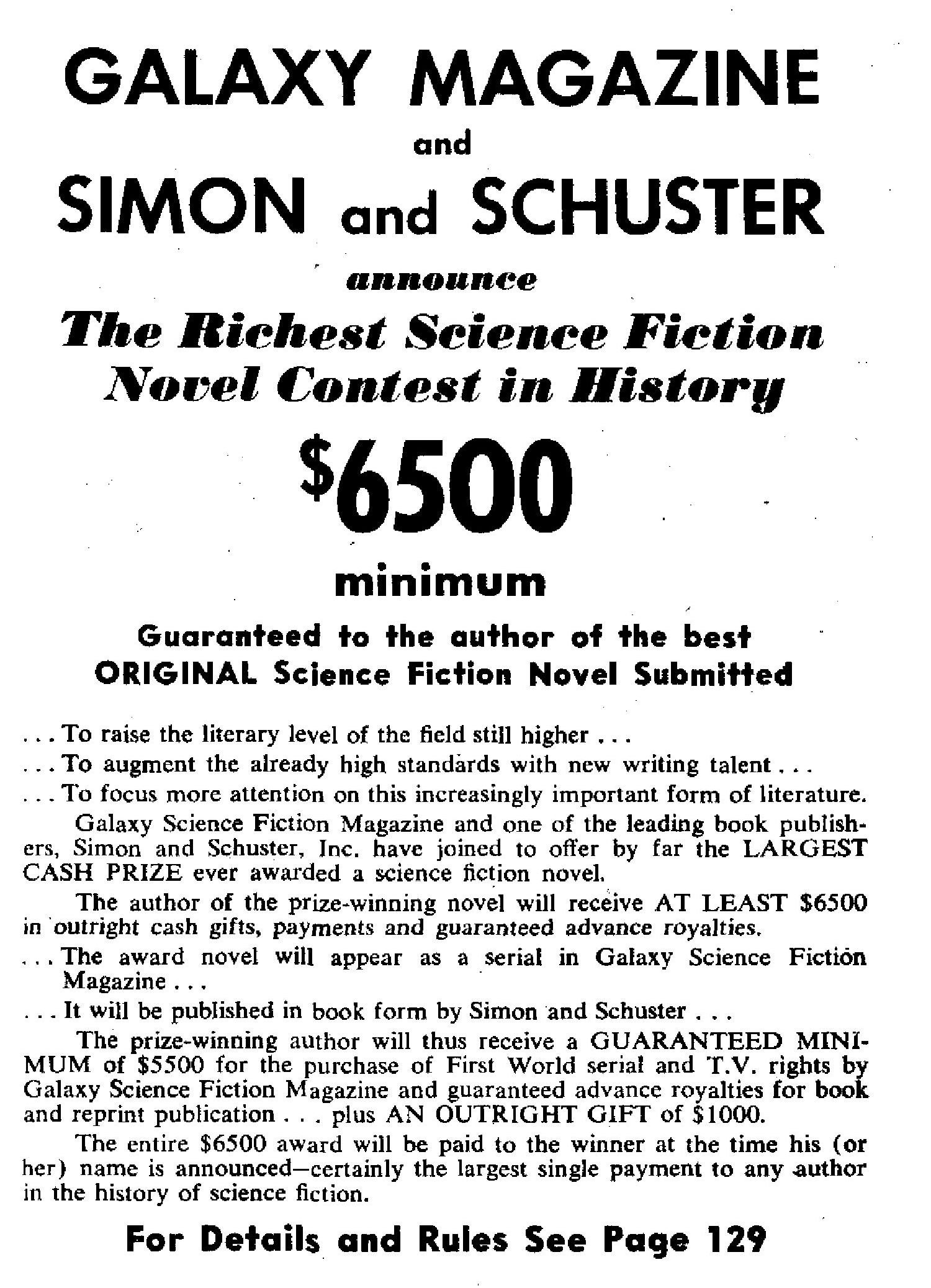
Now here’s something interesting: The back cover carries an announcement about a certain science fiction writing contest held by Galaxy, Dell, and Simon & Schuster. (“Veritably! By jove, what gives?!”) I didn’t really take note of this until editing the image for this blog post.
So, here’s the blurb about the contest, which appears in the book’s last page:
____________________
DELL BOOKS, GALAXY MAGAZINE, SIMON and SCHUSTER
Announce
THE RICHEST SCIENCE FICTION NOVEL CONTEST in HISTORY!
$6500.00 Minimum
Guaranteed to the author of the best ORIGINAL Science Fiction Novel Submitted.
The author of the prize-winning novel will receive at least $6500 in outright cash gifts, payments and guaranteed advance royalties.
The award novel will appear as a serial in Galaxy Science Fiction. It will afterward be published in book form by Simon and Schuster. And Dell Books will publish it as a reprint.
The prize-winning author will thus receive a GUARANTEED MINIMUM of $5500 for the purchase of First World Serial and T.V. rights by Galaxy Science Fiction Magazine, and advance royalties from Simon and Schuster and Dell Publishing Co. … Plus an outright gift of $1000.
FOR DETAILS AND RULES WRITE TO
NOVEL CONTEXT GALAXY SCIENCE FICTION 421 Hudson Street New York 14, New York
____________________
Like I said,“What gives?!”
As discussed in detail by Matthew Wuertz at the Black Gate and Charlie Jane Anders at Gizmodo (quoting from Matthew Wuertz, and, author Michael Ashley in Transformations: The Story of the Science Fiction Magazines from 1950 to 1970), the contest, if not characterized by a level of disingenuousness from the start, certainly eventuated in that direction: The actual submissions received by Horace L. Gold, editor of Galaxy, were deemed of poor quality. Instead, the chosen (as it were) novel – Preferred Risk, by Frederik Pohl and Lester del Rey; not even an actual entry – was “entered” under the pseudonym Edson McCann and declared the winner, and was serialized in Galaxy from June to September of 1953.
And with that, here’s the cover of Galaxy Science Fiction for March, 1953, wherein the “announcement” for the contest – * ahem * – is carried: A composite of photographs rather than “art”, per se. (The names of the lady and gentleman aren’t listed in the table of contents.)
Contest “rules” (!), as explained on pages 80 and 129 of the March issue. (These two images were made from a PDF version of the magazine, one of the several formats typically available for download at Archive.org’s Pulp Magazine Archive, rather than by scanning my own copy: I didn’t want to break the somewhat brittle, now seventy-seven-year-old binding!)
____________________
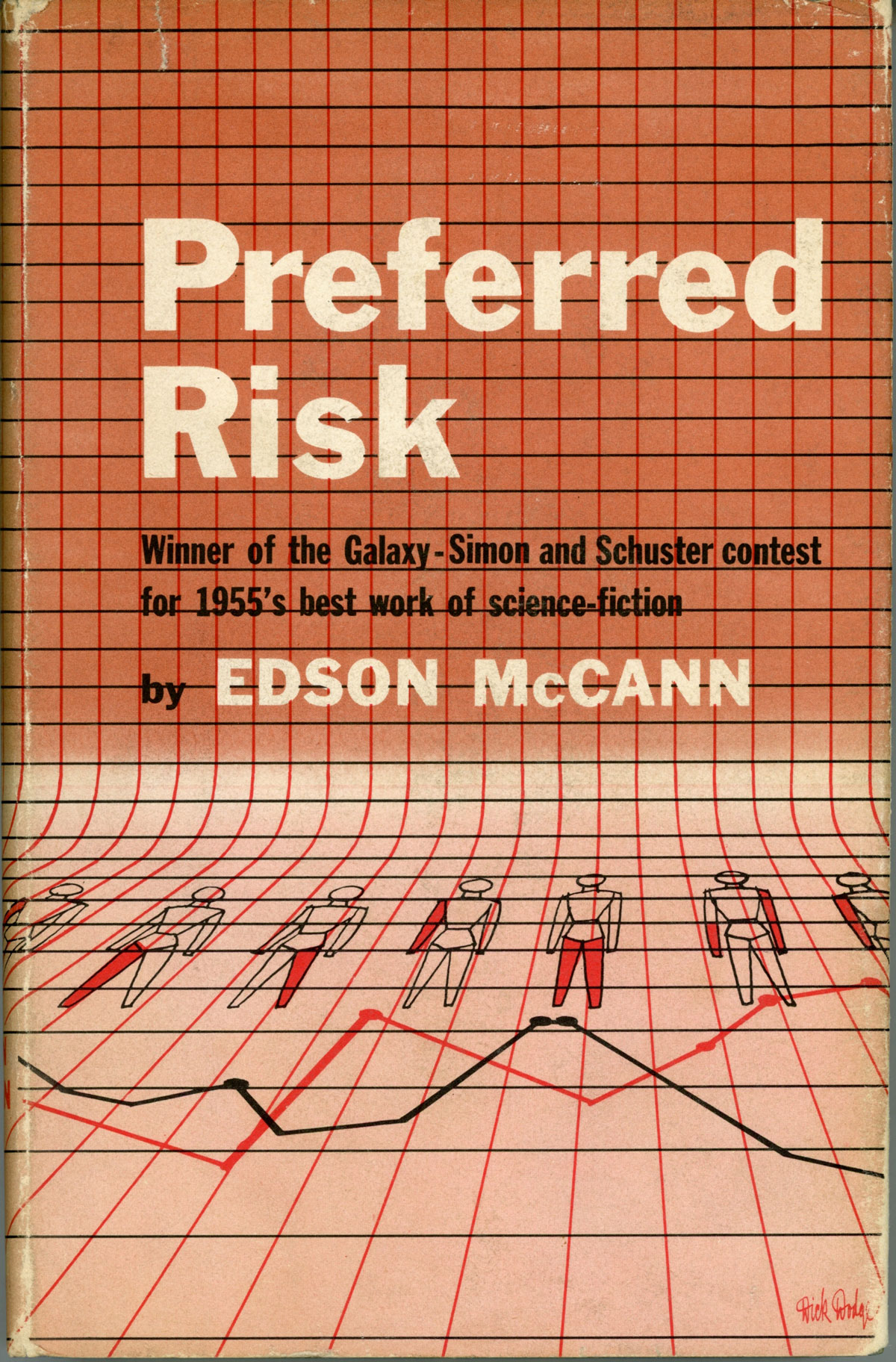
Here’s the cover of the 1955 Simon & Schuster edition of Preferred Risk, presently (August, 2021) on sale at L.W. Currey, Inc. Note the cover blurb – as ironic as it was cynical – “Winner of the Galaxy – Simon and Schuster contest for 1955’s best work of science-fiction.” The specific copy illustrated is described as having been signed on the front free end-paper by Lester Del Rey and Frederik Pohl as: “To Bob / Lester Del Rey / (1/2) Edson McCann / and also / Fred Pohl.”
So I see simplified figures – flattened, two-dimensional figures – of human beings superimposed on a graph. And…
Why do I think of ‘Acebook? (To be clear, not “Ace Books”!) Why do I think of ‘Witter? Why do I think of ‘Oogle? Why do I think of ‘Napchat? Why do I think of ‘Nstagram?
____________________
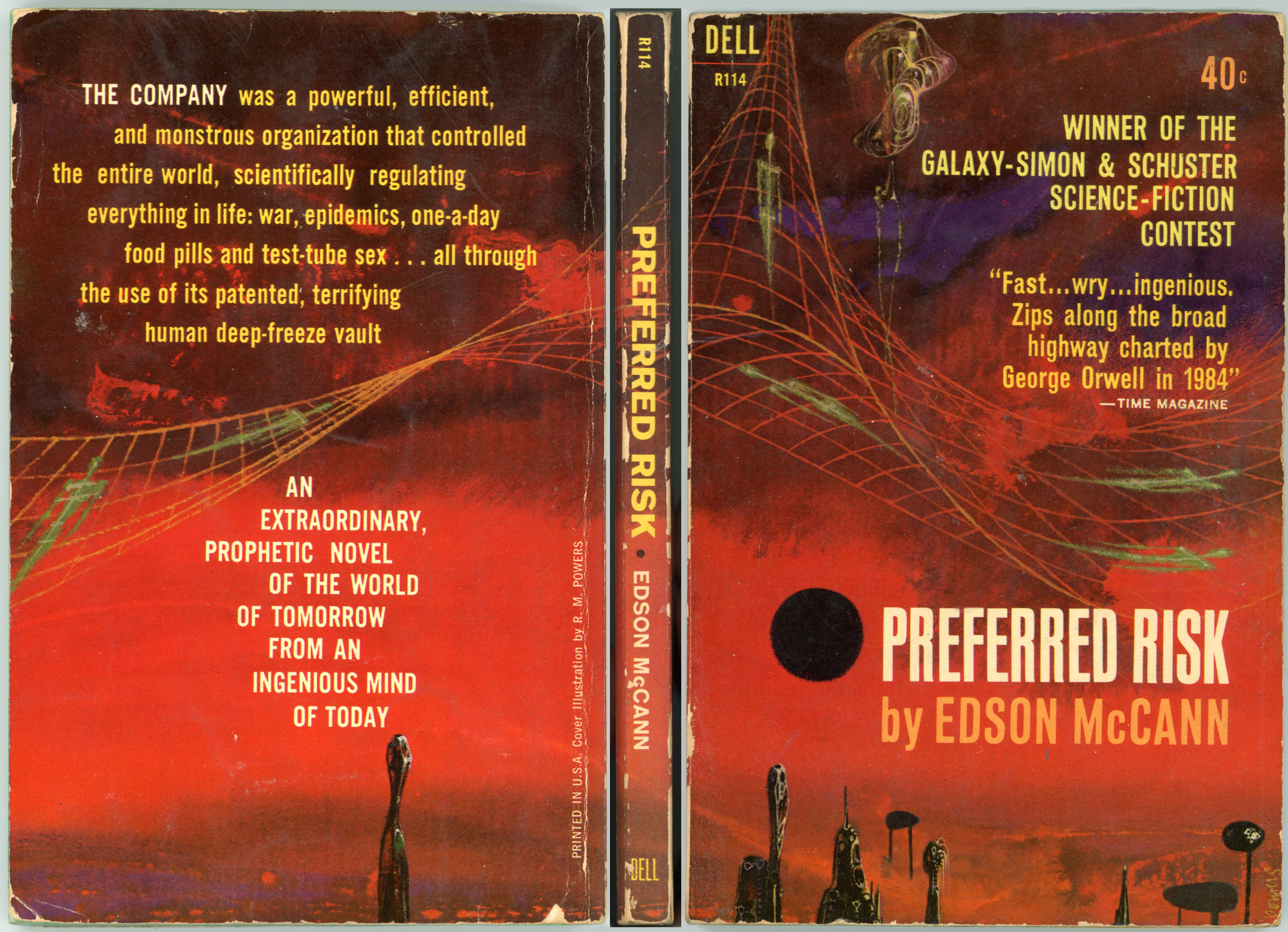
…while here’s the cover of Dell’s March, 1962 paperback edition of the book, with cover art by Richard M. Powers – immediately recognizable as such. Though slightly worn and chipped, this still-intact cover (it’s my own copy) clearly displays the central qualities by which Powers’ compositions can be recognized: An absence of realistically portrayed human figures; the presence of objects that are at once vaguely mechanical and vaguely organic, yet retaining a clearly anthropomorphic, elongated appearance; the presence of symbols and objects that are vaguely “techy” and “sciency” in appearance, such as – in this case – an undulating Cartesian graph with human skeletons superimposed upon it; a vaguely defined background (“Is that a horizon, or isn’t it?!”) comprised of shades of the same color.
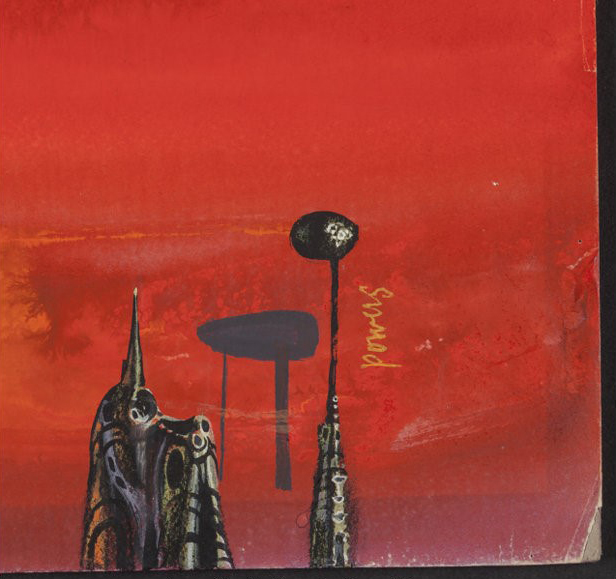
From Heritage Auctions, here are two images of Powers’ original art for the book’s Dell paperback edition. The composition is described as “Mixed media on board. 16.25 x 21.75 in. Signed lower right.” Part of the Bob and Diane Yaspan collection, the painting was reportedly sold on October 31, 2017, the sale including (bonus!) a copy of Dell’s 1962 printing.
A close-up of the composition, showing Powers’ signature, and, two uh – strange – uh – objects. People? (I don’t know!) Buildings? (I surely don’t know!) “Things?” (Most definitely!)
And, the painting’s backing board. Is that Powers’ signature on the back? Hmmm… …could be.
____________________
As seen above, the final interior page of Dell’s 1953 paperback edition of First He Died -the book’s final page lists the postal address to which submissions for the (supposed!) contest were to be sent: “421 Hudson Street, New York, N.Y.” which unsurprisingly was the address – at least, in 1953! – of the main office of Galaxy Science Fiction.
That made me a little curious. What? – where? – exactly was 421 Hudson Street?
It turns out that the answer is readily available. The building, very much standing and in good condition today (well, it should be – it’s a condo) was constructed in 1911, and goes by the name of The Printing House Building. As you can see from the map below, it’s located in the West Village of Manhattan.
Here’s an undated, sligthly sepia-toned image of the building, from NYCBlogEstate. According to CondoPedia, “…the Printing House began life as a commercial space that appropriately enough housed industrial printers. It was in 1979 that the building was first co-opted into use as a residential building, although it wasn’t until 1987 that the Printing House experienced its first big renovation and began to offer units for sale as condominiums.”
This image of 421 Hudson, ever-so-slightly-more-recent than above (!), originally (quite literally, a few weeks ago, this being mid-August of 2021) appeared at Halstead.com. While no longer a home to printers and publishers, the building’s external appearance has remained largely unchanged for over a century.
Where I Got All These Details n’Stuff
Cover of Simon and Schuster’s 1955 edition of Preferred Risk…
“It is strange how the mind can leapfrog across the years, selecting from a million, million memories for one that is even faintly relevant, while rejecting all the others.”
C Charlies was like a fly crawling over this darkened clock face. It had been aimed at the narrow illuminated section, but might already have missed it, to remain lost in the blackness that covered almost all the dial.
So this, Alan told himself without really believing it, was probably the most dangerous moment of his life. Introspection was not normally one of his vices; he could worry with the best, but did not waste time watching himself worrying. Yet now, as he roared across the night sky toward an unknown destiny, he found himself facing that bleak and ultimate question which so few men can answer to their satisfaction. What have I done with my life, he asked himself, that the world will be the poorer if I leave it now?
He had no sooner framed the thought than he rejected it as unfair. At twenty-three, no-one could be expected to have made a mark on the world, or even to have decided what sort of mark he wished to make. Very well, the question could be reframed in more specific terms: How many people will be really sorry if I’m killed now?
There was no evading this. It struck too close to home, brought back too vivid a memory of the tearless gathering around his father’s grave.
______________________________
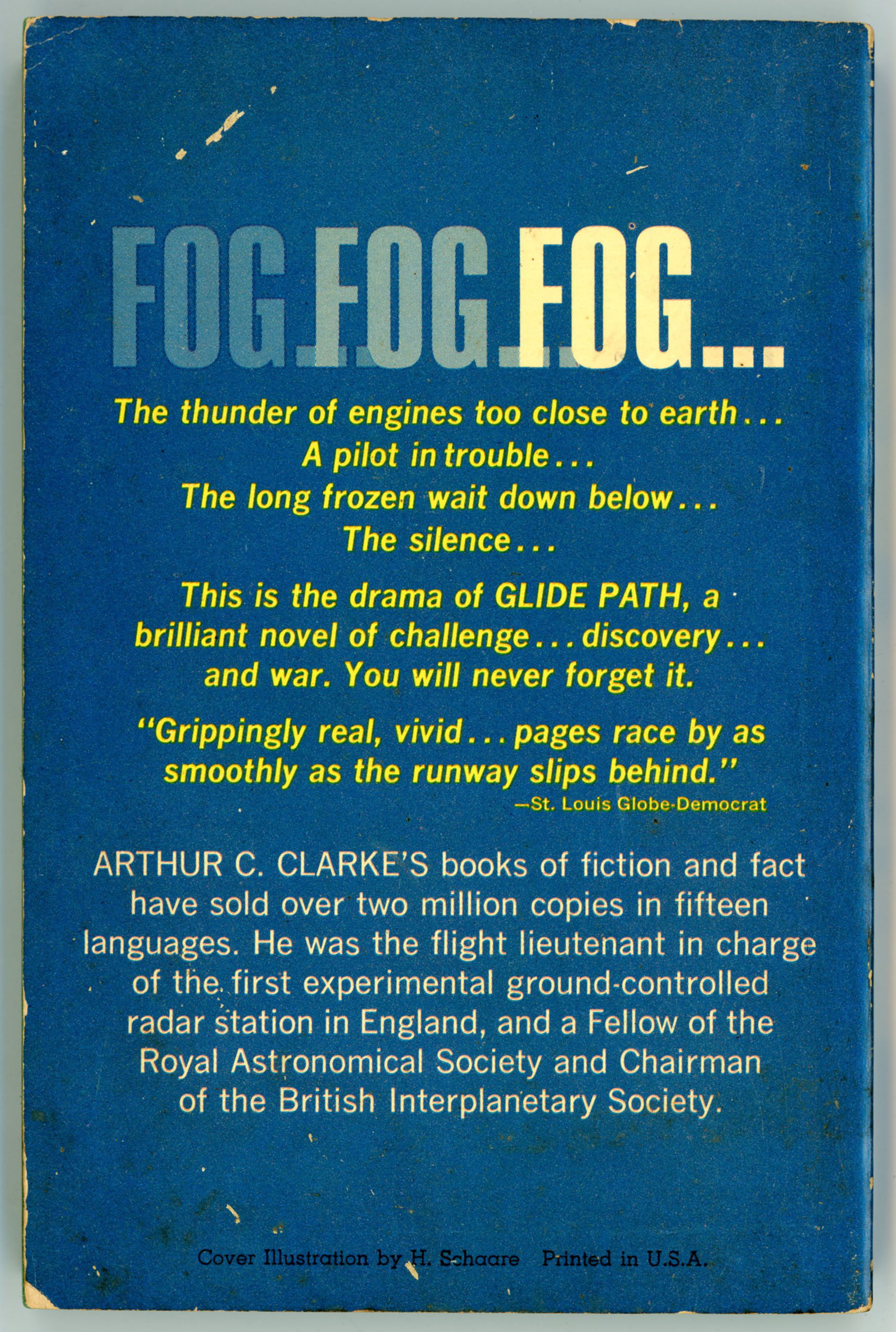
It is strange how the mind can leapfrog across the years, selecting from a million, million memories for one that is even faintly relevant, while rejecting all the others.