The Explorers, by Cyril M. Kornbluth – August, 1954 [Jack Faragasso]

A nice selection of Cyril Kornbluth’s stories can be found in Ballantine Books’ 1954 paperback The Explorers.

The cover is straightforward and simple in subject matter, yet highly effective:  A rocket rises from a launch pad, mountainous terrain behind, with a view of the moon’s looming crater-pocked surface as the background. 

The rocket’s shape is interesting:  It’s kind of German WW II V-2-ish in general configuration, but its Coke-bottle profile is reminiscent of the fuselage of America’s F-106 Delta Dart interceptor fighter of the Cold War, the aircraft having been designed in accordance with the aerodynamic design known as the area rule.  This is readily apparent in the vertical (top-down) view of the aircraft, as seen below. 

The rocket appears once more on the rear cover, as a sketch derived from the painting.  For this, artist Jack Faragasso has added a few details to the spacecraft’s body.

Interestingly and happily, while creating this post I discovered that Mr. Faragasso – also a writer and photographer – continues to be active some sixty-six years after the creation of his illustration for Kornbluth’s book.  You can view examples of his science-fiction / fantasy illustrations here, purchase some of his books (of poetry and on art instruction) here, and likewise purchase samples of his art, here.  Intriguingly, his body of work also includes an album of early photographs of Bettie Page

From the rear cover…

C.M. Kornbluth

…has produced some of the most satisfying suspense and the keenest satire to be found in science fiction.

THE SPACE MERCHANTS, the novel of a huckster’s utopia on which he collaborated with Frederik Pohl, was hailed by the New York Times as “a book so rewarding that it should henceforth show up on all lists of science-fiction classics.”

His solo flights – from the memorable TAKE-OFF to his most recent novel, THE SYNDIC – have been no less successful and have firmly established the name of C.M. Kornbluth among the brightest lights in this field.

The present collection – the first ever published of his shorter fiction – includes both one of his earliest stories (“Thirteen O’Clock”) and a brand-new novelette, “Gomez,” which appears here in print for the first time.  Told with excitement and power, these stories display the delightfully ironic imagination of a writer who is master of his craft.

________________________________________

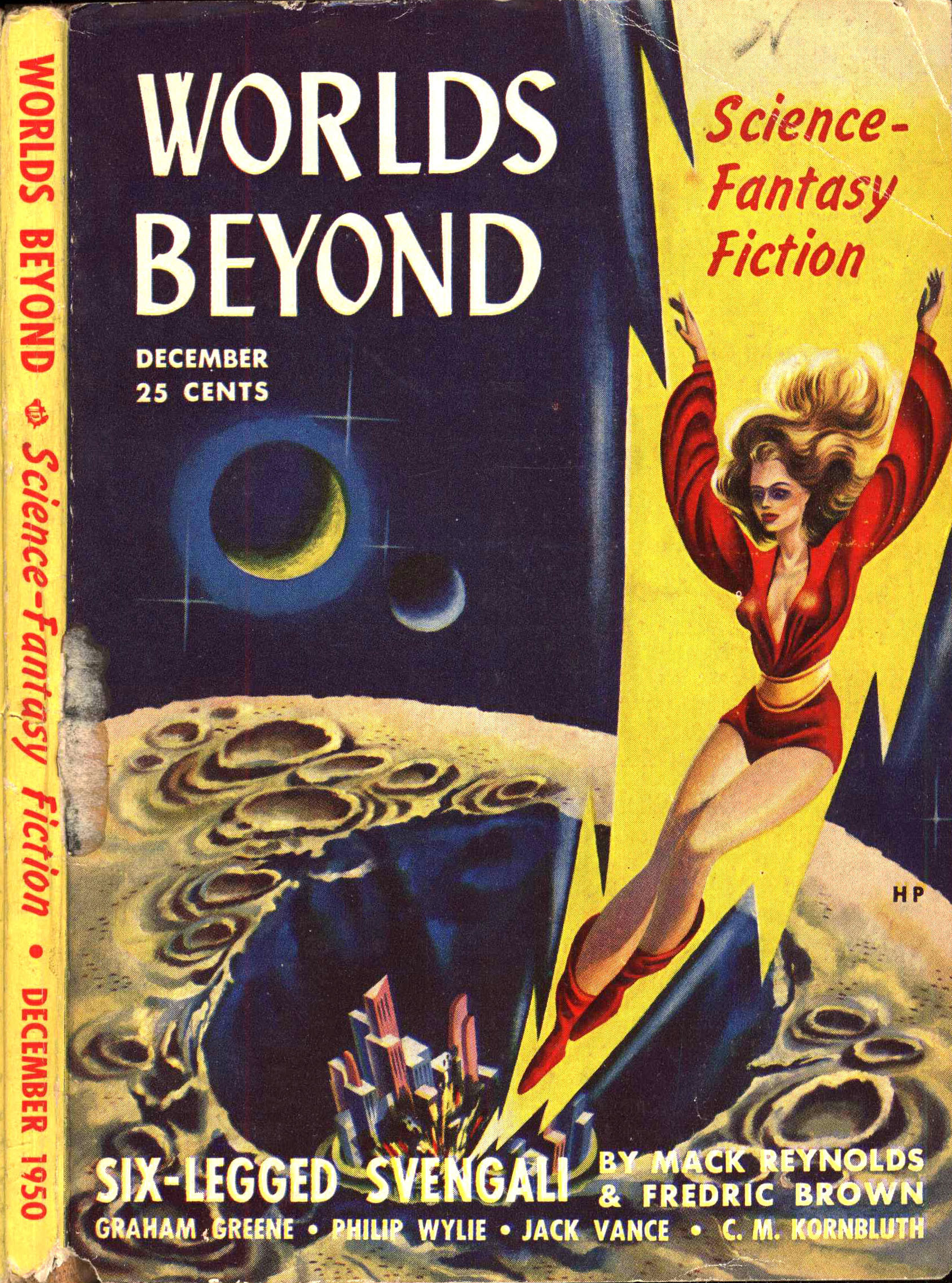
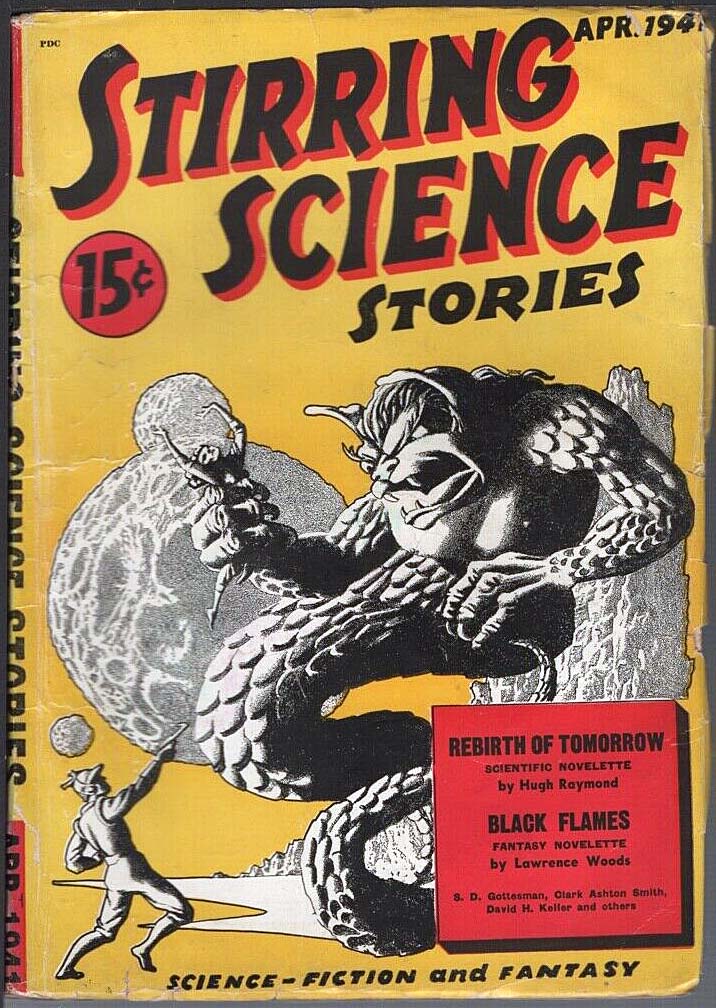
A list of the book’s contents appears below.  For three stories (“The Mindworm“, “The Rocket of 1955“, and “Thirteen O’Clock“) I’ve added images of the cover art of the magazine in which these stories originally appeared.  (Alas, found on the Internet; not part of my collection!)  I particularly liked the originality of “The Mindworm”, a very clever variation on the theme of vampires. 

Contents

Gomez, from this volume

The Mindworm, from Worlds Beyond, December, 1950 (Cover by Paul Callé)

The Rocket of 1955, from Stirring Science Stories, April, 1941 (as Cecil Corwin) (Cover by Hannes Bok)

The Altar at Midnight, from Galaxy Science Fiction, November, 1952

Thirteen O’Clock, later as “Mr. Packer Goes to Hell”, from Stirring Science Stories, February, 1941 (author as “Cecil Corwin”) (Cover by Leo Morey)

The Goodly Creatures, from The Magazine of Fantasy and Science Fiction, December, 1952

Friend to Man, from 10 Story Fantasy, Spring, 1951

With These Hands, from Galaxy Science Fiction, December, 1951

That Share of Glory, from Astounding Science Fiction, January, 1952

About C.M. Kornbluth, essay by C.M. Kornbluth, from this volume

References

Internet Speculative Fiction Database, for The Explorers

Jack Faragasso – His Own Website!

Sailing to Imagination: The Solar Sail, as Depicted in Amazing Stories (August, 1962) and Analog Science Fact – Science Fiction (April, 1964)

As “no man is an island” – to use a hackneyed but entirely true aphorism – neither is any field of knowledge.  The arenas of the arts, humanities, and sciences, disparate as they may be, have long intersected with and influenced one another in ways ranging from the intellectual, to the cultural, to the artistic.  And, beyond.  Certainly this has long been so in illustrations associated with science fiction, in venues ranging from books, to pulp magazines, to cinema, to the virtual world.  By nature and intent, all of these present visions of worlds past, present, and future – and often “parallel” – based on the science and technology rooted in the real (or, ostensibly “real”!) world.

Two interesting examples of this appeared in the early 1960s, as cover illustrations for the August, 1962 issue of Amazing Stories, and, the April 1964, issue of Analog Science Fact -> Science Fiction.  Though utterly different in artistic style, both compositions pertain to stories based upon the solar sail, a method of spacecraft propulsion by means of the radiation pressure of sunlight.

The Amazing Stories cover is by the very well-known artist Alex Schomburg, whose actual name (as I discovered when writing this post!) was either Alexander A. Schomburg, or, Alejandro Schomburg y Rosa.  His painting presents Jack Vance’s story – well, the title is prominently displayed on the cover! – “Gateway to Strangeness”.

“The ship, its great sail spread to the fading sunlight, fled through space like a ghost – out, always out.  There were still a billion miles to travel … a billion miles before they’d know whether they would ever come back.”

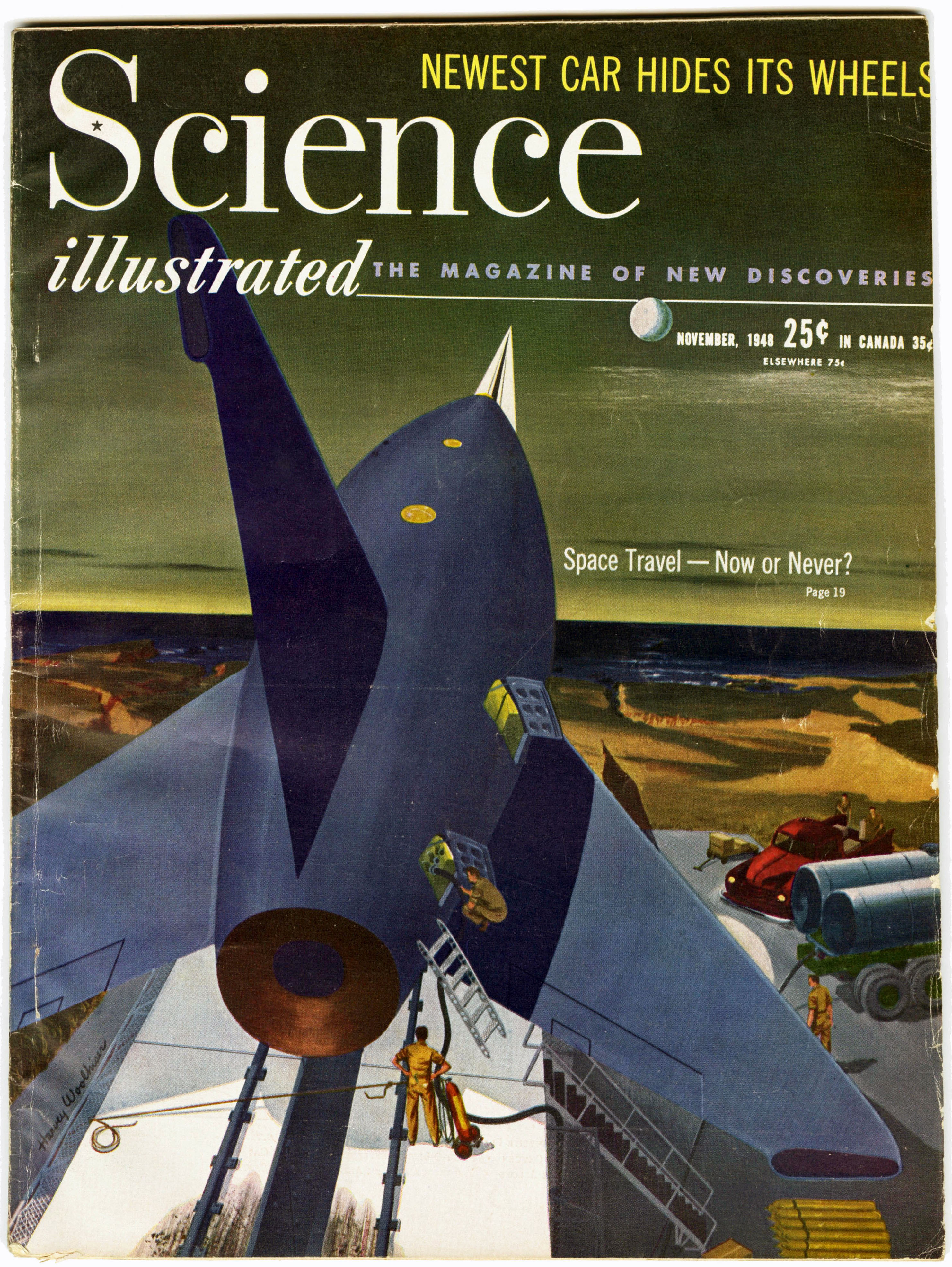
The Analog cover is by Harvey Woolhiser (actual name James Harvey Woolhiser) for “Sunjammer”, by Winston P. Sanders.  As far as I’ve been able to determine, this was the only cover illustration Woolhiser created for Analog, let alone Astounding.  Unsurprising: his forte seems not to have been science fiction, albeit he did create a straightforward cover, in muted tones of blue and green, for the November, 1948 issue of Science illustrated, appropriately for the article “Space Travel – Now or Never?”

But, what about “Sanders”?  Who was he?  (Hmmm…  Certainly not Bernie Sanders…  Definitely not Colonel Sanders…)  At first, I thought he may have been a “one-shot” or at best an infrequent author.  Then, a little searching quickly revealed that “Sanders” was actually one of the pen-names of the wonderfully talented Poul Anderson, under which were published these other stories, primarily in Analog.

Pact (1959)
Wherever You Are (1959)
Barnacle Bull (1960)
The Barrier Moment (1960)
The Word to Space (1960)
Industrial Revolution (1963)
What’ll You Give? (1963)
Say It With Flowers (1965)
Elementary Mistake (1967)

As you can see, not only are the covers different in design, style, and color palette, they’re slightly different in proportion as well: For Amazing Stories, Schomburg’s fits the magazine’s standard digest-size format nicely, while Woolhiser’s conforms to the larger, slick-upscale-coffee-table-ish (Manhattan-advertising-agency?  Southern-California aeronautical-engineering-firm?  Academic-think-tank?  Suburban-office-lounge?  University-dorm-room?) format in which Analog was published by Conde-Nast from March of 1963 through March of 1965.

Though both covers depict spacecraft and astronauts – the latter diminutive by virtue of their juxtaposition with spacecraft – I think Schomburg’s image “works” far better, precisely because there’s no central element to the composition: the very center of the scene is “empty” space:  Your eye and mind have to “work”, moving from the moon to the earth to the star-mottled indigo blackness of space to the multi-colored sail, its supporting framework, and attached habitation pod.  All the colors in the scene balance very nicely against the yellow and black “Amazing” logo at the upper left. 

It’s interesting, really. 

Though by the 50s and 60s and doubtless much earlier Amazing Stories lacked the gravitas and literary influence of the “big three” – Analog, Galaxy Science Fiction, and The Magazine of Fantasy and Science Fiction – the magazine’s art and illustrations, both cover and interior, sometimes stood – it seems to me – on a visual footing equal to and on occasion much better than those appearing in those publications.  Then again, compared to The Magazine of Fantasy and Science Fiction that wasn’t too difficult, at least in terms of interior illustrations, for those appeared in that publication in only few issues from the late 1950s, most notably for Ray Bradbury’s “Fondly Fahrenheit”.

So, anyway:  An Analog-ous cover…  (Please pardon predictable pun!)

…and, moving in for a closer view:

“The difference between ‘nothing’ and ‘practically nothing’ can turn out to be the most exceedingly practical, because anything whatever is an intolerable contaminant in nothing.  And if that sounds like nonsense – read on and find out!”

While these two covers depicted science-introducing-fiction during the early 1960s, today, nearly five decades later, they serve – indirectly, symbolically, and effectively – as fiction-introducing-science:  Both can be found at the June, 2019 post LightSail 2 Inspires Thoughts on Fictional Sails, at Paul Gilster’s Centauri Dreams website.

Devoted to the presentation of peer-reviewed academic research on the exploration of deep space, Centauri Dreams, which began in August of 2004, encompasses subjects such as the technology of interstellar propulsion and long-duration space travel; the exploration for and identification of extrasolar planets; investigation of the origin, evolution, and nature of other planetary systems; the search for extraterrestrial life (not necessarily alien civilizations a la the works of Arthur C. Clarke or Carl Sagan (whose writings have distinctly theological overtones, with technology and alien intelligence providing a form of secular salvation) but simply plain ole’ “life”, per se, in any form); lengthy philosophical speculation about cosmology, and, well, far more.  The majority of the posts are invaluable in presenting summaries of and excerpts from the latest academic journal papers in the fields of astrophysics, astrobiology, and space research, sometimes with an accompanying illustration or two from the original article, and virtually always with links to the original article in either abstract or open-access form. 

Fundamentally, what makes the site so worthwhile is that the sense of curiosity, wonder, and speculation inherent to its ethos and mission is undergirded by an appreciation of and respect for solid science. 

Well, why not let the website speak for itself?  Thus:

“In Centauri Dreams, Paul Gilster looks at peer-reviewed research on deep space exploration, with an eye toward interstellar possibilities.  For the last twelve years, this site coordinated its efforts with the Tau Zero Foundation.  It now serves as an independent forum for deep space news and ideas.”  Refreshingly (whew!)“…Centauri Dreams is not about the existence of UFOs, nor about alien abductions, ‘ancient astronauts,’ electric universe cosmology or other New Age talking points.  It is a review of peer-reviewed research.”

However, that disclaimer is a nice (and slightly ironic!) segue to a significant aspect of Centauri Dreams: Though by no means the central focus of the site, its innumerable posts include a sizeable number (as of mid-2020, I count over twenty) directly pertaining to science fiction.  These comprise discussions about landmark, significant, or just plain ‘ole interesting films (the posts about “Dark Star”, “Forbidden Planet”, and Howard Hawks’ “The Thing” are great), the history of science fiction (“Astounding in the Glory Years”, and Poul Anderson’s “We Have Fed Our Sea” / “The Enemy Stars”), literature (note the two 2006 posts on Astounding) and the mutual influence of space exploration and science fiction on one another.  In a larger sense, many posts at Centauri Dreams are enhanced by science-fiction cover art from books and magazines, which serve as reference points for the topic at hand.

The site’s science-fiction themed posts are below…   

2 0 2 0

January 3
Some Thoughts on Science Fiction Visuals

April 3
The Interstellar Ramjet at 60

________________________________________

2 0 1 9

June 10
LightSail 2 Inspires Thoughts on Fictional Sails

May 3
“An Intellectual Carrot – The Mind Boggles!” Dissecting The Thing from Another World

________________________________________

2 0 1 8

April 18
Civilization Before Homo Sapiens?

April 2
2001: A Space Odyssey – 50 Years Later

________________________________________

2 0 1 7

November 19
‘Dark Star’ and Staring into the Cosmic Abyss

September 11
Creating Our Own Final Frontier: Forbidden Planet

________________________________________

2 0 1 6

September 9
Star Trek Plus Fifty

February 5
The Distant Thing Imagined

January 25
Proxima Centauri & the Imagination

________________________________________

2 0 1 5

February 9
We Have Fed Our Sea

January 23
Who Will Read the Encyclopedia Galactica?

________________________________________

2 0 1 3

March 8
Stranger Than Fiction

________________________________________

2 0 1 2

March 9
Science Fiction and the Probe

________________________________________

2 0 1 1

November 18
Science Fiction and the Interstellar Idea

________________________________________

2 0 0 9

August 28
Science Fiction and Interstellar Thinking

January 26
A Science Fictional Take on Being There

________________________________________

2 0 0 8

November 15
Science Fiction: Future Past

________________________________________

2 0 0 7

March 10
Whither the Science Fiction Magazines?

________________________________________

2 0 0 6

September 4
Astounding in the Glory Years

April 15
A Key Paper from an Astounding Source

________________________________________

2 0 0 5

August 30
On the Evolution of Science Fiction

________________________________________

________________________________________

References

Centauri Dreams – Imaging and Planning Interstellar Exploration, at Centauri-Dreams.org

Alex Schomburg (Alexander A. Schomburg / Alejandro Schomburg y Rosa), at Wikipedia

James Harvey Woolhiser, obituary at Legacy.com

Poul Anderson, bibliography at Internet Speculative Fiction Database

Tau Zero Foundation – Pioneering Interstellar Flight, at tauzero.aero

“No man is an island,” at phrases.org

A Canticle for Leibowitz, by Walter M. Miller, Jr. – October, 1959 (February, 1961) [Unknown Artist]

“Maybe you’ve always thought of war as a business for the tough and the unimaginative.
It has been said that the best soldier leaves his emotions at home;
that pre-battle training is a period calculated to harden both mind and body.
But what of the boy who cannot harden?
What of the lad who cannot put his sensitivity in a suitcase and store it for the duration?
Walter Miller tells us.”

– Introduction to “Wolf Pack”, by Walter M. Miller, Jr., Fantastic, September-October, 1953

____________________

If the spirit of an age – its dreams and moods; fancies and wonders; fears and hopes – is reflected in its literature, then a prime example of such remains Walter M. Miller., Jr.’s 1959 novel, A Canticle for Leibowitz.  Based on and derived from three short stories published in the mid-1950s – the first of which shares and perhaps inspired the novel’s title – only a decade after the development of atomic weapons and amidst the (first?) Cold War, Miller’s tale was one of many works of science-fiction that presented a vision of the world, and particularly man’s place within that world, subsequent to a global nuclear war. 

In this context, I strongly recommend the recent (October, 2020) essay about Miller’s Canticle by Pedro Blas González, “A Canticle for Leibowitz and Cyclical History“.  Therein, Dr. Gonzalez discusses Miller’s novel through the lens of Catholicism (to which Miller converted after the war), viewing the novel as an expression of Miller’s interpretation and understanding of the nature of history.  As implied (albeit not specifically mentioned) within Dr. González’s essay, and moreso readily understood through a reading of the Canticle, Miller did not view human history as being “progressive” – and thus not having an “arc” in any direction – but instead, as being cyclical, even if those cycles would occupy great intervals of time.  

Though doubtless inspired by technological developments and geopolitics of the mid-twentieth century, the two animating ideas of Miller’s novel extend well beyond science fiction, for they represent chords of thought embedded deep within the psyche of men, nations, and civilizations.  These are the idea of an apocalypse, and, the gradual and tenuous rebirth of civilization after centuries during which the collective knowledge of the past (perhaps our present?…) has become myth at best, and utterly forgotten at worst.  However, rather than concluding upon a note of redemption, the book’s final chapters leave the reader with a sense of deep ambivalence, for the novel suggests that the currents of history are by nature cyclic.

Despite the novel’s origin during the Cold War, Miller’s inspiration for A Canticle for Leibowitz seems to have arisen from something simpler, immediate, and intensely personal: His military service during the Second World War, during which he served as an aerial gunner and radio operator in the United States Army Air Force.  Specifically, the impetus for his creation of the stories and novel was his participation in a combat mission during which his bomb group participated in the destruction of the hilltop abbey of Monte Cassino.  As discussed in academic and popular literature (see Alexandra H. Olsen’s paper in Extrapolation, William Roberson’s Reference Guide to Miller’s life and fiction, and Denny Bowden’s essay at Volusia History) on a fundamental level Miller world-view was profoundly affected, if not irrevocably altered, by the experience.

Though most sources (at least, web sources) about Miller describe his military service in general terms, Roberson’s Reference Guide specifically identifies Miller’s military unit: The 489th Bombardment Squadron.  The 489th was one of the four squadrons of the 340th Bomb Group (its three brother squadrons having been the 486th, 487th, and 488th), a unit of the Mediterranean-based 12th Air Force which flew B-25 Mitchell twin-engine medium bombers.  During the time that Miller was a member of the 489th (probably late 1943 through mid-1944) the squadron was stationed at the Italian locales of San Pancrazio, Foggia, Pompeii, and the Gaudo Airfield.

The 489th’s evocative unit insignia, which doubtless adorned the leather flight jackets of many of its officers and men, is shown below…

The best resource on the web (certainly better than anything in print!) for information about the 489th and 340th is the website of the 57th Bomb Wing Association.  This resource, covering the 57th’s four bomb groups (the 310th, 319th, 321st, and 340th) gives access to an enormous amount of information, as original Army Air Force Group and Squadron histories and Mission Reports, (many of which are transcribed as PDFs), and, a plethora of photographs.  Typical of Army Air Force WW II military records, there’s a degree of variation in the quantity and depth of this information from group to group, and, squadron to squadron:  Records for some (most?) combat units are complete, though there are inevitable gaps, “here and there”.

In documents pertaining to the 489th, I’ve discovered three references to Miller’s military service.

____________________

First, Timing: A record of combat missions flown by the 489th during the February of 1944.  For the fifteenth of that month, the record – like that for all other missions – is unsurprisingly laconic: “Benedictine Monastery, Italy.  6 planes.”

____________________

Second, Identification: Miller’s name appears within a list of airmen who, already having received the Air Medal (for completing five combat missions), had been awarded two Bronze Oak Leaf Clusters, thus signifying the completion – by the end of February – of up to fifteen combat missions.  His name is listed eleventh from the top in the “upper” list…

____________________

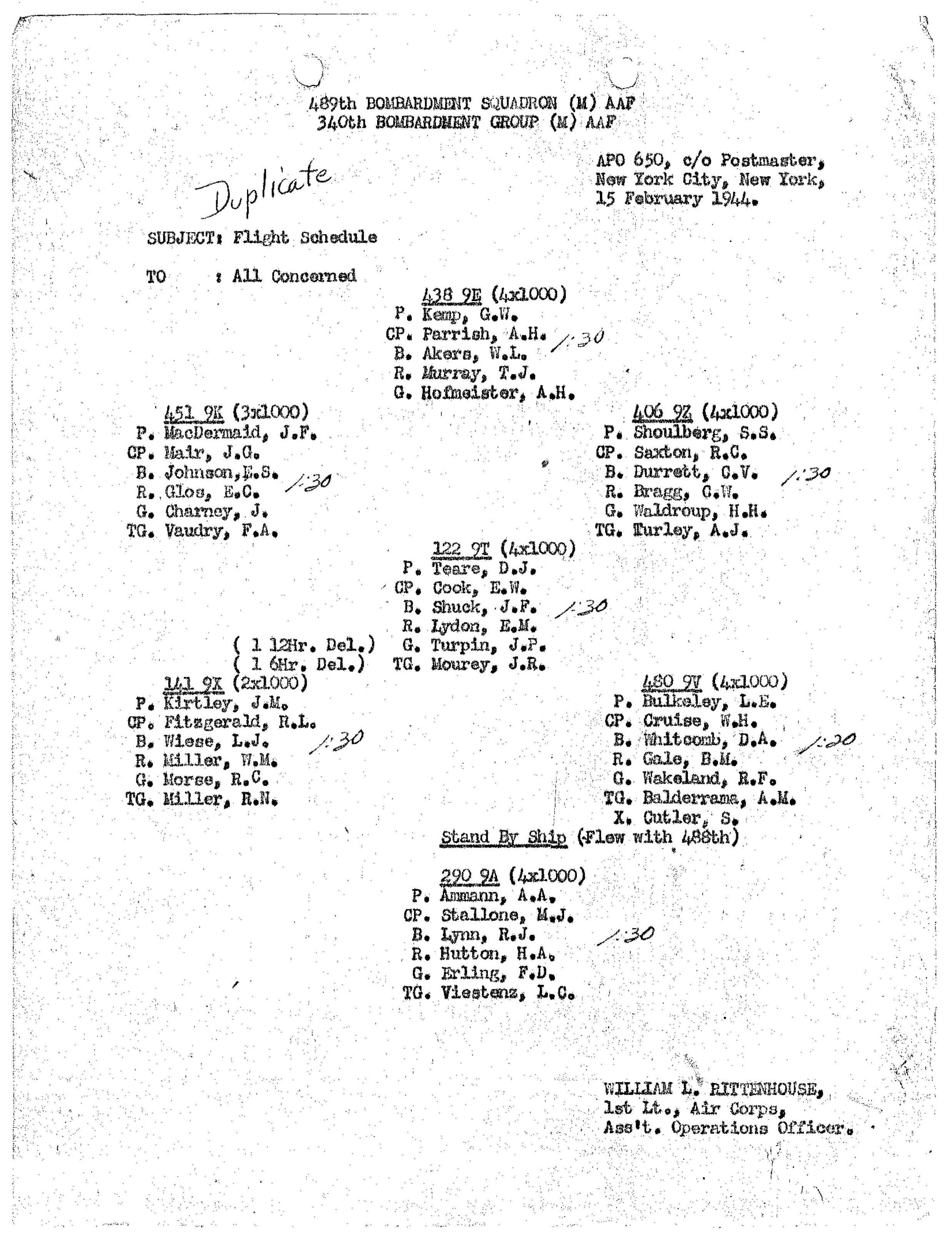
Third, Verification:  This “third” document – also found at 57th Bomb Wing – is what’s known in the parlance of the WW II Army Air Force as a “Loading List”, meaning that it lists the names of crewman assigned to specific planes during a combat mission or sortie, on an aircraft-by-aircraft basis.  This Loading List, covering 489th Bomb Squadron aircraft and crews which participated on the Cassino mission of February 15, 1944, shows that seven of the Squadron’s B-25s took part in the mission. 

Each plane is denoted by a three-digit number, which represents the last three digits of the B-25s Army Air Force serial number.  This is followed by the number “9” and a letter, the “9” representing the 489th Bomb Squadron, and the adjacent letter – a different letter for every plane in the squadron – uniquely identifying each B-25 in the squadron.  Each such number-letter combination was painted on the outer surface of the twin vertical tails of the squadron’s planes, a practice shared by the 340th’s other three squadrons.  This is followed by information about the planes’ bomb loads, which – in all cases but one – were three or four thousand-pound demolition bombs.

Then, we come to the crews themselves, which follow the same general sequence: P (Pilot), CP (Co-Pilot), B (Bombardier), R (Radio Operator), G (Aerial Gunner / Flight Engineer), and TG (Tail Gunner).

Where was Walter M. Miller, Jr.?  He’s there:  He was a radio operator in the aircraft commanded by J.M. Kirtley, B-25 “#141”, or, “9X”. 
As the 57th Bomb Wing includes Loading Lists for other missions flown by the 489th (and the 340th Bomb Group’s three brother squadrons), doubtless Miller’s name appears in these documents, as well.  But, this will suffice for now. 

____________________

The image below may be akin to the view seen by Miller on February 15, 1944:  Captioned,”Formation of North American B-25s of the 340th Bomb Group enroute to their target – Cassino.  March 15, 1944,” the picture is United States Army Air Force photo “68261AC / A22901”, and can be found within the (appropriately) entitled collection “WW II US Air Force Photos“, at Fold3.com.  The planes are aircraft of the 488th Bomb Squadron, the “give-away” being the “8C” (“8”, for 488th) code on the vertical tail of the aircraft in the left center. 
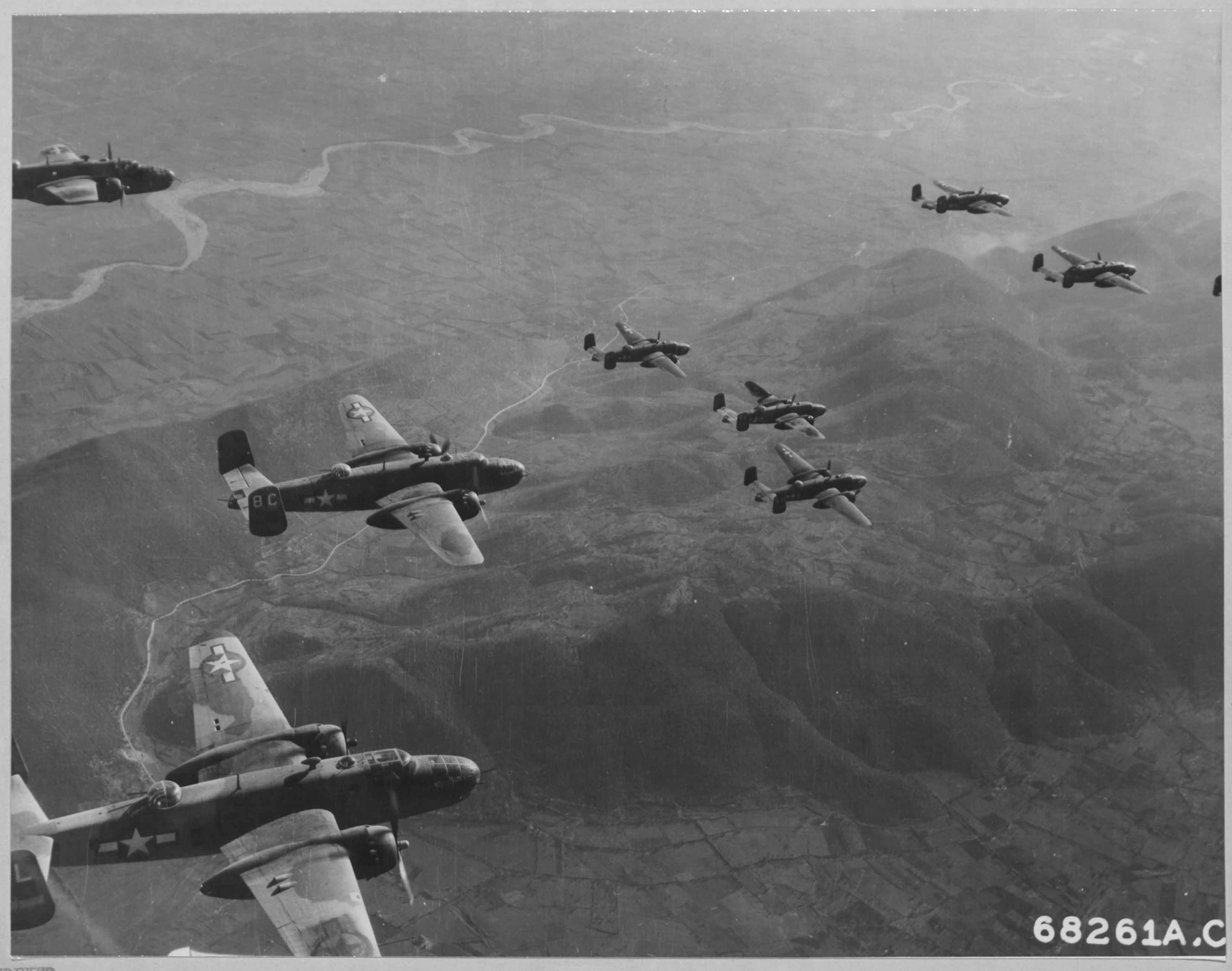
But, Walter Miller did not participate on the day’s mission, for his name is absent from the 489th’s Loading List for March 15….

____________________

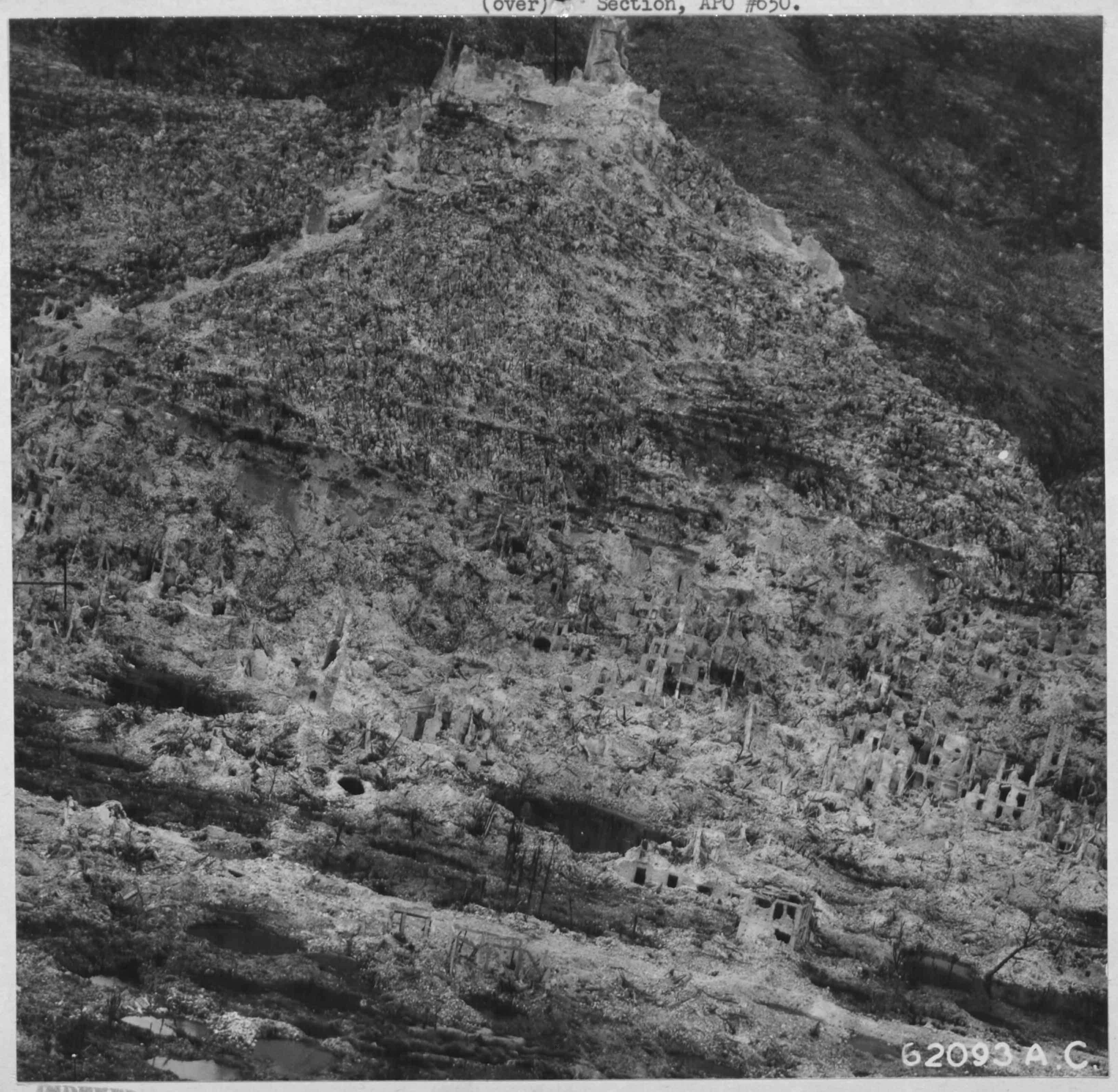
The results of war: A view of the remnants of the town of Cassino (foreground), and the hilltop abbey (upper center), in Army Air Force Photograph 62093AC / A25003.  Curiously, the caption on the rear of the photo states, “Bomb damage to Monte di Cassino  Abbey, Cassino, Italy, after bombing attacks by Allied planes.  The centuries-old monastery had been used by the German defenders as a strong point to block the Allied drive on Rome,” but the words “Monte di Cassino Abbey” are crossed out. 

The image is undated, but it was received by the Army Air Force or War Department in November of 1944.
________________________________________

As mentioned in the Wikipedia entry for the novel, and, discussed by Alexandra H. Olsen, A Canticle for Leibowitz, published in October of 1959, was created by melding and altering elements, characters, concepts, and plot devices from his three previously published post-cataclysmic stories (all having appeared in The Magazine of Fantasy and Science Fiction) into a single work, and, adding passages in Latin. 

The three stories which formed the basis of the novel were:

“A Canticle for Leibowitz”, published in April of 1955 (pp. 93-111)
“And the Light Is Risen”, published in August, 1956 (pp. 3-80)
“The Last Canticle”, published in February, 1957 (pp. 3-50)

A final tale in the series, “God Is Thus”, appeared in Fantasy & Science Fiction in November of 1997 (pp. 13-51), thirty-eight years after the novel’s publication. 

But… 

…though the motivation for the ultimate creation of Canticle of 1955 was Miller’s participation in the bombardment of Monte Cassino, evidence for the emotional impact of that is clearly evident in an earlier story of a vastly different literary nature:  This was “Wolf Pack”, which appeared in the September-October, 1953, issue of Fantastic.  Among the thirty-eight works of short fiction listed in Miller’s biographical profile at the Internet Speculative Fiction Database, “Wolf Pack” was the 26th, while “Secret of the Death Dome”, published in Amazing Stories in 1951, was the first.  “Wolf Pack” appeared two years before “A Canticle for Leibowitz’s” publication, in the 1955 The Magazine of Fantasy and Science Fiction. 

Though I’ve thus far barely (!) skimmed the story, it seems to belong entirely to the realm of fantasy as opposed to science fiction, for it relates a combat flyer’s confrontation with his conscience – himself? – on levels symbolic, psychological, and perhaps supernatural.

Do you want to read the story?  Here’s a PDF version of “Wolf Pack”

As for the artistic aspects of the Fantastic story – visual art, that is! – here’s the two-page opening illustration for the tale…

…and here’s an accompanying illustration, showing representations of a B-25 bomber (viewed from above) and a bombardier peering through a generic “black box” looking bombsight (not quite a Norden bombsight!), both visual elements being surrounded by symbolic vignettes of villages.  Both pieces are by Bernard Krigstein, whose work is much more strongly associated with comic books than pulps. 

________________________________________

Continuing on a theme of art, here’s the cover of Bantam Books’ 1961 paperback edition of the novel, which shows a monk against a backdrop of a destroyed city’s skyline.  Though the artist’s name isn’t listed, perhaps he was Paul Lehr, given the era of the book’s publication, and, the visual style of the composition.

In terms of Miller’s use of Latin, here’s the prayer uttered by Brother Francis Gerard of The Albertian Order of Saint Leibowitz, which appears very early in the novel’s first part (“Fiat Homo”), during the Brother’s exploration of the remains of a fallout shelter somewhere in the American Southwest.  The allusions to the actuality and legacy of nuclear war are explicit and vivid, and – recited in the format of prayer rather than prose, with each of the three central groups of verses being thematically linked – powerfully expressed and visually evocative. 

A spiritu fornicationis,
Domine, libera nos.
From the lighting and the tempest,

O Lord, deliver us.

From the scourge of the earthquake,
O Lord, deliver us.
From plague, famine, and war,

O Lord, deliver us.

From the place of ground zero,
O Lord, deliver us.
From the ruin of the cobalt,

O Lord, deliver us.
From the rain of the strontium,

O Lord, deliver us.
From the fall of the cesium,

O Lord, deliver us.

From the curse of the Fallout,
O Lord, deliver us.
From the begetting of monsters,

O Lord, deliver us.
From the curse of the Misborn,

O Lord deliver us.
A morte perpetua,

Domine, libera nos.

Peccatores,
te rogamus, audi nos.
That thou wouldst spare us,

we beseech thee, hear us.
That thou wouldst pardon us,

we beseech there, hear us.
That thou wouldst bring us truly to penance,

te rogamus, audi nos.
(pp. 14-15)

(In just a moment, Brother Gerard will discover a relic from the life of Saint Leibowitz…)

________________

________________

Of the larger folded papers, one was tightly rolled as well,
and it began to fall apart when he tried to unroll it;
he could make out the words RACING FORM, but nothing more. 
After returning it to the box for later restorative work,
he turned to the second folded document;
its creases were so brittle that he dared inspect only a little of it,
by parting the folds slightly and peering between them.

A diagram, it seemed, but – a diagram of white lines on dark paper!

Again he felt the thrill of discovery. 
It was clearly a blueprint
– and there was not a single original blueprint left at the abbey,
but only inked facsimiles of several such prints. 
The originals had faded long ago from overexposure to light. 
Never before had Francis seen an original,
although he had seen enough hand-painted reproductions to recognize it as a blueprint,
which, while stained and faded,
remained legible after so many centuries because of the total darkness and low humidity in the abbey.  He turned the document over – and felt brief fury:
What idiot had desecrated the priceless paper? 
Someone had sketched absent-minded geometrical figures and childish cartoon faces all over the back.  What thoughtless vandal-

The anger passed after a moment’s reflection.
At the time of the deed, blueprints had probably been as common as weeds,
and the owner of the box the probably culprit.
He shielded the print from the sun with his own shadow while trying to unfold it further.
It the lower right-hand corner was a printed rectangle containing,
in simple block-letters, various titles, dates, “patent numbers”, reference numbers, and names.
His eye traveled down the list until it encountered:
“CIRCUIT DESIGN BY: Leibowitz, I.E.

He closed his eyes tightly and shook his head until it seemed to rattle. 
Then he looked again. 
There is was, quite plainly:

“CIRCUIT DESIGN BY: Leibowitz, I.E.”

He flipped the paper over again. 
Among the geometric figures and childish sketches,
clearly stamped in purple ink,
was the form:

The name was written in a clear feminine hand,
not in the hasty scrawl of the other notes. 
He looked again at the initialed signature of the note in the lid of the box,
I.E.L. – and again at “CIRCUIT DESIGN BY …” 
And the same initials appeared elsewhere throughout the notes.

(Proof of the Saint’s existence!  Here’s the “Circuit Design Form” bearing his signature, from page 23 of the Bantam paperback.  Absent from “Canticle” in the 1955 edition of The Magazine of Fantasy and Science Fiction, in book form, it really catches the reader’s attention.) 

There had been argument, all highly conjectural,
about whether the beautiful founder of the Order, if finally canonized,
should be addressed as Saint Isaac or as Saint Edward.
Some even favored Saint Leibowitz as the proper address,
since the Beatus had, until the present, been referred to by his surname.

“Beate Leibowitz, ora pro me!” whispered Brother Francis. 
His hands were trembling so violently that they threatened to ruin the brittle documents.

He had uncovered relics of the Saint.  (pp. 22-24)

________________________________________

Given the novel’s success, it’s unsurprising that it was adapted for radio broadcast.  It’s available via Archive.org, at The Classic Archives Old Time Radio Channel, and Old Time Radio Downloads

Created in 1981, the play is comprised of fifteen segments, each of roughly a half-hour duration.  The informational blurb at Archive.org states, “The radio drama adaptation by John Reed, and produced at WHA by Carl Schmidt and Marv Nunn.  The play was directed by Karl Schmidt, engineered by Marv Nunn with special effects by Vic Marsh.  Narrator – Carol Collins and includes Fred Coffin, Bart Hayman, Herb Hartig and Russel Horton.  Music was by Greg Fish and Bob Budney and the Edgewood College Chant Group.”

________________________________________

________________________________________

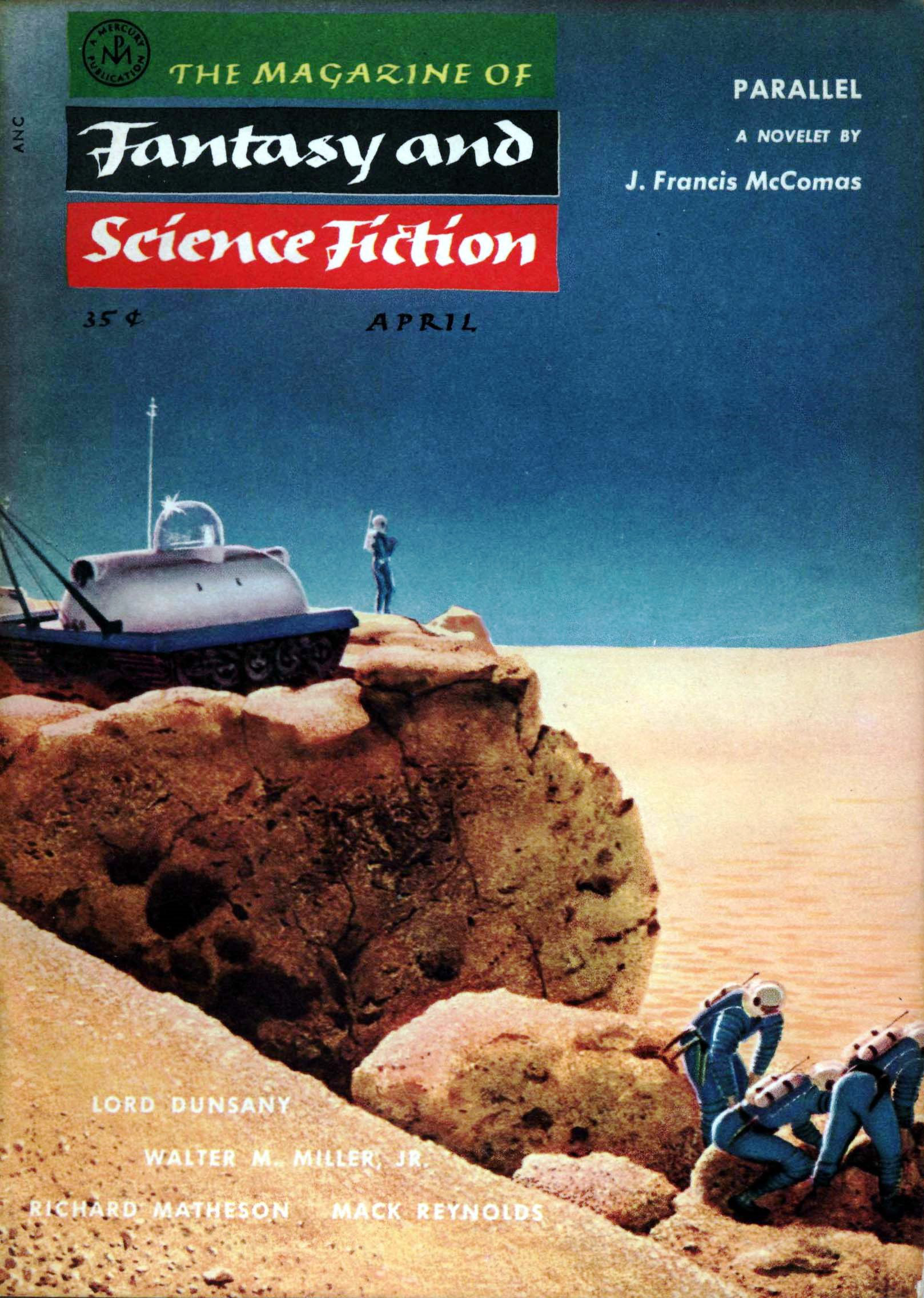
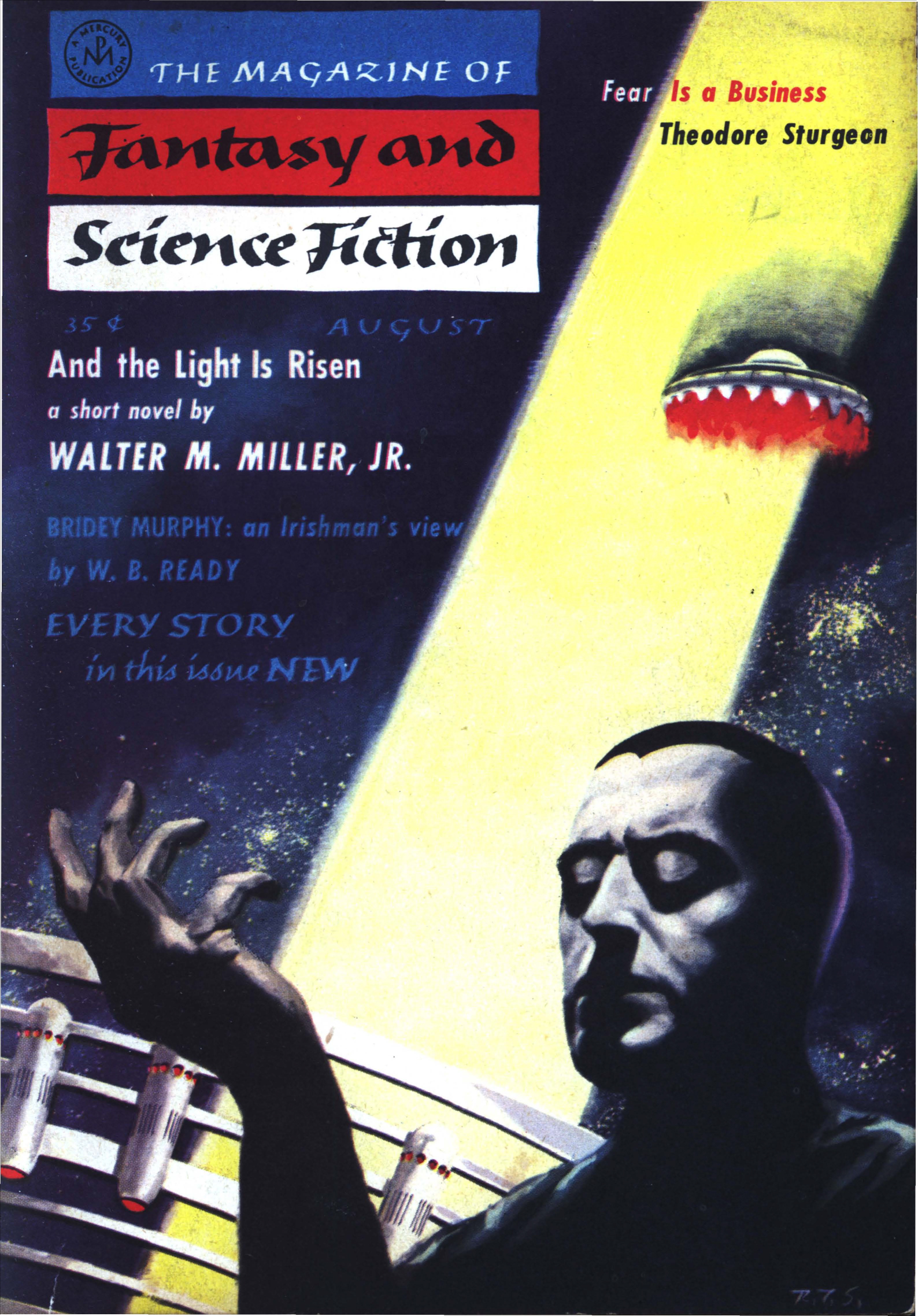
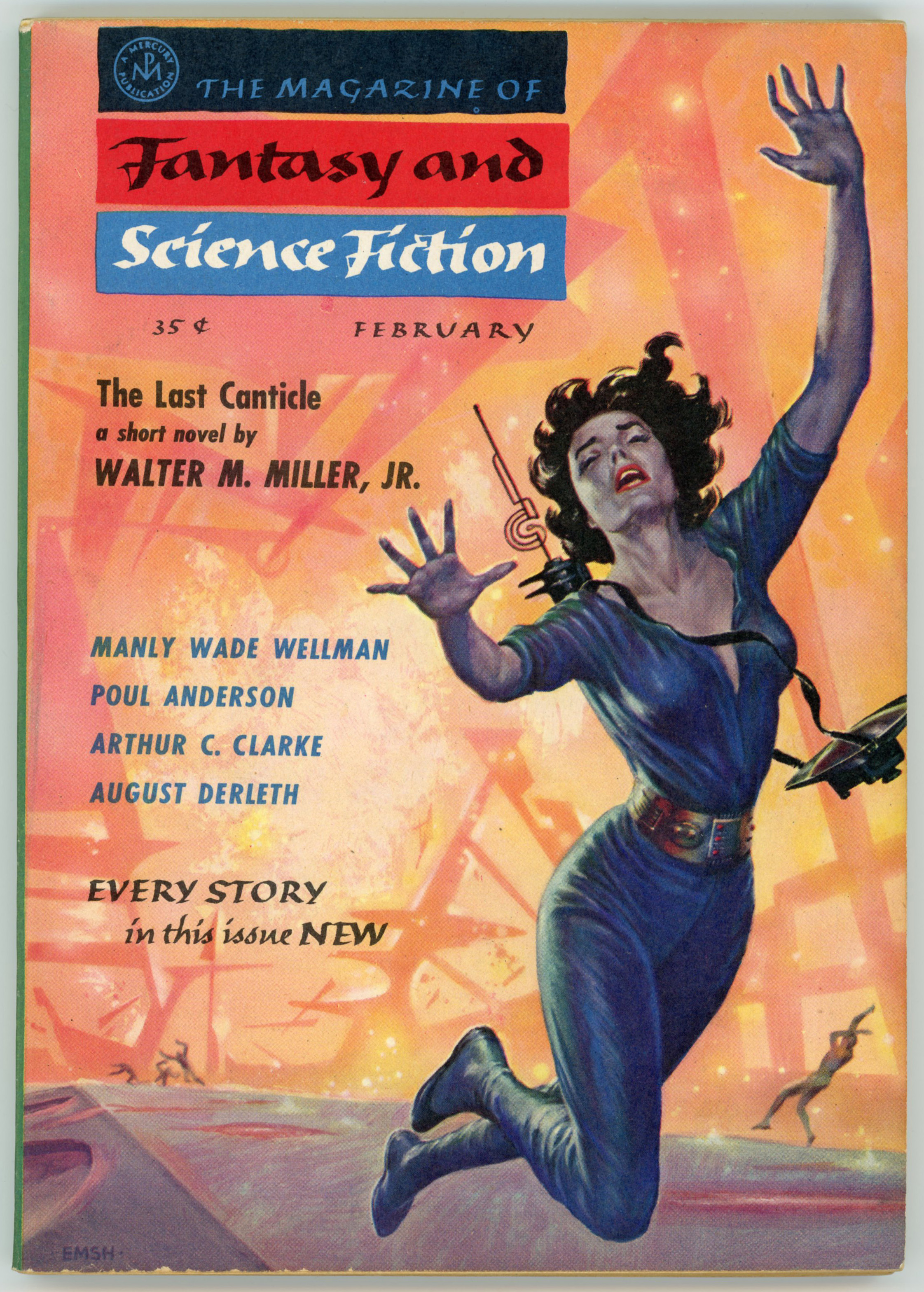
These are covers of the three 1950’s issues of The Magazine of Fantasy and Science Fiction in which appeared the three stories from which were derived Miller’s novel, and, the cover of Fantasy & Science Fiction in October-November of 1997, which was the venue for the last story in the series.  Ironically, none of the four issues feature cover art actually pertaining to Miller’s stories or novel.  Much the same was so for 1951 issue of Galaxy Magazine in which appeared Ray Bradbury’s “The Fireman”, later published in book form as Farhenheit 451:  That issue featured cover art by Chesley Bonestell.

__________

The cover of the April, 1955 issue features a close-up from Chesley Bonestell’s stunning panorama “Mars Exploration”.  Notice that the painting shows a strip of green – vegetation – at the base of weathered background hills.  Well, this was the mid-1950s, over a decade before Mariner probes revealed the true nature of the Martian surface.  Then again, maybe Mars is “green”, but a deeper, below-the-surface kind of green?

“A Canticle for Leibowitz”
April, 1955
____________________

“Mars Exploration”, by Chesley Bonestell

________________________________________

“And the Light Is Risen”
August, 1956
________________________________________

“The Last Canticle”
February, 1957
________________________________________

“God Is Thus”
October-November, 1997

________________________________________

References, Readings, and What-Not…

57th Bomb Wing, at 57thBombWing.com

340th Bomb Group History, at 57thBombWing.com

489th Bomb Squadron History, at 57thBombWing.com

489th Bomb Squadron History for February, 1944 (PDF Transcript), at 57th BombWing.com

489th Bomb Squadron insignia, at RedBubble.com

Bernard Krigstein, at Wikipedia

Walter M. Miller, Jr., at Wikipedia

Walter M. Miller, Jr., at Internet Speculative Fiction Database

“A Canticle for Leibowitz”, at Wikipedia

“Mars Exploration” (painting), by Chesley Bonestell, at RetroFuturism (subreddit)

The Magazine of Fantasy and Science Fiction (covers for April, 1955, August, 1956, and October-November, 1997), at Pulp Magazine Archive (Archive.org)

Bond, Harold L., Return to Cassino, Pocket Books, Inc., New York, N.Y., March, 1965

Bowden, Denny, Secret Life / Death of the Author of the Greatest Science Fiction Novel – Born in New Smyrna, Died in Daytona Beach, at VolusiaHistory.com

Majdalany, Fred, The Battle of Cassino, Ballantine Books, Inc., New York, N.Y., 1957

Olsen, Alexandra H., Re-Vision: A Comparison of Canticle for Leibowitz and the Novellas Originally Published, Extrapolation, Summer, 1997

Piekalkiewicz, Janusz, Cassino – Anatomy of the Battle, Orbis Publishing, London, England, 1980

Roberson, William H., Walter M. Miller, Jr.: A Reference Guide to His Fiction and His Life, McFarland and Company, Inc., Jefferson, N.C., 2011

Webley, Kayla, Top Ten Post-Apocalyptic Books: A Canticle for Leibowitz, Time, June 7, 2010
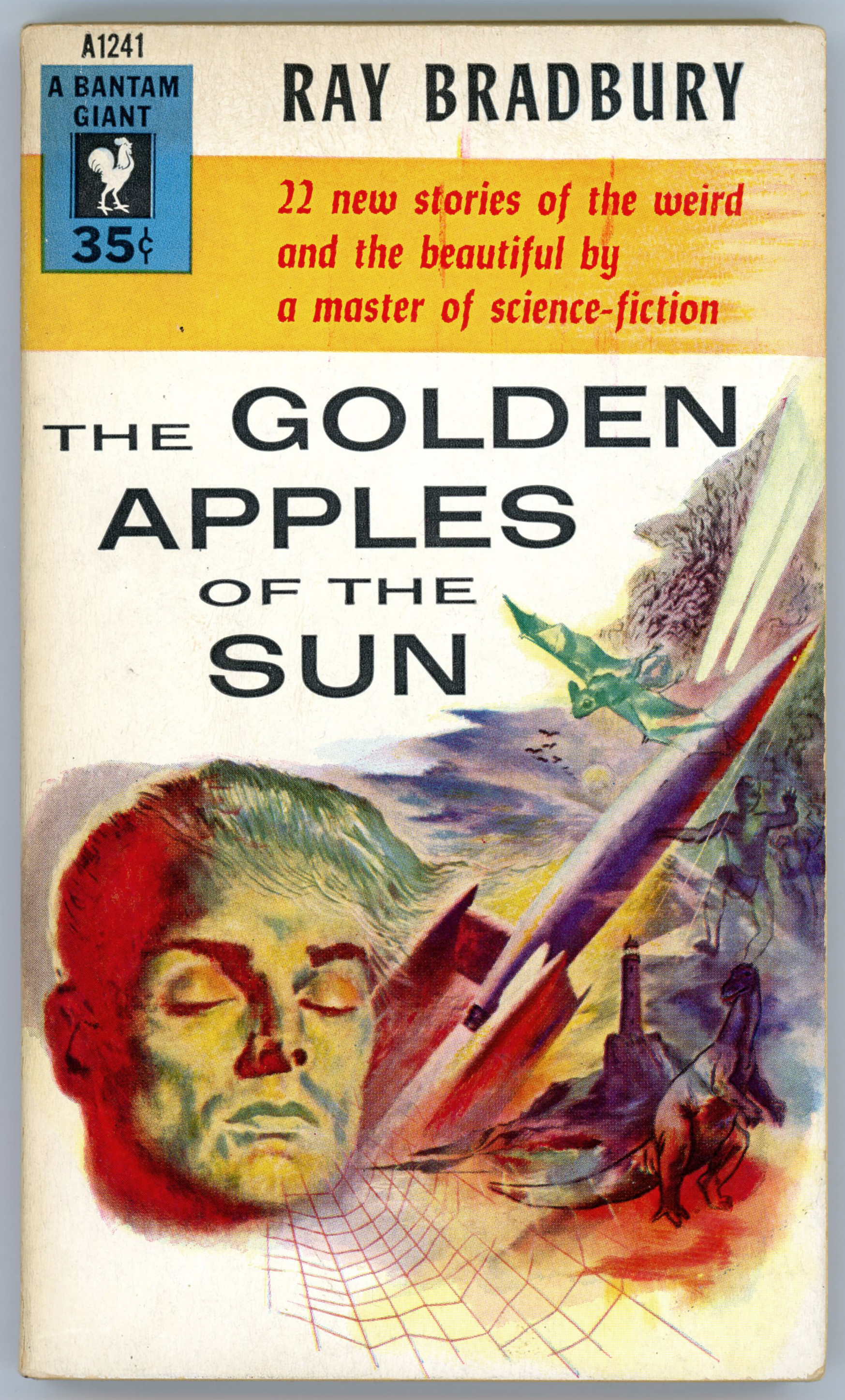
The Golden Apples of the Sun, by Ray Bradbury – 1954 [Barye W. Phillips…maybe]

Though I’ve never been partial to the literary style or underlying themes of Ray Bradbury’s writing, I can still appreciate and respect the cultural and historical significance of his body of work.  And, from what I know “about” him, he was a genuinely kind human being, quite willing to bestow time and advice to budding authors.  In that regard, the foremost qualities that emerge from his interview by Charles Platt (in Dream Makers – The Uncommon People Who Write Science Fiction) are a sense of integrity, and, a deep dedication to his craft.

You can’t ignore somebody like that.

So, here’s Bantam’s 1954 anthology of twenty-two of his stories, entitled (by virtue of the last listed title) The Golden Apples of the Sun.  For the story “Embroidery”, originally published in the November, 1951 issue of Marvel Science Fiction, I’ve included the magazine’s cover (by Hannes Bok), while for “The Golden Apples of The Sun”, which first appeared in the November, 1953 issue of Planet Stories, I’ve added the issue’s cover (by Frank Kelly Freas).  Both images were downloaded from Archive.org, and Photoshopified just a little bit.

Contents

The Fog Horn, from The Saturday Evening Post, June 23, 1951

The Pedestrian, from The Magazine of Fantasy and Science Fiction, February, 1952

The April Witch (from “The Elliott Family” series), from The Saturday Evening Post, April 5, 1952

The Wilderness (from “The Martian Chronicles” series) from The Magazine of Fantasy and Science Fiction, November, 1952

The Fruit at the Bottom of the Bowl, from Detective Book Magazine, Winter, 1948

Invisible Boy, from Mademoiselle, Winter, 1945

The Flying Machine

The Murderer

The Golden Kite, the Silver Wind

I See You Never, from The New Yorker, November 8, 1947

____________________

Embroidery, from Marvel Science Fiction, November, 1951

“This month’s 4-color cover by well-known cover and interior artist, HANNES BOK.  Using a mixed technique of dyes, color pencil, water-color, and ink.”

____________________

The Big Black and White Game, from The American Mercury, August, 1945

A Sound of Thunder, from Colliers, June 28, 1952

The Great Wide World Over There

Powerhouse (1948?)

En la Noche, from Cavalier, November, 1952

Sun and Shadow, The Reporter, 1953

The Meadow, World Security Workshop (ABC Radio Network radio program), 1947

The Garbage Collector

The Great Fire (“Green Town”?) (1949?)

Hail and Farewell

____________________

The Golden Apples of the Sun, Planet Stories, November, 1953

____________________

References

Platt, Charles, Dream Makers – The Uncommon People Who Write Science Fiction, Berkley Books, New York, N.Y., November, 1980

The Golden Apples of the Sun, at Internet Speculative Fiction Database

The Golden Apples of the Sun, at Wikipedia

Ray Bradbury, at RayBradbury.com

The Best of Barry N. Malzberg – January, 1976 [Robert Emil Schulz]

While common themes of science fiction art and illustration are inspired by technology, engineering, space exploration, let alone transcending the known and established physical laws governing the nature of the universe, another motif of the genre’s art pertains to the realm of the biological:

Genetic engineering, the effects of man upon his environment (and likewise, the effects of nature upon man – how jarringly topical now, in March of 2020…); relationships with alien species – whether romantic, sexual, or familial – as exemplified in striking combination through Philip Jose Farmer’s great “The Lovers“; the natural, random evolution of homo sapiens into forms and variants whose physical and intellectual abilities effectively create a new species of “man”.

These and other concepts have all been the basis of science fiction art, both in books and magazines.

A nice example of biological art appears as Robert E. Schulz’s cover illustration for The Best of Barry Malzberg.  No stylized, abstract spacecraft here, the symbolic center of the image is the form of a man, before whom are two helixes, probably representations of strands of DNA.  At his right side, glass laboratory-ware associated with chemistry (see that Erlenmeyer flask?), which seem to be involved in the condensation of some kind of chemical.  Plus, there’s that dark sphere outlined in a diffuse red halo (a planet?; a miniature black hole?), with an electrical circuit below.

But, his other side is different, for the symbolism isn’t scientific, it’s religious.  The central object is a huge chalice, above which is a crucifix, all ornamented by a seeming brass clockwork.  And, there seems to be a brass shield covering the man’s thigh.

Lots going on here!

As for the book itself?  – Oh, yes…  Though titled “The Best of…”, it’s actually a Pocket Books publication, rather than being part of the Del Rey / Ballantine Series “The Best of…” which covered the works of a variety of other authors.

Contents

Introduction to The Best of Barry N. Malzberg, by Barry N. Malzberg

Introduction to “A Reckoning”, by Barry N. Malzberg

“A Reckoning” (variant of Notes Leading Down to the Conquest), from New Dimensions III, October, 1943

Introduction to “Letting It All Hang Out”, by Barry N. Malzberg

“Letting It All Hang Out” (variant of Hanging), from Fantastic, September, 1974

Introduction to “The Man in the Pocket”, by Barry N. Malzberg

“The Man in the Pocket” (variant of The Men Inside), from New Dimensions II, December, 1972

Introduction to “Pater Familias”, by Barry N. Malzberg

“Pater Familias”, from The Magazine of Fantasy and Science Fiction, March, 1972 (by Kris Neville and Barry N. Malzberg)

Introduction to “Going Down”, by Barry N. Malzberg

“Going Down”, from Dystopian Visions, 1975

Introduction to “Those Wonderful Years”, by Barry N. Malzberg

“Those Wonderful Years”, from Frontiers 1: Tomorrow’s Alternatives, 1973

Introduction to “On Ice”, by Barry N. Malzberg

“On Ice”, from Amazing Science Fiction, January, 1973

Introduction to “Revolution”, by Barry N. Malzberg

“Revolution”, from Future City, 1973

Introduction to “Ups and Downs”, by Barry N. Malzberg

“Ups and Downs”, from Eros in Orbit, 1973

Introduction to “Bearing Witness”, by Barry N. Malzberg

“Bearing Witness”, from Flame Tree Planet, 1973

Introduction to “At the Institute”, by Barry N. Malzberg

“At the Institute”, from Fantastic, 1974

Introduction to “Making It Through”, by Barry N. Malzberg

“Making It Through”, from And Walk Now Gently Through the Fire and Other Science Fiction Stories, 1972

Introduction to “Tapping Out”, by Barry N. Malzberg

“Tapping Out”, from Future Quest, 1973

Introduction to “Closed Sicilian”, by Barry N. Malzberg

“Closed Sicilian”, from The Magazine of Fantasy and Science Fiction, November, 1973

Introduction to “Linkage”, by Barry N. Malzberg

“Linkage”, from Demon Kind, 1973

Introduction to “Introduction to the Second Edition”, by Barry N. Malzberg

“Introduction to the Second Edition”, by Barry N. Malzberg

Introduction to “Trial of the Blood”, by Barry N. Malzberg

“Trial of the Blood”, from The Berserkers, 1974

Introduction to “Getting Around”, by Barry N. Malzberg

“Getting Around”, from Frontiers 1: Tomorrow’s Alternatives, 1973

Introduction to “Track Two”, by Barry N. Malzberg

“Track Two”, from Fantastic, July, 1974

Introduction to “The Battered-Earth Syndrome”, by Barry N. Malzberg

“The Battered-Earth Syndrome”, from Saving Worlds, 1973

Introduction to “Network”, by Barry N. Malzberg

“Network”, from Fantastic, January, 1974

Introduction to “A Delightful Comedic Premise”, by Barry N. Malzberg

“A Delightful Comedic Premise”, from The Magazine of Fantasy and Science Fiction, February, 1974

Introduction to “Geraniums”, by Barry N. Malzberg

“Geraniums”, from Omega, 1973 (by Valerie King and Barry N. Malzberg)

Introduction to “City Lights, City Nights”, by Barry N. Malzberg

“City Lights, City Nights”, from Future City, 1973

Introduction to “Culture Lock”, by Barry N. Malzberg

“Culture Lock”, from Future City, 1973

Introduction to “As in a Vision Apprehended”, by Barry N. Malzberg

“As in a Vision Apprehended”, from The Berserkers, 1974

Introduction to “Form in Remission”, by Barry N. Malzberg

“Form in Remission”, from The Berserkers, 1974

Introduction to “Opening Fire”, by Barry N. Malzberg

“Opening Fire”, from Frontiers 2: The New Mind, 1973

Introduction to “Running Around”, by Barry N. Malzberg

“Running Around”, from Omega, 1973

Introduction to “Overlooking”, by Barry N. Malzberg

“Overlooking”, from Amazing Science Fiction, June, 1974

Introduction to “Twenty Sixty-one”, by Barry N. Malzberg

“Twenty Sixty-one”, from The Magazine of Fantasy and Science Fiction, July, 1974

Introduction to “Closing the Dead”, by Barry N. Malzberg

“Closing the Deal”, from Analog Science Fiction / Science Fact, March, 1974

Introduction to “What the Board Said”, by Barry N. Malzberg

“What the Board Said”, 1976

Introduction to “Uncoupling”, by Barry N. Malzberg

“Uncoupling”, from Dystopian Visions, 1975

Introduction to “Over the Line”, by Barry N. Malzberg

“Over the Line”, from Future Kin, 1974

Introduction to “Try Again” and “An Oversight”, by Barry N. Malzberg

“Try Again”, from Strange Gods, 1974

“An Oversight”, 1976, (variant of “Oversight”, from Strange Gods, 1974)

Introduction to “And Still in the Darkness”, by Barry N. Malzberg

“And Still in the Darkness”, 1976

References

The Best of Barry N. Malzberg, at the Internet Speculative Fiction Database

Robert E. Schulz, at the Internet Speculative Fiction Database

Facebook Page for The Art of Robert E. Schulz

Startling Stories – April, 1952 (Featuring “The Glory That Was”, by L. Sprague de Camp) [Alex Schomburg] [Updated post…!]

[Update, May, 2021! …  I recently learned from Mike Chomko, publisher of The Pulpster (affiliated with PulpFest), that the cover artist of this issue of Startling Stories was Alex Schomburg.  So, the text of this post has been updated accordingly.  Thanks for the tip, Mike.]

I’ve recently had the good fortune to acquire several issues of Startling Stories, giving me the opportunity to present my own scans of this magazine, rather than images randomly found on the ‘net. 

This post is the first such example:  Originally created on February 17, 2018, it’s been updated to include images of the front and rear covers of the the magazine’s issue of April, 1952.

Though no artist’s names appear in the issue’s table of contents, this softly-pink-horizoned-moonscape-with-cloudless-earth-floating-in-the-distance was created by Alex Schomburg.  It looks as if the light gray to silver to dark gray to black shadings of the lunar mining machine were done via airbrush…     

So, the front cover:

…and the back cover, with an advertisement for The Collected Works of Zane Grey

________________________________________

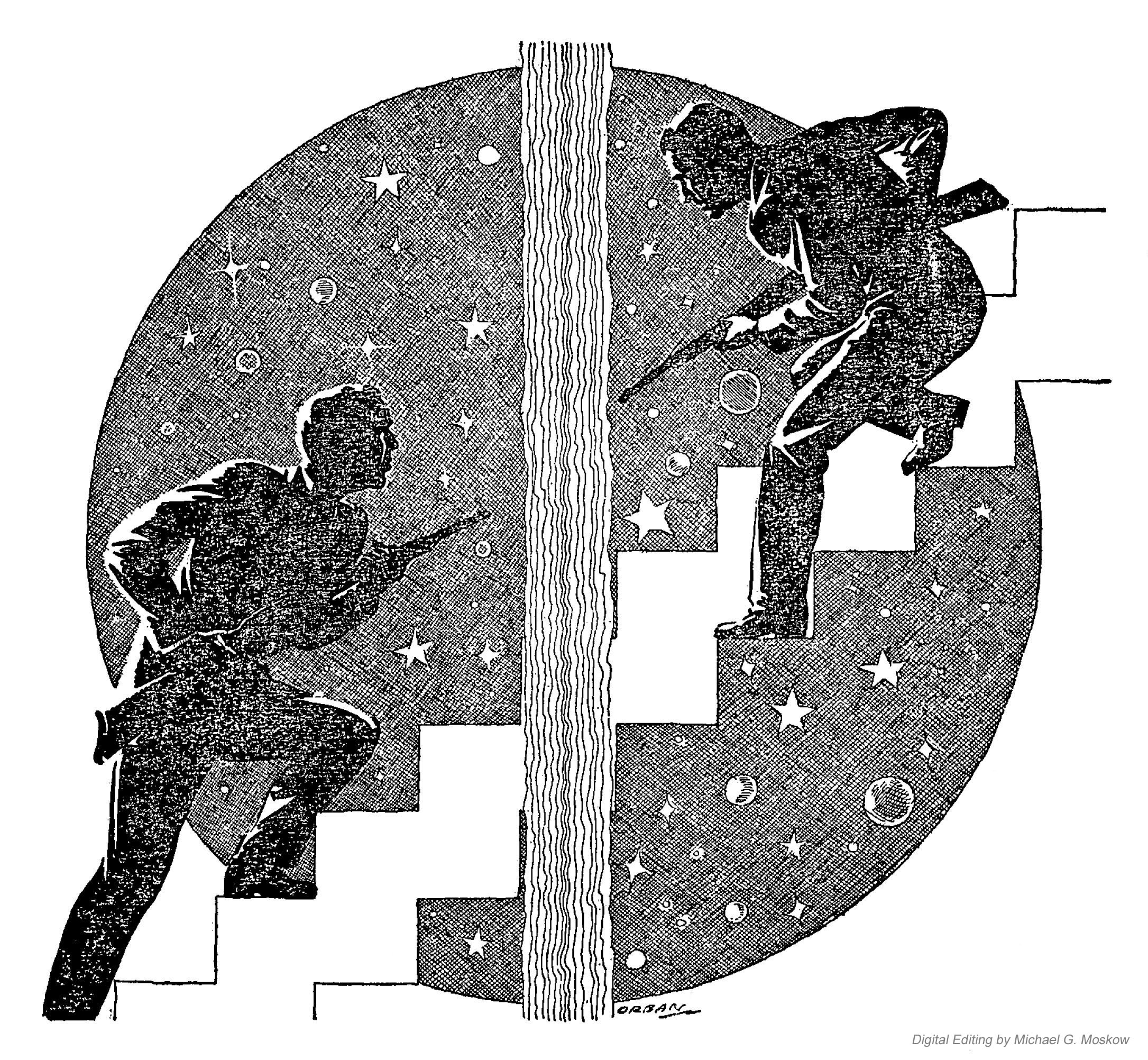
Here’s Paul Orban’s Illustration  – on page 89 – for “The Intruder”, by Oliver E. Saari, whose life encompassed the realms of engineering and science fiction

I’ve not read Saari’s story, but the theme of the “header” blurb – below – reminds me of episode six from (the otherwise sadly and highly uneven) season four of The Man in The High Castle: (“All Serious Daring“). 

The concept is also highly reminiscent of Fritz Leiber, Junior’s, “Destiny Times Three” – one of the most brilliantly executed tales of parallel universes I’ve ever read!  Then again, Leiber was an extraordinary writer! – which appeared in Astounding Science Fiction in March and April of 1945. 

“To have an exact duplicate of yourself show up and take over your business, your wife? … brother, it’s murder!”

________________________________________

Here’s the cover image – from Archive.org – that originally appeared in this post.

Future Science Fiction – September, 1951 (Featuring “Genesis”, by H. Beam Piper) [Milton Luros]

While perusing issues of Future Science Fiction at Archive.org, I discovered H.W. Kiemle’s evocative and interesting illustration for James Blish’s short tale “Elixir” – in the September, 1951 issue of the magazine – which I couldn’t help but download, edit, and put on display. 

The magazine itself features cover art by Milton Luros (Milton L. Rosenthal), while “Kiemle” is actually Henry W. Kiemle, Jr., – both of whose art hasn’t been previously featured in this blog, and interior illustrations by other artists, as well.  Like other “second string” science-fiction pulp magazines of the 1950s, the publication’s art is more striking than its literary content, and in visual quality equal to or better than interior art in better known publications of the same genre.

As for the physics and operation of rocket back-pack worn by “Jimmy”, well, that’s another question.  The propulsion unit as depicted utilizes a single nozzle, the outlet of which is located at or above the user’s center of gravity.  As such, in operation, the unit’s actual effect might be to simply induce a “head over heels” rotation around an axis parallel to the wearer’s mid-section, rather than forward, “flying through space” motion paralleling the “long axis” of the user’s body. 

In other words, you’ll go for a hell of a spin, but not much of a fly.  

No matter.  The picture’s cool. 

“Jimmy plotted his course carefully, to take himself safely out of the area of the burning ship.”

(Illustrating “Elixir”, by James Blish, pp. 38-46)

References

Henry W. Kiemle, Jr. at Pulp Artists

Milton Luros (Milton L. Rosenblatt) at Pulp Artists


If – Worlds of Science Fiction – January, 1953 (Featuring “Check and Checkmate”, by Walter M. Miller, Jr.) [Anton Kurka]

From table of contents:

“Cover by Anton Kurka, suggesting The Ultimate Re-Sowing of the Human Race – 4000 AD”.

Completely unrelated to the magazine’s contents, Kurka’s painting is a fascinating take on the theme of giant robots, a seemingly perennial trope of science fiction and popular culture.  The image is reminiscent of Frank Kelly Freas’ well-known (and oft reproduced with many variations) cover for the October, 1953 issue of Astounding Science Fiction, albeit the symbolism of Kurka’s painting is somewhat more benign than that of Freas. 

(A lot more benign, that is!)

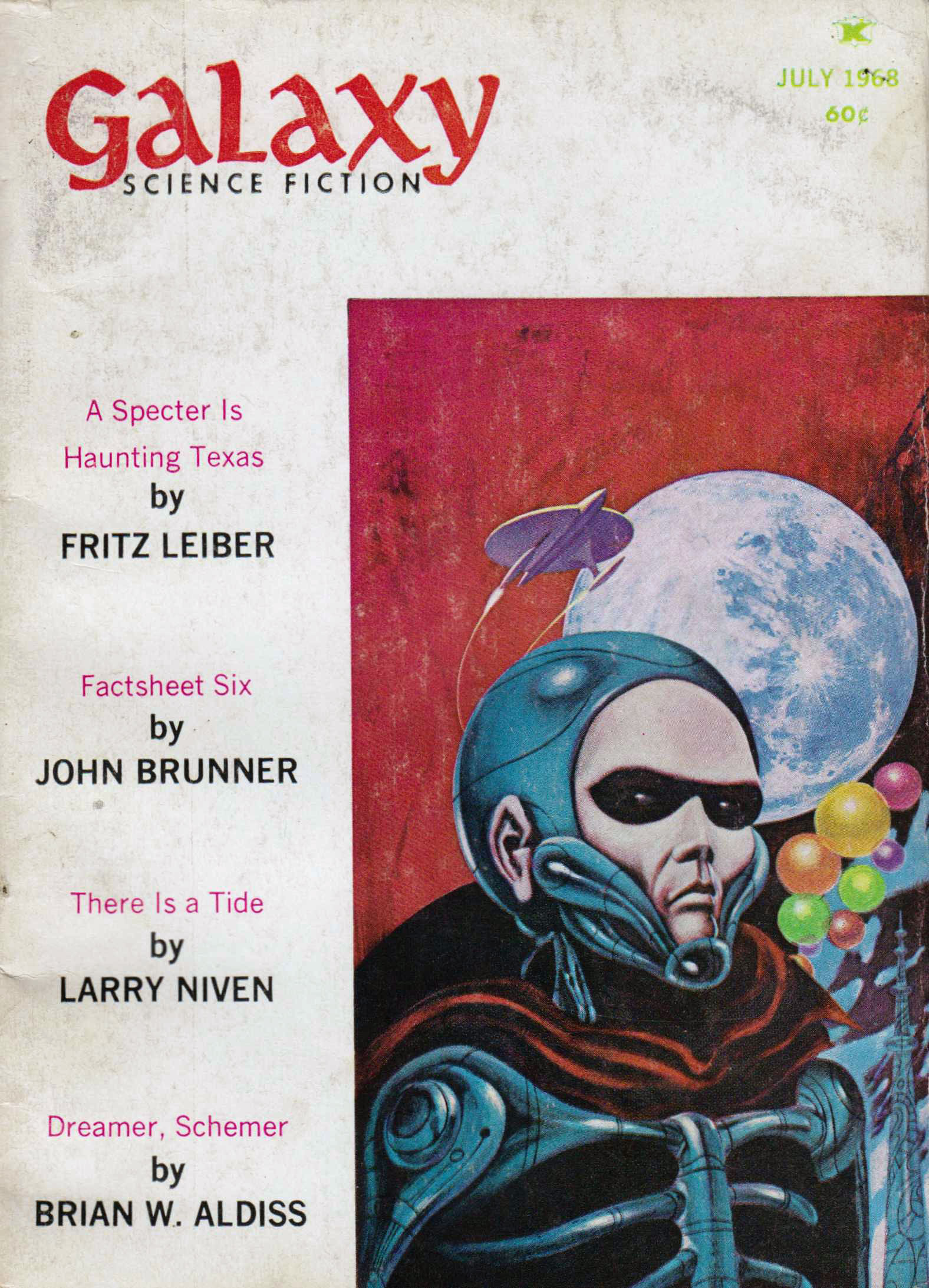
A Specter Is Haunting Texas, by Fritz Leiber – 1978 (1968) [Henry Richard Van Dongen (plus, Jack Gaughan)]

________________________________________

Symbolic illustration of Scully La Cruz (facing title page) by Jack Gaughan.

________________________________________

From rear cover …

“Scully La Cruz was a Thin – a muscleless free-fall phenomenon whose home was the Sack circling the Moon, who could only support life in Earth-gravity conditions by having himself encased in a titanium exo-sekleton.  To the inhabitants of the ravaged post-war Earth, he looked spectrally outlandish.

To Scully, the inhabitants of the Earth looked equally odd.  Because the U.S.A. had disappeared in the aftermath of the atomic conflict and had been replaced by Greater Texas.  And Greater Texas was dominated by the Greater Texans, masterful giants created by hormone treatments, who strode lordly about amidst their dwarvish peons and slaves.

To these unhappy underlings, Scull appeared as a Sign, a leader for revolt.  To Scully, this reverence sparked his actor instinct sufficiently to make him decide to accept that role.

This is one of Fritz Leiber’s most astonishing and satirical novels … a caricature of the future as living, chilling and ultimately serious of purpose as a Jules Feiffer cartoon.”

Excerpt (from pages 14-15) …

They were looking I discovered, at a handsome,
shapely,
dramatic-featured man,
eight feet eight inches tall and massing 147 pounds
and ninety-seven pounds without his exoskeleton. 
Except for relaxed tiny bulges of muscle in his forearms and calves
(latter to work lengthy toes, useful in gripping),
this man was composed of skin, bones, ligaments, fasciae, narrow arteries and veins,
nerves, small-size assorted inner organs, ghost muscles,
and a big-domed skull with two bumps of jaw muscles. 
He was wearing a skintight black suit that left bare only his sunken-chested,
deep-eyed, beautiful tragic face and big, heavy-tendoned hands.

This truly magnificent,
romantically handsome,
rather lean man was standing on two corrugated-soled titanium footplates. 
From the outer edge of each rose a narrow titanium T-beam that followed the line of his leg,
with a joint (locked now) at the knee,
up to another joint with a titanium pelvic girdle and shallow belly support. 
From the back of this girdle a T-spine rose to support a shoulder yoke and rib cage,
all of the same metal. 
The rib cage was artistically slotted to save weight,
so that curving strips followed the line of each of his very prominent ribs.

A continuation of his T-spine up the back of his neck in turn supported a snug,
gleaming head basket that rose behind to curve over his shaven cranium,
but it front was little more than a jaw shelf and two inward-curving cheekplates
stopping just short of his somewhat rudimentary nose. 
(The nose is not needed in Circumluna to warm or cool air.)

Slightly lighter T-beams than those for his legs reinforced his arms
and housed in their terminal inches his telescoping canes. 
Numerous black, foam-padded bands attached this whole framework to him.

A most beautiful prosthetic, one had to admit.  While to expect a Thin, or even more than a Fat,
from a free-fall environment to function without a prosthetic on a gravity planet
or in a centrifuge would be the ultimate in cornball ignorance. 

Eight small electric motors at the principal joints worked the prosthetic framework
by means of steel cables riding in the angles of the T-beams,
much like antique dentist’s drills were worked, I’ve read. 
The motors were controlled by myoelectric impulses from his ghost muscles
transmitted by sensitive pickups buried in the foam-padded bands. 
They were powered by an assortment of isotopic and lithium-gold batteries
nesting in his pelvic and pectoral girdles. 

“Did this fine man look in the least like a walking skeleton?”
 I demanded of myself outragedly. 
“Well, yes very much so,”
I had to admit now that I had considered the matter from the viewpoint of strangers. 
A very handsome and stylish skeleton,
all silver and black but a skeleton nonetheless,
and one eight feet eight inches tall,
able to look down a little even at the giant Texans around him.

________________________________________

________________________________________

Scully La Cruz, as originally envisioned by Jack Gaughan in Galaxy Science Fiction …

________________________________________

(pp. 6-7)

________________________________________

(pp. 28-29)