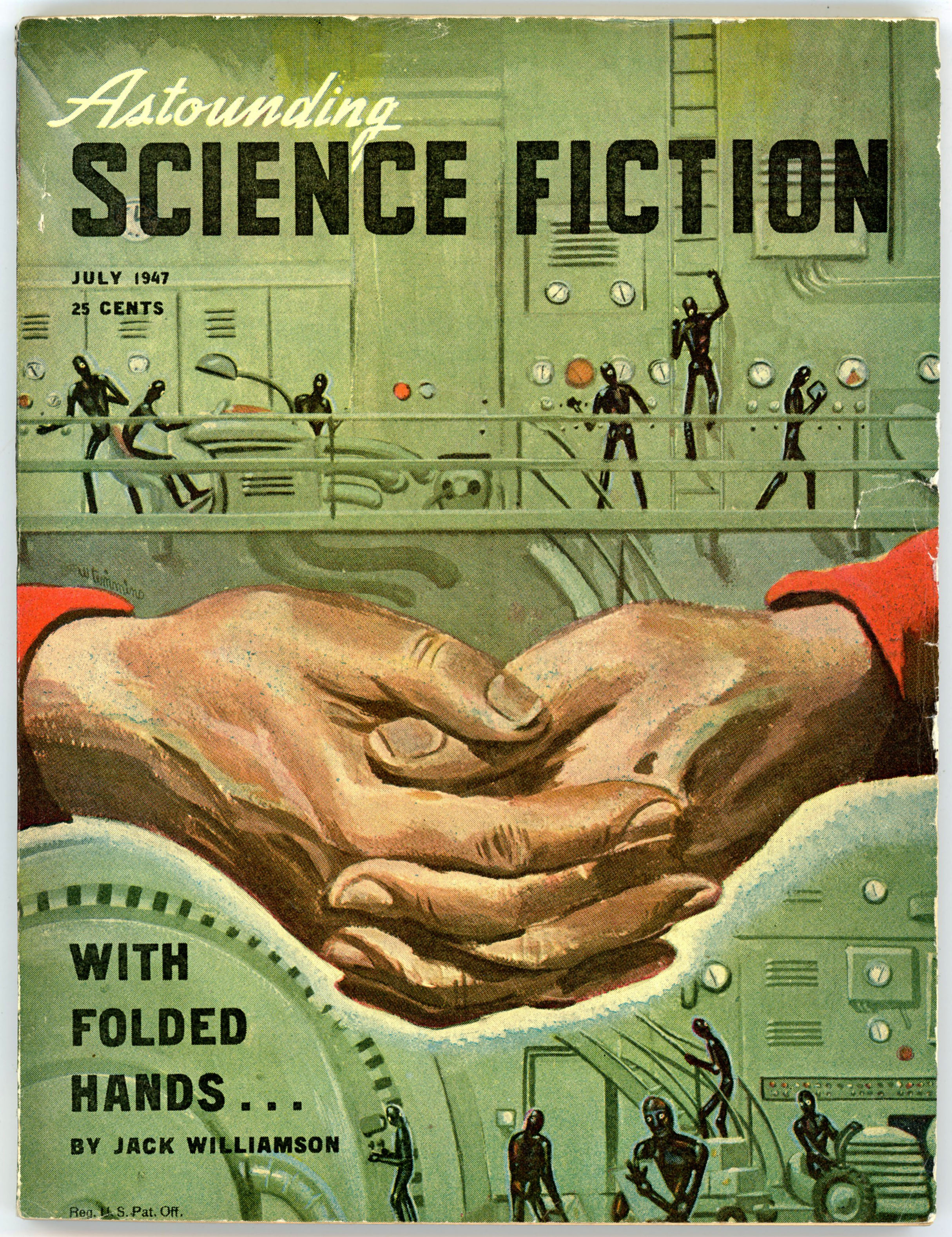
The Temperature of Chaos: Galaxy Science Fiction – February, 1951 (Featuring “The Fireman”,  by Ray Bradbury) [Joseph A. Mugnaini; Chesley Bonestell]

“Whether we entrust our decisions to machines of metal,
or to those machines of flesh and blood
which are bureaus and vast laboratories and armies and corporations,
we shall never receive the right answers to our questions unless we ask the right questions.” 
Norbert Wiener

________________________________________

In the summer of 2020, I read a book. 

Actually, in 2020 I read several books, and I’m reading a book right now, in 2021: Judgement Night, by Catherine L. Moore.  But of last year’s reading, two works – read back to back – have particularly stood out for me: S. Ansky’s (pen name of Shloyme Zanvl Rappoport) The Enemy At His Pleasure, and, Ray Bradbury’s Fahrenheit 451

A central theme of both – viewed from a very distant literary vantage point! – is the sudden and unanticipated transformation of a culture, society, and nation through the development and impact of forces within and without.  While in practically ever significant respect the books are vastly dissimilar (not even considering the central fact that Ansky’s is non-fiction and Bradbury’s not) a commonality of their writings is the reaction of people – people as individuals; people collectively – to overwhelming, unexpected, and traumatic social change. 

In retrospect, coincidentally or not, how very strange that having read in The Enemy At His Pleasure in April, I finished Bradbury’s novel on a Friday in the latter part of May: While seated in a quiet, shaded garden adjacent to a public library in a (for the time being…) peaceful suburb (was it only a few brief months ago that public libraries maintained full operating hours?) – considering the events would soon follow in the United States, and even beyond in the still-atrophying “West”, shortly thereafter.

Regardless of how the events of 2020 are viewed “now”, I think that future historians – that is, assuming history even survives as an intellectual discipline in the future – will come to understand the events of the past year (primarily in the United States, and secondarily in parts of Western Europe) as having been a kind of antinomian religious frenzy.  This strikingly parallels the millenarian social unrest that persisted in central and western Europe from the eleventh through the sixteenth centuries.  But, rather than ostensible (and really, superficial) concerns about “social justice”, the events of 2020 were at heart a reflection of obsessions about the potential loss of social status by a secular (and comfortably insular in that secularity), credentialed, technocratic, entitled, and ultimately quite venal elite. 

Or more accurately, “elite”.

Oh, back to the novel at hand…

And while the power and depth of Bradbury’s novel were well forceful enough on their own in literary, emotional, and intellectual terms, the intersection of these qualities with the impact of events in “outside world” – the “real” world – only intensified the validity and force of the book’s message.  Or, messages, of which there were several. 

And so…  This also gave me an appreciation for the quality of Ray Bradbury’s writing, for despite having long been a devotee of science fiction (specifically that of Cordwainer Smith and A.E. van Vogt and Philip K. Dick and Catherine L. Moore and Cyril Kornbluth and Dan Simmons and Poul Anderson; Isaac Asimov not so much and really not at all), this was actually the first time I’d read any of Bradbury’s novels.  (Well, I guess people change.)  The very antithesis of a “hard SF” writer – though technological conjecture and extrapolation are nonetheless central to his stories – I found that Bradbury excelled in the description of emotion and thought; actions and event; communication and conflict, with a richness of language born of an uncanny (well, sometimes overdone, but it works) use of metaphor and similie.

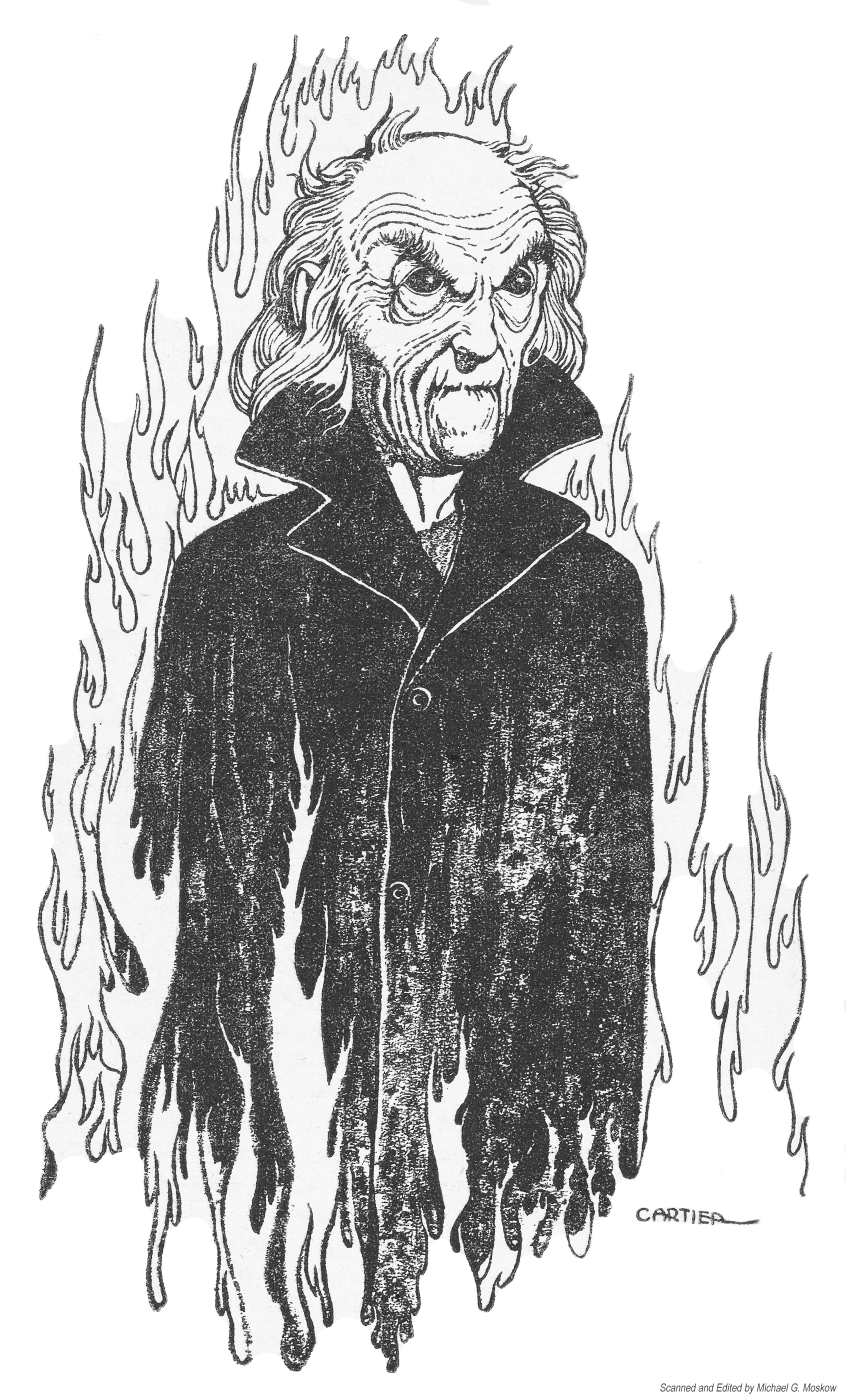
And, so…  In much that same way that my posts combine scans a book or magazine’s cover (and frequently interior) art with excerpts from those publications, this post revisits my earlier post about Fahrenheit 451, which displays the cover art of the book’s first American paperback edition, by displaying the cover of the book’s Del Rey / Ballantine Book edition of April, 1991.  As you can see, the central component of Joseph Mugnaini’s art – a “Fireman”, whose fireproof suit is actually made from the torn newspaper pages is wreathed in flames – has been retained from the 1953 edition, but otherwise, the cover is simplified: The Fireman appears in black & white, and there is no background.  That’s all there is.  For reasons of literary and cultural familiarity, I suppose this was enough.

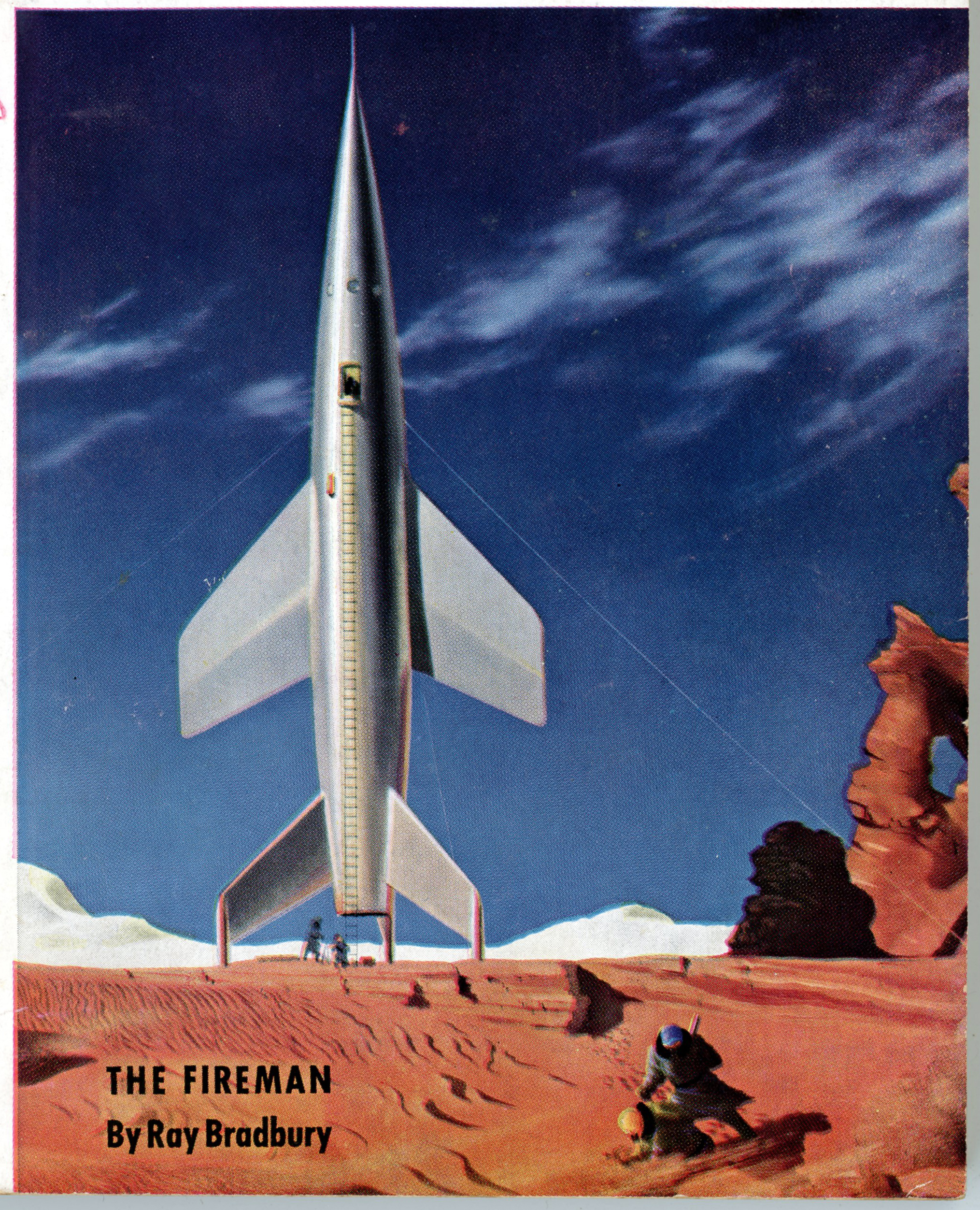
And…  In much the same way that some of my posts – at least, those for the genre of science fiction! – include images of both a book’s cover, and, the cover art of the magazine in which said book was first serialized, this post features images of Fahrenheit 451’s first appearance: The February, 1951, issue of Galaxy Science Fiction.  Bradbury’s novel, illustrated by Karl Rogers, occupies half the magazine’s length (pages 4 through 61), the other stories being “…And It Comes Out Here” by Lester Del Rey, “The Protector” by Betsy Curtis,  “Second Childhood” by Clifford D. Simak, “Two Weeks in August” by Frank M. Robinson, and the second installment of Isaac Asimov’s “Tyrann”. 

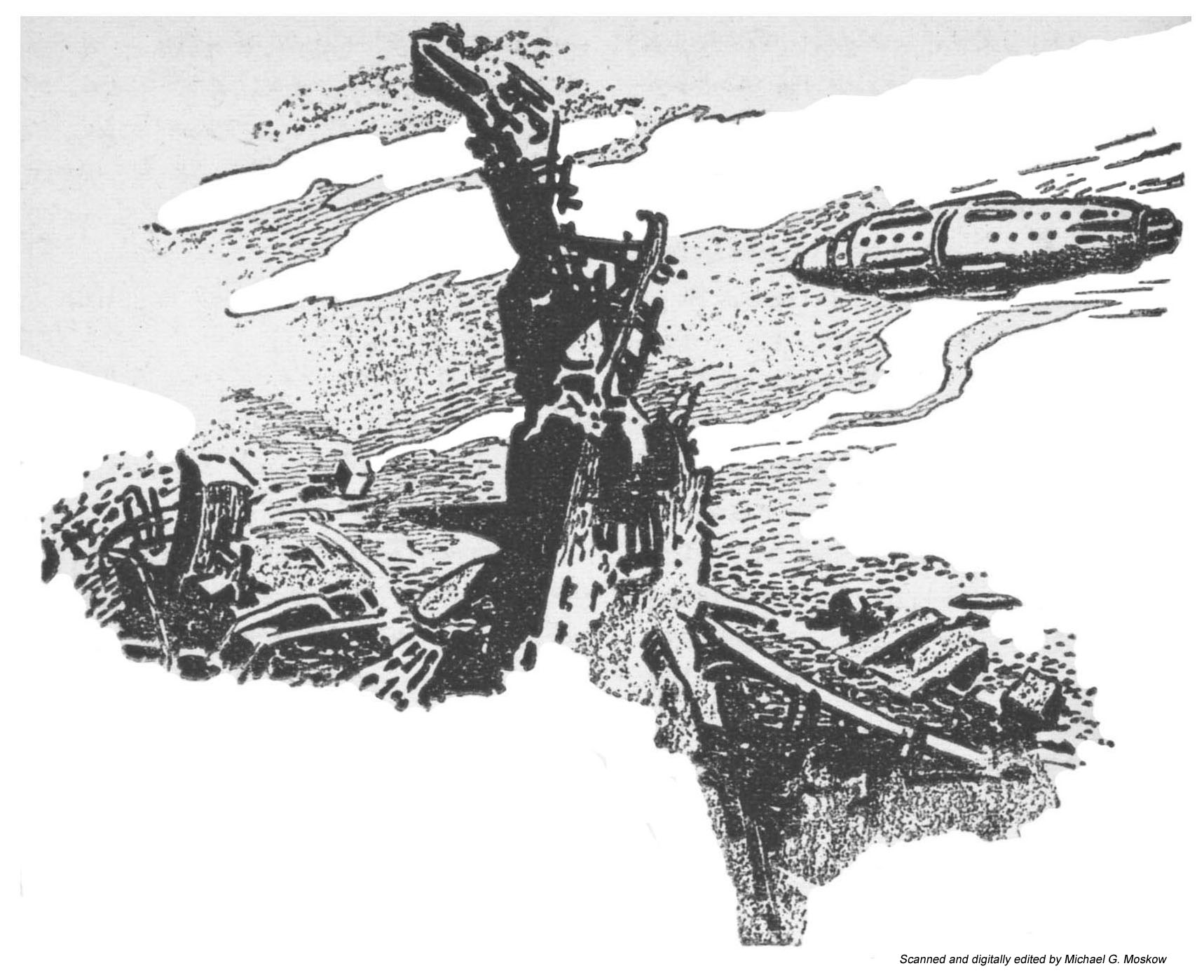
And…  This is an instance most interesting and not uncommon, where the magazine’s cover art has absolutely no relation to the stories within.  Entitled “The Tying Down of a Spaceship on Mars in a Desert Sandstorm,” the time-frame (early 50s) subject matter and vivid softness of the colors make the painting easily recognizable as a work of Chesley Bonestell,

And yet…  Even as I read Fahrenheit 451, I couldn’t help but notice the way that the world constructed by Ray Bradbury – either through prescience, chance, or an uncanny combination of both – has captured our world: The world of the recent past; the world that exists now, in 2020; the world that seems to await us, even as this second decade of the twenty-first century is shortly drawing to a close.  So, I’m presenting excerpts of some (hard to chose!) of the novel’s most crisply and vividly crafted passages, juxtaposed with contemporary symbols that most uncannily match and embody the events, scenes, and characters depicted in these very passages.  

Among these excerpts are some videos and book over art that reflect the mood and message of Fahrenheit 451

The post closes with by Yann Tiersen’s melody “Comptine d’un autre été – “Rhyme for Another Summer”, from the sound-track for trailer of 2001’s Amélie, at Rousseau’s YouTube channel.  I chose this because it’s the background theme for the short video, “This Is Our World – I Am Speechless“, in the “middle” of this post.

I wish that Ray Bradbury were with us now, to “illustrate” (pardon the pun!) by words the world we now inhabit.  But, he is not.  He died in 2012, only eight years by the measure of time, but another world by the measure of technology.  

Well, perhaps this is best expressed by Norbert Wiener:

“We have a good deal of experience as to how the industrialists regard a new industrial potential. 
Their whole propaganda is to the effect
that it must not be considered as the business of the government
but must be left open to whatever entrepreneurs wish to invest money in it.”

In the myths and fairy tales that we read as children
we learned a few of the simpler and more obvious truths of life,
such as that when a djinnee is found in a bottle,
it had better be left there;
that the fisherman who craves a boon from heaven too many times on behalf of his wife
will end up exactly where he started; that if you are given three wishes,
you must be very careful what you wish for. 
These simple and obvious truths represent the childish equivalent of the tragic view of life
which the Greeks and many modern Europeans possess,
and which is somehow missing in this land of plenty.

“Whether we entrust our decisions to machines of metal,
or to those machines of flesh and blood
which are bureaus and vast laboratories and armies and corporations,
we shall never receive the right answers to our questions unless we ask the right questions.” 

________________________________________

We must all be alike.
Not everyone born free and equal, as the Constitution says,
but everyone made equal.
Each man the image of every other;
then all are happy,
for there are no mountains to make them cower, to judge themselves against.
So!
A book is a loaded gun in the house next door.
Burn it.
Take the shot from the weapon.
Breach man’s mind.
Who knows who might be the target of the well-read man?

It didn’t come from the Government down.
There was no dictum, no declaration, no censorship, to start with, no!
Technology, mass exploitation,
and minority pressure carried the trick, thank God.
Today, thanks to them,
you can stay happy all the time…

For another of those impossible instants the city stood,
rebuilt and unrecognizable,
taller than it had ever hoped or strived to be,
taller than man had built it,
erected at last in gouts of shattered concrete
and sparkles of torn metal into a mural hung like a reversed avalanche,
a million colors,
a million oddities,
a door where a window should be,
a top for a bottom,
a side for a back,
and then the city rolled over and fell down dead.
________________________________________

His wife said, “What are you doing?”

He balanced in space with the book in his sweating cold fingers.

A minute later she said, “Well, just don’t stand there in the middle of the floor.”

He made a small sound.

“What?” she asked.

He made more soft sounds.
He stumbled towards the bed and shoved the book clumsily under the cold pillow.
He fell into bed and his wife cried out, startled.
He lay far across the room from her,
on a winter island separated by an empty sea.
She talked to him for what seemed a long while
and she talked about this and she talked about that
and it was only words,
like the words he had heard once in a nursery at a friend’s house,
a two-year-old child building word patterns,
talking jargon,
making pretty sounds in the air.
But Montag said nothing and after a long while when he only made the small sounds,
he felt her move in the room and come to his bed
and stand over him and put her hand down to feel his cheek.
He knew that when she pulled her hand away from his face it was wet. (41)

________________________________________

And he remembered thinking then that if she died,
he was certain he wouldn’t cry.
For it would be the dying of an unknown,
a street face,
a newspaper image,
and it was suddenly so very wrong that he had begun to cry,
not at death but at the thought of not crying at death,
a silly empty man near a silly empty woman,
while the hungry snake made her still more empty. (44)

________________________________________

A great thunderstorm of sound gushed from the walls.
Music bombarded him at such an immense volume
that his bones were almost shaken from their tendons;
he felt his jaw vibrate,
his eyes wobble in his head.
He was a victim of concussion.
When it was all over he felt like a man who had been thrown from a cliff,
whirled in a centrifuge
and spat out over a waterfall that fell
and fell into emptiness and emptiness
and never-quite-touched-bottom-never-never-quite-no not quite-touched-bottom … 
and you fell so fast you didn’t touch the sides either
… never … quite … touched … anything.

The thunder faded.  The music died.

“There,” said Mildred,

And it was indeed remarkable.
Something had happened.
Even though the people in the walls of the room had barely moved,
and nothing had really been settled,
you had the impression that someone had turned on a washing-machine
or sucked you up in a gigantic vacuum.
You drowned in music and pure cacophony.
He came out of the room sweating and on the point of collapse.
Behind him, Mildred sat in her chair and the voices went on again: (45)

________________________________________

He had chills and fever in the morning.

“You can’t be sick,” said Mildred.

He closed his eyes over the hotness.  “Yes.”

“But you were all right last night.”

“No, I wasn’t all right.” He heard the “relatives” shouting in the parlor.

Mildred stood over his bed, curiously.
He felt her there, he saw her without opening his eyes,
her hair burnt by chemicals to a brittle straw,
her eyes with a kind of cataract unseen but suspect far behind the pupils,
the reddened pouting lips,
the body as thin as a praying mantis from dieting,
and her flesh like white bacon. 
He could remember her no other way. (48)

________________________________________

“No, not water; fire.  You ever seen a burned house?
It smoulders for days.
Well, this fire’ll last me the rest of my life.
God!
I’ve been trying to put it out, in my mind, all night.
I’m crazy with trying.”

“You should have thought of that before becoming a fireman.”

“Thought!” he said. 
“Was I given a choice?  
My grandfather and father were firemen. 
In my sleep, I ran after them.”

The parlor was playing a dance tune.

“This is the day you go on the early shift,” said Mildred.
“You should have gone two hours ago.  I just noticed.”

“It’s not just the woman that died,” said Montag.
“Last night I thought about all the kerosene I’ve used in the past ten years.
And I thought about books.
And for the first time I realized that a man was behind each one of the books.
A man had to think them up.
A man had to take a long time to put them down on paper.
And I’d never even thought that thought before.”
He got out of bed. (51)

________________________________________

And then he shut up, for he remembered last week
and the two white stones staring up at the ceiling
and the pump-snake with the probing eye
and the two soap-faced men with the cigarettes moving in their mouths when they talked. 
But that was another Mildred, that was a Mildred so deep inside this one,
and so bothered, really bothered, that the two women had never met. 
He turned away. (52)

________________________________________

“Speed up the film, Montag, quick.
Click,
Pic,
Look,
Eye,
Now,
Flick,
Here,
There,
Swift,
Pace,
Up,
Down,
In,
Out,
Why,
How,
Who,
What,
Where, Eh?
Uh!
Bang!
Smack!
Wallop, Bing, Bong, Boom!
 

Digest-digests, digest-digest-digests.
Politics?
One column, two sentences, a headline!
Then, in mid-air, all vanishes!
Whirl man’s mind around about so fast under the pumping hands of publishers,
exploiters,
broadcasters,
that the centrifuge flings off all unnecessary, time-wasting thought!” (55)

________________________________________

“There you have it, Montag.
It didn’t come from the Government down.
There was no dictum, no declaration, no censorship, to start with, no!
Technology, mass exploitation,
and minority pressure carried the trick, thank God.
Today, thanks to them,
you can stay happy all the time,
you are allowed to read comics,

the good old confessions,
or trade journals.”

“Yes, but what about the firemen, then?” asked Montag.

“Ah.” Beatty leaned forward in the faint mist of smoke from his pipe.
“What more easily explained and natural?
With school turning out more runners,
jumpers,
racers,
tinkerers,
grabbers,
snatchers,
fliers,
and swimmers instead of
examiners,
critics,
knowers,
and imaginative creators,
the word `intellectual,’ of course, became the swear word it deserved to be.
You always dread the unfamiliar.
Surely you remember the boy in your own school class who was exceptionally ‘bright,’
did most of the reciting and answering while the others sat like so many leaden idols,
hating him.
And wasn’t it this bright boy you selected for beatings and tortures after hours?
Of course it was.
We must all be alike.
Not everyone born free and equal, as the Constitution says,
but everyone made equal.
Each man the image of every other;
then all are happy,
for there are no mountains to make them cower, to judge themselves against.
So!
A book is a loaded gun in the house next door.
Burn it.
Take the shot from the weapon.
Breach man’s mind.
Who knows who might be the target of the well-read man?
Me?

I won’t stomach them for a minute.
And so when houses were finally fireproofed completely,
all over the world (you were correct in your assumption the other night)
there was no longer need of firemen for the old purposes.
They were given the new job, as custodians of our peace of mind,
the focus of our understandable and rightful dread of being inferior;
official censors, judges, and executors.
That’s you, Montag, and that’s me.” (58)

________________________________________

(Art by Ed Lindlof, for cover of Neil Postman’s Amusing Ourselves to Death – Public Discourse in the Age of Show Business, 1986 Penguin Edition)

Peace, Montag.
Give the people contests they win
by remembering the words to more popular songs
or the names of state capitals
or how much corn Iowa grew last year.
Cram them full of noncombustible data,
chock them so damned full of ‘facts’ they feel stuffed,
but absolutely `brilliant’ with information.
Then they’ll feel they’re thinking, they’ll get a sense of motion without moving.
And they’ll be happy, because facts of that sort don’t change.
Don’t give them any slippery stuff like philosophy or sociology to tie things up with.
That way lies melancholy.
Any man who can take a TV wall apart
and put it back together again,
and most men can nowadays,
is happier than any man who tries to slide-rule,
measure, and equate the universe,
which just won’t be measured or equated without making man feel bestial and lonely.
I know, I’ve tried it; to hell with it.
So bring on your clubs and parties,
your acrobats and magicians,
your dare-devils, jet cars, motorcycle helicopters,
your sex and heroin, more of everything to do with automatic reflex.
If the drama is bad,
if the film says nothing,
if the play is hollow, sting me with the theremin, loudly.
I’ll think I’m responding to the play,
when it’s only a tactile reaction to vibration.
But I don’t care.
I just like solid entertainment.” (61)

________________________________________

“This Is Our World – I Am Speechless” (creator unknown)

“THESE SYSTEMS ARE FAILING”

________________________________________

 Across the street and down the way the other houses stood with their flat fronts.
What was it Clarisse had said one afternoon?
“No front porches.
My uncle says there used to be front porches.
And people sat there sometimes at night,
talking when they wanted to talk, rocking,
and not talking when they didn’t want to talk.
Sometimes they just sat there and thought about things, turned things over.
My uncle says the architects got rid of the front porches because they didn’t look well.
But my uncle says that was merely rationalizing it;
the real reason, hidden underneath,
might be they didn’t want people sitting like that, doing nothing, rocking, talking;
that was the wrong kind of social life.
People talked too much.
And they had time to think.
So they ran off with the porches.
And the gardens, too.
Not many gardens any more to sit around in.
And look at the furniture.
No rocking chairs any more.
They’re too comfortable.
Get people up and running around.
My uncle says … and … my uncle … and … my uncle …”
Her voice faded. (63)

 ________________________________________

The bombers crossed the sky and crossed the sky over the house,
gasping,
murmuring,
whistling like an immense, invisible fan,
circling in emptiness.

“Jesus God,” said Montag.
“Every hour so many damn things in the sky!
How in hell did those bombers get up there every single second of our lives!
Why doesn’t someone want to talk about it?
We’ve started and won two atomic wars since 1960.
Is it because we’re having so much fun at home we’ve forgotten the world?
Is it because we’re so rich and the rest of the world’s so poor
and we just don’t care if they are?
I’ve heard rumors; the world is starving, but we’re well fed.
Is it true, the world works hard and we play?
Is that why we’re hated so much?
I’ve heard the rumors about hate, too, once in a long while, over the years.
Do you know why?
I don’t, that’s sure!
Maybe the books can get us half out of the cave.
They just might stop us from making the same damn insane mistakes!
I don’t hear those idiot bastards in your parlor talking about it.
God, Millie, don’t you see?
An hour a day, two hours, with these books, and maybe…” (73)

________________________________________

He could hear Beatty’s voice.
“Sit down, Montag.
Watch.
Delicately, like the petals of a flower.
Light the first page, light the second page.
Each becomes a black butterfly.
Beautiful, eh?
Light the third page from the second and so on,
chain smoking,
chapter by chapter,
all the silly things the words mean,
all the false promises,
all the second-hand notions and time-worn philosophies.”
There sat Beatty,
perspiring gently,
the floor littered with swarms of black moths that had died in a single storm. (75-76)

________________________________________


The people who had been sitting a moment before,
tapping their feet to the rhythm of Denham’s Dentifrice,
Denham’s Dandy Dental Detergent,
Denham’s Dentifrice Dentifrice Dentifrice,
one two,
one two three,
one two,
one two three.
The people whose mouths had been faintly twitching the words Dentifrice Dentifrice Dentifrice.
The train radio vomited upon Montag, in retaliation,
a great ton-load of music made of tin, copper, silver, chromium, and brass.
The people were pounded into submission;
they did not run, there was no place to run;
the great air-train fell down its shaft in the earth. (79)

________________________________________

“It looks like a Seashell radio.”

“And something more!
It listens!
If you put it in your ear, Montag, I can sit comfortably home,
warming my frightened bones,
and hear and analyze the firemen’s world, find its weaknesses, without danger.
I’m the Queen Bee, safe in the hive.
You will be the drone, the travelling ear.
Eventually, I could put out ears into all parts of the city,
with various men, listening and evaluating.
If the drones die, I’m still safe at home,
tending my fright with a maximum of comfort and a minimum of chance.
See how safe I play it, how contemptible I am?” (90)

________________________________________

They were like a monstrous crystal chandelier tinkling in a thousand chimes,
he saw their Cheshire Cat smiles burning through the walls of the house,
and now they were screaming at each other above the din.
Montag found himself at the parlor door with his food still in his mouth. (93)

________________________________________

Montag said nothing but stood looking at the women’s faces
as he had once looked at the faces of saints in a strange church he had entered when he was a child.
The faces of those enameled creatures meant nothing to him,
though he talked to them and stood in that church for a long time,
trying to be of that religion,
trying to know what that religion was,
trying to get enough of the raw incense and special dust of the place into his lungs
and thus into his blood to feel touched and concerned
by the meaning of the colorful men and women with the porcelain eyes and the blood-ruby lips.
But there was nothing, nothing;
it was a stroll through another store,
and his currency strange and unusable there,
and his passion cold,
even when he touched the wood and plaster and clay.
So it was now, in his own parlor,
with these women twisting in their chairs under his gaze,
lighting cigarettes,
blowing smoke,
touching their sun-fired hair and examining their blazing fingernails
as if they had caught fire from his look.
Their faces grew haunted with silence.
They leaned forward at the sound of Montag’s swallowing his final bite of food.
They listened to his feverish breathing.
The three empty walls of the room were like the pale brows of sleeping giants now,
empty of dreams.
Montag felt that if you touched these three staring brows
you would feel a fine salt sweat on your finger-tips.
The perspiration gathered with the silence
and the sub-audible trembling around and about
and in the women who were burning with tension.
Any moment they might hiss a long sputtering hiss and explode. (95)

________________________________________

The room was blazing hot,
he was all fire,
he was all coldness;
they sat in the middle of an empty desert with three chairs and him standing,
swaying,
and him waiting for Mrs. Phelps to stop straightening her dress hem
and Mrs. Bowles to take her fingers away from her hair.
Then he began to read in a low,
stumbling voice that grew firmer as he progressed from line to line,
and his voice went out across the desert,
into the whiteness,
and around the three sitting women there in the great hot emptiness: (99)

________________________________________

His fingers were like ferrets that had done some evil
and now never rested,
always stirred and picked and hid in pockets,
moving from under Beatty’s alcohol-flame stare.
If Beatty so much as breathed on them,
Montag felt that his hands might wither,
turn over on their sides,
and never be shocked to life again;
they would be buried the rest of his life in his coat-sleeves, forgotten.
For these were the hands that had acted on their own,
no part of him,
here was where the conscience first manifested itself to snatch books,
dart off with job and Ruth and Willie Shakespeare,
and now, in the firehouse, these hands seemed gloved with blood. (105)

________________________________________

There was a crash like the falling parts of a dream fashioned out of warped glass,
mirrors, and crystal prisms. 
Montag drifted about as if still another incomprehensible storm had turned him,
to see Stoneman and Black wielding axes,
shattering window-panes to provide cross-ventilation. (114)

________________________________________

Nowhere.  There was nowhere to go, no friend to turn to, really.
Except Faber.
And then he realized that he was indeed, running toward Faber’s house, instinctively.
But Faber couldn’t hide him; it would be suicide even to try.
But he knew that he would go to see Faber anyway, for a few short minutes.
Faber’s would be the place
where he might refuel his fast draining belief in his own ability to survive.
He just wanted to know that there was a man like Faber in the world.
He wanted to see the man alive
and not burned back there like a body shelled in another body.
And some of the money must be left with Faber,
of course, to be spent after Montag ran on his way.
Perhaps he could make the open country
and live on or near the rivers and near the highways, in the fields and hills.

A great whirling whisper made him look to the sky.

The police helicopters were rising so far away
that it seemed someone had blown the grey head off a dry dandelion flower.
Two dozen of them flurried,
wavering,
indecisive,
three miles off,
like butterflies puzzled by autumn,
and then they were plummeting down to land, one by one, here, there,
softly kneading the streets where, turned back to beetles,
they shrieked along the boulevards or, as suddenly, leapt back into the sir, continuing their search. (125)

________________________________________

There it lay, a game for him to win,
a vast bowling alley in the cool morning.
The boulevard was as clean as the surface of an arena
two minutes before the appearance of certain unnamed victims and certain unknown killers.
The air over and above the vast concrete river trembled with the warmth of Montag’s body alone;
it was incredible how he felt his temperature could cause the whole immediate world to vibrate.
He was a phosphorescent target;
he knew it, he felt it. 
And now he must begin his little walk. (126)

________________________________________

He was three hundred yards downstream when the Hound reached the river.
Overhead the great racketing fans of the helicopters hovered.
A storm of light fell upon the river
and Montag dived under the great illumination as if the sun had broken the clouds.
He felt the river pull him further on its way, into darkness.
Then the lights switched back to the land,
the helicopters swerved over the city again,
as if they had picked up another trail.
They were gone.
The Hound was gone.
Now there was only the cold river and Montag floating in a sudden peacefulness,
away from the city and the lights and the chase, away from everything.

He felt as if he had left a stage behind and many actors. 
He felt as if he had left the great seance and all the murmuring ghosts. 
He was moving from an unreality that was frightening
into a reality that was unreal because it was new.

The black land slid by and he was going into the country among the hills:
For the first time in a dozen years the stars were coming out above him,
in great processions of wheeling fire. 
He saw a great juggernaut of stars form in the sky and threaten to roll over and crush him.

He floated on his back when the valise filled and sank;
the river was mild and leisurely,
going away from the people who ate shadows for breakfast
and steam for lunch and vapors for supper.
The river was very real;
it held him comfortably and gave him the time at last,
the leisure,
to consider this month,
this year,
and a lifetime of years.
He listened to his heart slow.
His thoughts stopped rushing with his blood. (140)

________________________________________

(Art by Guy Billout, for cover of Thedore Roszak’s The Cult of Information – The Folklore of Computers And the True Art of Thinking, 1986 Pantheon Books Edition)

“Listen,” said Granger, taking his arm,
and walking with him, holding aside the bushes to let him pass.
“When I was a boy my grandfather died, and he was a sculptor.
He was also a very kind man who had a lot of love to give the world,
and he helped clean up the slum in our town;
and he made toys for us and he did a million things in his lifetime;
he was always busy with his hands.
And when he died, I suddenly realized I wasn’t crying for him at all,
but for the things he did.
I cried because he would never do them again,
he would never carve another piece of wood
or help us raise doves and pigeons in the back yard or play the violin the way he did,
or tell us jokes the way he did.
He was part of us and when he died,
all the actions stopped dead and there was no one to do them just the way he did.
He was individual.
He was an important man.
I’ve never gotten over his death.
Often I think, what wonderful carvings never came to birth because he died.
How many jokes are missing from the world,
and how many homing pigeons untouched by his hands.
He shaped the world.
He did things to the world.
The world was bankrupted of ten million fine actions the night he passed on.”

***

Granger stood looking back with Montag.
“Everyone must leave something behind when he dies,
my grandfather said.
A child or a book or a painting or a house or a wall built or a pair of shoes made.
Or a garden planted.
Something your hand touched some way
so your soul has somewhere to go when you die,
and when people look at that tree or that flower you planted, you’re there.
It doesn’t matter what you do, he said,
so long as you change something from the way it was before you touched it
into something that’s like you after you take your hands away.
The difference between the man who just cuts lawns
and a real gardener is in the touching, he said.
The lawn-cutter might just as well not have been there at all;
the gardener will be there a lifetime.” (156-157)

________________________________________

The concussion knocked the air across and down the river,
turned the men over like dominoes in a line,
blew the water in lifting sprays,
and blew the dust and made the trees above them mourn with a great wind passing away south.
Montag crushed himself down, squeezing himself small, eyes tight.
He blinked once.
And in that instant saw the city, instead of the bombs, in the air.
They had displaced each other.

________________________________________

Commander John J. Adams (Leslie Nielsen) and Lt. “Doc” Ostrow (Warren Stevens), commander and medical officer of Starship C-57D, in Forbidden Planet (1956)

Adams: So you took the brain boost, huh?

Ostrow: You ought’a see my new mind.
It’s up there in lights.  Bigger than his now.

C’mon, easy, doc!

Morbius, was too close to the problem.
The Krell had completed their project.
Big machine.  No instrumentalities.
True creation!

C’mon doc, let’s have it.

But the Krell forgot one thing!

Yes, what?!

Monsters, John.  Monsters from the id!

________________________________________

For another of those impossible instants the city stood,
rebuilt and unrecognizable,
taller than it had ever hoped or strived to be,
taller than man had built it,
erected at last in gouts of shattered concrete
and sparkles of torn metal into a mural hung like a reversed avalanche,
a million colors,
a million oddities,
a door where a window should be,
a top for a bottom,
a side for a back,
and then the city rolled over and fell down dead. (160)

________________________________________

And so, we return to where we began: summer’s end.

Comptine d’un autre été – “Rhyme for Another Summer” by Yann Tiersen, from sound track for trailer of 2001’s Amélie, at Rousseau’s YouTube channel.

References (just three)

Forbidden Planet (film), at Wikipedia

Yann Tiersen

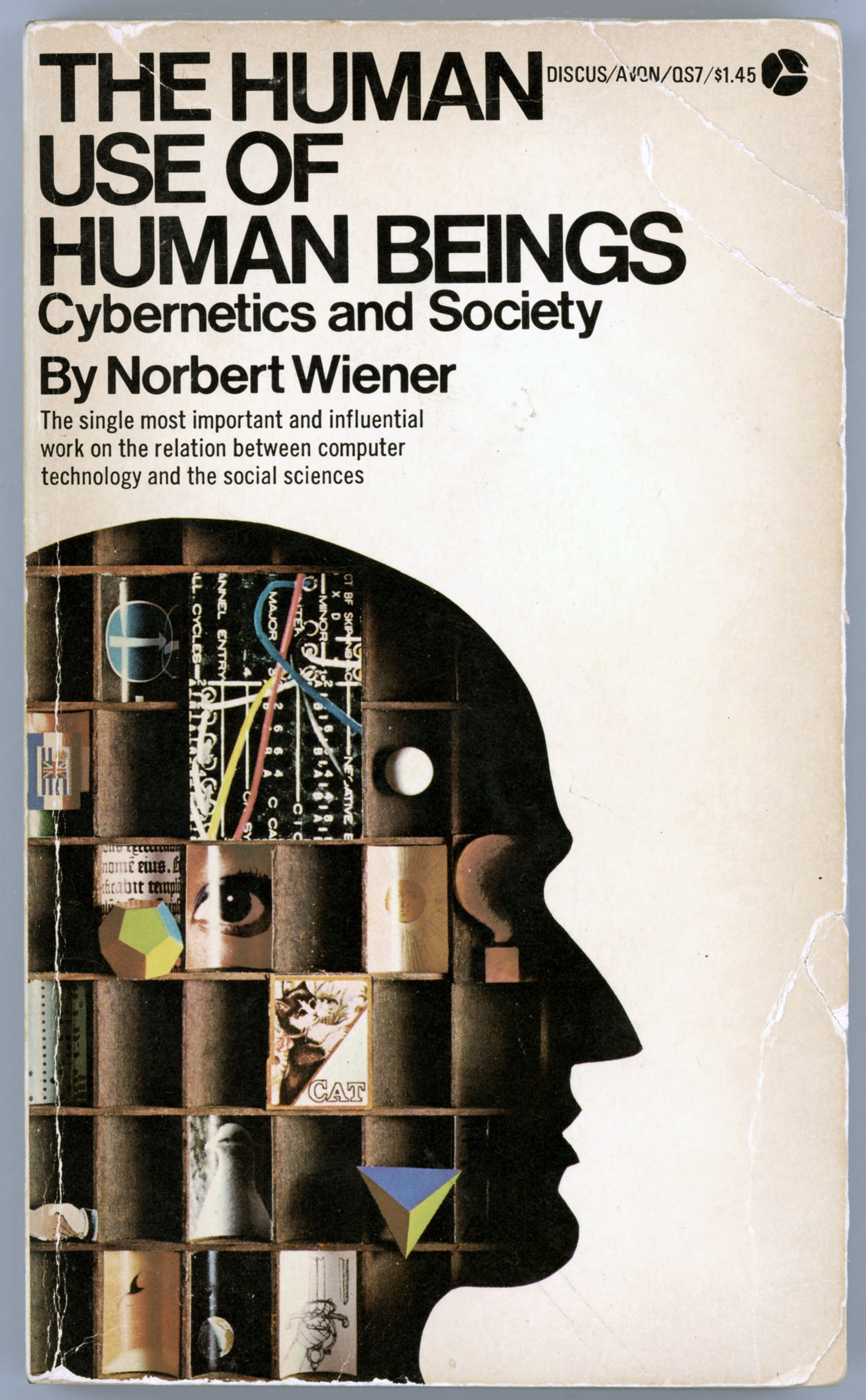
Wiener, Norbert, The Human Use of Human Beings – Cybernetics and Society, Avon Books, New York, N.Y., 1967

A Canticle for Leibowitz, by Walter M. Miller, Jr. – October, 1959 (February, 1961) [Unknown Artist]

“Maybe you’ve always thought of war as a business for the tough and the unimaginative.
It has been said that the best soldier leaves his emotions at home;
that pre-battle training is a period calculated to harden both mind and body.
But what of the boy who cannot harden?
What of the lad who cannot put his sensitivity in a suitcase and store it for the duration?
Walter Miller tells us.”

– Introduction to “Wolf Pack”, by Walter M. Miller, Jr., Fantastic, September-October, 1953

____________________

If the spirit of an age – its dreams and moods; fancies and wonders; fears and hopes – is reflected in its literature, then a prime example of such remains Walter M. Miller., Jr.’s 1959 novel, A Canticle for Leibowitz.  Based on and derived from three short stories published in the mid-1950s – the first of which shares and perhaps inspired the novel’s title – only a decade after the development of atomic weapons and amidst the (first?) Cold War, Miller’s tale was one of many works of science-fiction that presented a vision of the world, and particularly man’s place within that world, subsequent to a global nuclear war. 

In this context, I strongly recommend the recent (October, 2020) essay about Miller’s Canticle by Pedro Blas González, “A Canticle for Leibowitz and Cyclical History“.  Therein, Dr. Gonzalez discusses Miller’s novel through the lens of Catholicism (to which Miller converted after the war), viewing the novel as an expression of Miller’s interpretation and understanding of the nature of history.  As implied (albeit not specifically mentioned) within Dr. González’s essay, and moreso readily understood through a reading of the Canticle, Miller did not view human history as being “progressive” – and thus not having an “arc” in any direction – but instead, as being cyclical, even if those cycles would occupy great intervals of time.  

Though doubtless inspired by technological developments and geopolitics of the mid-twentieth century, the two animating ideas of Miller’s novel extend well beyond science fiction, for they represent chords of thought embedded deep within the psyche of men, nations, and civilizations.  These are the idea of an apocalypse, and, the gradual and tenuous rebirth of civilization after centuries during which the collective knowledge of the past (perhaps our present?…) has become myth at best, and utterly forgotten at worst.  However, rather than concluding upon a note of redemption, the book’s final chapters leave the reader with a sense of deep ambivalence, for the novel suggests that the currents of history are by nature cyclic.

Despite the novel’s origin during the Cold War, Miller’s inspiration for A Canticle for Leibowitz seems to have arisen from something simpler, immediate, and intensely personal: His military service during the Second World War, during which he served as an aerial gunner and radio operator in the United States Army Air Force.  Specifically, the impetus for his creation of the stories and novel was his participation in a combat mission during which his bomb group participated in the destruction of the hilltop abbey of Monte Cassino.  As discussed in academic and popular literature (see Alexandra H. Olsen’s paper in Extrapolation, William Roberson’s Reference Guide to Miller’s life and fiction, and Denny Bowden’s essay at Volusia History) on a fundamental level Miller world-view was profoundly affected, if not irrevocably altered, by the experience.

Though most sources (at least, web sources) about Miller describe his military service in general terms, Roberson’s Reference Guide specifically identifies Miller’s military unit: The 489th Bombardment Squadron.  The 489th was one of the four squadrons of the 340th Bomb Group (its three brother squadrons having been the 486th, 487th, and 488th), a unit of the Mediterranean-based 12th Air Force which flew B-25 Mitchell twin-engine medium bombers.  During the time that Miller was a member of the 489th (probably late 1943 through mid-1944) the squadron was stationed at the Italian locales of San Pancrazio, Foggia, Pompeii, and the Gaudo Airfield.

The 489th’s evocative unit insignia, which doubtless adorned the leather flight jackets of many of its officers and men, is shown below…

The best resource on the web (certainly better than anything in print!) for information about the 489th and 340th is the website of the 57th Bomb Wing Association.  This resource, covering the 57th’s four bomb groups (the 310th, 319th, 321st, and 340th) gives access to an enormous amount of information, as original Army Air Force Group and Squadron histories and Mission Reports, (many of which are transcribed as PDFs), and, a plethora of photographs.  Typical of Army Air Force WW II military records, there’s a degree of variation in the quantity and depth of this information from group to group, and, squadron to squadron:  Records for some (most?) combat units are complete, though there are inevitable gaps, “here and there”.

In documents pertaining to the 489th, I’ve discovered three references to Miller’s military service.

____________________

First, Timing: A record of combat missions flown by the 489th during the February of 1944.  For the fifteenth of that month, the record – like that for all other missions – is unsurprisingly laconic: “Benedictine Monastery, Italy.  6 planes.”

____________________

Second, Identification: Miller’s name appears within a list of airmen who, already having received the Air Medal (for completing five combat missions), had been awarded two Bronze Oak Leaf Clusters, thus signifying the completion – by the end of February – of up to fifteen combat missions.  His name is listed eleventh from the top in the “upper” list…

____________________

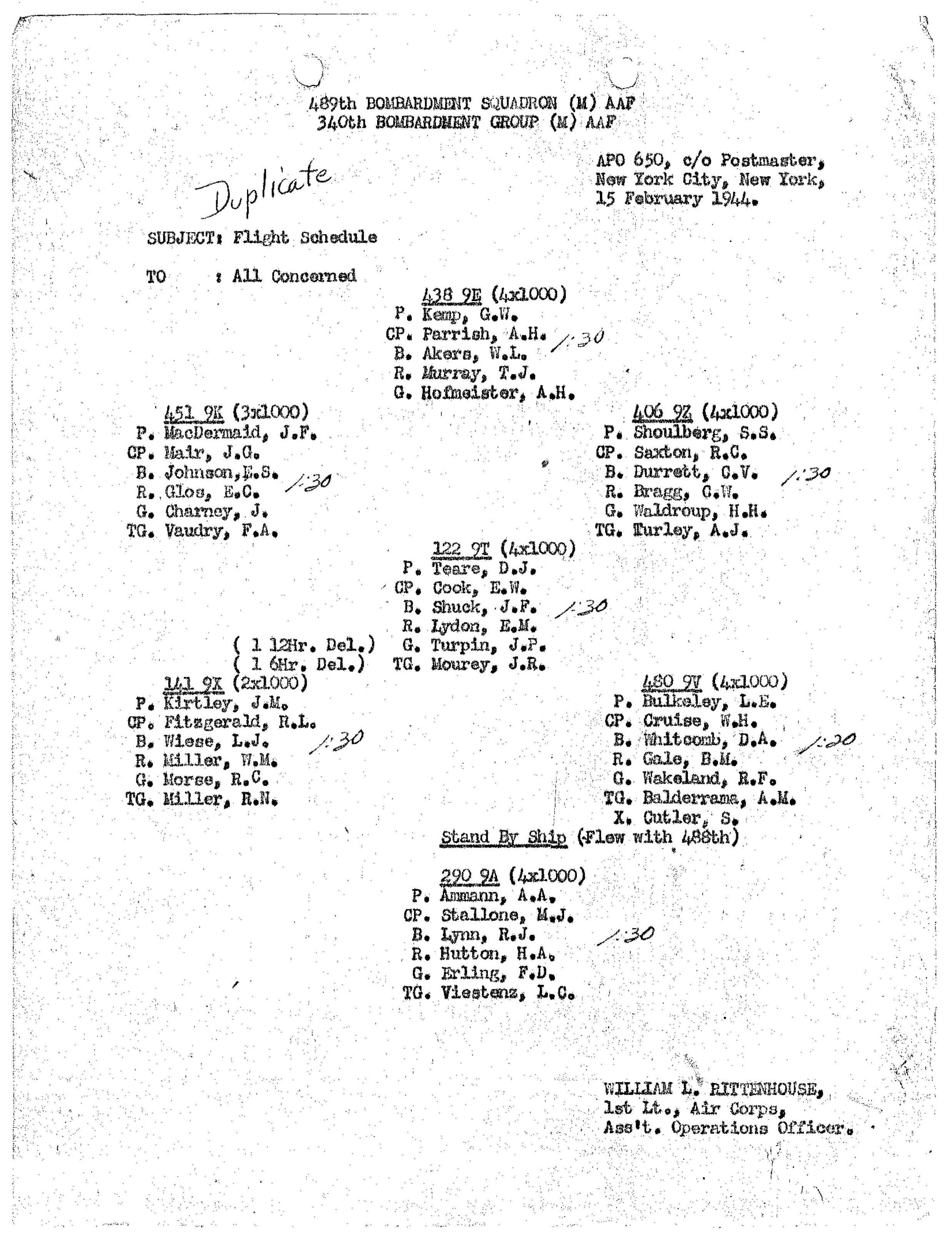
Third, Verification:  This “third” document – also found at 57th Bomb Wing – is what’s known in the parlance of the WW II Army Air Force as a “Loading List”, meaning that it lists the names of crewman assigned to specific planes during a combat mission or sortie, on an aircraft-by-aircraft basis.  This Loading List, covering 489th Bomb Squadron aircraft and crews which participated on the Cassino mission of February 15, 1944, shows that seven of the Squadron’s B-25s took part in the mission. 

Each plane is denoted by a three-digit number, which represents the last three digits of the B-25s Army Air Force serial number.  This is followed by the number “9” and a letter, the “9” representing the 489th Bomb Squadron, and the adjacent letter – a different letter for every plane in the squadron – uniquely identifying each B-25 in the squadron.  Each such number-letter combination was painted on the outer surface of the twin vertical tails of the squadron’s planes, a practice shared by the 340th’s other three squadrons.  This is followed by information about the planes’ bomb loads, which – in all cases but one – were three or four thousand-pound demolition bombs.

Then, we come to the crews themselves, which follow the same general sequence: P (Pilot), CP (Co-Pilot), B (Bombardier), R (Radio Operator), G (Aerial Gunner / Flight Engineer), and TG (Tail Gunner).

Where was Walter M. Miller, Jr.?  He’s there:  He was a radio operator in the aircraft commanded by J.M. Kirtley, B-25 “#141”, or, “9X”. 

As the 57th Bomb Wing includes Loading Lists for other missions flown by the 489th (and the 340th Bomb Group’s three brother squadrons), doubtless Miller’s name appears in these documents, as well.  But, this will suffice for now. 

____________________

The image below may be akin to the view seen by Miller on February 15, 1944:  Captioned,”Formation of North American B-25s of the 340th Bomb Group enroute to their target – Cassino.  March 15, 1944,” the picture is United States Army Air Force photo “68261AC / A22901”, and can be found within the (appropriately) entitled collection “WW II US Air Force Photos“, at Fold3.com.  The planes are aircraft of the 488th Bomb Squadron, the “give-away” being the “8C” (“8”, for 488th) code on the vertical tail of the aircraft in the left center. 

But, Walter Miller did not participate on the day’s mission, for his name is absent from the 489th’s Loading List for March 15….

____________________

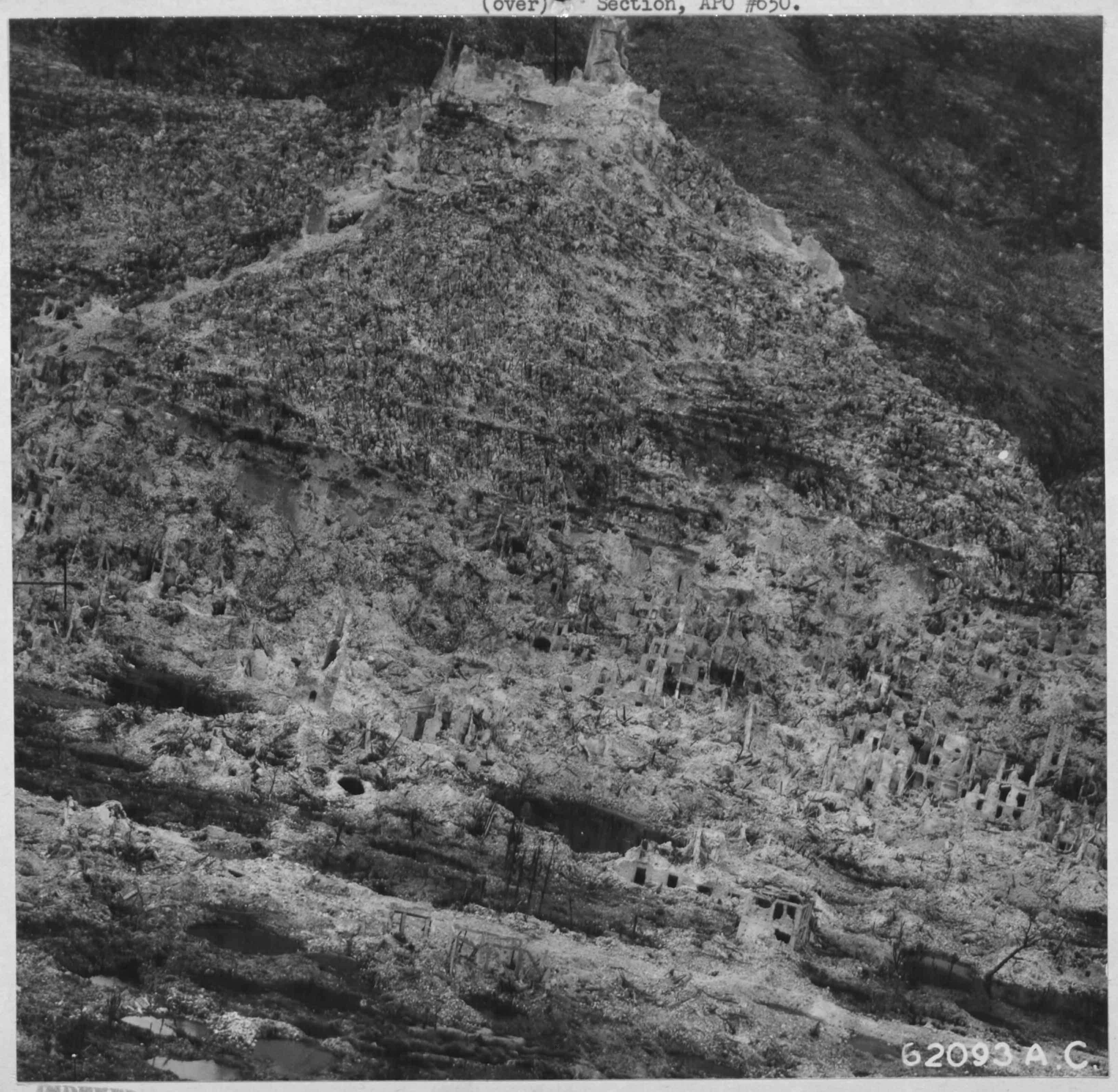
The results of war: A view of the remnants of the town of Cassino (foreground), and the hilltop abbey (upper center), in Army Air Force Photograph 62093AC / A25003.  Curiously, the caption on the rear of the photo states, “Bomb damage to Monte di Cassino  Abbey, Cassino, Italy, after bombing attacks by Allied planes.  The centuries-old monastery had been used by the German defenders as a strong point to block the Allied drive on Rome,” but the words “Monte di Cassino Abbey” are crossed out. 

The image is undated, but it was received by the Army Air Force or War Department in November of 1944.

________________________________________

As mentioned in the Wikipedia entry for the novel, and, discussed by Alexandra H. Olsen, A Canticle for Leibowitz, published in October of 1959, was created by melding and altering elements, characters, concepts, and plot devices from his three previously published post-cataclysmic stories (all having appeared in The Magazine of Fantasy and Science Fiction) into a single work, and, adding passages in Latin. 

The three stories which formed the basis of the novel were:

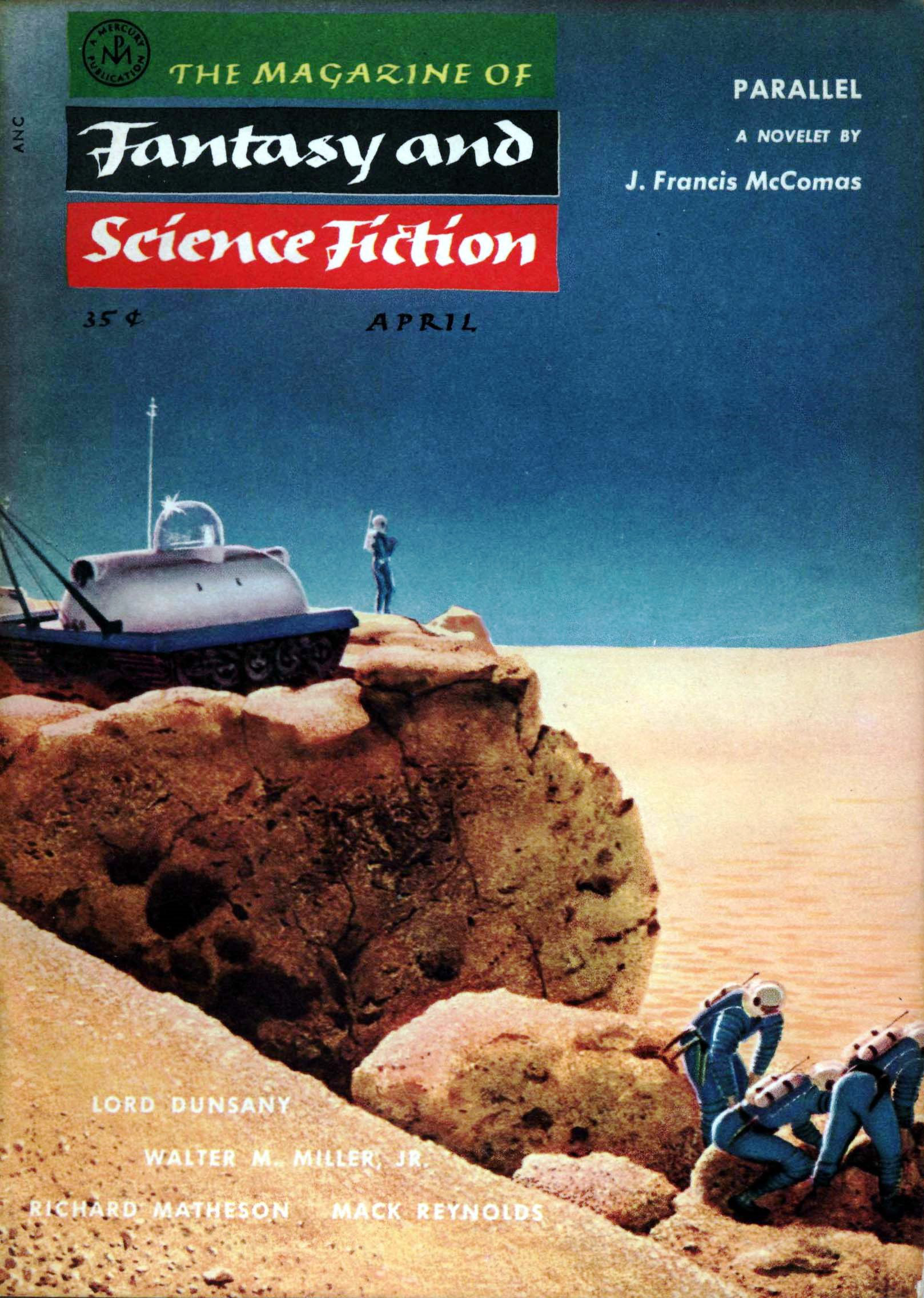
“A Canticle for Leibowitz”, published in April of 1955 (pp. 93-111)
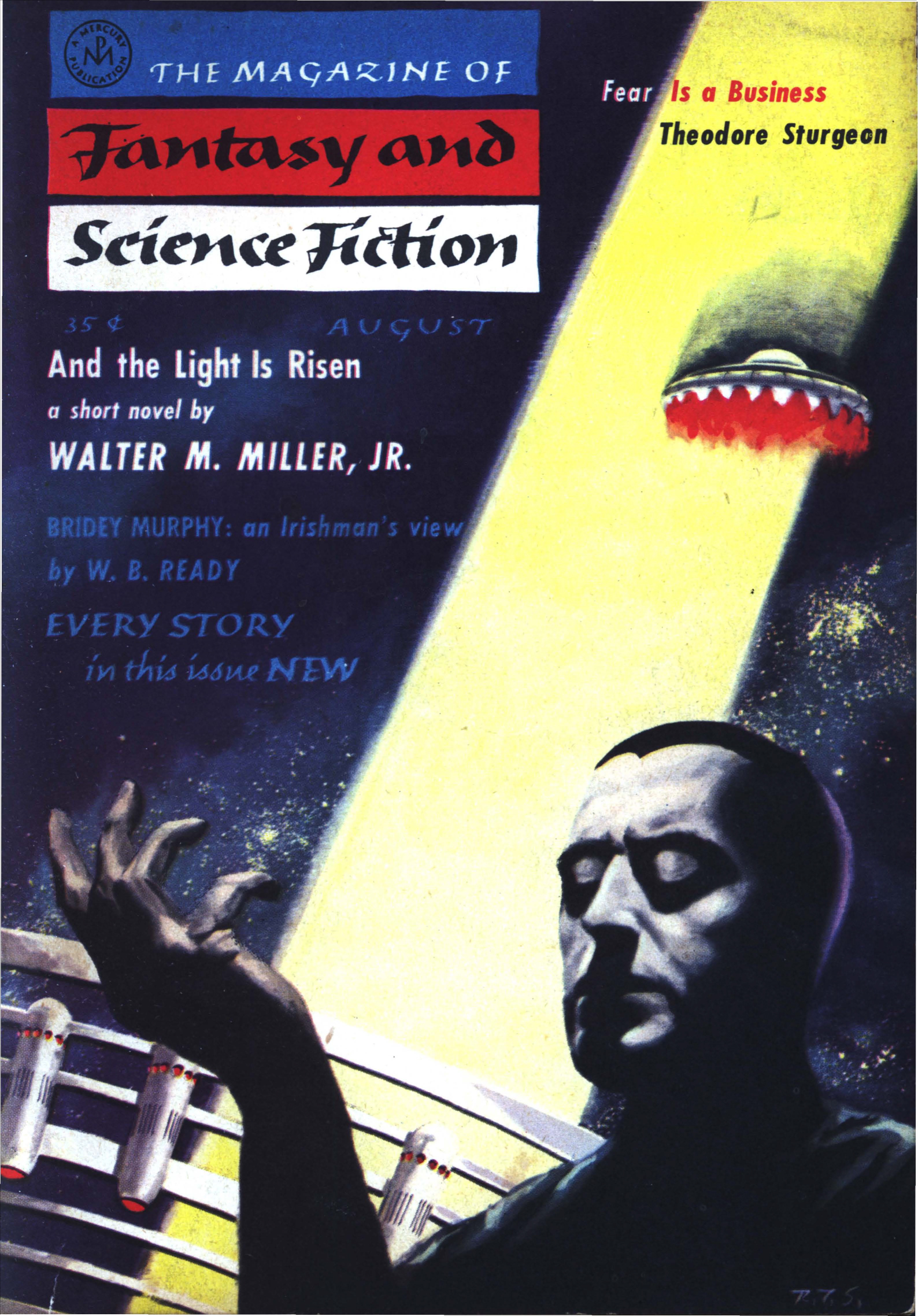
“And the Light Is Risen”, published in August, 1956 (pp. 3-80)
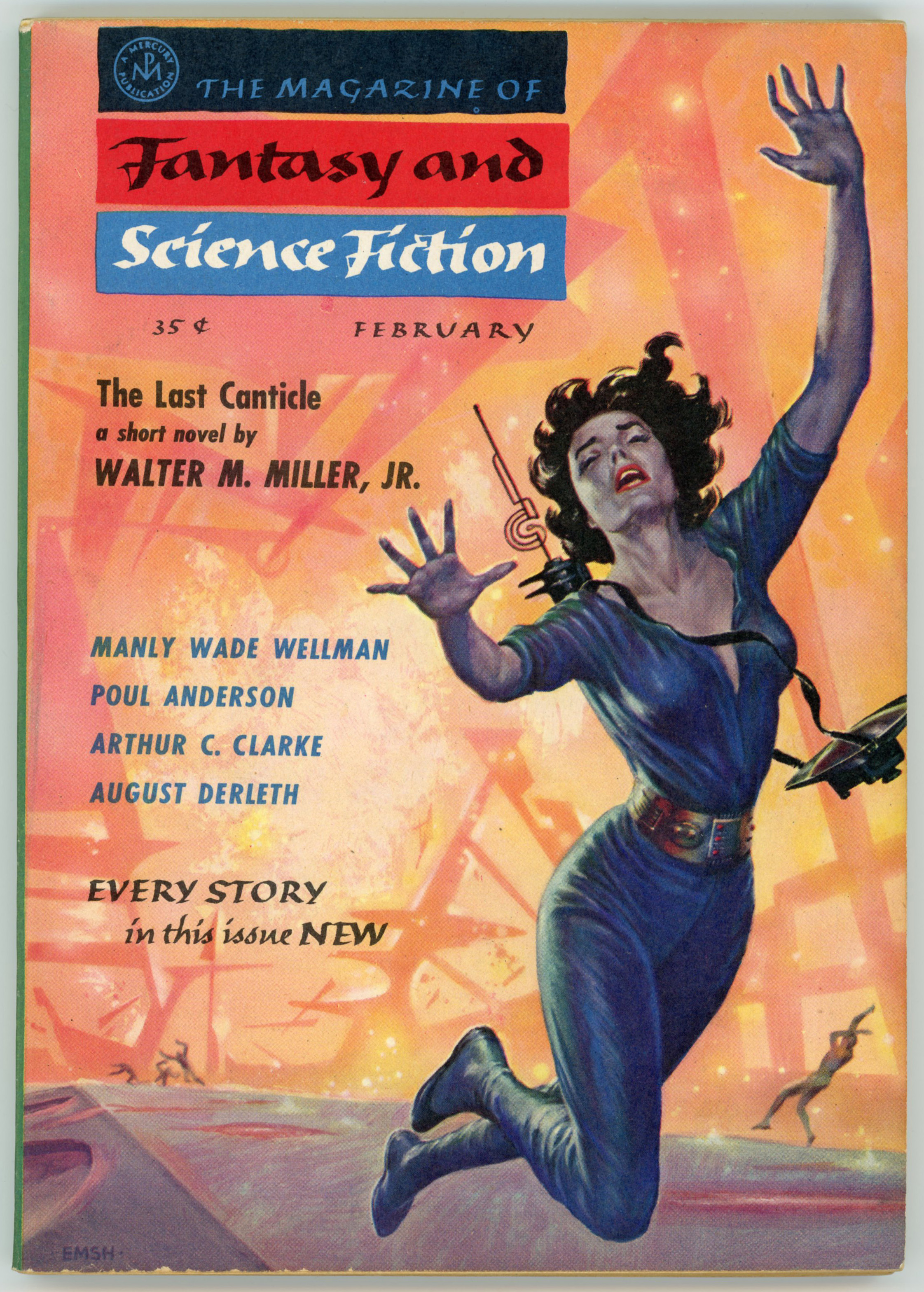
“The Last Canticle”, published in February, 1957 (pp. 3-50)

A final tale in the series, “God Is Thus”, appeared in Fantasy & Science Fiction in November of 1997 (pp. 13-51), thirty-eight years after the novel’s publication. 

But… 

…though the motivation for the ultimate creation of Canticle of 1955 was Miller’s participation in the bombardment of Monte Cassino, evidence for the emotional impact of that is clearly evident in an earlier story of a vastly different literary nature:  This was “Wolf Pack”, which appeared in the September-October, 1953, issue of Fantastic.  Among the thirty-eight works of short fiction listed in Miller’s biographical profile at the Internet Speculative Fiction Database, “Wolf Pack” was the 26th, while “Secret of the Death Dome”, published in Amazing Stories in 1951, was the first.  “Wolf Pack” appeared two years before “A Canticle for Leibowitz’s” publication, in the 1955 The Magazine of Fantasy and Science Fiction. 

Though I’ve thus far barely (!) skimmed the story, it seems to belong entirely to the realm of fantasy as opposed to science fiction, for it relates a combat flyer’s confrontation with his conscience – himself? – on levels symbolic, psychological, and perhaps supernatural.

Do you want to read the story?  Here’s a PDF version of “Wolf Pack”

As for the artistic aspects of the Fantastic story – visual art, that is! – here’s the two-page opening illustration for the tale…

…and here’s an accompanying illustration, showing representations of a B-25 bomber (viewed from above) and a bombardier peering through a generic “black box” looking bombsight (not quite a Norden bombsight!), both visual elements being surrounded by symbolic vignettes of villages.  Both pieces are by Bernard Krigstein, whose work is much more strongly associated with comic books than pulps. 

________________________________________

Continuing on a theme of art, here’s the cover of Bantam Books’ 1961 paperback edition of the novel, which shows a monk against a backdrop of a destroyed city’s skyline.  Though the artist’s name isn’t listed, perhaps he was Paul Lehr, given the era of the book’s publication, and, the visual style of the composition.

In terms of Miller’s use of Latin, here’s the prayer uttered by Brother Francis Gerard of The Albertian Order of Saint Leibowitz, which appears very early in the novel’s first part (“Fiat Homo”), during the Brother’s exploration of the remains of a fallout shelter somewhere in the American Southwest.  The allusions to the actuality and legacy of nuclear war are explicit and vivid, and – recited in the format of prayer rather than prose, with each of the three central groups of verses being thematically linked – powerfully expressed and visually evocative. 

A spiritu fornicationis,
Domine, libera nos.
From the lighting and the tempest,

O Lord, deliver us.

From the scourge of the earthquake,
O Lord, deliver us.
From plague, famine, and war,

O Lord, deliver us.

From the place of ground zero,
O Lord, deliver us.
From the ruin of the cobalt,

O Lord, deliver us.
From the rain of the strontium,

O Lord, deliver us.
From the fall of the cesium,

O Lord, deliver us.

From the curse of the Fallout,
O Lord, deliver us.
From the begetting of monsters,

O Lord, deliver us.
From the curse of the Misborn,

O Lord deliver us.
A morte perpetua,

Domine, libera nos.

Peccatores,
te rogamus, audi nos.
That thou wouldst spare us,

we beseech thee, hear us.
That thou wouldst pardon us,

we beseech there, hear us.
That thou wouldst bring us truly to penance,

te rogamus, audi nos.
(pp. 14-15)

(In just a moment, Brother Gerard will discover a relic from the life of Saint Leibowitz…)

________________

________________

Of the larger folded papers, one was tightly rolled as well,
and it began to fall apart when he tried to unroll it;
he could make out the words RACING FORM, but nothing more. 
After returning it to the box for later restorative work,
he turned to the second folded document;
its creases were so brittle that he dared inspect only a little of it,
by parting the folds slightly and peering between them.

A diagram, it seemed, but – a diagram of white lines on dark paper!

Again he felt the thrill of discovery. 
It was clearly a blueprint
– and there was not a single original blueprint left at the abbey,
but only inked facsimiles of several such prints. 
The originals had faded long ago from overexposure to light. 
Never before had Francis seen an original,
although he had seen enough hand-painted reproductions to recognize it as a blueprint,
which, while stained and faded,
remained legible after so many centuries because of the total darkness and low humidity in the abbey.  He turned the document over – and felt brief fury:
What idiot had desecrated the priceless paper? 
Someone had sketched absent-minded geometrical figures and childish cartoon faces all over the back.  What thoughtless vandal-

The anger passed after a moment’s reflection.
At the time of the deed, blueprints had probably been as common as weeds,
and the owner of the box the probably culprit.
He shielded the print from the sun with his own shadow while trying to unfold it further.
It the lower right-hand corner was a printed rectangle containing,
in simple block-letters, various titles, dates, “patent numbers”, reference numbers, and names.
His eye traveled down the list until it encountered:
“CIRCUIT DESIGN BY: Leibowitz, I.E.

He closed his eyes tightly and shook his head until it seemed to rattle. 
Then he looked again. 
There is was, quite plainly:

“CIRCUIT DESIGN BY: Leibowitz, I.E.”

He flipped the paper over again. 
Among the geometric figures and childish sketches,
clearly stamped in purple ink,
was the form:

The name was written in a clear feminine hand,
not in the hasty scrawl of the other notes. 
He looked again at the initialed signature of the note in the lid of the box,
I.E.L. – and again at “CIRCUIT DESIGN BY …” 
And the same initials appeared elsewhere throughout the notes.

(Proof of the Saint’s existence!  Here’s the “Circuit Design Form” bearing his signature, from page 23 of the Bantam paperback.  Absent from “Canticle” in the 1955 edition of The Magazine of Fantasy and Science Fiction, in book form, it really catches the reader’s attention.) 

There had been argument, all highly conjectural,
about whether the beautiful founder of the Order, if finally canonized,
should be addressed as Saint Isaac or as Saint Edward.
Some even favored Saint Leibowitz as the proper address,
since the Beatus had, until the present, been referred to by his surname.

“Beate Leibowitz, ora pro me!” whispered Brother Francis. 
His hands were trembling so violently that they threatened to ruin the brittle documents.

He had uncovered relics of the Saint.  (pp. 22-24)

________________________________________

Given the novel’s success, it’s unsurprising that it was adapted for radio broadcast.  It’s available via Archive.org, at The Classic Archives Old Time Radio Channel, and Old Time Radio Downloads

Created in 1981, the play is comprised of fifteen segments, each of roughly a half-hour duration.  The informational blurb at Archive.org states, “The radio drama adaptation by John Reed, and produced at WHA by Carl Schmidt and Marv Nunn.  The play was directed by Karl Schmidt, engineered by Marv Nunn with special effects by Vic Marsh.  Narrator – Carol Collins and includes Fred Coffin, Bart Hayman, Herb Hartig and Russel Horton.  Music was by Greg Fish and Bob Budney and the Edgewood College Chant Group.”

________________________________________

________________________________________

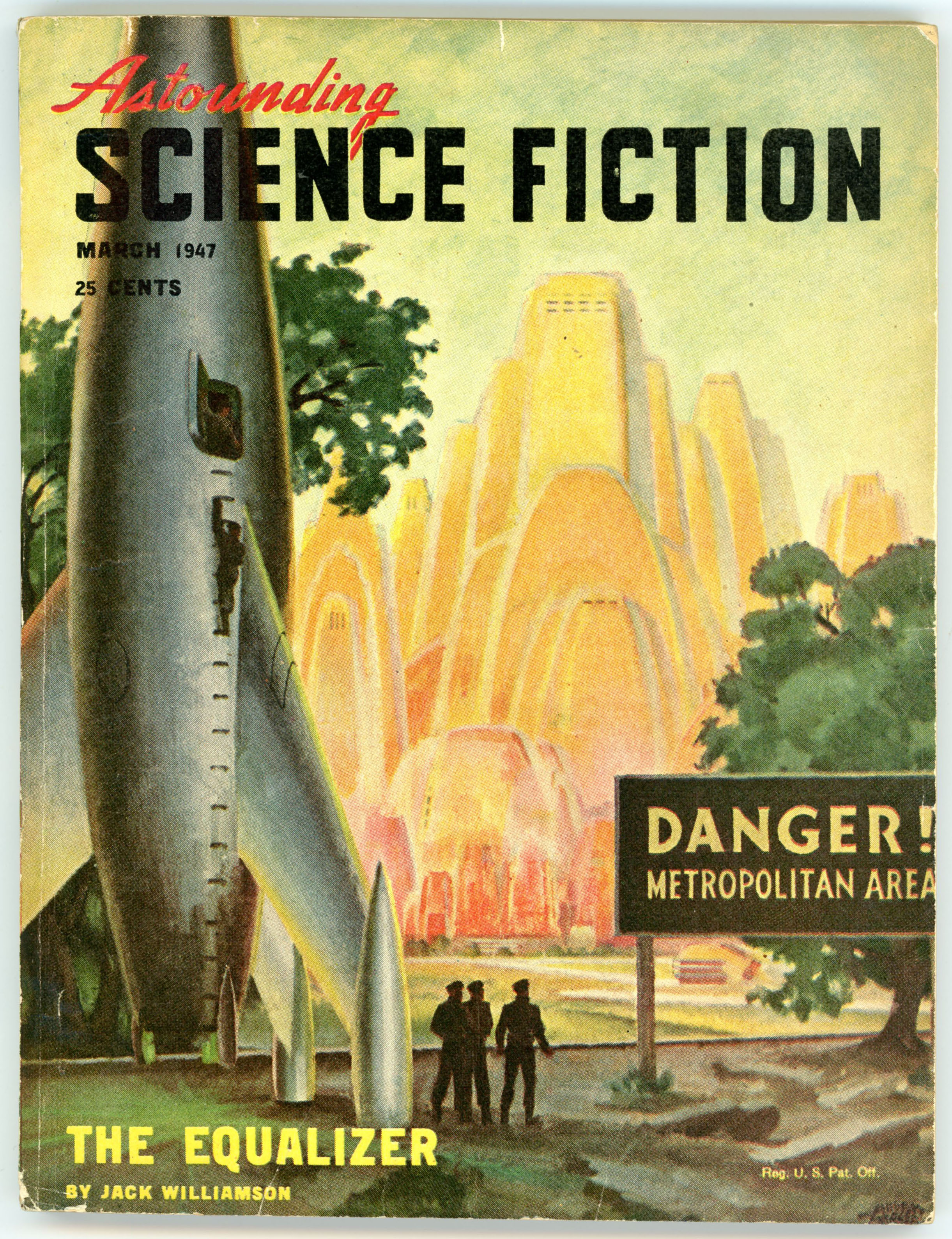
These are covers of the three 1950’s issues of The Magazine of Fantasy and Science Fiction in which appeared the three stories from which were derived Miller’s novel, and, the cover of Fantasy & Science Fiction in October-November of 1997, which was the venue for the last story in the series.  Ironically, none of the four issues feature cover art actually pertaining to Miller’s stories or novel.  Much the same was so for 1951 issue of Galaxy Magazine in which appeared Ray Bradbury’s “The Fireman”, later published in book form as Farhenheit 451:  That issue featured cover art by Chesley Bonestell.

__________

The cover of the April, 1955 issue features a close-up from Chesley Bonestell’s stunning panorama “Mars Exploration”.  Notice that the painting shows a strip of green – vegetation – at the base of weathered background hills.  Well, this was the mid-1950s, over a decade before Mariner probes revealed the true nature of the Martian surface.  Then again, maybe Mars is “green”, but a deeper, below-the-surface kind of green?

“A Canticle for Leibowitz”
April, 1955

____________________

“Mars Exploration”, by Chesley Bonestell

________________________________________

“And the Light Is Risen”
August, 1956

________________________________________

“The Last Canticle”
February, 1957

________________________________________

“God Is Thus”
October-November, 1997

________________________________________

References, Readings, and What-Not…

57th Bomb Wing, at 57thBombWing.com

340th Bomb Group History, at 57thBombWing.com

489th Bomb Squadron History, at 57thBombWing.com

489th Bomb Squadron History for February, 1944 (PDF Transcript), at 57th BombWing.com

489th Bomb Squadron insignia, at RedBubble.com

Bernard Krigstein, at Wikipedia

Walter M. Miller, Jr., at Wikipedia

Walter M. Miller, Jr., at Internet Speculative Fiction Database

“A Canticle for Leibowitz”, at Wikipedia

“Mars Exploration” (painting), by Chesley Bonestell, at RetroFuturism (subreddit)

The Magazine of Fantasy and Science Fiction (covers for April, 1955, August, 1956, and October-November, 1997), at Pulp Magazine Archive (Archive.org)

Bond, Harold L., Return to Cassino, Pocket Books, Inc., New York, N.Y., March, 1965

Bowden, Denny, Secret Life / Death of the Author of the Greatest Science Fiction Novel – Born in New Smyrna, Died in Daytona Beach, at VolusiaHistory.com

Majdalany, Fred, The Battle of Cassino, Ballantine Books, Inc., New York, N.Y., 1957

Olsen, Alexandra H., Re-Vision: A Comparison of Canticle for Leibowitz and the Novellas Originally Published, Extrapolation, Summer, 1997

Piekalkiewicz, Janusz, Cassino – Anatomy of the Battle, Orbis Publishing, London, England, 1980

Roberson, William H., Walter M. Miller, Jr.: A Reference Guide to His Fiction and His Life, McFarland and Company, Inc., Jefferson, N.C., 2011

Webley, Kayla, Top Ten Post-Apocalyptic Books: A Canticle for Leibowitz, Time, June 7, 2010

The God in The Trash: A Review of the Works of Philip K. Dick, by Alexander Star (The New Republic, December, 1993)

Being that I’m currently binge-watching Amazon Prime’s The Man In The High Castle (on Season Three just now) while holding off on season four of The Expanse ’til I’m done (aaaargh! – how much longer can I wait?!), I though it apropos to present Alexander Star’s perceptive and pithy essay about Philip K. Dick’s life and literary oeuvre, which was published in The New Republic in 1993. 

Alexander Star’s essay includes a portrait of PKD by former punk rock band manager (for the Germs) and actor & writer (for The Pee-Wee Herman Show) / script editor / author / essayist / photographer / jeweler (and more) Nicole Panter.  (See photo below.) 

Nicole Panter’s Flickr photostream also includes a superb 1978 color image (posted in 2008) of PKD, Nicole herself, K.W. Jeter and Gary Panter.  Being that I’ve no idea whether the image is copyrighted or not, I’m not actually presenting it “here”, in this post.  Rather, you can view it at Ms. Panter’s Photostream, here.  

________________________________________

The God in the Trash

The fantastic life and oracular work of Philip K. Dick

BY ALEXANDER STAR

The New Republic
December 6, 1993

(Photograph of Philip K. Dick by Nicole Panter)

________________________________________

Eye in the Sky by Philip K. Dick (Collier, 243 pp., $9 paper)
Time Out of Joint by Philip K. Dick (Carroll & Graf, 263 pp., $3.95 paper)
The Man in the High Castle by Philip K. Dick (Vintage, 259 pp., $10 paper)
The Three Stigmata of Palmer Eldritch by Philip K. Dick (Vintage, 230 pp., $10 paper)
Ubik by Philip K. Dick (Vintage, 216 pp., $10 paper)
Do Androids Dream of Electric Sheep? by Philip K. Dick (Ballantine, 216 pp., $4.95 paper)
A Scanner Darkly by Philip K. Dick (Vintage, 278 pp., $10 paper)
Valis by Philip K. Dick (Vintage, 256 pp., $10 paper)
The Collected Stories of Philip K. Dick (Citadel Press, 5 volumes, $12.95 each)
In Pursuit of Valis: Selections from the Exegesis edited by Lawrence Sutin (Underwood-Miller, 278 pp., $14.95 paper)
Divine Invasions: The Life of Philip K. Dick by Lawrence Sutin (Citadel Press, 352 pp., $12.95 paper)
On Philip K. Dick: 40 Articles from ‘Science-Fiction Studies’ edited by R.D. Mullen et al.  (SF-TH Inc., 290 pp., $24.95, $14.95 paper)

I.

Eleven years after his removal to a Colorado graveyard, Philip K. Dick is among the busiest of American writers.  New novels arrive regularly from the tomb; box office smashes (Total Recall) and Hollywood classics (Blade Runner) are spliced from his work; young writers of diverse persuasions sit raptly at his icy feet.  A science fiction journeyman, ardent bohemian and restless observer of suburban life, Dick never discovered a place for himself while he lived.  He was dismissed as a crackpot and hailed as a “visionary among charlatans”; and like most visionaries, he had a hard time finding a publisher.  Today his published work could fill a small bookstore.

To enter a novel by Philip K. Dick is to enter a zone of disappearing worlds, nested hallucinations and impossible time-loops.  This domain is inhabited by lonely repairmen, egotistical entrepreneurs and hapless housewives, and strewn with slant humor and menacing paradox.  Although the books vary, their inspiration is always the same: they are governed by a passionate apprehension of appearances.  Few writers have ever been so distrustful of the phenomenal world.  Dick’s characters are driven to doubt their environment, and their environment is driven with an equal and opposite force to doubt them.  There is always some primal error in Dick’s fictions, something “out of joint,” and the location of that error – inside the individual or outside the individual – can never be decided upon.  Dick systematically blurs the boundaries between mind and matter, between storms in the psyche and crises of the atmosphere.  The coiling search to set things right is doubled and redoubled and doubled again.  Dick never met a story that ended or a regression that was finite.

Although he is still pigeonholed as a writer of science fiction, Dick had little respect for the prestige of science, and even less for the dignity of fiction, to which it must be said he contributed very little.  His interest in hard and applied science was minimal, extending not far beyond a persistent (and unhappy) acquaintance with the details of automobile repair.  His maddeningly profuse plots make a mockery of the notion that the novel can be a stable and self-sustaining work of art.  And yet, all this notwithstanding, Dick’s novels demand attention.  They intrude extreme experiences into everyday scenarios with compassion, humor and poise.  He is both lucid and strange, practical and paranoid.  (“By their fruits ye shall know them, and their fruits are that they communicate by radio.”)  There is nothing merely willful or notional in the bizarre aspects of Dick’s work.

As an experimental writer of the 1950s and ‘60s, Dick belongs in the company of William Burroughs, J.G. Ballard and Thomas Pynchon.  His novels recall Burroughs’s pitiless cycles of addiction and schizophrenia and Ballard’s eroticized landscapes of celebrity and death.  What he lacks of Ballard’s unnerving coolness and Burroughs’s deadpan swagger, he makes up for with a compassion that is quite alien to them.  His most esoteric dismantlings of reality still insist on the need for human empathy; and they do so with an alertness to the serious obstacles that empathy must sometimes encounter.  Like Burroughs, his clipped prose wittily recycles the cliches of advertising lingo (“Emigrate or Degenerate: The Choice is Yours”) and pulp writing (“You’re a successful man, Mr. Poole.  But, Mr. Poole, you’re not a man.  You’re an electric ant”).  Sometimes it reaches a higher level of eloquence.  In his later years, as he came to believe that the revelations of a medieval rabbi were reaching him through occult channels, Dick’s sanity was open to question.  But throughout his career he wrote with qualities that are rare in a science fiction writer, or in any writer at all.  These included a sure feel for the detritus and debris, the obsolescent object-world, of postwar suburbia; a sharp historical wit; and a searching moral subtlety and concern.

II.

A heavy man with an absent smile and an intent gaze, Philip Dick typed 120 words a minute even when he wasn’t on speed, drank prodigious quantities of scotch and completed five marriages and over fifty novels before the pills and the liquor conspired to kill him at 54.  His busy life has been ably narrated by Lawrence Sutin in his biography, Divine Invasions, which appeared a few years ago.  Born in 1928, Dick witnessed the Depression from inside a broken home.  His father, an employee of the Department of Agriculture, left the family in 1931 and went on to host a radio show in Los Angeles called “This is Your Government.”  Dick grew up with his mother on the fringes of Berkeley’s fledgling bohemia.  A troubled student, he was often “hypochondriacal about his mental condition,” as one of his wives later put it.  And like many troubled boys of the time, he became a voracious reader of the science fiction pulp magazines that were then at their peak.  In Confessions of a Crap Artist, a novel written in 1959, he wryly portrayed himself as an awkward kid spouting oddball ideas from Popular Mechanics and adventure stores: “Even to look at me you’d recognize that my main energies are in the mind.”

Dick evidently had few friends until he went to work at a record store in Berkeley, where he acquired an encyclopedic knowledge of classical music and the friendship of customers and colleagues.  “Art Music” was also a site of romance.  The employees, university dropouts with time to spare, courted their customers with cunning; after impressing one frequent browser with his musical expertise, Dick married her.  Not long after the wedding they quarreled, and the bride’s brother threatened to smash his precious record collection.  A divorce followed; of his five marriages, it was the shortest.

In 1947, Dick moved into a Berkeley rooming house, living for a short time with the poet Robert Duncan.  After one unhappy term at Berkeley in 1949, he married again and settled down to a writing career, publishing his first science fiction stories in 1952.  Dick entered the market at a time when the genre was in flux.  Like the big bands, the great pulp magazines of the ‘30s declined after the war.  They were replaced by a flood of cheap paperbacks, and the leading format for science fiction became the “double paperback” published by Ace Books, two novels together in one binding with a different lurid cover illustration on each side.  Throughout the ‘50s Dick worked closely with Ace’s top editor, Don Wollheim.  Typing from morning to night, he cranked out large quantities of prose, and turned himself into a typically prolific and typically uneven writer of the genre.

Dick was not unsuccessful at this: his novel Solar Lottery, published in 1955, sold 300,000 copies, and he became one of the first clients of the powerful agent Scott Meredith.  Still, it was not a writer’s life; royalties were meager and manuscripts were altered at will to ensure the proper amount of extraterrestrial warfare and gee-whiz gadgetry.  (The Zap Gun was written because Wollheim insisted on publishing a book with that title.)  As he read widely Dick’s frustrations with science fiction grew, and his discontent became apparent.

Throughout his career Dick longed for a wider audience, and sought to escape the science fiction ghetto.  He envied writers such as Ursula Le Guin, who acquired a serious reputation and was even published in The New Yorker.  His readers, he complained, were “trolls and wackos.”  In the ‘50s and early ‘60s, he wrote a series of non-science fiction novels, all of which were rejected by publishers at the time.  These books were mainly somber tales of thwarted love in northern California, peopled with cranky record salesmen and bitter couples and narrated in a glumly painstaking fashion.  On the whole, their vision of domestic life is an unhappy one.  In Confessions of a Crap Artist, an accumulation of errant jealousies and petty insults leads to illness and insanity.  The novel ridicules the newly formed UFO cults of Marin County, though years later Dick reflected that the cults “didn’t seem as crazy to me now …”

Rebuffed by “mainstream” publishers, Dick abandoned his realist writings in 1963.  By then he had discovered a different way out of the Ace formula: he would transform the genre of science fiction from within.  Concerned with psychic dislocation, and its moral and philosophical consequences, he began to ignore the expectations of his editors.  In particular, he disregarded the most honored conventions of “hard S.F.,” that science fiction should be rigorously “extrapolative” of hard science, and that it should be “prophetic” of plausible futures.

By the late ‘50s, these conventions had a long and venerable history.  When Hugo Gernsback started his magazine Amazing Stories in 1926, initiating modern science fiction, he hired Thomas Edison’s son-in-law as a fact checker.  In its heyday, John W. Campbell Jr.’s Astounding Stories [sic] insisted that writers postulate one outlandish circumstance – the “what if?” clause – and rigorously follow the laws of science from there.  After World War II these conventions loosened, as the optimistic narrative of invention and discovery was tempered by dystopian broodings and doubts about the authority and integrity of science.  But the most important figures, Asimov, Heinlen, Bradbury, remained faithful to the Campbellian requirements of scientific accuracy and plausible prophecy.  As Asimov put it, “In my stories I always suppose a sane world.”

Philip Dick’s fictional worlds have a great many attributes, but sanity is not among them.  Campbell, the monarch of postwar science fiction, refused to publish his stories because they were “too neurotic.”  In his preoccupation with abnormal psychology, collective delusions and implanted memories, Dick in part followed the path of irregular science fiction writers of the ‘50s such as A.E. van Vogt and Theodore Sturgeon.  Yet he ranged further in his subversions.  Dick continued to rely on the ready-made materials of science fiction, the pulp prose, the planetary conflicts, the “psionic” powers of “precogs” (who read the future) and “telepaths” (who read minds); but he employed these materials to his own extravagant ends.

Dick’s novels of the late ‘50s were littered with intellectual debris of the period: the existential psychoanalysis of Ludwig Binswanger, popularized in America by Rollo May; the cybernetics of Norbert Weiner [sic] and the game theory of John von Neumann; gestalt psychology and Carl Jung; Tibetan Buddhism and the I Ching.  Eye in the Sky (1957) amusingly presents a nation given over to ostentatious piety and soulless technocracy.  Its engineers stabilize “reservoirs of grace” while “consulting semanticians” secure communication lines with God and IBM computers tabulate credits toward salvation.  (The satire of religious fundamentalism worried Dick’s editors at Ace, who changed a central character into a Muslim to avoid offending readers.)

Time Out of Joint, which appeared in 1959, departed even further from the norms of science fiction.  Its first hundred pages unfold a slow-paced story set in a small west coast town.  Evidence that something is “out of joint” gradually amasses, until the startling scene when a soft-drink stand vanishes into a strip of paper labeled “SOFT-DRINK STAND” and the entire community is revealed to be a Potemkin village; it is, in fact, an artificial replica of the ‘50s constructed in 1994 to salve the nerves of the protagonist, whose sanity is essential to national security.  In 1959 Dick was already proposing that the ‘50s themselves were a kind of pacifying fantasy available for the nostalgia of future generations.  Where traditional science fiction stirred anxieties about the future, Dick deftly introduced his uncertainties into the present and recent past.  Despite the concluding narrative fireworks, Ace refused to publish Time Out of Joint, and Doubleday brought it out instead as a “novel of menace.”

Dick’s biggest literary advance came in 1962, when he published The Man in the High Castle.  This study of an alternate universe in which the Axis won the Second World War was entirely devoid of the usual sci-fi devices.  (“No science in it,” a character observes.  “Nor set in future.”)  Mr. Tagomi, a Japanese bureaucrat and connoisseur of American antiques, is one of Dick’s most sympathetic characters.  Repelled by international intrigue and devoted to the occult beauty of old bottle caps and cheap jewelry, he resists Nazi brutality with a fragile but steady will.  Alter Bormann dies, a power struggle breaks out among the remaining Nazi leaders (Hitler has long since entered a sanitarium) and Tagomi unhappily plays one faction off against another, aware that they are all unspeakably evil.  Ingeniously, the book contains its own counterfiction: in this America divided into German and Japanese zones, rumors spread of an incendiary novel speculating that the allies actually won the war.  The narrative adroitly maneuvers back and forth between these two competing accounts of what is real.  The Man in the High Castle was Dick’s most assured and subtle work, and he hoped it would win him a wider audience.  He was chagrined when reviewers treated it as just another thriller.  Ironically, it was the science fiction community that celebrated the book, bestowing the Hugo Award on it in 1963.

Fueled by marital troubles, esoteric visions and an epic diet of speed and scotch, Dick composed eleven novels in a hectic two-year period.  The Three Stigmata of Palmer Eldritch (1964) and Ubik, written in 1966, are his ‘60s classics, his wildest experiments in the manufacture and management of chaos.  These are not Dick’s most accessible or likeable books, but they are his tours de force.  (Both are among the dozen titles by Dick that Vintage Books has happily reissued over the past three years.)  The time-loops and the Conspiracies, the conflicts between frail human subjects and large unsettling forces, the disorientations of perspective: all of these deuces are brought to new levels of complexity and compression.

In 1963, Philip Dick experienced the first of a number of “visions” that were to augment and to anguish his life.  Depressed by a failing marriage and troubled by memories of his lather’s wartime gas mask, Dick reported that he saw “a vast visage of evil” in the sky.  It had “empty slots for eyes, metal and cruel, and worst of all, it was god.”  Out of this emerged the demiurgic figure of Palmer Eldritch in The Three Stigmata of Palmer Eldritch, an interstellar drug lord luring his customers and competitors into a “negative trinity” of “alienation, binned reality and despair.”  Eldrilch’s powers are not absolute, but they are sufficient to rob other characters of confidence in their reality and in themselves.  “We see into his eyes,” they fret, and we see out of his eyes.”  In a typical conundrum, the protagonist, Leo Bulero, finds himself stranded in a blurred landscape, a “plain of dead things,” unable to know whether he is still in the grip of one of Eldritch’s hallucinations or whether he has returned to his original “reality.”  He meets two men, shakes their hands and watches his lingers slip through theirs.  He would assume that they are phantasms but they assume, just as reasonably, that he is a phantasm; and he concedes that they might be right.  In the realm of the “irreal,” as Dick called it, to doubt the solidity of one’s surroundings is to doubt the solidity of oneself.

In Palmer Eldritch Dick perfected one of his “irreal” themes, the nested hallucination.  In Ubik he perfected another, the experience of entropy, the onset of “decay, deterioration and destruction.”  Imprisoned in a purgatorial “half-life,” the paralyzed characters of Ubik witness the spread of a cataclysmic force, a mass “reversion of matter” that causes objects lo revert to prior forms of themselves: televisions become radios, spray cans turn into jars of ointment.  They struggle with their “obsessive fears that the entire world is turning into clotted milk” and “worn-out tape recorders,” that “all the cigarettes in the world are stale.”  Stranded in his apartment, the central character resignedly watches his sleek, modern elevator become a creaky and dangerous relic.  Ubik is a comedy of enforced obsolescence; the most familiar things acquire an unruly resonance as they confront their own historicity.

These two novels established Dick’s reputation as a master of experimental science fiction.  Ubik inspired his election in Europe to the College du Pataphysique, a kind of Academie Francaise for Dadaists, and John Lennon expressed an interest in producing a film of Palmer Eldritch.  “New wave” science fiction writers of the late ‘60s, led by Harlan Ellison, regarded him as a godfather.  But Dick, as usual, received few financial rewards.  The middle-aged pataphysician found himself living on welfare in a “run down, rubble-filled” house in Santa Venetia, a notorious crash-pad for dealers and runaways.

Squabbling with girlfriends, fearing the FBI and the IRS, Dick succumbed to serious bouts of paranoia and unease.  (His paranoia was not entirely without foundation: in 1957 the CIA had in fact intercepted a letter that he had sent to a Soviet physicist.  Fortunately he never knew of the Department of Health, Education and Welfare’s intention to compile a bibliography of drug-related science fiction.)  In 1971 Dick’s stability declined further when someone broke into his home and looted his papers.  He devoted countless hours of speculation to the identity of the burglars.  It was his own private Watergate.  At various times he suspected the FBI, the Black Panthers, a gang of local drug dealers, right-wing militiamen and himself.  He retrieved one tentative lesson from the debacle: “At least I’m not paranoid.”

Dick’s writing of this period trembles with fear of a totalitarian “betrayal state” of advanced surveillance and narcotic intrigue.  His novels envisage a burned-out post-’60s nation headed into a dark age of police repression and entertainment-enforced normality.  In Flow My Tears, The Policeman Said (1974), the authorities deploy an arsenal of bugs, sensors, minicams and tattoos to solve the mystery of a man who thinks that he is a television talk show host even though no one has heard of him.  A Scanner Darkly (1977) sympathetically observes the unraveling of Bob Arctor, an undercover cop in a Los Angeles police state where “straights” and addicts inhabit segregated areas and where access to shopping malls is restricted to those with the correct credit cards.  Arctor slowly becomes unhinged as he is forced to narc on himself.  Witnessing his friends’ fuzzy chatter (“Bob, you know something …  I used to be the same age as everyone else”) and acute distress, he worries that “the same murk covers me.”  Eventually it does; his brain splits into two distinct identities, his thinking comes to a halt and he becomes dead to the world: “His circuits welded shut.”  With its well-scored drug talk and its terrible portrait of a mind becoming opaque to itself, A Scanner Darkly is Dick’s funniest novel, and his most affecting.

In 1972, striving to escape the druggy clutter, the spreading “murk,” of his life, Dick traveled to Vancouver, where he gave a speech to an annual convention of science fiction writers.  In his lecture, “The Android and the Human,” Dick fashioned a kind of homespun anarchism, honoring young people of the ‘60s for their “sheer perverse malice,” their willingness to defy power, to “build improved electronic gadgets in your garage that’ll outwit the gadgets used by the authorities.”  Eschewing the dogmas of the New Left, he warned that all systems of explanation tend toward overdetermination, toward paranoia.  Paranoia, for Dick, was a temptation and a trap.  He feared conspiracies, and he feared the debilitating consequences of his fears.  And so, he advised, one “should be content” with the fleeting and the marginal, the “mysterious, the meaningless, the contradictory, the hostile and, most of all, the unexplainably warm and giving.”  This sudden, self-justifying affection, which Dick also referred to as “caritas” and as “empathy,” was the only guarantee of the “human.”

Having diagnosed the breakdown of society in his speech, Dick suffered a breakdown of his own and checked into a Vancouver clinic run on brutal Synanon-style principles of rehabilitation.  He was appalled by the clinic’s ruthless assault on its patients and their personalities, but his worst pill-popping days were through.  Lured by a college professor who admired his work, he returned to California and moved into a “jail-like, full-security” apartment complex in Orange County.  He married again and began to clean up his life, even writing to President Nixon and offering his assistance in the war against drugs.

But a complacent Orange County serenity was not at hand.  In March 1974 Dick underwent a series of visions that astonished and thrilled and hounded him for the rest of his life.  An onslaught of otherworldly insight and illumination seemed to press down on him for weeks.  (“Once God started talking …  he never seemed to stop.  I don’t think they report that in the Bible.”)  The elements of this experience, which he returned to obsessively in his writing, were many: flickering sequences of abstract color, three-eyed “invaders,” Latin and Russian texts, visions of a “Black Iron Prison,” messages that the Roman Empire never died, “hideous words” spoken out of an unplugged radio, a beam of pink light conveying knowledge.

When it was over, he believed that he had received confirmation that the universe was indeed the “cardboard fake” that he had long portrayed it to be.  As in gnostic myth, the world of appearances was an “iron prison” under the sway of a defective deity; illumination was available only from outside the prison, from a pure source of knowledge that Dick referred to as a ‘Vast Active Living Intelligence System” (VALIS).  For the remaining eight years of his life he filled notebook after notebook with an “Exegesis” of these peculiar days, constructing a gnostic cosmology involving “a double exposure of two realities superimposed.”  But Dick was never satisfied with his speculations.  In the Exegesis and in his novel Valis (1981), he wrestled with himself, asking over and over whether his revelations were real, and if they were not, what had triggered them.  (Radio signals from the future?  Water-soluble vitamins?  A stroke?)

Dick observed in 1978 that “my life …  is exactly like the plot of any one of ten of my novels or stories.”  After systematically dislocating the reality-principles of his readers, he came to find his own relation to reality increasingly unsure.  He combed T.V. ads and record albums for signs of VALIS, the hidden god.  Dick left his last wife in 1976 and moved back north to Sonoma, where he cruised the local asylum for dates and wrote The Transmigration of Timothy Archer (1982), a troubled memorial to his friend James Pike.  (Pike, the former Episcopalian bishop of California, had vanished in the Jordanian desert looking for Jesus, leaving behind two bottles of warm Coke and a road map.)  Meanwhile the Exegesis became a sprawling spiritual diary, by turns ordinary and extraordinary, filled with philosophical disputation, personal reminiscence and analysis of his previous work.

In the early ‘80s Dick’s hopes for renown revived, as younger writers arrived at his doorstep, royalties increased and German, French and Japanese editions of his work proliferated.  Back in the early ‘70s he had optioned his 1968 novel Do Androids Dream of Electric Sheep? to Hollywood; by 1980 the producers of the film promised that it would be the next Star Wars.  (Dick hoped that Victoria Principal would have a starring role.)  In fact, Blade Runner was a commercial disappointment in its initial release.  But Dick never knew of its early unsuccess.  In March 1982, he died of a stroke after proudly attending an advance screening of the movie.

Despite the greater comfort and recognition in his last years, Dick maintained his restless work on the Exegesis, ever lamenting the failure of his visions to repeat themselves, their maddening resistance to explanation.  Later passages of the Exegesis express his mingled resignation, devotion and ingenuity: “My attempt to know (VALIS) is a failure qua explanation …  Emotionally, this is useless.  But epistemologically it is priceless.  I am a unique pioneer …  who is hopelessly lost.  & the fact that no one yet can help me is of extraordinary significance!”  Like one of his own perplexed characters, strung out between parallel worlds, Dick never solved the puzzles that rattled him.  “They ought to make it a binding clause that if you find God you get to keep him,” he wrote sadly in Valis.  “…  Finding God (if indeed he did find God) became, ultimately, a bummer, a constantly diminishing supply of joy, sinking lower and lower like the contents of a bag of uppers.  Who deals God?”

III.

In the years since his death, Philip Dick has attracted a small army of interpreters.  He has been seen as a prophet of “hyperreality”; as a beleaguered and heroic humanist, championing “moral sanity” as his mind suffered; and as a gnostic visionary of the suburbs.  Marxist critics and theorists of postmodernism have busily sifted through his work, investigating its debased commodities and corporate conspiracies, its cold war fears and its elevation of paranoia into principle.  Dick’s fiction, in the view of the critic Scott Durham, is nothing less than a full-blown “theology of late capitalism” that “reflects on the psychic strains of the transition to postindustrial capitalism.”  According to Jean Baudrillard, one of Dick’s many French fans, it is “a total simulation without origin, past or future.”

Dick himself, interestingly enough, was alternately gratified, amused and alarmed by the attention that modish critics gave to his work.  When a delegation of French authorities visited him in Orange County to discuss his notions of “irrealism,” he offered them an exposition of his views, but as soon as they left he telephoned the FBI and warned that there was a gang of subversives in the neighborhood.  (Dick’s politics were never especially coherent; he nearly dedicated A Scanner Darkly to Nixon’s Attorney General Richard Kleindienst, but in the Exegesis he treats Nixon’s resignation as a providential event in sacred history.)  The Marxist and postmodern readings of Dick’s work are often informative; his novels do have more than their share of simulacra and spectacles, fractured identities and postindustrial proletariats.  But these readings do not do justice either to his insistence on compassion as a stabilizing force or to his earnest search for an “absolute reality.”  Their anatomy of “irrealism” is incomplete.

What, then, does this “irrealism” consist of?  In the Exegesis, Dick confided that his writing had a single overriding theme: it indicted “the universe as a forgery (& our memories also).”  In book after book, Dick portrayed the onset of doubt, of an elemental estrangement from reality.  The perceived defect in the substance of the world is traced back to a variety of sources – atomic catastrophes and potent drugs, dangerous gods and political conspiracies, schizophrenic derangement and paranoid insecurity.  But the origin doesn’t really matter; it is the experience of “irreality” that interested him most.  As his characters confront exasperating hallucinations and intersecting time-sequences, they respond with a typical blend of desperate speculation, cautious empathy and brittle humor.  (“God is responsible for everything, but it’s hard to get him to admit it.”)

The most recurrent anxiety in Dick’s fiction is that beneath the surface of appearances there is nothing except crude building materials: struts, wire, floor joists, rotten boards.  This anxiety was suited to its times.  The postwar heyday of science fiction coincided with a nationwide accumulation of raw materials; the United States became a Popular Mechanics Utopia.  There was plenty of tin and wire and aluminum to go around, and there were plenty of young inventors prepared to devise ingenious contraptions in their garages.  More than any other science fiction writer, Dick turned these innocuous materials into the stuff of nightmare.  What if the paste and wire and tinfoil substratum of the built environment was also the substratum of our own bodies and minds?  Such a possibility arises in one Dick novel after another: that the world is made of “wires and staves and foam-rubber padding,” that a man is a “skeleton wired together …  with bones connected with copper wire …  artificial organs of plastic and stainless steel …  the voice taped.”

Indeed, you never know when one of Dick’s full-bodied characters might become a creaky automaton, no longer capable of empathy, love or spontaneity.  Sometimes the transposition is metaphorical: “Her heart …  was an empty kitchen: floor tile and water pipes and a drainboard with pale scrubbed surfaces, and one abandoned glass on the edge of the sink that nobody cared about.”  Often it is deadly literal.  In a harrowing passage of A Scanner Darkly, Dick compares an addict to a machine, programmed to find the next score.  A junkie is a “closed loop of tape” with a “brain of twisted wire”; his voice is “the music you hear on a clock-radio …  it is only there to make you do something …  He, a machine, will turn you into his machine.”

In many of Dick’s early novels, these distortions of perspective are attributed to paranoia.  His characters fear conspiracies and plots, preordained worlds where “there are no genuine strangers.”  They also fear ordinary appliances and fixtures, dreading that “everything has a life of its own, vicious and hateful.”  Things, appliances, entire houses suddenly come alive, bristling with menace.  In later novels, the focus shifts to schizophrenia.  Dick’s interest in abnormal psychology led him to the work of

Ludwig Binswanger, a Swiss psychoanalyst who believed that schizophrenia involved a disturbance in the patient’s orientation toward time.  In his famous paper, “The Case of Ellen West,” Binswanger described the “tomb world” that his subject seemed to inhabit, a realm of “moldering and withering” in which time no longer moved forward and West felt like “a nothing, a timid earthworm smitten by the curse surrounded by black night.”

For Dick, the tomb world connoted a kind of interior entropy, a sentiment that the world and oneself are inexorably “moving toward the ash heap.”  The process of decline is all-embracing: people, places, things, time and space themselves all seem caught in a great storm of regression.  Terrifying visions of the tomb world recur throughout Dick’s novels of the late ‘50s and ‘60s.  Tagomi, the sympathetic aesthete-bureaucrat of The Man in the High Castle, recoils from the presence of evil and likens human beings to “blind moles, creeping through the soil, feeling with our snouts.  We know nothing.”  In Martian Time-Slip (1964), the autistic child Manfred intuits a grotesque future of ashen limbs and dust-covered rubble.  In Do Androids Dream of Electric Sheep? a radiation-damaged truck driver lives amidst global scarcity and barren silence.  Ubik is his greatest distillation of the theme; in a film scenario for the novel, Dick brilliantly proposed to embed this decay in the movie itself, using older film stocks and directing techniques as the story progressed.

Dick’s alterations of ordinary reality, his tomb worlds and time-loops, never seem like conjuring tricks because he is able to establish the tangibility and the immediacy of the worlds that he disrupts.  In Time Out of Joint, the bitter couple-swapping and boredom of ‘50s suburbia are nimbly detailed.  Every potato peel and pinup photo is fully observed before the arrival of “leaks in our reality.”  As the town begins to flicker in and out of view, Dick hauntingly presents the edges of his pseudo-environment: Main Street trailing off into a half-glow of empty shopping strips and gas stations, the bus station queues that don’t move, the strange airplanes that signal overhead.

Setting the immediate and the “irreal” into a precarious balance, Dick presented litanies of destruction, detailed inventories of objects that are named only as they vanish.  In Time Out of Joint, we see “the soft-drink stand go out of existence, along with the counter man, the cash register, the big dispenser of orange drink, the taps for Coke and root beer, the ice-chests of bottles, the hot dog boiler, the jars of mustard, the shelves of cones, the row of heavy round metal lids under which were the different ice creams.”  In Eye in the Sky, the survivors of a nuclear accident find themselves trapped in each others’ hallucinations.  One member of the group is a fastidious Victorian moralist whose mind is a sexless place of soap factories and shrubbery.  (For her, Freud believed in a basic urge to create cultural masterpieces, and worried that this impulse might be sublimated into sexual desire.)  As she recoils from the polluted objects of the world, she wills their destruction.  “Cheese, doorknobs, toothbrushes,” she calls out, and they all vanish.  Her dismal roll call continues, and the entire planet begins to disappear.

Dick’s narrative method, here and elsewhere, is to furnish the world as he dismantles it.  On a political level, this operation encapsulates the nuclear anxieties of the ‘50s.  The artifacts of everyday life take on an extra poignancy, and a heightened presence, under the conditions of their own possible destruction.  Indeed, only the specter of total incineration can make the sprawling banality of the California suburbs into something precious.  But these vanishing things are also vulnerable to other, less apocalyptic dangers.  In the degraded landscape of postwar consumerism, commodities are obsolescent and bear the seeds of their own demise.  Dick sifts through the trash, the old magazines and the soiled wrappers; it is only a matter of time, he suggests, before the suburbs are swallowed by their own landfills.  On an occult level, Dick’s negations suggest something very different.  Just as the mind can make the world, he implies, so it can unmake it.  In a reversal of Adam’s naming of the animals, the bestowal of names robs things of their materiality, it causes them to vanish.  The danger, of course, is that you might not be the one with the power to name names.  You might be on the list.

Dick’s fallen worlds are not, to put it mildly, happy places.  And yet they are at least partially redeemed by fleeting glimpses of a hidden god.  ‘Trash” and divinity, Dick believed, were intimately linked.  In an Exegesis entry, he wrote: “Premise: things are inside out …  Therefore the right place to look for the almighty is, e.g., in the trash in the alley.”  A “concealed god,” he added in Valis, takes on “the likeness of sticks and trees and beer cans in gutters”; he “presumes to be …  debris no longer noticed” so that he can “literally ambush reality, and us as well.”  Dick did not regard the artifacts of industrial civilization as indices of man’s alienation from the divine.  God’s disavowal of the world was both older and deeper.  Carrying on a distinctly American visionary tradition, Dick proposed that God preferred industrial waste to holy sanctuaries.  In its spiritualization of the coarse and the vulgar, Dick’s demotic gnosticism unexpectedly echoes Emerson, or Whitman, or even Melville.  He sought a kind of urban sublime, looking for shards of divinity in piles of junk.

Dick’s spiritual beliefs were highly variable, but his ethical code was not.  What becomes of love and loyalty, he asked, in a deceit-ridden world, in which all surfaces are suspect and all foundations can be unforged?  Dick’s concise, somewhat saccharine and still moving answer was that empathy is the only ground for morality.  The existence of the “other” is a sufficient reason for helping the other.  The problem is that “we don’t have an ideal world where morality is easy because cognition is easy.”  The substitution of circuity for nerve tissue can murder the possibility of empathy.  Still, Dick insists that empathy is the only means to retain one’s humanity in a world that is “metal and cruel”.  Many of his most memorable characters – Tagomi in High Castle, Leo Bulero in Palmer Edritch – grope towards an identification with others in defiance of their hostile and unyielding circumstances.  Dick’s elevation of empathy is not a way to make morality easy; he was allergic to New Age bromides and to psychobabble of any kind.  In the company of paste-and-wire executives and mechanical sweethearts, empathy is always a challenge.

Dick explored the problem of decency in a dead world most forcefully in Do Androids Dream of Electric Sheep?  Rick Deckard is a bounty-hunter, paid to track down and destroy a party of androids that has infiltrated the planet.  Deckard employs an “empathy” test that records his subjects’ responses to unpalatable thoughts of cruelty and death; the test can distinguish between androids and their identical-looking human counterparts.  The typical Dickian twist comes when Deckard, unlike one of his partners, begins to empathize with the androids that he kills.  Does this mean that he might be an android himself, or does his powerful feeling of empathy confirm precisely that he is human?  Deckard investigates incidents of empathy with the care of an experiences detective, but he cannot take anything for granted.  The special horror of the work is that a sudden “flattening of affect” might occur at any time, to others or to himself.  The practice of empathy is fragile, uncertain and imperative.

IV.

Science fiction is a dangerous profession.  Its practitioners have often mistaken themselves for prophets.  L. Ron Hubbard began as a novelist, and his preliminary draft of Dianetics appeared originally in the pages of Campbell’s Astounding Science Fiction.  Dick, too, was often unable to distinguish his writings from reality (“All I know today that I didn’t know when I wrote UBIK is that VBIK isn’t fiction”).  But he never regarded himself as a priest or a propagandist.  He worked out no system of spiritual evolution, no fourteen-point program for cosmic harmony.  In his later work he diligently recorded his own struggle to cope with disquieting experiences and difficult losses.  He held strange views, but he held them provisionally, and with a healthy measure of doubt.  In his mystical writings, Dick was not trying to convert others, he was trying to comprehend himself.  (Lawrence Sutin has produced a fascinating selection from the Exegesis, but it is unlikely that Dick ever intended these writings to be published.)

Dick’s double compulsion to assemble and to disassemble fictional worlds might seem merely strange, the product of a fertile and eccentric mind.  Yet both tendencies also inform the history of fiction itself.  The traditional novel invents a solid material setting; it displays all the metronomes, mantle pieces and ledgers of middle-class life.  Yet it also investigates the social world with a stringent and destabilizing skepticism, questioning the correspondence of reality and appearances, of motives and deeds.  The objects that litter Dick’s novels are mostly empty matchbooks and rusty bottle caps, forgotten relics of modern domesticity, but like a latter-day archaeologist of the suburbs, he uncovered their underlying integrity and facticity.  At the same time, he subjected his ordinary things and citizens to a bracing and expansive doubt.

Paranoia is the flip side of omniscience; and so it is not surprising that the paranoid writer became a writer about God.  Dick’s social and psychological doubt was finally a kind of metaphysical doubt.  He was exercised less by hidden intentions than by hidden substances.  His fascination with the invisible foundations of the modern city led him to confront the problem of invisible foundations.  And the breakdown of modern buildings and streets, which exposed the stuff of which they were really made, taught him that breakdown was also the occasion when hidden things might be revealed.  In the most literal and physical way, modern life introduced Dick to the occult.

Dick was an esoteric writer who proposed dramatic revisions of reality whenever the inspiration came to him.  But even at his most arcane, he was aware of the vulnerabilities and uncertainties of ordinary people.  (The very antithesis of a Philip Dick character would be Arnold Schwarzenegger, who was disastrously miscast as the hero of Total Recall.)  He did not believe that the arrival of universal simulation and information theory required the writer to relinquish his grasp on reality or to jettison his moral imagination.  Rather, he regarded the novel as a laboratory in which to measure the tangibility of things and the shocks of sentience.  Visionary literature and realistic fiction, fantasy and conscience, rarely meet.  It took a man whose hunger was the match of his instability to bring them together.

References

Nicole Panter, at NoSuchThingAsWas

Nicole Panter, at PunkGlobe

Nicole Panter’s Flickr Photostream (Note especially this great image at Frogtown, Ca.)

Alexander Star’s essays and articles (1996 through 2008), at Slate (Note particularly The Filming of Philip K. Dick, from April 25, 2002)

Astounding Science Fiction – July, 1947 (Featuring “With Folded Hands…”, by Jack Williamson) [William Timmins]

William Timmins’ straightforward and somewhat uninspiring covert art, though visually consistent with and appropriate for “With Folded Hands…”, belies the depth, power, and literary quality of Jack Williamson’s 1947 story. In 1954, it was expanded as Galaxy Science Fiction Novel number 21, under the title The Humanoids, with cover art by Edward Emshwiller.      

I discovered Williamson’s tale years ago, within “Volume IIA” of The Science Fiction Hall of Fame.

The story was one of fifty science fiction stories adapted by Ernest Kinoy and George Lefferts for the NBC 1950-1951 radio program Dimension X, and broadcast on April 15, 1950.  You can listen to the program here, at the American Radio Classics YouTube channel, where, oddly, it’s listed under the category of “comedy”.

“Comedy?!”  Nooo…  No.  It’s not a comedy.

I was reminded of Williamson’s story in the mid-1990s after reading Norbert Wiener’s The Human Use of Human Beings, which I found to be eerily – nay, chillingly! – prescient (albeit now, 69 years too early…), imbued with a sense of compassion, and, composed with an almost poetic sense of language (though obviously not poetry, per se!).  Above all, the “tone” of the book is one of deep humility, and, a profound, refreshing absence of the ideologically motivated hubris that passes for intellectuality, so characteristic of the current age.  In this, the book’s resemblance to Sir Roger Penrose’s works on the origin and nature of consciousness is striking.

Anyway…  I read With Folded Hands once again, and found that Williamson’s story had lost neither its depth nor its impact despite the passage of time.  (Other science fiction stories?  Not always so much.)

It’s interesting that Williamson’s story and Wiener’s book appeared within three years of one another.  This may attest to a commonality of thought about the implications and effect – viewed from the perspective of the mid-twentieth century, the Second World War having ended only a few years earlier – of the intersection of and anticipation of several technological and social trends: Automation, the eventuality of artificial intelligence and machine learning (though I doubt those phrases were conceived of as such, at the time), and computer networks (the humanoids are in constant real-time communication with one another, after all), upon the economic and social “place” of men, both individually and collectively.  

Excerpts from Norbert Wiener’s book (1973 Discus edition) follow, a little further down this post..

“At your service,” Mr. Underhill.”  Its blind steel eyes stared straight ahead, but it was still aware of him.  “What’s the matter, sir?  Aren’t you happy?”

(Since creating this post in May of 2019, I’ve acquired a copy of the July, 1947, Astounding, in much better condition than the original – which is displayed at the “bottom” of this post.  The “new” copy, minus chipped edges and missing corners, is shown below…)

Underhill felt cold and faint with terror.
His skin turned clammy.
A painful prickling came over him.
His wet hand tensed on the door handle of the car,
but he restrained the impulse to jump and run.
That was folly.
There was no escape.
He made himself sit still.

“You will be happy, sir,” the mechanical promised him cheerfully.
“We have learned how to make all men happy under the Prime Directive.
Our service will be perfect now, at last.

Even Mr. Sledge is very happy now.”

Underhill tried to speak, but his dry throat stuck.
He felt ill.
The world turned dim and gray.
The humanoids were prefect – no question of that.
They had even learned to lie, to secure the contentment of men

He knew they had lied.
That was no tumor they had removed from Sledge’s brain,
but the memory,
the scientific knowledge,
and the bitter disillusion of their own creator.
Yet he had seen that Sledge was happy now.

He tried to stop his own convulsive quivering.

“A wonderful operation!”
His voice came forced and faint.
“You know Aurora has had a lot of funny tenants,
but that old man was the absolute limit.
They very idea that he had made the humanoids,
that he knew how to stop them! I always knew he must be lying!”

Stiff with terror, he made a weak and hollow laugh.

“What is the matter, Mr. Underhill?”

The alert mechanical must have perceived his shuddering illness.

“Are you unwell?”

“No, there’s nothing the matter with me,” he gasped desperately.
“Absolutely nothing!
I’ve just found out that I’m perfectly happy under the Prime Directive.
Everything is absolutely wonderful.”
His voice came dry and hoarse and wild.
“You won’t have to operate on me.”
 The car turned off the shining avenue,
taking him back to the quiet splendor of his prison.
His futile hands clenched and relaxed again, folded on his knees.

There was nothing left to do.

( – Jack S. Williamson – )

____________________

Illustration by Hubert Rogers, for Jack Williamson’s story “And Searching Mind” (Astounding Science Fiction, May, 1948 – Part III of III) (p. 118)

______________________________

The Human Use of Human Beings
by Norbert Wiener
Avon Books – (1950) 1973

In the myths and fairy tales that we read as children
we learned a few of the simpler and more obvious truths of life,
such as that when a djinnee is found in a bottle,
it had better be left there;
that the fisherman who craves a boon from heaven too many times on behalf of his wife
will end up exactly where he started;
that if you are given three wishes, you must be very careful what you wish for.
These simple and obvious truths represent the childish equivalent of the tragic view of life
which the Greeks and many modern Europeans possess,
and which is somehow missing in this land of plenty.

“Whether we entrust our decisions to machines of metal,
or to those machines of flesh and blood

which are bureaus
and vast laboratories
and armies
and corporations,

we shall never receive the right answers to our questions unless we ask the right questions.”

I have said that the modem man,
and especially the modern American,
however much “know-how” he may have, has very little “know-what.”
He will accept the superior dexterity of the machine-made decisions
without too much inquiry as to the motives and principles behind these.
In doing so, he will put himself sooner or later in the position of the father
in W.W. Jacobs’ The Monkey’s Paw, who has wished for a hundred pounds,
only to find at his door the agent of the company for which his son works,
tendering him one hundred pounds as a consolation for his son’s death at the factory.
Or again, he may do it in the way of the Arab fisherman in the One Thousand and One Nights,
when he broke the Seal of Solomon on the lid of the bottle which contained the angry djinnee.

Let us remember that there are game-playing machines
both of The Monkey’s Paw type and of the type of the Bottled Djinnee.
Any machine constructed for the purpose of making decisions,
if it does not possess the power of learning,
will be completely literal-minded.
Woe to us if we let it decide our conduct,
unless we have previously examined the laws of its action,
and know fully that its conduct will be carried out on principles acceptable to us!
On the other hand,
the machine like the djinnee which can learn and can make decisions on the basis of its learning,
will in no way be obliged to make such decisions as we should have made,
or will be acceptable to us.
For the man who is not aware of this,
to throw the problem of his responsibility on the machine,
whether it can learn or not,
is to cast his responsibility to the winds,
and to find it coming back seated on the whirlwind.

Reference

Bova, Ben (Editor), The Science Fiction Hall of Fame – Volume IIA, Avon Books, New York, N.Y., 1973

____________________

Original cover image, from May of 2019…

The Humanoids, by Jack Williamson – 1954 [Edmund A. Emshwiller]

One of the forty-six Galaxy Science Fiction novels published between 1950 and 1961, The Humanoids includes and was based upon Jack Williamson’s tale “With Folded Hands…”, which appeared in the July, 1947 issue of Astounding Science Fiction, with cover art by William Timmins.

Astounding Science Fiction, December, 1945 (Featuring “Beggars in Velvet” by Lewis Padgett [Henry Kuttner and Catherine L. Moore]) [William Timmins]

At the core of all literary genres are stories that are emblematic – in terms of theme, plot, characters, and setting.  Tales of adventure, drama, fantasy, mystery, romance, tragedy, and more, are represented by  particular works, which in the names of their very titles, represent to the reader (or, viewer!) “that” body of literature, without even the briefest need for depiction, description, or explanation.

In the genre of science fiction, one such tale (well, really, a set of tales) continues to remain iconic: Isaac Asimov’s Foundation Trilogy, comprising Foundation, Foundation and Empire, Second Foundation (the trilogy having been expanded with two sequels and two prequels commencing in 1981), which initially appeared as a series of eleven short stories in Astounding Science Fiction from May of 1942, through January of 1950.

As derived from information at the International Science Fiction Database, the Wikipedia entry for the Foundation Series, plus a brief perusal of my own copies of Astounding, the body of stories that comprise the Trilogy are listed below:

May, 1942 – “Foundation” (also known as “The Encyclopedia”)

June, 1942 – “Bridle and Saddle”

August, 1944 – “The Big and The Little” (also known as “The Merchant Princes”)

October, 1944 – “The Wedge” (also known as “The Traders”)

April, 1945 – “Dead Hand”

November, 1945, December, 1945 – “The Mule”

January, 1948 – “Now You See It”

November, 1949, December 1949, January 1950 – “And Now You Don’t” (also known as “Search for The Foundation”)

Of the eleven issues of Astounding listed above, six were published with cover art symbolizing or representing the actual Foundation story within the particular issue.  But, the cover art for issues of May, 1942; October, 1944; December, 1945; December, 1949, and January, 1950 was unrelated to Asimov’s story. 

An example appears below.  It’s the cover of Astounding for December, 1945, with art by William Timmins for Lewis Padgett’s (Henry Kuttner and Catherine L. Moore’s) “Beggars in Velvet”.  While I’ve not yet read the story, the juxtaposition of archers garbed in “Daniel Boonish” attire in the left foreground, with a crowd of seeming civilian hostages to the right – with a futuristic cityscape behind – presents an unusual sight.

Within appears part two of “The Mule”, the text of both parts of which was later incorporated into “Foundation and Empire”.

______________________________

The story is illustrated with five drawings by Paul Orban, two of which – the most “science-fictiony” – you can view below.  

This image – the leading illustration of the story – shows the spacecraft Bayta, crewed by Toran and Bayta Darell, Ebling Mis, and Magnifico (the Mule himself, unbeknownst to the other three) as they search for the Great Library of Trantor.   The year: 12,376, by Galactic Era chronology.

(Illustration on page 60)

“The location of an objective area the great world of Trantor presents a problem unique in the Galaxy.  There are no continents of oceans to locate from a thousand miles distance.  There are no rivers, lakes, and islands to catch sight of through the cloud rifts.

The metal-covered world was – had been – one colossal city, and only the old Imperial palace could be identified readily from outer space by a stranger.  The Bayta circled the world at almost air-car height in repeated painful search.

From polar regions, where the icy coating of the metal spires were somber evidence of the weather-conditioning machinery, they worked southwards.  Occasionally they could experiment with the correlations – (or presumable correlations) – between what they saw and what the inadequate map obtained at Neotrantor showed.

But it was unmistakable when it came.  The gap in the metal coat of the planet was fifty miles.  The unusual greenery spread over hundreds of square miles, inclosing the mighty grace of the ancient Imperial residences.

The Bayta hovered and slowly oriented itself.  There were only the huge super-causeways to guide them.  Long straight arrows on the map; smooth, gleaming ribbons there below them.

What the map indicated to be the University area was reached by dead reckoning, and upon the flat area of what once must have been a busy landing-field, the ship lowered itself.

It was only as they submerged into the welter of metal that the smooth beauty apparent from the air dissolved into the broken, twisted near-wreckage that had been left in the wake of the Sack.  Spires were truncated, smooth walls gouted and twisted, and just for an instant there was the glimpse of a shaven area of earth – perhaps several hundred acres in extent – dark and plowed.”  (pp. 93-94)

______________________________

This image shows an Empire spacecraft ramming the Foundation spaceship Cluster, during a battle between space fleets of the Foundation and the Empire.  The events are watched live (evidently, the time-lag inherent to speed-of-light communication over intragalactic distances is not an issue – oh, well!) by Toran Darell and Ebling Mis. 

(Illustration on page 151)

“Toran sat down upon the cot that served as Magnifico’s bed, and waited.  The propaganda routine of the Mule’s “special bulletins” were monotonously similar.  First the martial music, and then the buttery slickness of the announcer.  The minor news items would come, following one another in patient lock step.  Then the pause.  Then the trumpets and the rising excitement and climax.

Toran endured it.  Mis muttered to himself.

The newscaster spilled out, in conventional war-correspondent phraseology, the unctuous words then translated into sound the molten metal and blasted flesh of a battle in space.

“Rapid cruiser squadrons under Lieutenant General Sammin hit back hard at the task force striking out from Iss – ”  The carefully expressionless face of the speaker upon the screen faded into the blackness of a space cut through by the quick swaths of ships reeling across the emptiness in deadly battle.  The voice continued through the soundless thunder –

“The most striking action of the battle was the subsidiary combat of the heavy cruiser Cluster against three enemy ships of the ‘Nova’ class – ”

The screen’s view veered and closed in.  A great ship sparked and one of the frantic attackers glowed angrily, twisted out of focus, swung back and rammed.  The Cluster bowed wildly and survived the glancing blow that drove the attacker off in twisting reflection.

The newsman’s smooth unimpassioned delivery continued to the last blow and the last hulk.

Then a pause, and a largely similar voice-and-picture of the fight off Mnemom, to which the novelty was added of a lengthy description of a hit-and-run landing – the picture of a blasted city – huddled and weary prisoners – and off again.”  (pp. 77-78)

_____________________

When I first saw Orban’s drawing of the viewing screen (on page 151), I was intrigued: A large-diameter viewing scope, with a set of cables attached to its periphery, mounted at an angle to a seated viewer’s line of sight?  Hmmm…

Where did I see such image – or its inspiration – before?

Then, I remembered.

The design of Orban’s view-screen – or, at least the front of it – bears a similarity to cathode-ray tube of the World War Two era H2X ground-mapping radar unit, which was primarily utilized in heavy bombers (B-17 Flying Fortresses and B-24 Liberators) of the United States Army Air Force.

Photographs of H2X units in two B-17 Flying Fortress bombers of the 401st Bomb Group of the British-based Eighth Air Force – taken in England on December 5, 1944 – were received in June of 1945, and presumably released to the news media after that date, months before the publication of Orban’s illustrations in the December issue of Astounding.

Given the timing of the photographs’ distribution, and their presumed availability to the general public, could Paul Orban have been inspiration for his illustration in Astounding have been these photographs?

I don’t really know.  Just pure speculation.

But, it’s an idea.

You can view the two images of the H2X radar unit below.  They’re among the nearly 89,000 images in NARA’s Records Group 342 (Black and White and Color Photographs of U.S. Air Force and Predecessor Agencies Activities, Facilities, and Personnel – World War II ) now available to the public through Fold3.com.  Since I scanned both pictures at 400 dpi, a “full-screen” / enlarged view will reveal detailed views of the units’ buttons, switches, control panels and associated equipment.

Army Air Force Photo 65812AC / A12719

Based on this set’s location relative to the bulkhead and fuselage, this unit is probably located in the navigator’s station of the B-17.

______________________________


Army Air Force Photo A-65812AC / A12720

Based on the location of the door (to the left) and curvature of the fuselage wall (on the right), this unit is situated within the B-17’s radio compartment.  Note the curtain on the left and above the H2X unit, giving the radar operator a view of his scope unimpeded by sunlight.

 References

Foundation Series – at Wikipedia

Foundation and Empire – at Wikipedia

Isaac Asimov Short Stories Bibliography – at Wikipedia

International Science Fiction Database – Foundation (Original Stories)

World War Two German Technical Analysis of Captured R-78 / APS-15A Radar (featuring Photo A-68512AC) – at Foundation for German Communication and Related Technologies

R-78A Receiver-Indicator, AN/APS-15 Radar Equipment – Two color images from Smithsonian National Air and Space Museum

Glide Path, by Arthur C. Clarke – 1963 (1965) [Harry Schaare] [Revised post]

“It is strange how the mind can leapfrog across the years,
selecting from a million, million memories for one that is even faintly relevant,
 while rejecting all the others.”

C Charlies was like a fly crawling over this darkened clock face. 
It had been aimed at the narrow illuminated section,
but might already have missed it,
to remain lost in the blackness that covered almost all the dial.

So this, Alan told himself without really believing it,
was probably the most dangerous moment of his life. 
Introspection was not normally one of his vices;
he could worry with the best,
but did not waste time watching himself worrying. 
Yet now, as he roared across the night sky toward an unknown destiny,
he found himself facing that bleak and ultimate question which so few men can answer to their satisfaction. 
What have I done with my life, he asked himself,
that the world will be the poorer if I leave it now?

He had no sooner framed the thought than he rejected it as unfair. 
At twenty-three, no-one could be expected to have made a mark on the world,
or even to have decided what sort of mark he wished to make. 
Very well, the question could be reframed in more specific terms:
How many people will be really sorry if I’m killed now?

There was no evading this. 
It struck too close to home,
brought back too vivid a memory of the tearless gathering around his father’s grave.

______________________________

It is strange how the mind can leapfrog across the years,
selecting from a million,
million memories for one that is even faintly relevant,
 while rejecting all the others. 

Astounding Science Fiction – Decorative Art of the 40s and 50s

B r a s s  T a c k s

October, 1941, by unknown artist (probably Camp, Kolliker, Orban, or Rogers)

__________

January, 1943, by Charles Schneeman.

__________

December, 1951, by Edd Cartier (First appearance January, 1950)

____________________

T h e  R e f e r e n c e  L i b r a r y

December, 1953, by Edd Cartier (First appearance December, 1951)

____________________

S h i p s  o f  S p a c e

September, 1945, by unknown artist

__________

December, 1947 (Masthead), by unknown artist

__________

January, 1948, by unknown artist (only known appearance between 1948 and 1955)

____________________

R a n d o m  A r t

September, 1945, by unknown artist

__________

February, 1950, by Brush (First appearance October, 1949)

__________

July, 1952, by Paul Orban (First appearance?)

__________

December, 1952, by unknown artist (First appearance March, 1951)

__________

October, 1953, by unknown artist (First appearance?)

____________________

A d v e r t i s e m e n t s

Gnome Press

September, 1951, by Edd Cartier (First appearance April, 1951)

__________

Astounding Science fiction

“Moving?  Going to have a new address?”

January, 1952, by Edd Cartier (First appearance May, 1951)


Astounding Science Fiction – March, 1947 (Hubert Rogers) [Featuring “The Equalizer”, by Jack Williamson]

Illustration by Pat Davis, for Jack Williamson’s story “The Equalizer” (p. 6)

Illustration by Edd Cartier, for Poul Anderson and F.N. Waldrop’s story “Tomorrow’s Children” (p. 72)

Illustration by Paul Orban, for Isaac Asimov’s story “Little Lost Robot” (p. 111)

Illustration by Edd Cartier, for William Tenn’s story “Child’s Play” (p. 146)